Dec. 19, 2025 — Rocket Lab is ending the week at the center of both the space economy and Wall Street attention, after a rapid-fire stretch of mission milestones, fresh analyst optimism on industry consolidation, and a major U.S. defense procurement update that puts the company alongside the biggest aerospace primes.
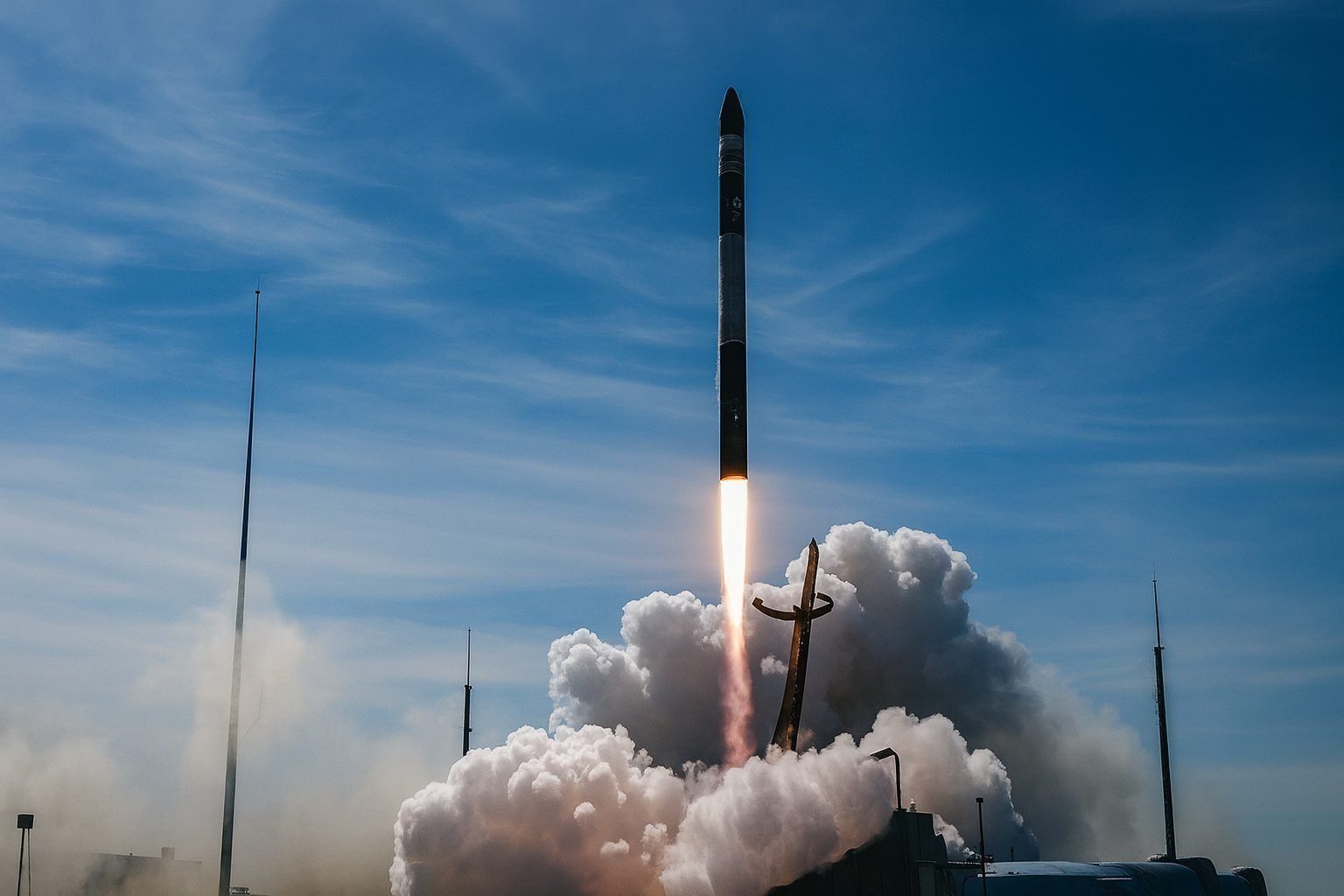
On Thursday, Rocket Lab shares surged at a double-digit clip after the company successfully executed the STP-S30 mission for the U.S. Space Force—five months ahead of schedule—deploying four experimental “DiskSat” spacecraft into low Earth orbit. The Motley Fool+1
Today, the Space Development Agency (SDA) added to that momentum by announcing $3.5 billion in awards for Tranche 3 Tracking Layer satellites—including a contract with a total potential value of $805 million for Rocket Lab to deliver 18 missile-warning / missile-tracking / missile-defense (MWTD) satellites for launches planned in fiscal 2029. SDA
Together with Rocket Lab’s recent first dedicated launch for Japan’s space agency JAXA, the week’s headlines sharpen the same investment narrative: Rocket Lab is no longer “just” a small-launch provider—it’s pushing into higher-value national-security space systems, with a growth profile that some analysts argue will reward scale and integration as the sector consolidates.
Why Rocket Lab stock jumped: an ahead-of-schedule Space Force mission
Rocket Lab’s stock move this week traces directly to a clear operational win: the company completed STP-S30—nicknamed “Don’t Be Such a Square”—from Launch Complex 2 at Wallops Island, Virginia, deploying four DiskSat spacecraft to a ~550 km low Earth orbit shortly after liftoff. Rocket Lab+1
Investors keyed in on the phrase that matters in aerospace: ahead of schedule.
Rocket Lab said the launch was performed five months earlier than planned, reinforcing a key selling point for government customers who increasingly want “responsive” launch options and fast turnaround in contested environments. Rocket Lab+1
That responsiveness is also showing up in the company’s cadence. Rocket Lab characterized STP-S30 as Electron’s 20th launch of 2025 and the company’s 78th mission overall, extending what it called a new annual launch record. GlobeNewswire+1
What are DiskSats—and why this test matters
DiskSats are exactly what they sound like: a disk-shaped alternative to the familiar CubeSat form factor.
NASA describes DiskSat as a plate-shaped spacecraft design intended to offer more power and more surface area for instruments, while preserving the broader advantages that made CubeSats popular (standardization, simpler integration, and easier rideshare/containerization). NASA
Rocket Lab’s STP-S30 mission is the first on-orbit demonstration for this specific architecture, which is being developed by The Aerospace Corporation and funded through NASA’s small spacecraft technology efforts, according to both Rocket Lab and independent mission reporting. Rocket Lab+1
Coverage of the launch emphasized that the technology demo isn’t only about the spacecraft shape—it’s also about deployment and maneuvering:
- The mission included a containerized dispenser designed to deploy DiskSats safely and sequentially. Military Embedded Systems+1
- Spaceflight reporting noted DiskSats built around a fiber composite main structure about one meter in diameter and roughly 2.5 cm thick, and said two satellites are expected to remain near the initial orbit while the other two demonstrate operations at lower altitudes (often described as very low Earth orbit, or VLEO). Spaceflight Now
- Local reporting added that the vehicles carry onboard computing, communications, and electric propulsion to support orbit changes and orbit maintenance, with at least one unit expected to maneuver lower after initial deployment. WRAL News+1
For Rocket Lab, this kind of mission is strategically valuable because it sits at the intersection of three demand drivers: national security, NASA-backed technology development, and small satellite innovation. Even when the payload isn’t a commercial “production” satellite, repeatedly winning and executing these missions strengthens the company’s reputation for reliability—an attribute that often translates into more awards.
The JAXA “RAISE and Shine” mission: Rocket Lab’s international momentum
The Space Force launch wasn’t Rocket Lab’s only recent marquee mission.
On Dec. 13–14, Rocket Lab completed its first dedicated launch for the Japan Aerospace Exploration Agency (JAXA), deploying the RAISE-4 satellite on the “RAISE And Shine” mission from Rocket Lab’s New Zealand launch site. Rocket Lab said RAISE-4 is designed as a demonstration of eight technologies developed across Japan’s private sector, universities, and research institutions. GlobeNewswire
Rocket Lab also framed the mission as the first of two dedicated flights for JAXA’s Innovative Satellite Technology Demonstration Program, with a second mission slated for Q1 2026. GlobeNewswire
Independent coverage reported that the satellite was delivered to a circular orbit around 540 km and highlighted that the launch followed a delay for additional checks—common in this business, but noteworthy because Rocket Lab still managed to stack wins closely together across hemispheres. Space+1
The connective tissue for investors: these launches support the thesis that Rocket Lab’s Electron program is increasingly a “go-to” option for dedicated access to orbit—not just for U.S. government customers, but for allied space agencies seeking schedule control.
Bank of America’s thesis: consolidation, “winner-take-most,” and operating leverage
While this week’s stock pop was sparked by mission execution, the bigger debate around Rocket Lab in late 2025 is whether the company is building the scale to become one of the few long-term platform winners in a consolidating space industry.
In a note summarized by The Fly, Bank of America raised its Rocket Lab price target to $60 from $50 and reiterated a Buy rating, arguing that disruption and consolidation could produce a “winner-take-most” dynamic—rewarding companies that can integrate acquisitions and offer broader end-to-end capability. TipRanks
A separate Bank of America-themed roundup emphasized Rocket Lab’s end-to-end integration push—pairing launch services with spacecraft and payload capabilities—as a competitive advantage, while noting that scale can help the company capture rising government and commercial work even as its larger Neutron rocket timeline extends into 2026. Investing.com
That’s where “operating leverage” comes in. The simplest way to think about it:
- In space launch and space manufacturing, a meaningful share of costs are fixed (facilities, engineering teams, production lines, test infrastructure).
- As cadence rises and contracts scale, more revenue runs through the same infrastructure, potentially expanding margins—if execution stays tight.
Rocket Lab’s own financial disclosures are increasingly pointing in that direction. In its Q3 2025 results, the company reported record revenue of $155 million and a 37% GAAP gross margin, and guided to $170–$180 million in revenue for Q4 2025. GlobeNewswire
Rocket Lab also disclosed it had more than $1 billion in liquidity after its at-the-market program, a figure echoed in coverage of Bank of America’s sector view. GlobeNewswire+1
In other words: Rocket Lab has more balance-sheet flexibility than many smaller “space pure plays,” which matters if consolidation accelerates.
Today’s biggest headline: Rocket Lab lands a major SDA Tranche 3 award
On Dec. 19, 2025, the Space Development Agency announced awards totaling about $3.5 billion to build 72 Tracking Layer satellites for Tranche 3 of the Proliferated Warfighter Space Architecture (PWSA)—a key defense initiative aimed at persistent missile warning, tracking, and (for part of the constellation) missile defense-quality tracking from low Earth orbit. SDA
The SDA said Rocket Lab USA was awarded a firm fixed-price OTA with a total potential value of $805 million to deliver and operate 18 MWTD space vehicles, with launches planned in fiscal year 2029. SDA
The SDA also specified that each Tracking Layer satellite will carry an infrared mission payload, optical communications terminals, and Ka-band communications, with an S-band backup for telemetry, tracking, and command. SDA
This is a material development for Rocket Lab’s “space systems” identity:
- It validates Rocket Lab as a defense satellite contractor—not only a launch provider.
- It places Rocket Lab in the same award cohort as Lockheed Martin, Northrop Grumman, and L3Harris on this tranche. SDA
- It reinforces the logic behind Rocket Lab’s acquisitions and vertical integration strategy—exactly the strategic direction Bank of America has been highlighting.
The broader story: Rocket Lab is pitching itself as an end-to-end space company
Rocket Lab’s recent communications consistently frame the company as a full-stack player: launch services, spacecraft, payloads, satellite components, and future medium-lift capability with Neutron. GlobeNewswire+1
This isn’t just branding. It reflects where government procurement is going:
- Defense customers increasingly want systems-level performance (payload + bus + comms + orbit operations), not just “a ride to space.”
- “Proliferated” constellations and rapid refresh cycles reward vendors who can manufacture at scale and integrate quickly.
Rocket Lab’s Q3 2025 release underscored this direction with references to strategic M&A, including the Geost acquisition and progress toward the Mynaric deal process, alongside updates on Launch Complex 3 for Neutron. GlobeNewswire+1
What to watch next
As Rocket Lab closes out 2025, several near-term developments are likely to remain in focus for both space watchers and investors:
1) Next Electron missions and cadence
Rocket Lab has indicated additional Electron launch details for the remainder of 2025 would be announced soon after STP-S30. GlobeNewswire
2) JAXA’s second dedicated launch
Rocket Lab says the second mission in its JAXA deal is targeted for Q1 2026, extending what could become a repeatable international-government launch lane. GlobeNewswire
3) Neutron timeline and execution risk
Rocket Lab updated its Neutron schedule with the vehicle arriving at Launch Complex 3 in Q1 2026, with the first launch thereafter pending qualification and acceptance testing. GlobeNewswire
Investors broadly see Neutron as a potential inflection point because it would move Rocket Lab into a larger payload class and a wider set of national-security and constellation missions.
4) Follow-through on defense space systems awards
The SDA Tranche 3 award announced today is scheduled for launches in FY2029, but execution milestones—design reviews, supplier readiness, optical terminal integration, and manufacturing scale-up—can shape sentiment well before first launch. SDA
Bottom line
Rocket Lab’s latest surge isn’t riding on hype alone: it’s being driven by a visible pattern of mission execution, expanding defense relevance, and a corporate strategy aligned with where major U.S. space procurement is heading.
This week, Rocket Lab proved it can execute responsive launch on a Space Force mission ahead of schedule, reinforced its international credibility with a dedicated JAXA technology demonstration flight, and—most notably on Dec. 19—was named by the Space Development Agency as an awardee for 18 Tranche 3 Tracking Layer satellites worth up to $805 million.
For investors and industry observers alike, the core question heading into 2026 is whether Rocket Lab can keep turning this momentum into sustained scale—because if the “winner-take-most” consolidation thesis plays out, consistency may matter as much as innovation. SDA+2Investing.com+2