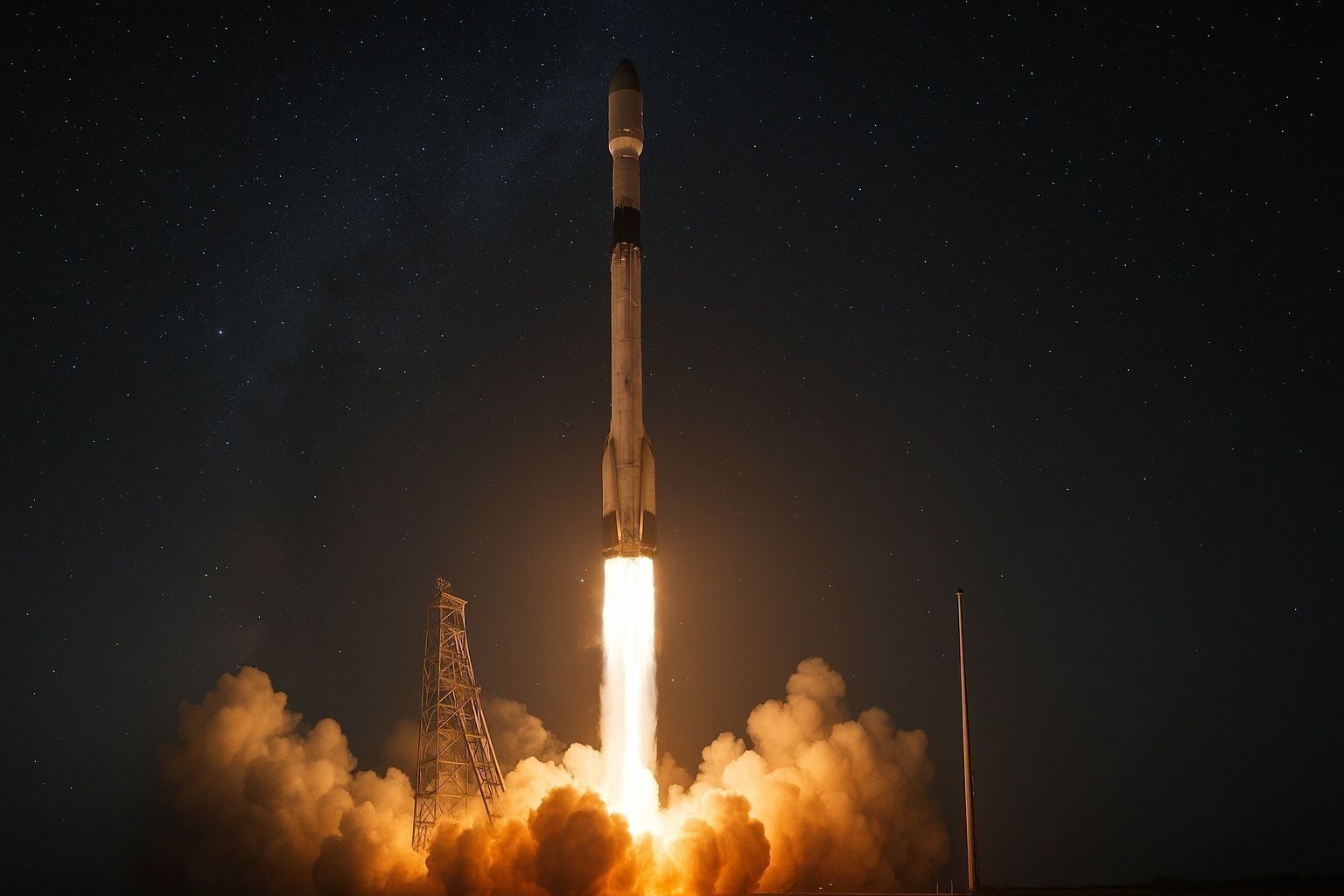

Europe’s newest heavy-lift rocket notched another high-profile success in the early hours of December 17, 2025, sending two Galileo navigation satellites toward medium Earth orbit—while the global launch calendar stays packed with two SpaceX Falcon 9 Starlink flights still on the schedule for later today. In the Asia-Pacific region, Japan’s H3 rocket launch was canceled after an issue was found in ground facilities. And in South America, a highly watched debut attempt from Brazil’s Alcântara spaceport was pushed back, as South Korean startup INNOSPACE rescheduled its first commercial orbital mission.
Taken together, the day’s launch news shows a space sector moving in two directions at once: established systems like Galileo and Starlink expanding at scale, while newer launch providers and spaceports try to break through with firsts—and sometimes run into the real-world friction of hardware, ground systems, and last-minute inspections.
Ariane 6 Successfully Launches Galileo L14, Boosting Europe’s Navigation Autonomy
The headline liftoff of the day came from Europe’s Spaceport in Kourou, French Guiana, where Arianespace’s Ariane 6 (Ariane 62 configuration) launched the Galileo L14 mission at 05:01 UTC (02:01 local time in Kourou / 06:01 CET). The payload: Galileo SAT 33 and SAT 34, part of the European Union’s flagship satellite navigation program.
Arianespace said the mission—designated VA266—successfully placed the satellites into medium Earth orbit at roughly ~23,000 km altitude, with separation occurring just under four hours after liftoff. ESA later confirmed the launch was declared successful after signal acquisition and satellite health checks, including solar array deployment.
Beyond the technical milestones, the symbolism matters: ESA framed the flight as Galileo’s first launch on Ariane 6, reinforcing the continent’s push for resilience and autonomous access to space—a theme that has become increasingly central to Europe’s space policy and infrastructure planning.
What These Galileo Satellites Add to the Constellation
Galileo is often described as Europe’s answer to GPS, but the practical story is broader than geopolitics. ESA points to Galileo’s role in 24/7 positioning, navigation, and timing services used worldwide, plus specialized offerings such as its High Accuracy Service (already operational) for users who need tighter precision than standard smartphone navigation.
With SAT 33 and SAT 34 now moving through early operations and in-orbit testing, ESA says the constellation is expected to reach 29 active satellites in the coming months—an incremental step that can translate into stronger coverage and redundancy for everything from transportation systems to timing-dependent services.
Ariane 6’s Momentum in 2025
Arianespace characterized VA266 as the fifth Ariane 6 flight, and emphasized that the rocket is moving into a higher-tempo operational era after its inaugural campaign. The company also highlighted that this mission required payload- and adapter-side adaptations for Galileo’s dual-satellite configuration.
ESA likewise described Ariane 6 as a modular heavy-lift launcher designed to support missions across a wide range of orbits, and positioned today’s Galileo flight as a capstone moment for Europe’s 2025 launch narrative.
SpaceX’s Starlink Doubleheader: Two Falcon 9 Launches Still Targeted for Today
After the Ariane 6 success, attention shifts to the United States, where SpaceX is aiming for two Falcon 9 launches on December 17—one from Florida and one from California—each carrying a new batch of Starlink broadband satellites.
The company’s near-term cadence has become familiar: rapid pad turnarounds, frequent Starlink deployments, and routine booster recoveries on autonomous drone ships. But today’s West Coast mission adds an extra headline-grabber: SpaceX plans to fly a Falcon 9 first stage for its 30th launch, a milestone that underscores just how far the reusability playbook has been pushed in day-to-day operations.
Florida: Starlink 6-99 from Kennedy Space Center
SpaceX is scheduled to launch the Starlink 6-99 mission from Launch Complex 39A at NASA’s Kennedy Space Center, with liftoff currently set for 8:42 a.m. EST (13:42 UTC). The mission is expected to carry 29 Starlink satellites.
According to Spaceflight Now, the mission will use booster B1094 on its sixth flight, and SpaceX will attempt recovery on the drone ship Just Read the Instructions in the Atlantic.
Local Florida outlets echoed the same core plan—Starlink payload, LC-39A liftoff timing, and droneship landing—highlighting the continuing rhythm of Space Coast launch activity as the year closes out.
California: Starlink 15-13 from Vandenberg—and a 30-Flight Booster
Later today, SpaceX is also targeting a Falcon 9 launch from Space Launch Complex 4 East at Vandenberg Space Force Base in California. Spaceflight Now lists liftoff for 7:22 a.m. PST (15:22 UTC) for the Starlink 15-13 mission, which is expected to deploy 27 satellites.
The notable hardware detail: the mission is slated to fly Falcon 9 booster B1063 on its 30th launch, making it (per Spaceflight Now) SpaceX’s third booster to reach the 30-flight milestone. The booster is expected to attempt landing on the drone ship Of Course I Still Love You in the Pacific.
If successful, Spaceflight Now notes the landing would mark another step in SpaceX’s already massive recovery tally, illustrating how reusability is no longer a “special event” for the company—but an assumed part of standard flight operations. Spaceflight Now
Japan Cancels H3 Rocket Launch of Michibiki No. 5 (QZS-5)
Not every launch planned for today is moving forward.
Japan’s space agency JAXA said it canceled the planned launch of MICHIBIKI No. 5 (QZS-5)—a satellite for Japan’s Quasi-Zenith Satellite System—which had been scheduled to fly on the 8th H3 launch vehicle (H3 F8) from Tanegashima Space Center at 11:11 JST on December 17, 2025.
JAXA stated the cancellation came after an “uncertain incident” was found in ground facilities that required confirmation, and that further information would be updated on its website. global.jaxa.jp
Reuters also reported the scrub as a facility-related issue, reinforcing that the hold is tied to ground-side troubleshooting rather than an announced in-flight or vehicle-stage anomaly.
Brazil’s Big Orbital Moment Waits: INNOSPACE Reschedules Hanbit-Nano “SPACEWARD” to Dec. 19
One of the more closely watched “new space” stories on the calendar—INNOSPACE’s Hanbit-Nano “SPACEWARD” mission from Brazil—also changed on December 17.
In a company update dated 2025-12-17, INNOSPACE said it rescheduled its first commercial launch of HANBIT-Nanoto Friday, December 19 at 3:45 p.m. (Brazil time) to allow time to replace a component in the cooling unit of the first-stage oxidizer feed system after an anomaly was identified during final launch inspections.
The company emphasized that the issue does not indicate a structural defect in the vehicle, and noted that the launch window for the SPACEWARD mission remains open from December 16 to December 22 (BRT).
Just two days earlier, INNOSPACE had said it was entering the final preparation phase for a Dec. 17 launch attempt from its dedicated platform at the Alcântara Space Center, with the mission aiming to deploy customer payloads into low Earth orbit at roughly 300 km altitude and ~40° inclination.
What Today’s Launch News Says About the Space Industry Right Now
December 17, 2025 is a snapshot of modern spaceflight’s new normal:
- Institutional space infrastructure continues to grow: Galileo’s expansion is part of a long-run strategy to harden positioning and timing services as critical utilities, with Ariane 6 increasingly positioned as a key European launcher for that mission set.
- Commercial megaconstellations keep the cadence high: SpaceX’s back-to-back Starlink plans show how constellation growth is now driven by operational tempo—and how booster reuse has become a central lever for launch frequency.
- Reliability is still built in the last 48 hours: Japan’s H3 scrub and INNOSPACE’s slip are reminders that ground systems, inspections, and late-stage anomalies can reshape schedules even when rockets are stacked and teams are ready.
If you’re tracking “rocket launches today,” the key takeaway is straightforward: Europe already flew, the United States still has two Starlink missions lined up, and major Asia-Pacific and South American launch plans are paused or shiftedpending ground and hardware fixes. 이노스페이스+4Newsroom Arianespace+4Spaceflight Now+4