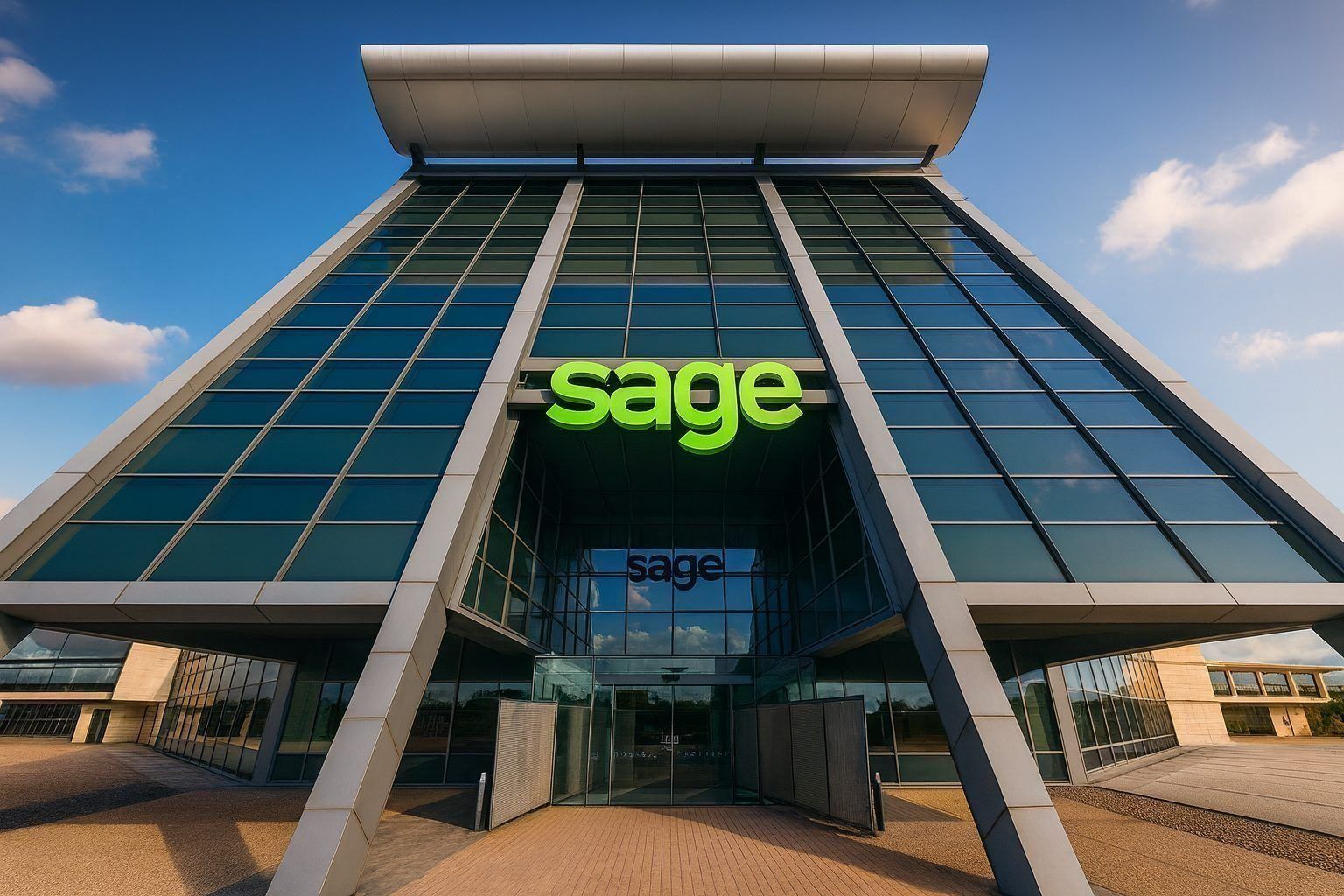
Sage Group plc’s share price is trading near the bottom of its 52‑week range, just as the FTSE 100 software group ramps up a £300 million share buyback, reports strong full‑year 2025 results, and discloses a flurry of insider share awards and sales. That combination makes Sage (LON: SGE) one of the more interesting “quality compounder at a discount” stories on the London market going into 2026.
Sage share price on 5 December 2025
As of trading on 5 December 2025, Sage shares are changing hands at around 1,068p on the London Stock Exchange, slightly above Thursday’s close of 1,064.5p. Intraday, the stock has traded in a narrow range between roughly 1,060.5p and 1,070p. Investing.com
Over the last year, the shares have moved between a 12‑month low of about 1,034.5p (set on 18 November 2025) and a high of 1,349p (early February 2025), leaving the current price close to the lower end of that band. FT Markets+1
At these levels:
- Sage’s market value is roughly £10–10.2 billion. MarketBeat+1
- The stock trades on about 30–31x trailing earnings using statutory EPS, but closer to the mid‑20s on management’s preferred underlying EPS. MarketBeat+1
- Beta is around 0.5, meaning Sage has historically been less volatile than the wider market. MarketBeat
In other words: the shares are priced like a high‑quality software franchise, but currently sit near a 52‑week low despite robust underlying results.
This week’s big developments: insider awards and share sales
CEO and senior team share transactions
The most eye‑catching headline today is “Insider Selling: The Sage Group (LON: SGE) Insider Sells 127,828 Shares of Stock”, highlighting that CEO Steve Hare sold 127,828 shares at an average price of £10.65 (1,065p), worth about £1.36 million, in a transaction dated 3 December 2025. MarketBeat
However, the underlying Regulatory News Service (RNS) filing paints a more nuanced picture:
- Hare acquired 271,690 shares through the vesting and release of long‑term incentive awards.
- He then sold 127,828 of those shares to cover tax liabilities associated with the vesting.
- After the transactions, he still holds 654,749 shares in Sage. Investegate
The same RNS shows similar activity for other senior executives:
- CFO Jonathan Howell acquired 188,582 shares and sold 88,727 to cover tax, leaving ~292,800 shares.
- Several other PDMRs (Persons Discharging Managerial Responsibilities) also received performance and restricted share awards, then sold portions at roughly £10.65 to satisfy tax obligations. Investegate
From a governance perspective, these are largely mechanical transactions linked to long‑term incentive plans that vested on 2 December 2025, not open‑market discretionary selling in response to a change in outlook. The CEO’s net exposure to Sage equity increased, even though the headline focuses on the gross number of shares sold.
Director/PDMR shareholding RNS
The Director/PDMR Shareholding announcement dated 4 December 2025 confirms that these transactions relate to awards under Sage’s Deferred Share Bonus Plan, Restricted Share Plan and 2015 Performance Share Plan, with the tax‑driven sales taking place on 3 December 2025 at around 1,064–1,065p. Investegate+1
For investors monitoring insider activity, the key takeaway is that insiders are still heavily aligned with shareholders, and the disposals are primarily tax‑driven, not an obvious vote of no confidence.
£300 million buyback: fresh RNS activity this week
Alongside the insider movements, Sage is in the middle of an aggressive £300 million share buyback programme announced with its full‑year 2025 results and scheduled to run from 19 November 2025 to no later than 19 March 2026. TechStock²+1
Over the last few days, there has been a steady stream of “Transaction in Own Shares” announcements:
- 2 December 2025 – Sage bought back 768,007 shares under the programme; the RNS confirms they will be cancelled. FT Markets+1
- 3 December 2025 – A further 663,934 shares were repurchased at a volume‑weighted average price (VWAP) of 1,063.02p, with prices ranging from 1,060.50p to 1,068.50p; again, all shares are to be cancelled. Investegate+1
- 4 December 2025 – The company disclosed the buyback of 96,465 shares at a VWAP of 1,065.54p, within a range of 1,064.00p to 1,066.00p, also for cancellation. Investegate+1
Earlier updates collated by TechStock² show that, from 21–26 November, Sage had already repurchased at least 2.4 million shares (including 926,428 shares on 21 November and 715,428 shares on 26 November). TechStock²
Adding the December trades, Sage has bought back roughly 4 million shares in just over two weeks, modestly shrinking the free float and lifting future earnings per share. Total voting rights fell from 963.5 million at the end of October to about 961.7 million by 28 November, with further reductions to come as the programme continues. TechStock²+1
The structure of the programme matters:
- It’s executed via non‑discretionary mandates with J.P. Morgan (and, per earlier disclosures, Morgan Stanley), who make day‑to‑day trading decisions within preset parameters. TechStock²+1
- All repurchased shares are cancelled, rather than held in treasury – a stronger signal that the board sees the stock as undervalued and wants to permanently reduce share count. TechStock²+1
Combine that with the insider awards and you get an interesting picture: executives are being paid in shares, the company is buying back stock aggressively, and net share count is drifting down, even as headline “insider selling” stories surface.
Full‑year 2025 results: double‑digit growth and AI push
Sage’s current capital‑return spree rests on a solid set of full‑year 2025 numbers (year ended 30 September 2025), released on 19 November 2025. TechStock²+1
On an underlying basis (Sage’s preferred metric):
- Total revenue rose 10% to £2,513m.
- Annualised recurring revenue (ARR) increased 11% to £2,574m.
- Underlying operating profit grew 17% to £600m, lifting the underlying operating margin from 22.4% to 23.9%.
- Underlying EPS climbed 18% to 43.2p, with underlying EBITDA up 15% to £694m and cash conversion at around 110%. TechStock²+1
On a statutory basis, revenue also came in at £2,513m, up about 8%, with operating profit up 17% to £530m and EPS up 18% to 37.7p. TechStock²
The growth continues to be driven by Sage’s cloud and SaaS transition:
- Sage Business Cloud revenue rose 13% to £2,083m.
- Cloud‑native revenue (products like Sage Intacct) jumped 23% to £885m.
- Subscription revenue now represents the vast majority of the business, up 12% to £2,093m, with subscription making up about 83% of total revenue. TechStock²+1
Management is leaning heavily into AI and automation:
- Sage Copilot, a generative AI assistant, is being rolled out across Sage Intacct, Sage X3, Sage Accounting, Sage 50 and other products. TechStock²+1
- A growing set of embedded AI agents is automating workflows and surfacing insights for finance, HR and payroll teams. TechStock²+1
Acquisitions continue to support that strategy, with recent deals including ForceManager (rebranded as Sage Sales Management), Fyle (AI‑enabled expense management) and Criterion Inc., a US‑based HCM platform, all bolstering Sage’s cloud portfolio in finance, HR, payroll and spend management. TechStock²+1
Looking ahead, Sage is guiding to organic total revenue growth of at least 9% in FY26, with operating margins expected to continue trending upwards as scale benefits flow through. TechStock²+1
Dividend, balance sheet and capital returns
Income investors have also been rewarded:
- Sage has proposed a final dividend of 14.4p per share, taking the full‑year dividend to 21.85p, up roughly 7% from 20.45p in FY24. TechStock²+1
- The ex‑dividend date for the final payment is expected to be 8 January 2026, with a payment date of 10 February 2026. TechStock²
At a share price around 1,065–1,070p, that implies a trailing dividend yield of about 2%, with mid‑to‑high single‑digit annual growth. TechStock²+1
On the balance sheet side:
- Net debt sits at roughly 1.7x underlying EBITDA, comfortably within management’s target range and leaves room for both investment and further shareholder returns. TechStock²+1
Together, the £300m buyback plus a growing dividend signal strong confidence in cash generation and suggest Sage is transitioning from pure “growth story” to cash‑rich SaaS compounder.
Analyst ratings and price targets as of early December 2025
Broker consensus
Across the sell‑side, sentiment is constructive but not euphoric:
- MarketBeat reports that seven covering brokers currently rate Sage a “Hold”, with four holds and three buys, and an average 12‑month price target of 1,300p. MarketBeat+1
- The Financial Times aggregates 18 analysts with a median target of 1,345p, a high of 1,600p and a low of 1,050p, implying about 26% upside from a reference price of 1,064.5p. FT Markets+1
- Fintel quotes an average one‑year price target of 1,381p, with a range from 1,060.5p to 1,680p. Fintel
- eToro shows a similar picture, with an average target around 1,297.5p. eToro
TechStock²’s synthesis of TipRanks data suggests a “Moderate Buy” consensus from about 13 analysts, with an average target near 1,319p and a high‑low range of 1,500p / 1,050p. TechStock²
A recent Simply Wall St piece on Yahoo Finance notes that the consensus price target has edged down modestly post‑results (from roughly 1,349p to about 1,323p), as some brokers trimmed targets even while remaining broadly supportive of the story. TechStock²+1
Quant and AI‑driven views
Quantitative and AI‑driven models are more cautious in the very short term:
- Danelfin, which ranks stocks using AI, gives Sage an AI Score of 5/10 (Hold), estimating the shares have a 48.85% chance of outperforming the STOXX 600 over the next three months, slightly below the 49.6% average for European stocks – a ‑0.75 percentage point “probability advantage” versus the market. Danelfin AI
This lines up with the broker view: fundamentals are attractive, but the near‑term risk/reward is balanced rather than skewed aggressively in either direction.
Technical picture: consolidating near support
Chart‑based services summarised in recent analysis classify Sage as a “hold/accumulate” candidate rather than a momentum play:
- After a pull‑back from its 52‑week high, the stock is drifting in a wide horizontal trading range, with support around 1,060–1,070p and initial resistance in the 1,090–1,100p area. TechStock²
- Models from services like StockInvest (as quoted by TechStock²) suggest, with high probability, a trading band roughly in the 1,085–1,200p area over the coming quarter, assuming the current range holds. TechStock²
Some moving‑average and MACD signals are negative after the recent slide from February’s highs, offset by shorter‑term “buy” signals from recent pivot lows – again reinforcing the “consolidation, not collapse” narrative. TechStock²+1
Valuation and quality metrics
Third‑party valuation models highlight Sage’s blend of high quality and moderate undervaluation:
- AlphaSpread’s composite model (as cited in TechStock²) estimates a fair value around 1,275p per share, about 15–16% above current levels, based on a blend of discounted cash flow and relative valuation. TechStock²
- The underlying business shows classic software‑style profitability, with very high gross margins (around 90%+), strong operating and free‑cash‑flow margins and a return on equity north of 40%. TechStock²+1
At roughly 25x underlying EPS and just over 30x statutory EPS, Sage is not cheap on absolute terms, but it is cheaper than it was at February’s peak and trades at a discount to where many US SaaS peers with similar growth and margin profiles are priced. TechStock²+1
Key upside and downside factors as of December 2025
Potential positives
- Recurring revenue engine: High and rising subscription/ARR base, with cloud‑native products growing above 20% and business‑cloud revenue in the low‑teens. TechStock²+1
- Margin expansion: Evidence of operating leverage as operating margins tick up despite continued investment in product and AI. TechStock²+1
- Capital returns: A combination of dividend growth and a £300m buyback that’s already reducing share count. TechStock²+2Investegate+2
- Defensive profile: Lower beta and a focus on essential finance, payroll and HR systems for SMEs, which can be more resilient than discretionary IT in downturns. Reuters+1
Key risks
- Valuation sensitivity: With a high‑20s P/E on underlying numbers, any disappointment on growth or margins could compress the multiple. TechStock²+1
- Competitive pressure: Strong rivals in cloud accounting and ERP (Intuit, Xero, Oracle NetSuite and others) mean Sage must continue executing on AI and product innovation. Wikipedia+1
- Macro exposure to SMEs: A deeper UK or global slowdown could slow new customer acquisition and expansion, even if renewal rates remain robust. Simply Wall St+1
- Institutional ownership and sentiment: With a large institutional shareholder base and ongoing programme‑driven trading in the stock (buybacks, vestings, tax‑driven insider sales), flows and sentiment can amplify moves in both directions. TechStock²+1
What today’s news means for Sage shareholders
Putting it all together, the 5 December 2025 snapshot looks like this:
- The share price sits near 52‑week lows, despite double‑digit underlying growth, rising margins and strong cash generation. TechStock²+1
- The £300m buyback is now fully under way, with millions of shares already cancelled in the last two weeks, providing a steady underlying bid for the stock. TechStock²+2Investegate+2
- Insider transactions making headlines are predominantly award vestings and tax‑covering sales, with the CEO and CFO still holding substantial stakes and, in net terms, increasing their shareholdings. Investegate+1
- Analyst targets cluster around 1,300–1,380p, implying around 20–30% potential upside over 12 months if the business delivers on its FY26 guidance. TechStock²+3FT Markets+3Fintel+3
For investors, Sage currently looks like a quality, cash‑generative SaaS transition story consolidating after a pull‑back, rather than a broken growth equity. Whether that sets up an attractive entry point or a value trap depends largely on your view of:
- Sage’s ability to sustain high‑single to low‑double‑digit growth in a tougher macro environment, and
- The extent to which its AI‑driven product roadmap can deepen its moat against increasingly capable cloud competitors.