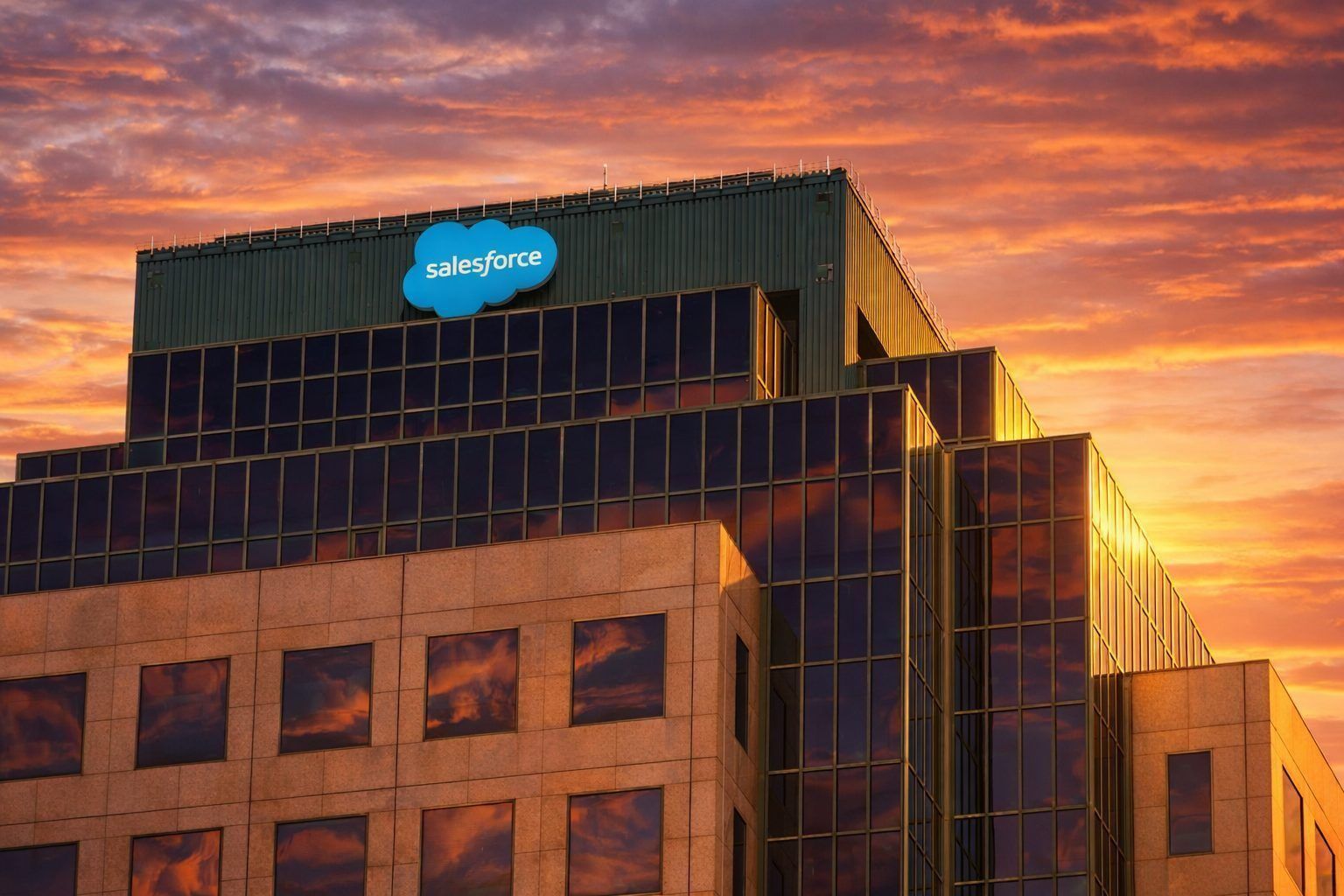
Salesforce, Inc. (NYSE: CRM) heads into the next U.S. trading session with investors focused on one central question: can its “Agentforce” strategy turn AI momentum into durable growth and predictable monetization—without sacrificing margins?
This pre-market briefing is written for the U.S. market open on Monday, December 22, 2025. (The most recent completed U.S. session before that open was Friday, Dec. 19, 2025.)
Salesforce stock snapshot heading into Dec. 22
Salesforce shares most recently closed at $259.91 on Friday, Dec. 19, with a small after-hours move to about $259.88. The stock’s 52-week range sits roughly between $221.96 and $367.09, highlighting how sharply sentiment has swung during 2025.
Performance has been mixed: Reuters/LSEG key metrics show CRM down about 20.98% year-to-date, while up about 14.60% month-to-date (daily basis)—a notable late-year bounce after a difficult stretch earlier in 2025.
A few quick “numbers investors track” going into the open (from widely followed market data pages):
- Market cap: about $243.5B
- Forward P/E: about 20.6
- Dividend: about $1.66 annualized (yield roughly 0.64%), with a recent ex-dividend date of Dec. 18, 2025
The headline driving the newest chatter: Salesforce’s deal for Qualified
The freshest company-specific catalyst is M&A.
On Dec. 17, 2025, Salesforce announced it signed a definitive agreement to acquire Qualified, describing it as a provider of agentic AI marketing solutions. Salesforce says Qualified’s flagship product works like an “always-on” AI worker that turns websites into conversational experiences to qualify and nurture leads—effectively pushing web traffic → pipeline with less human effort. Salesforce
Why that matters for CRM stock:
- It’s a direct reinforcement of Salesforce’s “agentic enterprise” narrative—moving beyond chatbots into autonomous pipeline generation.
- It extends Agentforce from sales/service workflows into the top of funnel, where marketing budgets can be sizable but scrutinized.
Timing note: Salesforce expects the transaction to close in Q1 of its fiscal year 2027, pending customary conditions and regulatory approvals.
Earnings recap: the AI story improved, and guidance went up
The last major financial catalyst was Salesforce’s fiscal Q3 2026 report (quarter ended Oct. 31, 2025), released Dec. 3, 2025.
Salesforce highlighted:
- Revenue: about $10.3B, up 9% year-over-year
- Current RPO (cRPO): $29.4B, up 11% YoY
- Total RPO: $59.5B, up 12% YoY
- Operating cash flow: $2.3B (up 17%)
- Free cash flow: $2.2B (up 22%)
- Capital return: $4.2B returned to shareholders (including $3.8B buybacks and $395M dividends)
Most importantly for the “AI monetization” debate, Salesforce emphasized that Agentforce + Data 360 became real scale businesses:
- “Agentforce and Data 360 ARR reached nearly $1.4B,” up 114% year-over-year
- “Agentforce ARR surpassed half a billion in Q3,” up 330% year-over-year
- Salesforce said it has over 9,500 paid Agentforce deals and has processed more than 3.2 trillion tokens through its gateway
Guidance was lifted as well. Reuters reported Salesforce raised its FY2026 outlook to:
- Revenue: $41.45B–$41.55B
- Adjusted EPS: $11.75–$11.77
From a pre-market perspective, that mix—backlog growth + raised guidance + accelerating AI ARR—is why many investors see December’s move as more than just a technical bounce.
Informatica is no longer “a pending deal”—it’s closed, and it’s central to the Agentforce pitch
Another major piece of the Salesforce story is the data layer. Salesforce announced on Nov. 18, 2025 that it completed its acquisition of Informatica, positioning it as a foundation for “agentic AI” across the enterprise. Salesforce
Salesforce’s rationale is straightforward: autonomous AI agents are only as good as the data they’re allowed to access—and the controls wrapped around it. Salesforce says Informatica brings capabilities in data cataloging, integration, governance, quality, privacy, metadata management, and master data management, with planned benefits across Data 360, MuleSoft, Agentforce 360, and Tableau.
For historical context, Reuters reported earlier in 2025 that Salesforce agreed to buy Informatica for about $8 billion to sharpen its competitive edge in AI-era data management.
Salesforce’s “mini-acquisition spree” in 2025 is building an agentic stack
Qualified and Informatica weren’t isolated moves. Through 2025, Salesforce also announced a series of smaller AI-focused acquisitions aimed at expanding capabilities around data access, process automation, analytics, and enterprise search, including:
- Doti (enterprise search talent; completed Dec. 1, 2025 per Salesforce)
- Spindle AI (agentic analytics; completed Nov. 21, 2025 per Salesforce)
- Waii (natural language-to-SQL for enterprise data access; completed Aug. 15, 2025 per Salesforce)
Individually, these may be financially small. Collectively, they reinforce the strategic message: Salesforce wants Agentforce to be a platform, not a feature.
Pricing and monetization: AELA is the most important “how Salesforce gets paid” change to watch
The biggest debate around CRM stock in late 2025 isn’t whether Salesforce can demo AI—it’s how Salesforce will monetize AI.
Multiple reports describe Salesforce introducing an Agentic Enterprise License Agreement (AELA), a flat, seat-based licensing approach designed to give customers cost predictability. The Register reported that Salesforce leadership has signaled it can tolerate short-term margin pressure on these arrangements if it helps lock in long-lived customer relationships that can be monetized over time.
AELA matters because it changes the near-term financial optics:
- Seat-based pricing can accelerate adoption (budgetable, familiar procurement motion)
- But it may delay “consumption upside” that some investors expected from AI usage-based pricing
- It increases the importance of long-term attach/renewal dynamics—and raises “vendor lock-in” questions that some analysts flag as a strategic risk The Register
Salesforce’s own investor site shows CRO Miguel Milano spoke at the Barclays 23rd Annual Global Technology Conference on Dec. 11, 2025, a venue where this pricing and monetization framework drew attention in the press.
Wall Street forecast: analysts are mostly bullish, but the stock still needs proof points
Despite a weak year-to-date showing, analyst sentiment across major trackers has skewed constructive after the Q3 beat-and-raise.
Investopedia reported that following earnings, analysts were “widely bullish,” citing:
- Morgan Stanley reiterating an overweight stance with a Street-high target of $405
- Bank of America pointing to backlog strength with a $305 target
- Jefferies maintaining a $375 objective
- Visible Alpha data showing 14 “buy” ratings vs 4 neutral, with a mean target around $330 Investopedia
A separate widely used market data summary shows an average price target around $324.20 (about +25% upside from ~$260 levels), also reflecting a “Buy”-leaning consensus. StockAnalysis
What would likely move those targets (up or down) from here?
- Evidence that AELA expands adoption and keeps lifetime margins healthy
- Continued growth in Agentforce/Data 360 ARR and expansion deals
- Early signals that Informatica integration improves enterprise outcomes (and reduces “hallucination”/governance concerns)
The bull case for CRM into early 2026
If you’re scanning for what could push Salesforce stock higher from here, bulls generally anchor on five themes:
- AI revenue is starting to show up in measurable metrics
Salesforce is no longer only talking about AI features; it’s reporting ARR, paid deals, bookings mix, and token throughput tied to Agentforce/Data 360. - Backlog suggests resilience
With RPO near $59.5B and cRPO $29.4B, investors have a clearer line of sight into committed demand than many software peers. - Data foundation is now a strategic moat narrative
Salesforce is positioning Informatica as the governance-and-trust layer for agentic AI at scale—especially relevant in regulated industries. - AI partnerships expand distribution and credibility
Reuters reported Salesforce expanded ties with OpenAI and Anthropic, including embedding OpenAI’s GPT-5 and Anthropic’s Claude models into Salesforce’s ecosystem and enabling access to Agentforce within ChatGPT workflows. - Shareholder returns remain substantial
Salesforce returned $4.2B in Q3 alone via buybacks and dividends—supportive if the company sustains free cash flow strength.
The bear case: what could still go wrong
Bears don’t usually argue that Salesforce “has no AI.” They argue about willingness-to-pay, competitive pressure, and monetization timing.
Key risk points to keep in mind before the open:
- AI monetization may lag AI excitement. A Barron’s summary of a KeyBanc CIO survey suggested willingness to pay for AI features from a CRM provider softened, and reported relatively low usage levels for Salesforce’s Agentforce tools in that sample—while still noting Salesforce remained the leading CRM vendor cited.
- Seat-based AI deals can be a margin headwind if usage outpaces economics. Reporting around AELA indicates Salesforce is willing to accept near-term pain to entrench long-term relationships—an approach that can work, but can also pressure profitability if not managed tightly.
- Integration execution risk is real. Informatica is large enough that customers and analysts will watch whether product integration delivers concrete outcomes (and whether cross-sell assumptions hold).
- Competition is intense. Even if Salesforce remains CRM leader, the enterprise AI budget fight is increasingly crowded across productivity, cloud platforms, and vertical software.
A practical checklist for the Dec. 22 market open: what to watch today
Here are the most actionable things traders and longer-term investors typically monitor “before the bell” for Salesforce stock:
- Any follow-on headlines about Qualified
Watch for deal terms (if later disclosed), regulatory timing, and early messaging about how Qualified will be packaged into Agentforce Marketing/Sales. - Any new commentary on AELA pricing and margins
The key question: does predictability accelerate adoption without permanently capping upside? - Analyst notes reacting to “AI ARR” vs “AI profitability”
After guidance was raised and AI ARR numbers accelerated, the next phase is whether analysts shift focus to unit economics and renewal/attach rates. Investopedia - Technical levels investors reference
Without charting, the main “tape” reference points are still helpful:- Recent close: $259.91
- Recent day range: $255.50–$262.04
- 52-week range: $221.96–$367.09
- Macro/sector tape
Salesforce can trade with the broader software complex, especially when the market narrative centers on AI spending, enterprise budgets, and rates.
Bottom line before the bell
Salesforce enters Dec. 22 with renewed momentum—not because the market suddenly forgot the 2025 drawdown, but because Salesforce now has harder AI traction metrics, raised FY2026 guidance, and a fresh M&A headline (Qualified) that strengthens the “agentic enterprise” story. Salesforce+2Reuters+2
At the same time, the stock’s next leg likely depends less on splashy demos and more on monetization clarity: how fast Agentforce becomes a budget line item customers renew and expand, and whether AELA improves adoption while protecting long-term margins.