As of midday on 2 December 2025, shares of Seatrium Limited (SGX:5E2) are trading around S$2.14, about 0.9% lower than Monday’s close of S$2.16, leaving the stock modestly positive year-to-date but down over the last quarter.MarketScreener+1
Investors are trying to balance a strengthening order book and fresh deepwater contracts with BP against a high‑stakes arbitration over a cancelled US$475 million wind vessel contract and other legacy issues. The result is a stock that still carries a consensus “Buy” rating – but with very real execution and legal risks.
1. Share price snapshot as of 2 December 2025
- Last close (1 Dec 2025): S$2.16StockInvest
- Intraday price (2 Dec 2025, MarketScreener quote): ~S$2.14, down ~0.93% on the day.MarketScreener
- 52‑week range: approximately S$1.62 – S$2.60.StockInvest
- Performance (MarketScreener): about +4.35% year-to-date, -9.2% over 3 months, and roughly flat over the last month.MarketScreener
This leaves Seatrium trading just below the middle of its 1‑year range – hardly distressed, but no longer priced for perfection either.
2. Order book and growth targets: Q3 2025 in focus
In a Q3 2025 business update published in mid‑November, Seatrium reported a net order book of S$16.6 billion as at end‑September 2025, spread across 24 projects with deliveries stretching out to 2031.The Business Times
Key takeaways from that update:
- The order book declined from S$18.6 billion at end‑June, mainly due to project deliveries rather than cancellations.The Business Times
- New orders in the quarter included:
- The upgrade of the FLNG vessel Hilli (see Golar LNG section below).The Business Times+1
- A series of repair and upgrade projects, primarily for repeat customers.The Business Times
- Management reiterated a 2028 revenue target of S$10–12 billion, emphasising “steady progress” towards those financial goals and highlighting a “robust pipeline” of opportunities, especially in oil & gas and offshore renewables.The Business Times
CEO Chris Ong pointed to rising global energy demand – including data‑centre and AI‑driven consumption – and governments’ renewed focus on energy security as secular drivers of offshore investment, noting that Seatrium is still pursuing around S$19 billion of potential projects beyond the current order book.The Business Times
On the flip side, Citi analyst Luis Hilado flagged that order book growth in Q3 was “sparse”, with only one new order secured, and cautioned that the timing of new awards remains heavily dependent on client final investment decisions.The Business Times
3. BP’s Tiber FPU: a flagship win in deepwater oil & gas
The most market‑moving positive catalyst in recent weeks has been BP’s Tiber Floating Production Unit (FPU) award.
On 26 November 2025, Seatrium announced it had won a contract from BP Exploration and Production to deliver the Tiber FPU, to be installed in the Gulf of Mexico.The Business Times
According to Seatrium and Business Times reporting:
- The Tiber FPU is Seatrium’s second consecutive deepwater project for BP, following the Kaskida FPU contract in December 2024.The Business Times+1
- The Tiber unit will share over 85% of its design with Kaskida, allowing Seatrium to reuse engineering and supply‑chain learnings to improve cost and schedule efficiency.The Business Times
- Nameplate capacity is expected to be around 80,000 barrels of oil per day, using “advanced technologies” for safety and operational efficiency.The Business Times
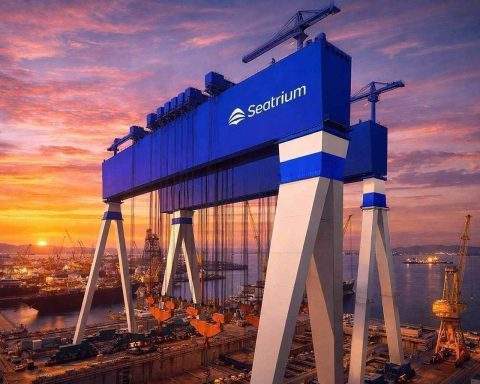
- The topsides will be installed via Seatrium’s single‑lift integration methodology, enabled by its giant twin Goliath cranes in Singapore – a key competitive differentiator in large FPU work.The Business Times
Seatrium said the Tiber award pushes new contract wins for FY2025 above S$2 billion, reinforcing its positioning as a preferred supplier for large deepwater developments.The Business Times+1
4. Repair & upgrade contracts and FLNG work: stable, high‑margin niches
Beyond mega‑project newbuilds, Seatrium has been beefing up its repairs, upgrades and FLNG‑related work – businesses that tend to be:
- shorter‑cycle,
- less politically exposed, and
- often higher‑margin.
S$170 million repair and upgrade wins
Ahead of its Q3 results, Seatrium announced S$170 million in new contracts across cruise, leisure and naval vessels, plus offshore and LNG carriers:The Business Times+1
- Major docking and repair jobs for cruise ships such as Discovery Princess, Crown Princess, Silver Moon and Le Soléal.
- Retrofit and repair work for three navy vessels.
- Offshore repairs for a drillship and pipelayer vessels from McDermott.
- Upgrades for three LNG carriers and three tankers, including work aimed at reducing greenhouse‑gas emissions.
- Repairs and upgrades for two power station vessels owned by Karpowership – Karadeniz Powership Mehmet Bey and Fatmagul Sultan – a repeat customer.
All these projects are scheduled to complete by Q1 2026, providing good near‑term yard utilisation.The Business Times+1
FLNG Hilli: Golar LNG picks Seatrium yard
In its Q3 2025 results, Golar LNG disclosed that it had selected Seatrium’s Singapore yard for the redeployment and life‑extension work on FLNG Hilli.GlobeNewswire
Key points:
- Hilli will end its current contract in Cameroon in July 2026 and is expected to enter Seatrium’s yard in Q3 2026 for upgrades and life extension.GlobeNewswire
- The vessel will then move on to a 20‑year FLNG contract in Argentina starting 2027.GlobeNewswire
The Hilli project reinforces Seatrium’s credentials in complex LNG and FLNG conversions, a niche that could prove structurally important as the LNG market expands and more gas projects seek flexible liquefaction solutions.
5. Portfolio clean‑up: selling non‑core Brazilian vessels
On 3 November 2025, Seatrium announced it would sell 100% of its indirect Brazilian ship‑owning subsidiary, Guanabara Navegação, to Posidonia Shipping & Trading for US$59.7 million (about S$77 million).The Business Times+1
The company emphasised:
- The transaction is part of its strategy to divest non‑core assets and improve capital and operational efficiency.
- No material operational impact is expected – Guanabara owns two platform supply vessels rather than core yard infrastructure.The Business Times+1
Separately, Citi’s Luis Hilado noted that planned yard sales could eventually generate about S$30 million in annual cost savings, underlining management’s push to rationalise its legacy footprint.The Business Times
6. The Maersk / Empire Wind 1 dispute: a US$475 million swing factor
The biggest overhang on Seatrium’s investment case is the Empire Wind 1 wind turbine installation vessel (WTIV) dispute with a Maersk Offshore Wind affiliate.
What happened?
- In October 2025, Seatrium disclosed that it had received a termination notice for a US$475 million WTIV contract, signed in 2022, with the vessel about 98.9% complete.The Business Times+1
- The vessel was intended for the Empire Wind 1 offshore wind project in the US, a joint venture between Equinor and BP.The Business Times
- Seatrium rejected the termination, calling it a “repudiatory breach” by the buyer and reserving all rights to seek redress.The Business Times+1
Dual arbitration moves
- On 20 October, Seatrium informed the buyer it would proceed to deliver the vessel by 30 January 2026 as per contract.The Business Times+1
- On 21 October, it received a notice of arbitration from the Maersk affiliate, stipulating that disputes be resolved in London under London Maritime Arbitrators Association rules.Splash247+1
- On 30 November, Seatrium escalated matters by initiating its own arbitration, seeking:
- a declaration that the termination was wrongful,
- confirmation that the contract remains valid,
- an order for the buyer to take delivery and pay the instalment due, or alternatively,
- damages to be assessed.The Business Times
Crucially, this is a legacy “pre‑merger” contract where only 20% of the price was paid upfront and the remaining 80% is due on delivery – unlike Seatrium’s newer milestone‑based structures.The Business Times+1
Citi’s Hilado has warned that because Seatrium has already incurred most of the build costs but collected only 20% of the revenue, the contract structure is unfavourable from a working‑capital standpoint, even if the project’s gross margin was relatively low.The Business Times+1
Bottom line:
The arbitration outcome could swing hundreds of millions of dollars between:
- full payment and delivery (a major cash inflow), versus
- a potential write‑down and a search for a new buyer for a highly specialised vessel.
Until the case is resolved, investors should treat it as a binary, high‑impact risk.
7. Other legal and legacy issues
$126.6 million legacy rig dispute
In September 2025, Upstream reported that Seatrium failed to halt a US$126.6 million rig contract payment in a long‑running dispute involving its former Keppel FELS yard, though the company is still pursuing arbitration.Upstream Online
Details are sparse due to paywalls, but the case underlines how legacy offshore rig contracts continue to create noise around cash flows and litigation.
Operation Car Wash settlement
On 30 July 2025, Seatrium announced a comprehensive settlement of its Brazilian corruption exposure (tracing back to Operation Car Wash when it was still Sembcorp Marine):The Straits Times
- Around S$168.4 million in penalties to Brazilian prosecutors.
- US$57 million (about S$73 million) in penalties to Singapore authorities, after partial offsets for amounts paid to Brazil.
- A deferred prosecution agreement in Singapore requiring further enhancements to ethics and compliance programmes.
Singapore authorities indicated that, assuming the company complies with the agreement, no further action will be taken against Seatrium or its officers.The Straits Times
Morningstar’s analyst Lee Chok Wai argued that the settlement helps draw a line under legacy issues and expects gradual margin recovery as Seatrium focuses on series‑build projects and improved cost controls, with a fair value estimate of S$2.92 per share – above today’s market price.The Straits Times
8. Fundamentals and valuations
A snapshot from MarketScreener’s consensus and ratio data (all figures are estimates):MarketScreener+1
- Market capitalisation: about S$7.3 billion.
- P/E 2025E: ~23x.
- P/E 2026E: ~14x, implying strong earnings growth expectations.
- EV/Sales 2025E: ~0.79x – relatively low for a capital‑intensive engineering firm if margins continue to recover.
- Dividend yield 2025E: around 1.0%, rising towards 1.7% in 2026 based on current estimates.
From a structural perspective, Seatrium has:
- Returned to full‑year profitability in 2024 for the first time since 2017, and
- More than tripled H1 2025 net profit to roughly S$144 million year‑on‑year according to Business Times.The Straits Times+1
These numbers support the story of a post‑merger turnaround, but they are still early in the cycle and exposed to project execution risk.
9. Earnings and growth forecasts
Independent equity‑research platform Simply Wall St summarises analyst expectations for Seatrium as follows:Simply Wall St
- Earnings (net profit) growth: forecast to grow at about 25–26% per year over the next three years.
- Revenue: expected to decline slightly (~1.3% per year) as the mix shifts and older lower‑margin projects run off.
- EPS growth: roughly 26% per year.
- Return on equity (ROE): projected to reach around 9.3% in three years – respectable, but not spectacular given project risk.
This combination – rising profitability on a flat‑to‑slightly‑lower revenue base – reflects the thesis that margin recovery and better project selection matter more than simple top‑line growth.
10. Analyst ratings and target prices
According to MarketScreener’s aggregation of sell‑side research:MarketScreener+1
- Number of covering analysts: 9
- Mean recommendation:“Buy”
- Average 12‑month target price: about S$2.83
- Implied upside vs Monday’s close (S$2.16): roughly 31%
Recent moves by major brokers include:
- DBS: target price S$2.96, rating Buy.MarketScreener
- OCBC: target S$2.76, Buy.MarketScreener
- Citi: upgraded Seatrium to Buy earlier in 2025, with a target of S$2.65.MarketScreener
- UOB Kay Hian: more cautious, cutting its target from S$3.23 to S$2.35 in June while maintaining a Buy stance.MarketScreener
Morningstar’s S$2.92 fair‑value estimate sits slightly above the broker average.The Straits Times
Overall, the sell‑side consensus is constructive: they largely see Seatrium as a cyclical recovery and energy‑transition beneficiary, with contract and legal risks that are serious but ultimately manageable.
11. Technical picture and near‑term trading view
Technical‑analysis site StockInvest.us recently upgraded Seatrium to a short‑term “Buy candidate” as of 1 December 2025:StockInvest
Key points from its model:
- The share price rose to S$2.16 on 1 December, marking four consecutive up days and about 0.5% gains over the last two weeks.
- Trading volume on the last session increased to roughly 8 million shares, seen as a constructive signal.
- The stock trades within a wide but downward short‑term trend channel, with the algorithm projecting that, if the trend persists, the price could fall about 13% over the next three months, ending up in a S$1.65–S$1.97 range with 90% probability.
- Short‑term support is identified near S$2.15 and first major resistance near S$2.28.
- For trading on 2 December, the model expected an open around S$2.15 and an intraday range roughly between S$2.14 and S$2.18.
The site emphasises that, despite the downward channel, the mix of signals (price above key moving averages, rising volume from a pivot low) offers a short‑term trading opportunity, though with the caveat that its longer‑horizon trend model is still cautious.StockInvest
This is algorithmic technical analysis, not a guarantee; but it does reflect why some short‑term traders see Seatrium as range‑bound with a modest bullish bias, at least until fresh headlines on the Maersk arbitration or new contract awards.
12. Business profile: where Seatrium actually makes money
For readers less familiar with the name: Seatrium is the combined entity of Sembcorp Marine and Keppel Offshore & Marine, now a leading engineering group serving the offshore, marine and energy industries.MarketScreener+1
Core segments include:
- Rigs & floaters – including FPSOs and FPUs such as Shell’s Vito and Whale projects and BP’s Kaskida and now Tiber.The Business Times+1
- Repairs & upgrades – cruise, LNG, naval and offshore vessels, a business where Seatrium has been winning S$170m‑class contract packages.The Business Times+1
- Offshore platforms & specialised shipbuilding – including platforms for Petrobras and offshore wind substations.MarketScreener+1
- New energies and offshore renewables – wind installation vessels, power‑barge conversions and other decarbonisation‑linked assets.MarineLink+1
The group operates shipyards and engineering centres across Singapore, Brazil, China, India, Indonesia, Japan, Malaysia, the Philippines, Norway, Saudi Arabia, UAE, the UK and the US, giving it a genuinely global footprint – and global exposure to both oil‑and‑gas and energy‑transition cycles.DredgeWire
13. Key upside catalysts vs major risks
Potential upside drivers
- Resolution of the Maersk arbitration in Seatrium’s favour – either via full payment and delivery or a negotiated settlement – would remove a large overhang and potentially release significant cash.The Business Times+1
- Further deepwater and FLNG awards (following Kaskida, Tiber, and Hilli work) could reinforce the “premium engineering” narrative and support medium‑term earnings growth.The Business Times+1
- Execution of the 2028 revenue (S$10–12bn) and margin targets would likely justify or even exceed current analyst targets around S$2.80–2.90.The Business Times+1
- Additional asset divestments and yard sales could unlock capital and reduce fixed costs, improving return on equity.The Business Times+1
Major risks to watch
- Adverse arbitration outcome on the US$475m WTIV contract (and other legacy disputes) could force impairments and cash outflows and weigh heavily on sentiment.The Business Times+1
- Project execution risk on large FPUs and FLNG work – any cost overruns or delays can quickly erode margins in lump‑sum contracts.
- Policy and political risk in offshore wind and oil & gas, especially in the US, where changing support for offshore projects has already hit Empire Wind 2 and other developments.The Business Times+1
- Cyclicality: Seatrium is still heavily exposed to the global offshore capex cycle; a downturn in oil prices or renewables capex would hurt order inflows.
- Reputational and compliance risk, although the Operation Car Wash settlement significantly de‑risks past conduct.The Straits Times
14. Is Seatrium stock a buy right now?
From a purely top‑down perspective, Seatrium as of 2 December 2025 looks like this:
- A repaired balance sheet and returning profitability, with growing contribution from higher‑quality segments like FPUs, FLNG and specialised repairs.The Business Times+1
- A sizeable S$16.6 billion order book providing revenue visibility through 2031.The Business Times
- A consensus Buy rating and an average target price about 30% above the last close.MarketScreener+1
- A valuation that assumes continued earnings growth and margin recovery, but not perfection (mid‑teens forward P/E).MarketScreener+1
Set against this is the very real tail risk that the US$475m Maersk dispute, plus other legacy issues, could destroy value if outcomes go against the company.
For long‑term, higher‑risk investors who:
- believe in a sustained offshore capex cycle,
- think Seatrium will keep winning complex deepwater and LNG work, and
- are comfortable with legal uncertainty and project risk,
the stock can credibly be framed as a cyclical recovery plus energy‑transition play with potential upside if things go right.