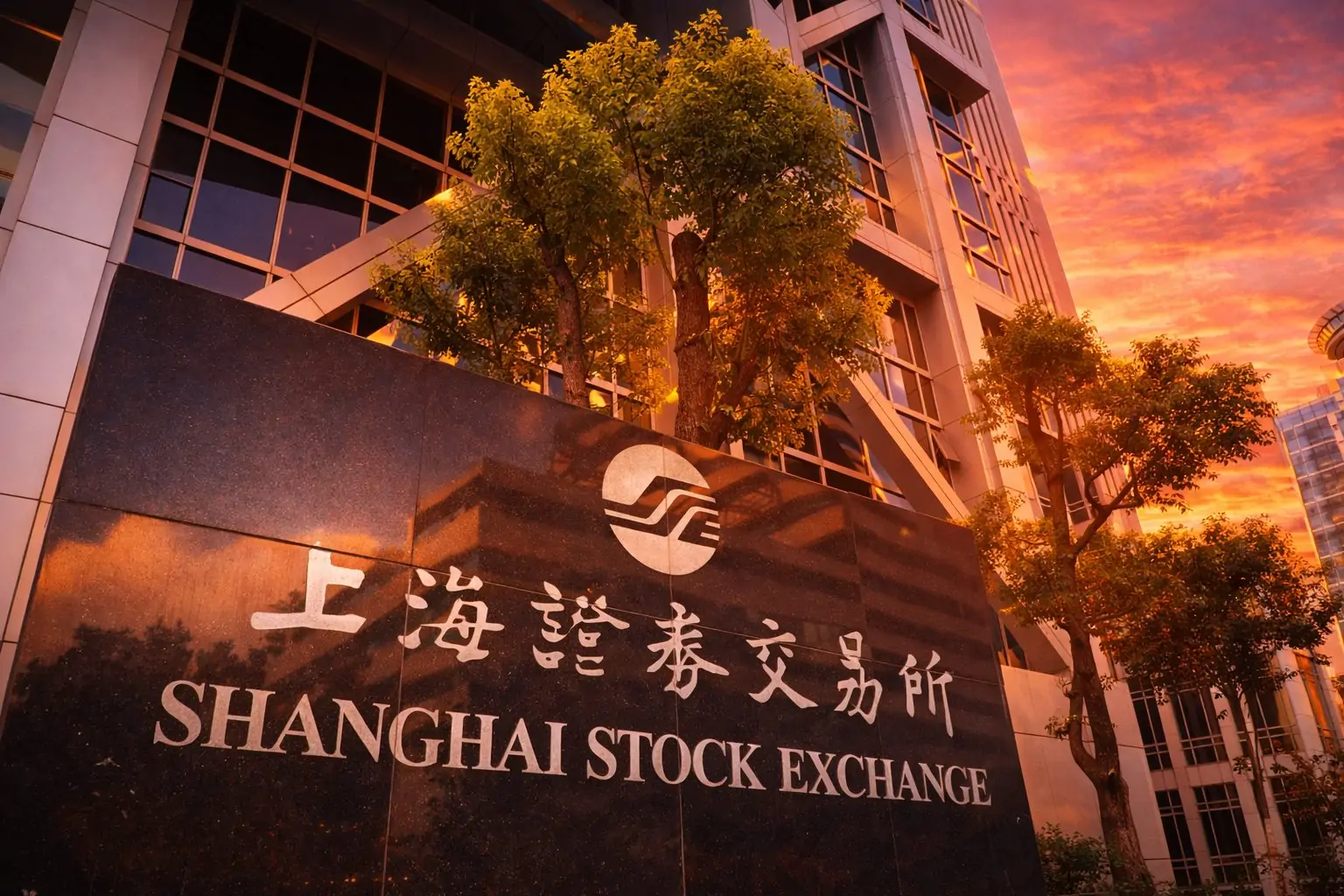
NEW YORK (8:02 a.m. ET, Saturday, Dec. 27, 2025) — With Wall Street closed for the weekend and year-end positioning in full swing, investor attention is drifting back toward Asia’s next opening bell. The Shanghai Stock Exchange (SSE) is closed right now—it’s Saturday in both New York and Shanghai—but China’s market narrative is very much “open,” shaped by a fresh macro data jolt, evolving policy guidance from Beijing, and a growing stack of 2026 outlook calls from global strategists.
On Friday, mainland equities ended the week modestly higher, leaving the Shanghai Composite Index near 3,963.68, a level that some market trackers flagged as a more-than-one-month high. Xinhua News+1
Shanghai Composite recap: where mainland stocks left off before the weekend
China’s benchmark Shanghai Composite rose 0.1% on Friday to 3,963.68, while the Shenzhen Component gained 0.54%. Xinhua News
A quick scan of recent closes shows the market has been grinding upward across several sessions, with widely watched data vendors also recording Friday’s close at 3,963.68. Investing.com+2Yahoo Finance+2
That slow-and-steady profile fits one of the recurring 2025 themes: a rally that hasn’t always looked dramatic on any single day, but has been persistent enough to force investors to keep recalibrating their assumptions about China risk.
The big weekend headline for Shanghai: industrial profits just fell hard
The most market-relevant release hitting headlines as the weekend begins is not a corporate earnings surprise—it’s the health of the industrial economy.
China’s industrial profits fell 13.1% year-on-year in November 2025, the sharpest drop in more than a year, according to Reuters’ reporting of official data. The decline accelerated from October’s 5.5% fall, highlighting continued pressure from weak domestic demand and factory-gate deflation—exactly the kind of backdrop that tends to revive the “will Beijing do more?” stimulus debate ahead of the next trading session. Reuters
Reuters added that profits growth for the first 11 months of 2025 slowed to about 0.1%, with a steep drop in coal-sector profits a major drag, while autos and high-tech manufacturing showed relative strength. Reuters
The Financial Times also framed the data as another sign of stress tied to weak demand, deflation dynamics, and overcapacity, reinforcing why policy expectations remain such a powerful driver of China equities. Financial Times
Why Shanghai investors care: industrial-profit momentum feeds directly into expectations for credit support, fiscal follow-through, and sector leadership on the SSE (industrials, materials, financials, and policy-favored “new economy” supply chains).
Policy watch: PBOC liquidity message stays supportive—but not “anything goes”
China’s central bank has been leaning into a “supportive, but measured” communication stance. A state-linked summary citing a PBOC statement after the central bank’s policy committee meeting said the PBOC would maintain ample liquidity aligned with economic growth and work to lower overall financing costs for the real economy—language equity markets typically interpret as supportive for valuations, especially when growth is uneven. State Council of China+1
At the same time, market commentary has been emphasizing that policy support may be designed to be sustainable rather than explosive. Bloomberg reported a similar theme: steady support while maintaining caution toward aggressive stimulus. Bloomberg.com
Translation for equity investors: the floor may feel firmer under risk assets when liquidity is “ample,” but the upside path may depend more on whether earnings actually lift in 2026—something strategists are debating loudly right now.
New rules that matter for listings and capital flows: overseas funds must be repatriated
A major regulatory development with direct implications for China-listed companies (and cross-border sentiment) landed on Friday.
China will require domestic firms to repatriate funds raised overseas “in principle” under new rules aimed at tightening oversight of cross-border financing. Reuters reported the measures were issued jointly by the central bank and the foreign exchange regulator, and they are set to take effect on April 1, 2026. Reuters
This is not a minor paperwork tweak. It touches how companies plan offshore fundraising, how proceeds are managed, and how regulators want capital to circulate back into the domestic system—topics that can influence investor perception of both risk controls and policy priorities.
Shanghai’s IPO pipeline gets a sci‑fi twist: STAR Market rules eased for reusable rocket firms
The Shanghai Stock Exchange isn’t just a macro and banking story; it’s also where Beijing tries to incubate strategic technology.
Reuters reported that China has eased IPO rules to support firms developing reusable rockets, allowing certain companies to list on Shanghai’s tech-focused STAR Market by meeting key technological milestones even if they don’t clear traditional profitability or revenue thresholds. Reuters
That move is tightly aligned with China’s push to build “national mission” capabilities and close gaps in frontier technology. For equity markets, it reinforces the idea that parts of the Shanghai ecosystem—especially STAR—will continue to be shaped by industrial policy as much as by pure private-market economics.
Property still matters (yes, still): Beijing signals renewed focus for 2026
China’s property sector remains the heavyweight in the background, even when the day’s tape is moving on tech, industrials, or policy beneficiaries.
Reuters reported China has pledged to step up urban renewal and stabilize the housing market in 2026, describing 2026 as a key starting point for implementing new strategies under the 2026–2030 plan period. Reuters
For the Shanghai market, property is less about “who sells apartments tomorrow” and more about confidence, household balance sheets, bank asset quality, and the gravity it exerts over domestic demand.
What the experts are forecasting for 2026: earnings, liquidity, and “selectivity” over broad beta
A striking feature of late-2025 coverage is that many strategists are no longer arguing about whether China is “investable” in the abstract. The debate has shifted to where and why within China—particularly the balance between “new economy” winners and a still-sluggish domestic backdrop.
UBS: tech-led upside, with a broader equity backdrop improving
UBS Global Wealth Management said it expects strong earnings growth in 2026 to drive China’s tech stocks higher, while also arguing that the broader Chinese equity outlook has improved with support from domestic liquidity and earnings—even if economic growth remains muted. Australia+1
Morgan Stanley: upside depends more on earnings than re-rating
In a Morgan Stanley “Thoughts on the Market” discussion on Asia in 2026, Morgan Stanley’s Chetan Ahya and Laura Wang said they see MSCI China earnings growth around 6% year-on-year in 2026, with upside more likely to be earnings-driven rather than purely valuation-driven. Morgan Stanley
Citi: dialing back China within EM allocations
Citi strategists downgraded China to Neutral from Overweight, citing weaker earnings momentum and macro signals relative to other emerging markets, according to Investing.com’s reporting of the bank’s note. Investing.com
Reuters’ caution flag: rallies need fundamentals
Reuters analysis earlier in the year warned that China’s bull market risked running out of momentum without improved corporate fundamentals and earnings, pointing to structural profitability pressures as a longer-run constraint. Reuters
Put together: the mainstream view is not “all China stocks up” or “all China stocks down.” It’s selective, earnings-sensitive, and extremely reactive to policy and macro prints—exactly the conditions that can produce sharp sector rotations on the Shanghai Stock Exchange.
Is the Shanghai Stock Exchange open right now?
No. It’s closed because it’s Saturday.
For investors planning around the next session, here are the standard SSE trading hours (China Standard Time, GMT+8), as listed by the exchange:
- Opening call auction: 9:15–9:25
- Continuous trading: 9:30–11:30 and 13:00–14:57
- Closing call auction: 14:57–15:00 Shanghai Stock Exchange
Because Shanghai (UTC+8) is 13 hours ahead of New York (UTC‑5) at this time of year, the next Shanghai open hits New York on the prior evening:
- Monday 9:30 a.m. in Shanghai = Sunday 8:30 p.m. in New York (ET)
That time-zone flip is one reason China-market news can feel like it “arrives overnight” for U.S.-based investors.
What investors should know before the next Shanghai session
This is not personalized investment advice—just the practical checklist that tends to matter most for the next open given the current headline stack.
1) Monday’s open may be shaped by the profits shock
The 13.1% drop in industrial profits is the kind of macro surprise that can reprice policy expectations quickly—especially in sectors tied to domestic demand and pricing power. Reuters+1
Reuters also noted the Rhodium Group estimate that China’s 2025 growth may have been well below official targets—another reason “policy response” becomes a market variable rather than a background assumption. Reuters
2) Watch end-of-month China data on the calendar
Markets are also heading into a typical end-of-month data cluster. Several economic-calendar providers flag the timing of China PMI releases around year-end, which can matter for cyclical leadership and risk appetite. CME Group+1
3) Policy headlines are increasingly “micro-structural”
Two policy headlines are particularly Shanghai-relevant:
- Overseas listing proceeds repatriation rules effective April 1, 2026 (capital-flow and corporate-finance implications). Reuters
- STAR Market IPO rule adjustments aimed at strategically important tech (pipeline and sector sentiment implications). Reuters
4) Don’t get blindsided by the upcoming China holiday closure
The SSE has published its 2026 market-closure schedule (“休市安排”). For New Year’s Day, the exchange indicates it will be closed from Jan. 1–Jan. 3, 2026, and will resume trading on Jan. 5, 2026 (with Jan. 4 being a normal weekend closure). SSE
That matters because liquidity can thin out before holiday breaks—sometimes amplifying moves.
5) Global flows still matter—especially into year-end
Even though this piece is Shanghai-focused, global positioning feeds into Asia’s risk appetite. U.S. markets are closed today (Saturday), and U.S. holiday scheduling around New Year’s can affect global liquidity and futures activity. Investopedia notes U.S. stock markets are closed on Jan. 1, 2026, with a full trading day on Dec. 31, 2025. Investopedia
Bottom line: Shanghai is closed, but the narrative is moving fast
The Shanghai Stock Exchange heads into the next session with a classic late‑December mix: a market that’s been trending higher, a macro print that raises uncomfortable questions about domestic demand, and policy signals that are supportive but disciplined.
The near-term direction may hinge less on any single headline and more on how investors weigh three competing forces:
- Policy support and liquidity (still a tailwind) State Council of China+1
- Macro and earnings reality checks (new pressure from industrial profits) Reuters+1
- 2026 selectivity (tech and policy-favored sectors vs. broader growth constraints) Australia+2Morgan Stanley+2
When Shanghai reopens, expect traders to test whether the rally’s “next leg” is powered by real earnings acceleration—or whether it needs yet another policy push to keep momentum alive.