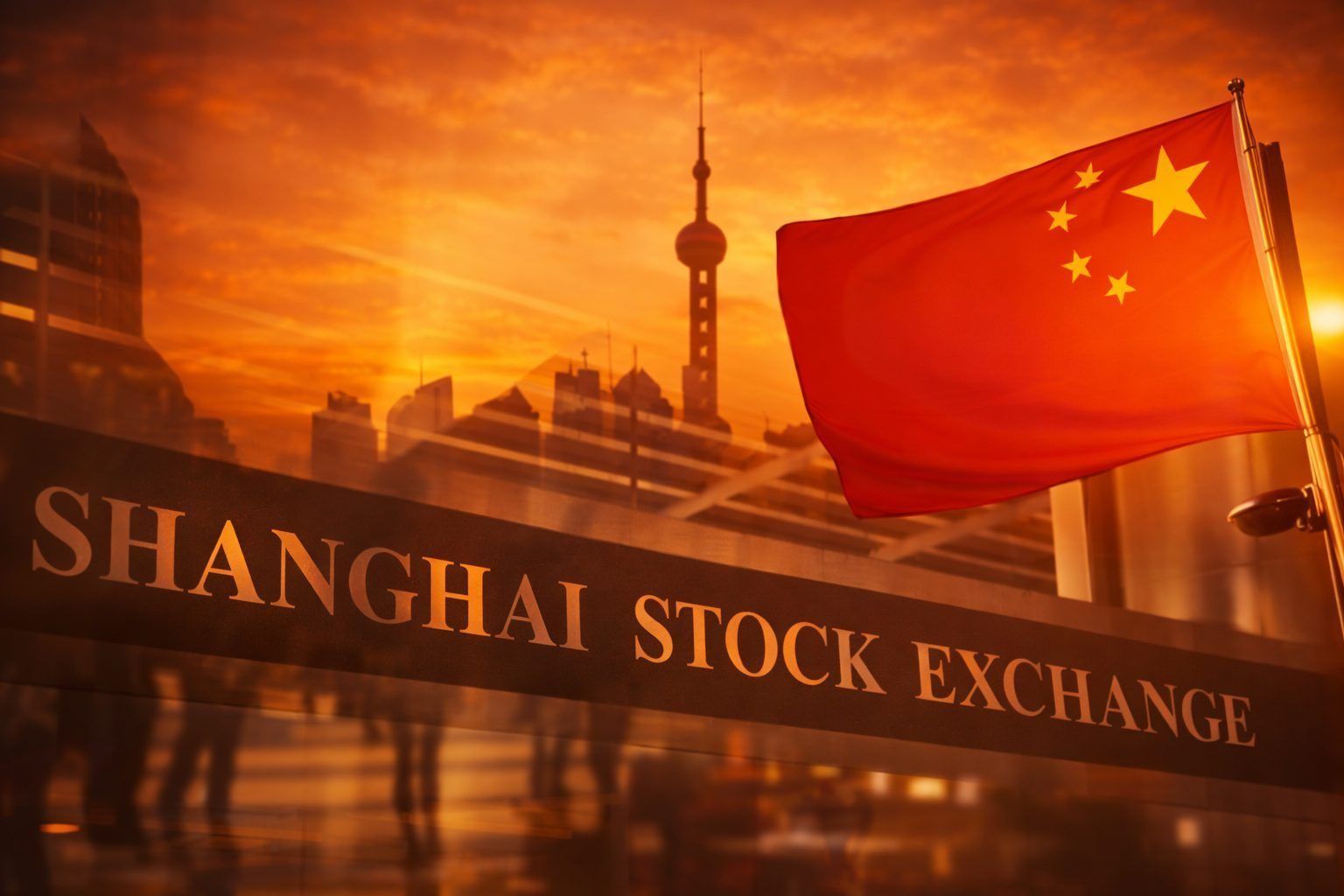
SHANGHAI / BEIJING — December 20, 2025. The Shanghai Stock Exchange (SSE) is heading into the final stretch of 2025 with a familiar China-market cocktail: a consumer-led bounce, policy-driven thematic trades, and a tightening web of market governance—plus a notable step in opening the exchange bond market to overseas institutions.
Friday’s onshore session (Dec. 19) delivered the headline that traders love because it’s both simple and symbolic: the Shanghai Composite briefly reclaimed the 3,900 level intraday, before ending the day just under it—still up, still green, and still pulling attention back to “old economy” consumer names after a long tech-led run. Cnstock Paper+2Xinhua News+2
But the bigger story for the SSE isn’t only where the index closed. It’s the structure underneath the tape: regulators are sweeping harder against market rumors and illegal stock touting, the exchange is escalating surveillance on abnormal trading, and the Shanghai and Shenzhen exchanges (with ChinaClear) have issued a notice that formally expands exchange bond repo channels for overseas institutional investors—a plumbing change that matters far more than most daily candlesticks. Caixin Global+2STCN+2
Below is what today’s reporting and analyst commentary (dated Dec. 20, 2025, and the freshest context available as of today) collectively says about the Shanghai Stock Exchange—what moved, what changed, and what strategists think comes next.
Shanghai Composite: a consumer-fueled push, with breadth doing the heavy lifting
In Friday’s session (Dec. 19), the Shanghai Composite closed at 3,890.45, up 0.36%, while Shenzhen’s component index rose 0.66% and ChiNext gained 0.49%. Trading value across Shanghai, Shenzhen, and Beijing hit RMB 1.7487 trillion, higher than the prior session, and market breadth was wide—with roughly 4,500 stocks rising in the Shanghai Securities News account of the day. Cnstock Paper+2Xinhua News+2
The day’s leadership wasn’t subtle:
- “Big consumption” (retail, dairy, duty-free) stayed hot, with multiple consumer names hitting limit-up moves in domestic coverage.
- Hainan-themed names jumped, and duty-free heavyweight China Tourism Group Duty Free drew particular focus. Cnstock Paper+1
This matters for the SSE because the Shanghai market’s index composition often makes it a magnet for rotation trades: when investors want broad, liquid exposure (especially to large-cap “old economy” leaders), Shanghai is frequently where the flow expresses itself first.
Why Hainan and “duty-free” became a Shanghai market catalyst again
Two narratives converged:
- Policy optics and timing. Shanghai Securities News linked Friday’s surge in Hainan and duty-free names to the December 18 milestone for Hainan Free Trade Port operations (described in domestic coverage as the start of “all-island” closure operations), framing it as a new phase of opening with consumer-facing price implications. Cnstock Paper
- Global-media amplification. Reuters’ market snapshot (carried via TradingView) explicitly said the CSI Tourism Index was boosted after China launched a $113 billion free-trade experiment on Hainan, reinforcing the theme trade for both domestic and offshore readers. TradingView
Even if you ignore the slogans, the mechanism is straightforward: duty-free and tourism names are easy for markets to price as a “policy-beta” trade—especially into year-end when earnings catalysts thin out and macro headlines fill the vacuum.
The other force shaping SSE sentiment: information control meets market integrity
If the Shanghai Composite’s 3,900 flirtation was the crowd-pleaser, today’s regulatory news was the plot.
1) Crackdown on AI-generated misinformation and illegal stock tips
On Dec. 20, Caixin reported that China’s cyberspace and securities regulators shut down and penalized online accounts accused of spreading false information and illegally promoting stocks, including tactics such as fabricating policies, distorting disclosures, and using AI-generated content to lure investors. Platforms mentioned in the story included major Chinese social and content ecosystems. Caixin Global
For the Shanghai Stock Exchange, this kind of cleanup is not just reputational—it’s market-structure defense. A rumor-driven tape is a liquidity mirage: it looks deep until it isn’t.
2) SSE’s own surveillance: abnormal trading actions and targeted monitoring
Separate reporting (Dec. 19 disclosure summarized by Securities Times) said the Shanghai exchange took self-regulatory actions on 95 cases involving suspected “ramp-and-dump,” false declarations, and other abnormal trading behaviors during the week of Dec. 15–19, and kept closer watch on several highly volatile and delisting-related names. It also cited special checks on major company matters and referral of suspected illegal case leads to the CSRC. STCN
Put those together and you get a coherent (and very SSE-relevant) message:
Beijing wants a market that can rally without being a rumor casino.
A big “plumbing” headline for the Shanghai exchange bond market: overseas institutions get clearer repo access
One of the most consequential Shanghai Stock Exchange developments reported today is about bonds, not stocks.
According to a Securities Daily report republished by Sina Finance on Dec. 20, the Shanghai Stock Exchange and Shenzhen Stock Exchange, together with China Securities Depository and Clearing Corporation (ChinaClear), issued notices on Dec. 19 to support overseas institutional investors participating in exchange bond repurchase (repo) business, effective immediately. Sina Finance
The notice (as summarized there) clarifies that overseas institutions may participate in multiple repo formats, including:
- Pledged agreement repo
- Pledged tri-party repo
- Participation in general pledged repo as a reverse repo party (lending funds) Sina Finance
It also emphasizes operational and risk controls—such as requiring overseas institutions to trade through qualified onshore members (domestic securities companies), sign the relevant agreements, and comply with exchange and ChinaClear rules, while the exchanges and ChinaClear maintain ongoing monitoring and enforcement tools. Sina Finance
Why this matters for the SSE in plain English:
- Repo is the market’s liquidity management gearshift.
- Expanding and formalizing repo access makes it easier for foreign institutions to manage cash, collateral, and short-term funding needs—key ingredients for scaling durable participation in the onshore market.
- It fits a broader “open-but-controlled” pattern: widen access, tighten rules, watch the flows.
STAR Market and “hard tech”: IPO heat, valuation froth, and consolidation momentum
No Shanghai Stock Exchange article is complete in 2025 without the STAR Market (SSE’s tech-heavy board) barging into the room wearing a GPU as a hat.
AI chip IPOs: massive demand, very loud first-day moves
Reuters reported that MetaX Integrated Circuits surged by about 700% on its debut in Shanghai earlier this week (Dec. 17), following another splashy AI-chip debut by Moore Threads in Shanghai (Dec. 5) with gains reported above 400% on day one. Reuters also flagged investor enthusiasm driven by China’s push for AI-chip self-sufficiency—and warned about speculative valuation signals. Reuters+1
For the Shanghai Stock Exchange, these debuts are doing two things at once:
- They reinforce Shanghai/STAR as a domestic capital formation venue for strategic tech.
- They also raise the question regulators hate and traders secretly enjoy: is this innovation financing, or is some of it heat-seeking capital chasing a national narrative?
STAR Market M&A: not just IPOs—more “industrial logic” deals
China News Agency reporting (Dec. 19) cited SSE information saying that since the implementation of the “科八条” policy framework, STAR Market firms have disclosed 156 new M&A transactions, including equity/convertible-bond deals and cash major transactions, spanning semiconductors, biomedicine, software, and other hard-tech fields. The report said 95 of those disclosures occurred in 2025, and highlighted a surge in major asset reorganizations. China News
The strategic angle: if IPOs are the front door, M&A is the hallway that turns a cluster of listed companies into an ecosystem—supply chains, consolidation, and “buy to build” strategies.
Governance gets real: delistings and enforcement remain part of the SSE story
A rising index doesn’t mean a softer exchange. In fact, 2025’s rally narrative has been repeatedly paired with governance tightening.
A Dec. 20 report by National Business Daily described the delisting countdown for Jiangsu Wuzhong, noting the company disclosed earlier (Dec. 1) that the Shanghai Stock Exchange decided to terminate its listing due to issues including multi-year financial fraud and non-operational fund occupation; the stock entered a delisting整理 trading period on Dec. 9, with an expected final trading day of Dec. 29. NBD
This is the SSE’s “grown-up market” signal: the exchange is not only chasing listings and liquidity—it is also willing to end the story for companies that fail the rulebook.
2026 outlook: what strategists and forecasters are saying now
Today’s “Shanghai Stock Exchange” conversation is really a debate about what kind of market 2026 will be: consumer rebound? tech dominance? policy-driven barbell? Here’s what the latest mix of brokerage strategy notes and global research implies.
1) Rotation: consumption can run, but “the main line is still tech”
Shanghai Securities News quoted multiple domestic brokerages arguing that policy support could continue to bolster consumption, and that investors may increasingly focus on business models and defensible profitability rather than pure short-term “new consumption” narratives. The same coverage also carried the view that 2026’s main market line remains technology, even if style rotation temporarily favors lower-positioned cyclicals or consumer catch-up. Cnstock Paper
That’s a very Shanghai-market setup: tech aspiration + consumer liquidity + cyclical optionality.
2) Macro forecasts: growth cooling, stimulus timing matters
Reuters’ market wrap (via TradingView) included a Nomura call forecasting China GDP growth around 4.3% in 2026, with a softer first half and a rebound later on expectations of spring stimulus and base effects—alongside a view that the gap between property and exports could persist. TradingView
On rates, a separate Reuters piece said markets widely expected China to keep benchmark lending rates unchanged for a seventh month, with economists watching banking-sector margin pressure and some anticipating modest easing in early 2026. Reuters
For SSE investors, the implication is classic: if growth is “managed,” then policy sequencing (fiscal support, consumption incentives, tech industrial policy, property stabilization) matters as much as earnings.
3) IPO fundraising forecast: SSE positioned as a leading venue again
Deloitte’s China capital markets outlook (released this month) forecast that, as of year-end 2025, the mainland A-share market would see 114 IPOs raising RMB 129.6 billion, with Shanghai’s Main Board expected to lead by funds raised and the SSE projected to lead in proceeds raised (RMB 80.0 billion), while also describing reforms that could support a pickup in 2026—particularly for sectors aligned with national priorities (including AI and high-end manufacturing). Deloitte
This is the “Shanghai exchange as national-strategy venue” thesis in forecast form.
What to watch next on the Shanghai Stock Exchange
As of Dec. 20, 2025, the SSE narrative is less “one index” and more three interacting systems:
- The tape (price action): Shanghai Composite momentum has leaned on consumption and policy themes, with 3,900 acting as a psychological battleground. Cnstock Paper+1
- The plumbing (market access): exchange bond repo access for overseas institutions is getting clearer and broader—an underappreciated shift that can support more stable foreign participation. Sina Finance
- The rulebook (governance and information control): crackdown on rumor mills, tighter surveillance on abnormal trading, and visible delistings signal that “clean market” credibility is being treated as a core policy variable. Caixin Global+2STCN+2