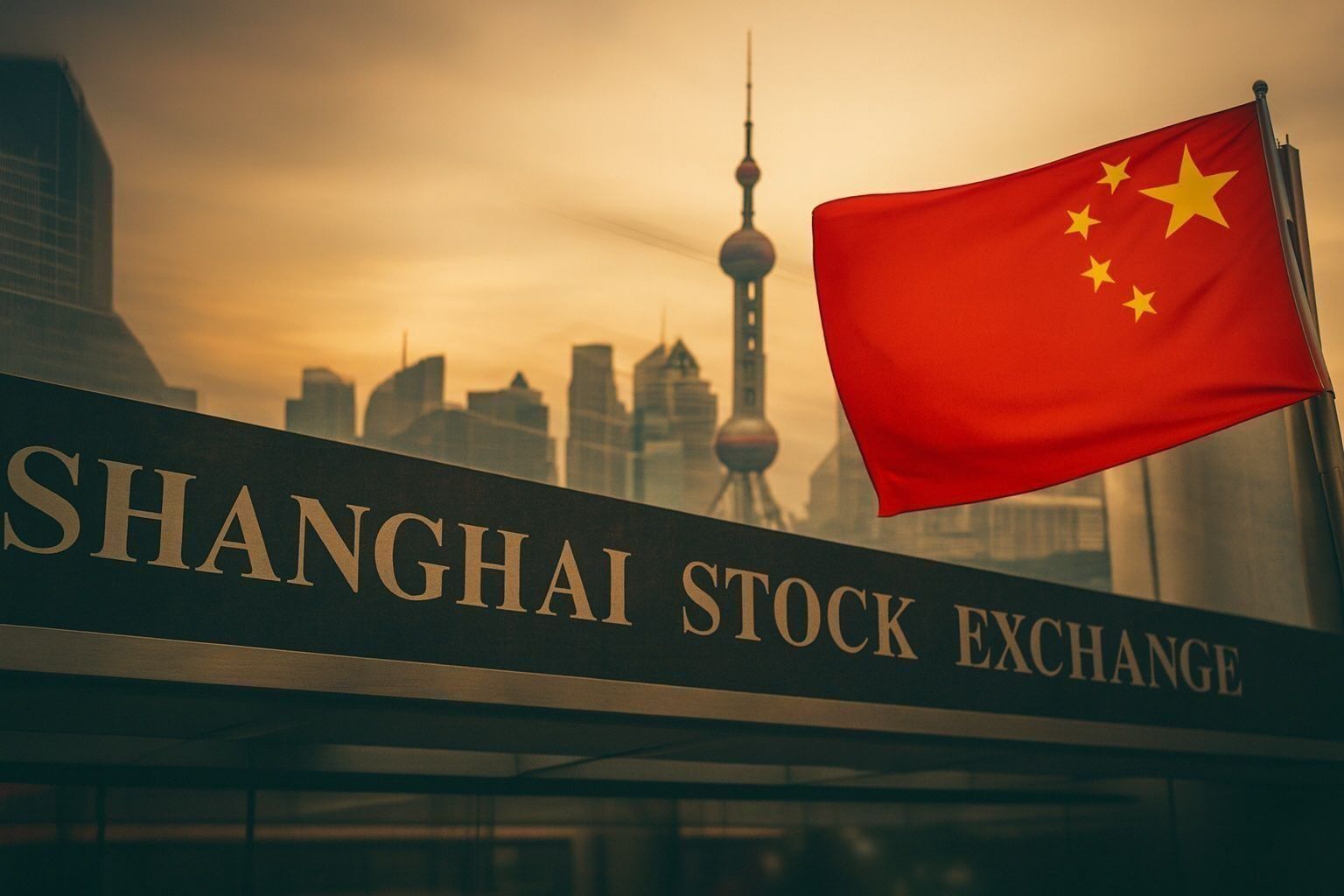

The Shanghai Stock Exchange heads into the new week with investors balancing two competing forces: increasingly explicit policy support for growth in 2026 and stubborn evidence that domestic demand—and especially household borrowing—remains fragile. The Shanghai Composite ended Friday, December 12 at 3,889.35, edging about 0.34% lower on the week versus the prior Friday close, after a volatile stretch driven by Beijing’s top-level policy meetings, inflation signals, property-sector headlines, and shifting global risk sentiment.
With industrial production, retail sales, fixed-asset investment and unemployment due from China’s National Bureau of Statistics on Monday, December 15, traders in A-shares will get a near-term reality check on whether the pro-growth tone from Beijing can translate into a firmer consumption and credit cycle.
Where Shanghai stands after Dec 8–13: a choppy week, a small net decline
The Shanghai Composite’s week was defined less by a single macro print and more by the sequencing of policy headlines:
- Mon, Dec 8: The index rose 0.54% to 3,924.08, as markets digested signals from a Politburo meeting emphasizing “more proactive” fiscal policy and “appropriately loose” monetary policy for 2026—language investors read as supportive for growth targets and potential easing. Xinhua News+1
- Tue, Dec 9: The Shanghai Composite slipped 0.37% to 3,909.52 as some traders pared expectations of imminent stimulus after the leadership meeting, even as trade and property risks stayed in the frame.
- Wed, Dec 10: The index fell 0.23% to 3,900.50 amid mixed inflation signals—consumer inflation improved, but producer-price deflation remained deep—while property names swung on deal and policy chatter.
- Thu, Dec 11: The Shanghai Composite dropped 0.70% to 3,873.32 as investors weighed global central-bank signals and waited for clearer guidance from China’s key economic policy meeting.
- Fri, Dec 12: The index rebounded 0.41% to 3,889.35, supported by the readout from the Central Economic Work Conference (CEWC), which reiterated a “proactive” fiscal stance and ongoing support for growth—while some analysts still framed the policy tone as incremental rather than a “bazooka.” Xinhua News+2TradingView+2
Net-net: from 3,902.81 (Dec 5) to 3,889.35 (Dec 12), the Shanghai Composite fell by roughly 13.46 points—a modest weekly decline that masks meaningful day-to-day rotation beneath the surface.
What mattered most in the Dec 8–13 news flow
1) Beijing’s policy messaging: supportive, but calibrated
The Politburo statement (Dec 8) set the tone by emphasizing domestic demand and signaling room for more proactive fiscal policy and easier monetary conditions in 2026—language that fed expectations of a high deficit, debt issuance and further rate cuts over time.
But by Dec 9, market participants were already debating what Beijing didn’t say. Reuters reporting cited analysts arguing the messaging suggested less urgency for near-term stimulus, with attention on the shift in wording around “cross-cyclical adjustment.” Indo Premier
That tension carried into the Central Economic Work Conference (Dec 10–11). The official readout emphasized boosting consumption and income while also backing investment—an approach that can buoy risk assets, but also revives the long-running question of whether China is ready to shift away from a production- and investment-led model.
2) Inflation signals: CPI improved, but factory-gate deflation stayed a drag
On Dec 10, Reuters noted China’s CPI rose 0.7% year-on-year in November (a 21‑month high) while PPI fell 2.2% year-on-year, underscoring ongoing deflationary pressure in the industrial economy. Citi analysts warned about the breadth and sustainability of price recovery and said demand-side support remained important.
For Shanghai-listed cyclicals and banks, persistent PPI weakness matters because it can compress margins, weigh on cashflows in upstream supply chains, and reinforce caution on credit expansion.
3) Credit and property: weak household borrowing remains a flashing signal
A major late-week datapoint: China’s new bank loans rose to 390 billion yuan in November, but missed forecasts; Reuters highlighted a contraction in household borrowing and continued property-market softness as key explanations.
Meanwhile, property shares remained headline-sensitive. On Dec 10, Reuters described Vanke leading property names higher as it began a debt-extension vote, amid unverified market rumors of a large mortgage-subsidy package.
From a “week ahead” standpoint, the message is clear: policy intent may be improving, but private-sector credit demand has yet to respond convincingly—a dynamic that can keep Shanghai trading in ranges rather than trending cleanly.
4) “Involution” and price wars: autos and broader industrial margins in focus
Chinese authorities continued to spotlight concerns about destructive competition and pricing pressure. Reuters reported that regulators met major automakers and urged them to stop “price wars,” reinforcing the “anti-involution” theme that has been hovering over parts of the industrial sector.
On Dec 13, a senior economic official also warned about deflationary “price wars” that hurt business profitability—language that markets can interpret as support for more orderly competition, potentially favoring higher-quality names with pricing power. Reuters
5) Tech and semiconductors: Nvidia H200 headlines add upside and uncertainty
One of the most market-moving global-to-China linkages this week came from U.S. export policy.
Reuters reported Nvidia is considering increasing production of its H200 AI chips due to strong demand from Chinese firms after U.S. President Donald Trump said H200 exports to China would be allowed (with a 25% fee). Reuters also reported Chinese officials were holding emergency meetings on whether to approve the imports, with discussions that could include support for domestic chips.
Then came political pushback: Reuters reported U.S. lawmaker John Moolenaar requested details on the decision to allow H200 sales to China, highlighting the risk that the policy could tighten again.
For Shanghai and broader A-share tech, this creates a two-way setup:
- Upside: improved access to leading AI hardware can support domestic cloud, AI infrastructure and the ecosystem around AI deployment.
- Risk: policy reversals, licensing delays, or tighter enforcement can quickly change earnings assumptions and sentiment.
Shanghai Stock Market Week Ahead: the catalysts that can move A-shares
1) China’s “activity data day” on Monday, Dec 15
The next Shanghai driver is straightforward: hard data.
Multiple previews indicate markets will focus on November industrial production, retail sales, fixed-asset investment and unemployment due on Monday, Dec 15.
A Bloomberg economist median cited by The Business Times expects retail sales growth of about 2.9% year-on-year—a pace that would underscore how difficult it remains to generate a strong consumption rebound—while fixed-asset investment expectations were also described as weak.
Investing.com’s calendar listings also point to industrial production and house-price releases around the start of the week, keeping “growth vs. deflation vs. property” in tight focus at once. Investing.com Nigeria+1
Why it matters for Shanghai:
- Stronger-than-expected retail sales could support consumer, services, and select internet/tech beneficiaries of domestic demand.
- Another soft set could reinforce the case for fiscal support and incremental monetary easing, but also keep pressure on banks, property, and highly leveraged cyclicals.
2) Property prices: still central to confidence
The house-price print is less about a single month and more about the narrative: is stabilization spreading beyond new homes and top-tier cities?
With Reuters already emphasizing weak household borrowing and ongoing housing softness, even a small downside surprise can ripple into consumer sentiment and bank-credit expectations—two of the most important swing factors for A-share breadth.
3) Global macro and liquidity: watch risk appetite, not just China headlines
Global markets are still adjusting to the Federal Reserve’s December rate cut and the debate over how quickly policy can ease in 2026—an issue that often influences foreign risk appetite for emerging markets.
In addition, Reuters noted investors are watching delayed U.S. economic data releases after a prolonged shutdown, a setup that can inject volatility into global rates, the dollar, and risk sentiment—all of which can spill into Asia trading hours.
For Shanghai specifically, this typically shows up through:
- CNY moves, which can affect foreign flows and commodity-sensitive stocks.
- Global tech sentiment, which can amplify or dampen rallies in AI-adjacent names.
Sector watch: where investors may rotate in the week ahead
Property and banks: still headline- and data-sensitive
Property shares have shown they can spike on policy chatter, but the broader system needs a clearer turn in household borrowing and sales momentum to sustain a trend. The latest loan data suggests that turn isn’t here yet.
Banks, meanwhile, can be pulled in opposite directions:
- Easing expectations can support valuations.
- Weak credit demand can limit earnings upside.
Industrials, materials and “policy winners”
If Beijing’s CEWC follow-through translates into visible project pipelines and improved payment discipline, it can favor infrastructure-linked industrials and select state-owned “core” names—a theme that has historically attracted risk-off rotation inside A-shares. Reuters+1
Tech and semiconductors: policy volatility is the price of admission
The Nvidia H200 storyline highlights the opportunity and the fragility of the AI trade across China markets. Near term, Shanghai-listed tech could remain sensitive to:
- licensing/approval headlines in China,
- U.S. political developments around export controls,
- and any signs of substitution policies favoring domestic chip ecosystems.
Autos and consumer discretionary: “anti-price-war” signals vs. demand reality
If regulators lean harder against destructive pricing, it could help margins for leaders over time. But the near-term question is still demand—especially if Monday’s retail-sales print confirms consumers remain cautious.
The bottom line for Shanghai in the week ahead
The Shanghai stock market enters the week of Dec 15 with a clearer pro-growth policy message from Beijing—but also with enough evidence of weak demand (deflation pressure and soft household borrowing) to keep investors selective.
If Monday’s activity data beats expectations, Shanghai could get a confidence boost that the policy pivot can work through to the real economy. If it disappoints, markets may revert to a familiar playbook: buying “policy-safe” large caps and defensives while fading high-beta rallies until credit demand and consumption show more convincing traction. Reuters+2TradingView+2
This article is for informational purposes only and does not constitute investment advice.