
NEW YORK, June 22, 2026, 06:22 EDT
- China moved fast to block Chinese-origin dual-use exports to Red Cat, Teal Drones, and eight other U.S. entities.
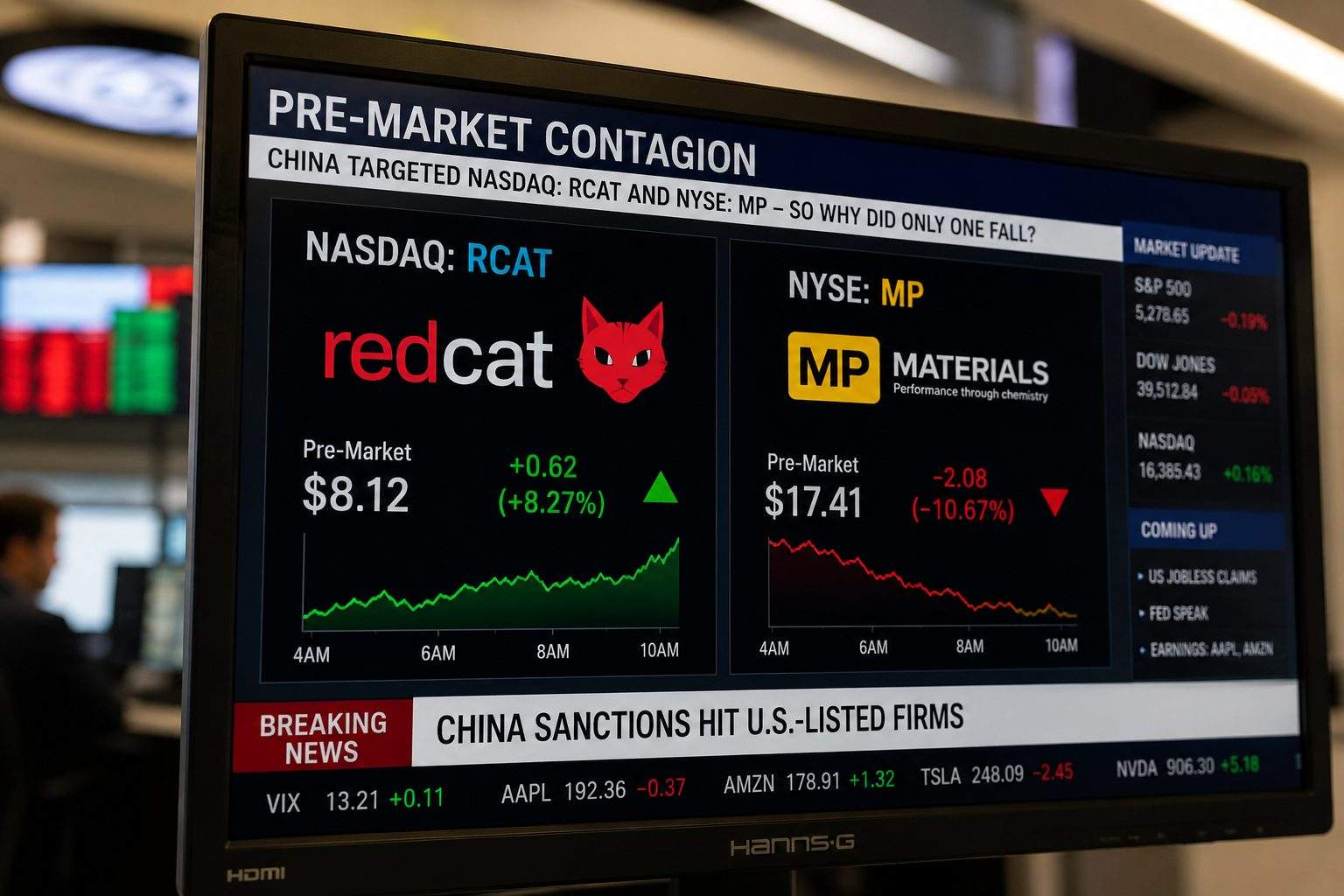
- Pre-market data had NASDAQ: RCAT down 0.79% at $11.35. NYSE: MP gained 1.02% to $61.50, the snapshot showed.
- The 1.81-percentage-point divergence shows traders moving past the first headline hit and starting to price names based on their real China exposure.
Red Cat Holdings (NASDAQ: RCAT) slipped 0.79% to $11.35, down $0.09 pre-market, after China announced an immediate halt on dual-use exports to Red Cat and its Teal Drones arm. The move hit before the Wall Street open, with Beijing’s ban coming into thin trading—so sanctions terms moved the price before investors checked true supply-chain ties. MP Materials (NYSE: MP) was also listed in the order, but shares climbed 1.02% to $61.50 in the same Public feed snapshot. That 1.81-percentage-point split says the selloff wasn’t across the board. Market sorted it fast by business model.
Regulatory news after Thursday’s close, not operational. China’s Commerce Ministry put out Announcement No. 23 of 2026, moving 10 more U.S. entities to its export-control list and told shippers to halt deliveries right away. The ban also applies to third parties outside China if they send Chinese-origin controlled goods to any of the listed targets. Red Cat Holdings and Teal Drones were called out on the list, giving automated news screens two clear entity hits.
An overnight foreign notice can turn into a Wall Street price event before most investors are even awake. A headline-scraper can spot a company and “export ban” with “effective immediately,” drop bids or trim the position, and then hang back while slower models work through the legal filing. There is no public order data tying any specific algo to RCAT selling on Monday. But the pattern matches up with what FINRA has flagged: combining market news with thinner after-hours trading can drive an outsized, temporary price swing. The SEC has logged cases where auto-orders push early moves that fade when liquidity comes back. finra.org
The key number missed is how much trading it actually takes to nail down that first price. RCAT showed pre-market volume of just 36,180 shares, only about 0.16% of the 22.98 million shares that changed hands in the last regular session. MP’s pre-market volume was close by count, but its higher price meant a dollar total about 5.3 times RCAT’s. Thin prints like these can still hit screens, fire alerts, and shift the opening auction, but they don’t have the weight of a regular session move.
MP is up after the company stopped sending rare-earth concentrate to China in April 2025. MP said its California plant is now processing close to half its output, with almost all of that sold outside China. The Pentagon is now MP’s biggest shareholder and will support a $110-per-kilogram NdPr price floor and a 10-year magnet supply deal. “We’re getting an important national security need met, but we’re maintaining our free market public company approach,” CEO James Litinsky said at the time of the deal. Monday’s sanction looks like another nod to MP’s ex-China scarcity premium, not a hit to its China sales. MP Materials
Red Cat’s annual filing outlines a separate sourcing risk. It says all parts in Red Cat products come from third-party suppliers, with some parts only available from single or few sources, and it relies on factories in Asia and some other areas for these key parts. The filing doesn’t say if Teal uses any parts targeted by Monday’s Chinese order, an absence now at the center of early price action. About 73% of fiscal 2025 revenue is tied to U.S. government contracts. U.S. moves against Chinese drones and parts have already pushed demand toward homegrown makers. Supply, not customer loss in China, is the issue.
George Chen, partner for Greater China at The Asia Group, said the commercial hit may be small. “Those companies are not going to do business in China, so the impact will be quite symbolic,” he told Reuters. That lines up with Red Cat’s customer list, but it doesn’t answer the full supplier question. A defense contractor could sell nothing in China and still get a Chinese-made chip, motor, magnet or lens sent via another country—the loophole Beijing’s transfer rule tries to close. Reuters
The contagion risk isn’t limited to the main export list. China also blocked government purchases from 46 U.S. companies, including Lockheed Martin, Raytheon, and General Dynamics affiliates. Automated trading can hit stocks, defense sector baskets, and hedge models with both sets of moves, even before the legal difference is sorted—one action blocks inputs to U.S. firms, the other blocks sales to Chinese state buyers. Monday’s RCAT–MP spread shows why the details make a difference.
The risk here isn’t split evenly. If Red Cat says it can’t swap out a Chinese-origin part, then $10.73—its low from Thursday’s session—looks like the first key breakdown level. A move below would take RCAT shares 6.2% beneath the $11.44 close, and that’s before factoring in any analyst projections for delayed deliveries or pricier sourcing. If the opposite happens—management says the bill of materials is already free of Chinese content and the new sanction is symbolic—a thin short position could get squeezed above $11.44 and the early loss could vanish fast.
The next major event isn’t another geopolitical story. It’s a sourcing disclosure from Red Cat—whether that comes in a statement, a filing, or a supplier note—making clear if there’s any Chinese-controlled part in its supply chain. MP is also set to present at the J.P. Morgan Natural Resources Conference on June 23, giving an early test of the market’s bullish reaction. Until Red Cat or MP say more about the real scope of Beijing’s order, the first trades will set the tone, sorting out whether Monday was just an algo-driven blip or the start of a real cost and supply crunch.
Related articles: NYSE:MP