NEW YORK, Dec. 27, 2025, 8:29 a.m. ET — Market closed
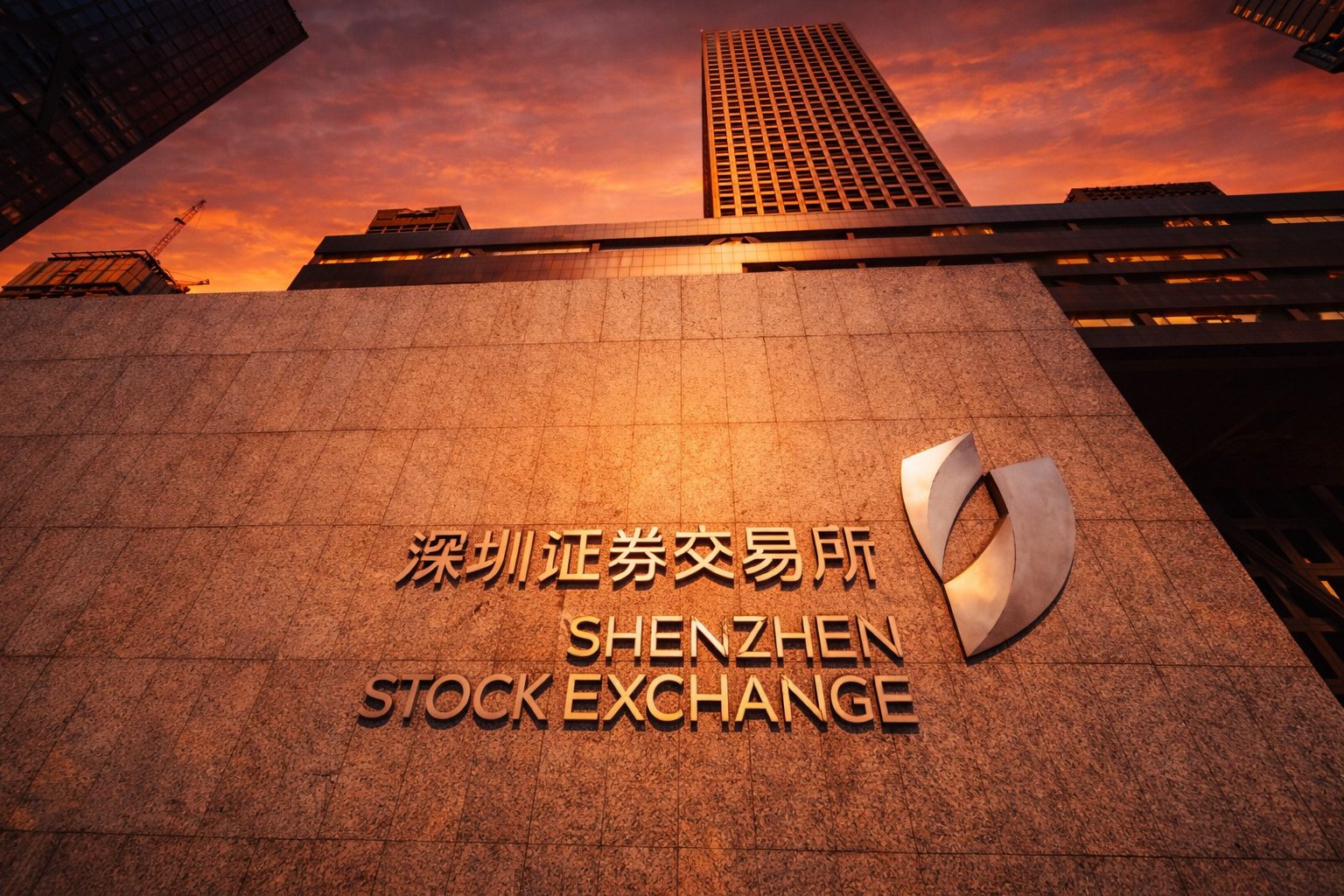
The Shenzhen Stock Exchange (SZSE) heads into the weekend with momentum still intact in several “new economy” corners of China’s equity market—but with fresh macro and policy headlines complicating the setup for the final trading days of 2025.
On Friday, mainland shares ended higher, with the Shenzhen Component Index closing up 0.54% at 13,603.89, while the ChiNext Index—often described as China’s Nasdaq-style board—added 0.14% to 3,243.88. Turnover across the Shanghai and Shenzhen benchmarks totaled 2.16 trillion yuan, up from 1.92 trillion yuan the previous session, a sign of year-end participation despite the holiday-thinned global tape. Spaceflight-related names, lithium battery stocks and Hainan Free Trade Port plays led gains, while papermaking and computing hardware were among the laggards. Xinhua News
With U.S. markets closed for the weekend and Shenzhen trading paused until Monday’s Asia session, investors are now parsing a cluster of developments from the last 24–48 hours: a sharper-than-expected drop in China’s industrial profits, new cross-border rules for cash raised overseas, and a renewed policy push toward advanced manufacturing and strategic technologies—exactly the kinds of themes that tend to concentrate in SZSE-heavy sectors such as EV supply chains, batteries, hardware components, and growth industrials. Reuters+2Reuters+2
Shenzhen’s latest close: steady gains, “space + batteries” leadership
Friday’s session extended a modest two-day climb for Shenzhen benchmarks. On Thursday, the Shenzhen Component Index ended up 0.33% at 13,531.41. Xinhua News
While the headline moves were relatively contained, the sector map mattered: the leadership came from areas closely aligned with Beijing’s current industrial-policy framing—commercial spaceflight and batteries in particular—suggesting traders are still willing to pay for long-duration themes even as parts of the traditional economy remain under pressure. Xinhua News
For investors tracking the “how” as much as the “what,” third-party market data also showed a fairly active range on Friday (with the Shenzhen Component trading between roughly 13,517 and 13,675 intraday), consistent with a market that’s still rotating rather than simply drifting into year-end. Investing.com
Macro reality check: industrial profits slump, demand concerns return to the foreground
The most market-relevant macro headline landing over the weekend was China’s industrial profit data. Profits at China’s industrial firms fell 13.1% year-on-year in November—Reuters described it as the steepest decline in over a year—accelerating from October’s 5.5% drop and reinforcing the idea that weak domestic demand is still acting as a drag even as exports show resilience. Reuters
That matters for Shenzhen because the exchange sits at an intersection: it lists a large share of China’s innovative manufacturers and growth companies, but many of those firms ultimately depend on domestic capex (capital spending), consumer upgrades, and healthier pricing power across supply chains.
Reuters reported that Xu Tianchen, senior economist at the Economist Intelligence Unit, said the profit figures fit with a broader cooling in fourth-quarter activity driven by soft domestic demand. He also argued profitability could improve under “anti-involution” dynamics—Beijing’s shorthand for pushing back against cutthroat, margin-eroding competition—as companies scale back investment over time. Reuters
The same report quoted National Bureau of Statistics chief statistician Yu Weining as saying the recovery in industrial profitability still needs to be put on a firmer footing. Reuters also cited the Rhodium Group estimating China’s 2025 GDP growth at 2.5%–3% (below official targets), underscoring why markets remain sensitive to any incremental stimulus signal. Reuters
Policy pulse: Beijing doubles down on tech breakthroughs and manufacturing upgrades
Against that softer profit backdrop, the policy message has been: press harder on technology and industrial upgrading.
A Reuters report carried by Investing.com said China pledged to “double down” on upgrading its manufacturing base and promised capital support for technological breakthroughs. The report cited an expectation from China’s industry ministry that output of large industrial companies rose about 5.9% in 2025 versus 2024, and said the policy focus includes integrated circuits, the “low-altitude economy,” aerospace, and biomedicine. It also said China launched a national venture capital fund aimed at channeling billions into “hard technologies,” naming areas such as quantum technology and brain-computer interfaces. Investing.com
That mix—pressure on old-economy profitability, paired with explicit capital allocation toward advanced sectors—is one reason SZSE and ChiNext stay in the spotlight for global allocators trying to express “China tech/industrial” views without relying entirely on offshore listings.
Capital markets rules shift: China moves to repatriate overseas listing proceeds
Another headline with direct implications for listed companies and capital-market plumbing: China will require domestic firms to repatriate funds raised from overseas listings “in principle” under new rules aimed at tightening oversight of cross-border financing, Reuters reported Friday.
According to Reuters, the guideline—jointly issued by China’s central bank and the foreign exchange regulator—would require approvals for firms that want to keep proceeds offshore for foreign direct investment, overseas securities investment, or overseas loans before the listing is completed. The rules take effect April 1, 2026, and include requirements such as using dedicated capital accounts for cross-border settlements, while also easing some procedural timelines (including extending a registration deadline to 30 days from 15). Reuters
For Shenzhen-listed investors, the immediate market impact may be more about signaling than mechanics (the rules are not effective until 2026). But the direction is clear: Beijing is leaning toward tighter control over offshore funding flows and, by implication, a stronger emphasis on onshore financing channels—where Shenzhen plays a central role.
IPO and listing pipeline: SZSE’s review machinery keeps moving
Even during a headline-heavy week, the exchange’s own issuance pipeline offered a concrete datapoint.
In an official results announcement, the SZSE Listing Review Committee said its 2025 “35th review meeting” was held on Dec. 26. It concluded that Nanchang Sanrui Intelligent Technology Co., Ltd. (IPO) met issuance conditions, listing conditions, and information disclosure requirements. The committee’s on-site questions highlighted the sustainability of performance growth (including downstream demand, competitive landscape, R&D investment, and customer stability), and it asked for improved risk disclosures in the prospectus, with the sponsor instructed to provide a clear opinion. ReportDocs
That language is typical of China’s listing-review style, but the investor takeaway is practical: regulators are still pressing hard on durability of earnings and disclosure quality—an important theme for ChiNext-style growth narratives where long-term projections can sometimes outrun near-term cash flows.
“Commercial spaceflight” goes mainstream—again
The market’s Friday leadership in commercial spaceflight names is also landing amid policy changes that may keep the theme alive into 2026.
Reuters reported Friday that China eased IPO rules for firms developing reusable rockets, creating a faster IPO lane on Shanghai’s STAR Market that can exempt rocket firms from some financial requirements if they hit specific technological milestones (including an orbital launch using reusable rocket technology). Reuters
While that specific rule change is tied to STAR, not SZSE, it reinforces something Shenzhen investors are already trading: government-backed strategic sectors can receive tailored capital-market support. In practice, that can lift sentiment across supply chains that include Shenzhen-listed component makers, advanced materials firms, electronics manufacturers, and automation suppliers.
Cyclicals and “old economy” constraints: steel controls and overcapacity risks
On the more cyclical end, Reuters reported that China said it will continue regulating crude steel output and prohibit illegal new capacity additions during 2026–2030, a continuation of post-2021 efforts to limit emissions and manage overcapacity. The report cited China’s state planner, the National Development and Reform Commission, saying the raw materials industry faces an insufficient supply-demand balance and needs deeper supply-side reform during the next five-year plan period. Reuters
For Shenzhen, the relevance is indirect but real: the exchange is not just “tech.” It also lists industrials and supply-chain companies exposed to construction cycles, manufacturing utilization, and commodity-linked pricing—areas sensitive to policy moves targeting overcapacity.
Cross-border access: Stock Connect calendars and what to expect Monday
For international investors who access Shenzhen A-shares through the Shenzhen-Hong Kong Stock Connect channel, the calendar matters as much as the fundamentals.
HKEX materials show that Hong Kong markets were closed for Christmas on Dec. 25 and 26 and were set to reopen on Dec. 29. HKEX’s Stock Connect calendar also flags non-trading days for northbound flows when either side is closed. Hong Kong Exchanges and Clearing+2Hong Kon…
If Hong Kong reopens normally on Dec. 29, the practical implication is that Stock Connect-related liquidity and price discovery should normalize as the final mainland sessions of the year get underway—an important consideration for Shenzhen names with heavy overseas participation.
Forecasts and outlook: why 2026 narratives keep pointing back to Shenzhen
The short-term tape is noisy, but the medium-term narrative continues to favor the market segments Shenzhen is known for: innovation, manufacturing upgrades, and tech-adjacent growth.
A South China Morning Post report this week quoted Goldman Sachs analysts led by Kinger Lau as expecting Chinese stocks’ bull run to continue in 2026, “but at a slower pace,” describing a transition “from hope to growth” where earnings realization and moderate valuation expansion do more of the work. South China Morning Post
On the capital markets side, Deloitte China’s Capital Market Services Group said in a Dec. 18 outlook that A-share IPO activity is expected to grow steadily in 2026, with policy priorities under China’s 15th Five-Year Plan shaping what listings are favored. Deloitte also pointed explicitly to sectors such as AI, new energy, high-end manufacturing, commercial aerospace, quantum technology, and bio-manufacturing as well positioned for A-share fundraising. The report included commentary from Deloitte leaders including Dick Kay and Tony Huang on the outlook for A-share listings and regulatory emphasis on applicant quality and technological advancement. Deloitte
And from a global investor perspective, Barron’s published an outlook note Saturday framing Chinese stocks’ trajectory as highly sensitive to the U.S. backdrop—while highlighting continued investor enthusiasm for China’s “new economy” sectors such as AI, biotech, robotics, semiconductors, and clean tech, alongside ongoing concerns about sluggish traditional sectors and property. Barron’s
What investors should know before the next Shenzhen session
With the Shenzhen market closed over the weekend, the key question becomes: what could matter most when trading resumes?
Here are the main items investors are likely to focus on heading into Monday’s reopen:
- Macro pressure vs. policy support. The sharp industrial profit drop is a reminder that demand remains a weak link, even as officials signal continued support for upgrading manufacturing and funding tech breakthroughs. Reuters+1
- Capital-market rule direction. The new repatriation requirement for overseas listing proceeds (effective April 1, 2026) is a medium-term policy signal that could influence funding strategies, cross-border flows, and sentiment around onshore listings. Reuters
- Theme leadership and crowding risk. Friday’s leaders—commercial spaceflight and lithium batteries—are aligned with policy priorities, but that also makes them vulnerable to positioning swings into thin year-end liquidity. Xinhua News+1
- IPO pipeline discipline. The SZSE Listing Review Committee’s questions around demand, competition, R&D, and customer stability underscore ongoing scrutiny of growth durability—especially relevant for ChiNext-style stories. ReportDocs
- Cross-border access and calendars. For Stock Connect participants, the Hong Kong reopen on Dec. 29 is a practical marker for the return of normal cross-border participation into Shenzhen names. Hong Kong Exchanges and Clearing+2Hong Kon…
One more calendar item: SZSE’s early-2026 holiday closure
Investors mapping settlement cycles and exposure around the turn of the year should also note Shenzhen’s published holiday schedule for early 2026. According to SZSE’s English trading calendar, the market will be closed Jan. 1–2, 2026, and resume trading on Jan. 5. Shenzhen Stock Exchange
That may sound mundane, but around year-end it’s often the “plumbing”—trading days, cross-border connectivity, and settlement timing—that quietly amplifies volatility.
Shenzhen’s big-picture setup remains a paradox in motion: a market structurally geared toward China’s preferred future (advanced manufacturing and hard tech), trading in the shadow of China’s present (soft domestic demand and uneven profitability). Monday’s reopen won’t resolve that contradiction—but it will price it.