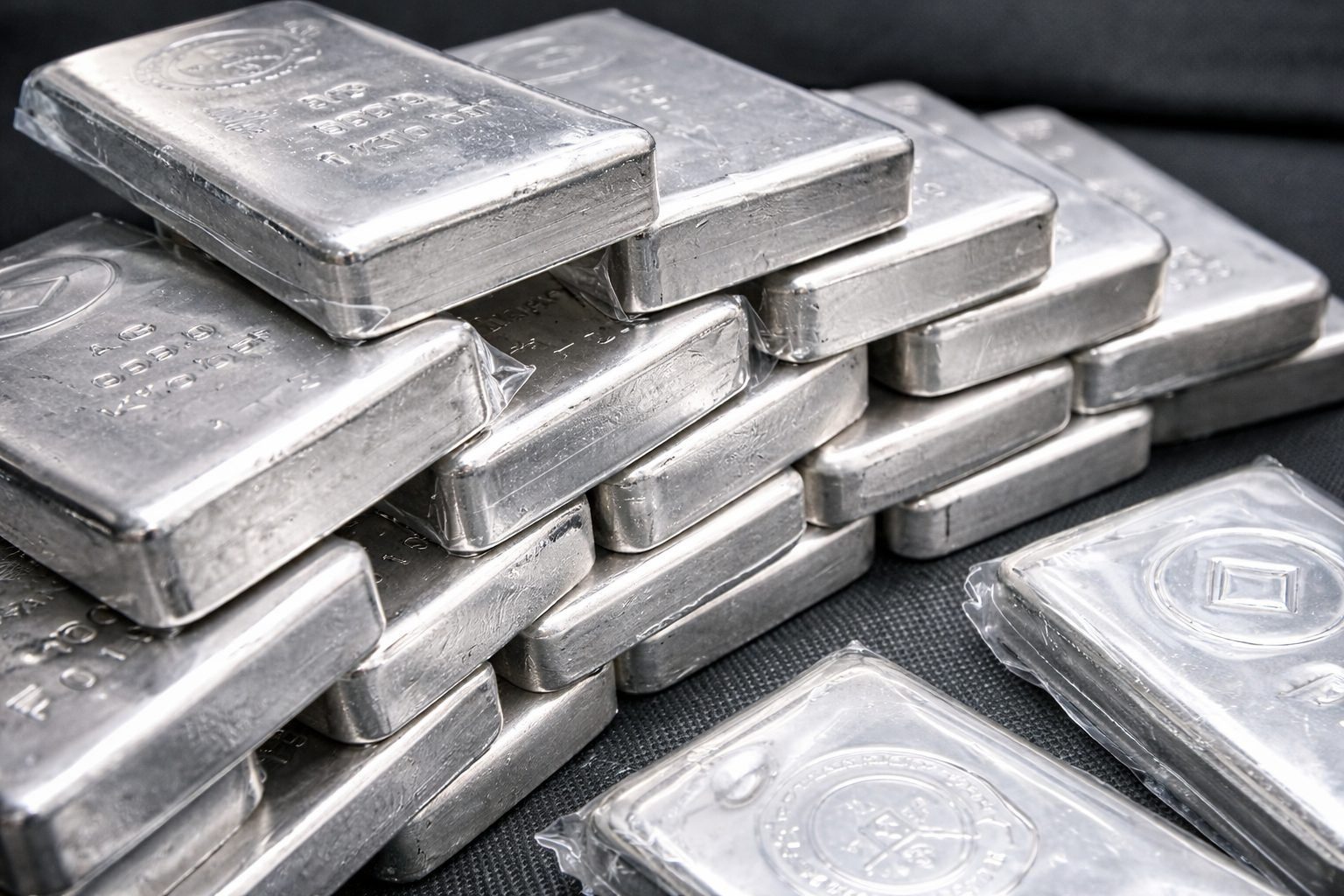

On Friday, December 26, 2025, the precious-metals rally that’s defined much of this year pushed into fresh territory: silver traded above $75 an ounce for the first time, gold hit another all-time high near $4,530, and platinum extended a record run with outsized gains—all in a market that’s being turbocharged by thin post-holiday liquidity, shifting rate expectations, and a scramble for both safe-haven and industrial metals exposure.
For investors who prefer ETFs over physical bars, the moves are reverberating across the biggest names in the space—SLV (silver), GLD (gold) and PPLT (platinum)—after a year in which silver and platinum have dramatically outpaced gold’s already-stunning advance.
What happened on December 26: silver clears $75, gold and platinum hit new peaks
In late-morning trading in Europe, Reuters reported spot gold up around 0.6% near $4,505 per ounce, after touching an intraday record around $4,530.60, while spot silver jumped as high as $75.62 before easing back—still up sharply on the day. Platinum rose to a new record intraday high near $2,448.25, with palladium also surging in a broad-based move across the complex.
The scale of the 2025 move is hard to overstate. Reuters pegged silver up about 158% year-to-date versus gold up roughly 72%, underscoring why silver has become the “high-octane” vehicle of this rally—especially for ETF investors. Reuters
Why precious metals are exploding higher: rate-cut bets, geopolitics, and a liquidity effect
A core macro driver remains the same: markets are leaning into lower U.S. rates ahead, which tends to support non-yielding assets like gold and silver. UBS analyst Giovanni Staunovo described the “prospect of lower U.S. interest rates” as a continuing tailwind and warned that low liquidity is amplifying volatility—a key point for anyone chasing late-year momentum. Reuters
At the same time, the rally is no longer just “gold as a hedge.” Silver and platinum are being pulled higher by a mix of industrial demand and investor rotation—a dynamic that can create sudden, outsized price moves because the markets for platinum and palladium are smaller and more thinly traded than gold. Reuters
Silver is the breakout star—and the market structure helps explain why
Silver’s surge isn’t just a headline price story; it’s a market structure story.
Reuters highlighted four big forces behind silver’s rise: industrial demand, investment demand, persistent supply shortfalls, and silver’s recent designation as a U.S. critical mineral—with momentum-driven buying adding fuel as prices break psychological levels.
How investors are getting exposure: OTC, futures, ETFs, and physical
Silver trading spans everything from London’s OTC bullion market to COMEX futures—but for mainstream investors, ETFs have become the “one-click” instrument. Reuters noted that London vaults held 27,187 tons of silver as of end-November 2025, and described how ETF creation/redemption helps pull ETF prices back toward underlying metal values when demand surges. Reuters
Reuters also emphasized the sheer scale of ETF holdings: the iShares Silver Trust (SLV) is the largest, holding around 529 million ounces of silver worth roughly $39 billion at prevailing prices.
On BlackRock’s iShares product page, SLV reported 528,782,210.80 ounces in trust and about $38.16 billion in net assets (as of December 24, 2025), illustrating how physical-backed silver ETFs have grown into a major channel for investment demand.
Precious metals ETFs “go vertical”: silver and platinum outpace gold
ETF.com framed 2025 as a historic year for precious metals ETFs, driven by a feedback loop: rising prices attract inflows, inflows reinforce the rally, and performance chasers broaden the trade.
As of December 23, ETF.com reported:
- SLV up about 142% year-to-date
- GLD up nearly 70%
- PPLT up about 144% as platinum traded above $2,200 and approached prior cycle highs Etf
Just as important: ETF.com estimated nearly $93 billion poured into precious-metals ETFs globally in 2025, with about $82 billion into gold funds, more than $10 billion into silver ETFs, and less than $200 million into platinum ETFs. That imbalance helps explain why platinum can “gap” higher: relatively small incremental flows can move a smaller market quickly. Etf
Gold is still breaking records—yet retail demand is showing stress
Gold’s 2025 narrative has been anchored by “classic” drivers: central bank buying, ETF inflows, and a broader debate about de-dollarization and sovereign debt sustainability. Reuters said gold is on pace for its strongest annual gain since 1979, supported by those forces alongside Fed easing. Reuters
But the physical market is sending a more nuanced signal. On December 26, Reuters reported that gold discounts in India widened to their highest in more than six months as record prices curbed retail buying, while China discounts narrowed sharply from last week’s extremes—helped by speculative buying and constrained supply tied to import quotas.
In other words: financial demand is blazing, but jewelry/retail demand is price-sensitive—a tension that can matter if liquidity returns in January and the market starts to test how much “real economy” buying remains at these levels.
Platinum’s shock catalyst: tight supply and Europe’s combustion-engine policy pivot
Platinum has been the surprise accelerant of late 2025—partly because it sits at the intersection of industrial inputs and investment flows.
On December 26, Reuters reported platinum hitting another record high as markets digested three reinforcing themes:
- Supply constraints
- Investor rotation out of gold into “cheaper” precious metals
- A policy shift in Europe that could prolong demand for catalytic converters Reuters
That policy shift is significant: Reuters reported the European Commission unveiled a plan to drop the EU’s effective 2035 ban on new combustion-engine cars, moving instead toward a 90% emissions-reduction target, while allowing certain non-electric vehicle pathways via offsets and alternative fuels—though the proposal still requires approval from EU governments and the European Parliament.
Euronews similarly described the Commission’s move as scrapping the full ban, lowering the requirement to 90%, and allowing continued production of several hybrid/ICE configurations beyond 2035.
Because platinum and palladium are key catalytic converter metals, even a marginal extension of internal-combustion or hybrid vehicle pathways can change medium-term demand expectations—and markets are reacting now, not later.
SLV in focus: price levels, volume surge, and why it matters for ETF investors
While spot silver dominated December 26 headlines, SLV’s recent trading action shows how quickly ETF participation can surge when a commodity breaks into new highs.
A market recap on Meyka reported that SLV traded around $65.22, touching an intraday high near $65.53 (a fresh 52-week high) while volume swelled to roughly 58.8 million shares, well above the stated average—an indicator of heavy participation during a breakout.
BlackRock’s iShares page also listed daily volume of 58,825,951 (as of December 24), with a 30-day average volume of 48,803,766, reinforcing the “volume confirmation” theme often watched by technical traders. BlackRock
GLD vs SLV: choosing “steady climb” or “high-octane surge”
For investors asking a practical question—gold ETF or silver ETF?—the differences come down to volatility, scale, and how each metal behaves when macro conditions shift.
The Motley Fool compared the two flagship ETFs and highlighted major contrasts (as of December 19, 2025):
- Expense ratio: SLV ~0.50% vs GLD ~0.40%
- AUM: SLV ~$34.1B vs GLD ~$146.9B
- Beta (vs S&P 500): SLV ~1.39 vs GLD ~0.49
- 1-year return: SLV ~126.9% vs GLD ~66.8% The Motley Fool
A useful way to think about it in late 2025:
- GLD tends to behave like portfolio insurance—more directly tied to rates, the dollar, and central-bank demand.
- SLV behaves like a hybrid of “gold beta” plus industrial-cycle leverage, which can outperform dramatically—but can also whip around faster if growth expectations, risk appetite, or positioning shifts.
Many investors ultimately blend exposures rather than treat it as a binary decision—especially when the whole complex is moving together, but at different speeds.
The risk case: why a late-year melt-up can reverse fast
The bullish narrative is obvious in the price action. The risk narrative is equally important—particularly for Google News readers who may be encountering these record highs for the first time.
Three red flags to watch:
- Liquidity and volatility: UBS’s Staunovo explicitly warned that low liquidity is amplifying volatility—exactly the kind of environment where breakouts can overshoot and snap back.
- Physical demand fatigue: India’s widening discounts signal that high prices can choke off jewelry demand, even if investment demand stays strong.
- Crowded positioning: When silver is making history and retail attention spikes, the trade can attract late momentum money—often the most sensitive to pullbacks.
None of this negates the rally. It simply raises the odds that the path forward is not linear, especially once normal market participation returns in early January.
Bottom line: 2025 ends with metals in charge—and ETFs are the battlefield
December 26 made one thing clear: the 2025 precious-metals story is no longer just about gold. Silver is rewriting the volatility playbook, platinum is responding to both supply and policy shocks, and ETF inflows are magnifying the moves—sometimes dramatically.
If the market is correct that rate cuts and geopolitical uncertainty remain persistent features of 2026, precious metals could stay center stage. But with records being set into thin holiday trading, investors may want to treat “vertical” price action with the respect it demands: opportunity, yes—but also real two-way risk. Reuters