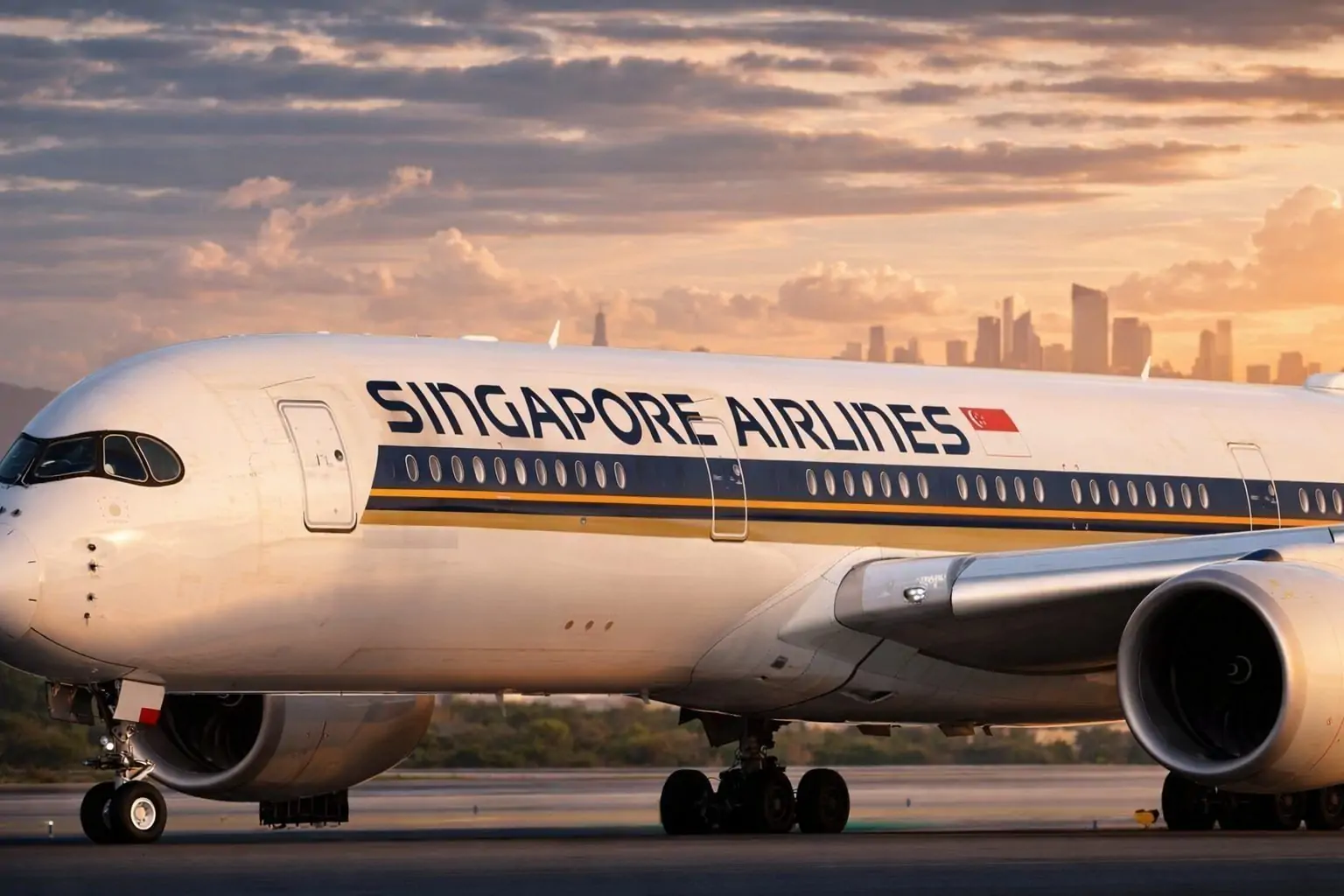
Singapore Airlines Ltd (SIA) stock (SGX: C6L) traded around S$6.41 on 26 December 2025, edging higher on the day as investors balanced a shareholder-friendly dividend story against the airline’s more complicated reality: strong demand and solid operating profit, but a weaker bottom line influenced by Air India losses and intensifying competition across key routes. Google
This end‑of‑year setup matters because airlines rarely move on one headline alone. The share price tends to reflect a mash‑up of factors—traffic and load factors, yields (fares), fuel, capacity growth, and investor returns. For SIA, the latest operating statistics and half‑year results offer a clearer picture of what the market is weighing as 2026 approaches. Singapore Airlines
Singapore Airlines share price today (26 December 2025)
As of 26 December, Singapore Airlines shares were quoted around S$6.41, with trading showing a tight range around the mid‑S$6.40s. Google
Two quick context points for investors tracking SIA share price moves:
- This week’s backdrop included a broader year‑end risk‑on tone in parts of Asia’s markets, which can lift sentiment even in stocks without fresh company-specific announcements. Reuters
- On the company newsflow side, SIA’s most recent SGX-listed updates have centered on traffic data and the November operating results release, rather than a brand-new 26 December filing. SG Investors
Latest Singapore Airlines news: November traffic held up, cargo improved
The most recent operating snapshot for the business is SIA Group’s November 2025 operating results, released earlier in December. It showed:
- Group passenger traffic +2.6% year-on-year, ahead of capacity +2.2%
- Group passenger load factor 87.3% (up 0.3 percentage points)
- Passengers carried: ~3.53 million (up 6.0%)
- Cargo and mail carried: 107.7 million kg (up 12.4%), with cargo load factor at 60.2% Singapore Airlines
Business publications covering the data highlighted that the load factor remained high and cargo benefited from year‑end demand, even as different route regions showed uneven performance. The Business Times
For equity investors, these operating stats matter because they hint at the “quality” of revenue: high load factors can support profitability, but they don’t guarantee it—especially if yields (average fares per kilometer) are being competed down.
Earnings reality check: operating profit resilient, net profit weaker
SIA’s first-half FY2025/26 results (for the half-year ended 30 September 2025) provide the most important fundamental anchor behind current forecasts and analyst caution.
From the company’s SGX-released results summary:
- Total revenue:S$9.675 billion (up 1.9% year‑on‑year)
- Operating profit:S$803 million (up 0.9%)
- Net profit:S$239 million (down 67.8%) SGX Links
The split is telling. The core airline operation delivered a sturdy operating result, supported by demand and lower fuel prices, but net profit fell sharply due to non-operating and below-the-line factors.
SIA also disclosed that passenger yields declined 2.9% (to 9.9 cents per revenue passenger‑kilometre) and attributed the decline to increased competition—a key phrase, because yield compression is one of the fastest ways to turn “full planes” into “meh profits.” SGX Links
Reuters’ coverage of the same results emphasized the same tension: demand remained firm, but competition squeezed yields while cost and associate impacts weighed on profit. Reuters
Air India exposure: strategic stake, near-term drag
A major swing factor in the 2025 narrative is SIA’s associate contribution—especially its stake in Air India.
Reuters reported that SIA’s profit was hit by losses at its Indian associate Air India, and noted that SIA began accounting for Air India’s earnings from December 2024 after the integration of Vistara into Air India, with SIA holding a 25.1% stake. Reuters
In its own results materials, SIA framed the Air India stake as part of a longer‑term multi‑hub strategy and stated it remains committed to working with Tata Sons to support Air India’s multi‑year transformation programme—while acknowledging ongoing challenges. SGX Links
For Singapore Airlines stock watchers, this creates a classic market dilemma:
- Strategic upside: exposure to one of the world’s fastest-growing aviation markets over time.
- Execution risk now: near-term losses and the possibility that a turnaround demands more time (and potentially more capital) before becoming earnings‑accretive.
Dividends and capital return: the support pillar for SIA stock
If Air India has been the “drag” headline, dividends have been the “support” headline.
SIA disclosed a capital return plan structured as a special dividend package of 10 Singapore cents per share annually over three financial years (about S$0.9 billion in total). SGX Links
For the first half of FY2025/26 specifically, SIA’s board declared:
- Interim dividend:5 cents per share
- Interim special dividend:3 cents per share
- Payment date:23 December 2025 (with an ex-date of 5 December 2025) SGX Links
Local reporting also highlighted that a second tranche of the special dividend for FY2025/26 is subject to shareholder approval at the annual general meeting (AGM), and that the company expects further special dividends in subsequent years barring unforeseen circumstances. The Straits Times
For valuation, this dividend framework can meaningfully influence how investors “price” the stock. Even when earnings normalize, a credible capital return plan can keep a floor under sentiment—especially in a market that tends to reward steady distributions.
Fleet and network: growth to meet demand, but capacity can pressure yields
SIA’s own disclosure shows the group is still actively developing its fleet and network—good for long‑term competitiveness, but not automatically good for near‑term margins.
In its half‑year materials, SIA said that for the Northern Winter 2025 operating season (26 Oct 2025 to 28 Mar 2026) it planned to:
- Increase frequencies to destinations such as Auckland, Busan, Da Nang, Kathmandu, Kochi, Phuket, Siem Reap, and Tokyo (Haneda)
- Add supplementary services to Chitose (Sapporo), Christchurch, and Taipei during specific peak windows SGX Links
Scoot, the group’s low-cost carrier, also expanded with new services and frequency increases across Southeast Asia and beyond, including launches such as Nha Trang and additional destinations rolling into early 2026. SGX Links
The investor takeaway is nuanced:
- Network growth can protect market share and feed the Singapore hub.
- But if the wider region is adding capacity at the same time, it can intensify price competition—exactly the yield pressure SIA already flagged. SGX Links
Boeing 777-9 delays: management says impact should be limited
Fleet planning risk has been another recurring theme for global airlines, especially with widebody delivery schedules.
Reuters reported that SIA’s CEO said the airline is not expecting a major operational impact from the delayed delivery of Boeing’s 777‑9 aircraft, pointing to flexibility built into fleet planning. Reuters
This matters for investors because widebody delays can force airlines to keep older aircraft longer (raising maintenance costs) or lease capacity at unattractive rates. Management’s message is essentially: “We’ve planned for some turbulence here.”
Analyst forecasts for Singapore Airlines stock: targets cluster around the low-to-mid S$6 range
As of 26 December 2025, market consensus signals lean cautious rather than bullish.
Investing.com’s compiled analyst view for Singapore Airlines shows:
- Consensus rating: “Sell”
- 14 analysts in the dataset, with 0 buy, 8 sell, and 6 hold
- Average 12‑month price target:~S$6.17
- High/low targets:S$7.00 / S$5.25 Investing
Other market data aggregators show a similar “around S$6” center of gravity for target prices on SIA shares, with some estimates implying modest downside from the mid‑S$6.40s. Beansprout
It’s worth reading that consensus in plain English: the market isn’t forecasting collapse, but it also isn’t collectively pricing in a strong 12‑month rerating—likely because it expects continued yield normalization, competitive pressure, and uncertainty around associate earnings.
What could move Singapore Airlines (C6L) stock next?
Based on the latest disclosed numbers and current analyst framing, the next big drivers for SIA stock look less like one-off “breaking news” and more like a sequence of fundamentals:
1) Passenger yields and competitive intensity
SIA has already pointed to competition as a driver of yield decline. If yields stabilize faster than expected, earnings can surprise to the upside. If discounting intensifies, loads may stay high while margins thin. SGX Links
2) Air India’s trajectory
The associate line has become material enough that it can reshape net profit optics. Clear evidence of Air India’s turnaround progress—or a clearer timeline to improved economics—could alter valuation narratives. Reuters
3) Cargo demand and trade volatility
SIA has highlighted uncertainty in cargo, including pressure on yields even when volumes rise. Cargo won’t necessarily be the headline business for most retail investors, but it can move profit in meaningful ways—especially for an airline group with dedicated freighter capacity. Reuters
4) Dividends and shareholder approvals
The market tends to price what it can trust. Delivering on the stated special dividend framework—subject to required approvals—could remain a stabilizer for SIA’s share price even during earnings normalization. SGX Links
5) Fleet execution amid manufacturer delays
SIA says it has flexibility, but delivery timing and fleet costs remain a sector-wide risk variable. Any changes in delivery schedules, leasing strategy, or capex can influence forward cash flow expectations. Reuters
Bottom line
On 26 December 2025, Singapore Airlines Ltd stock sits in a familiar airline-investor balancing act: robust demand and a strong brand, tempered by yield pressure, associate losses (notably Air India), and the reality that post‑boom airline earnings often normalize even when planes remain full. SGX Links
Analyst targets clustering around ~S$6.17 suggest the market sees SIA as fairly valued to slightly expensive at current levels, unless yields, costs, and associate performance improve more than expected. Investing
At the same time, SIA’s dividend and special dividend plan provides a tangible shareholder-return narrative that many airlines globally can’t match—one reason the stock may remain comparatively supported even as the sector wrestles with competition and supply-chain constraints. SGX Links