
NEW YORK, January 4, 2026, 17:01 ET
- Scientists tracked water output from interstellar comet 3I/ATLAS using ultraviolet observations from the SOHO spacecraft.
- The comet’s water production peaked in early November, then fell sharply as it receded from the Sun.
- The results add rare “after-perihelion” data on one of only three confirmed interstellar visitors to the solar system.
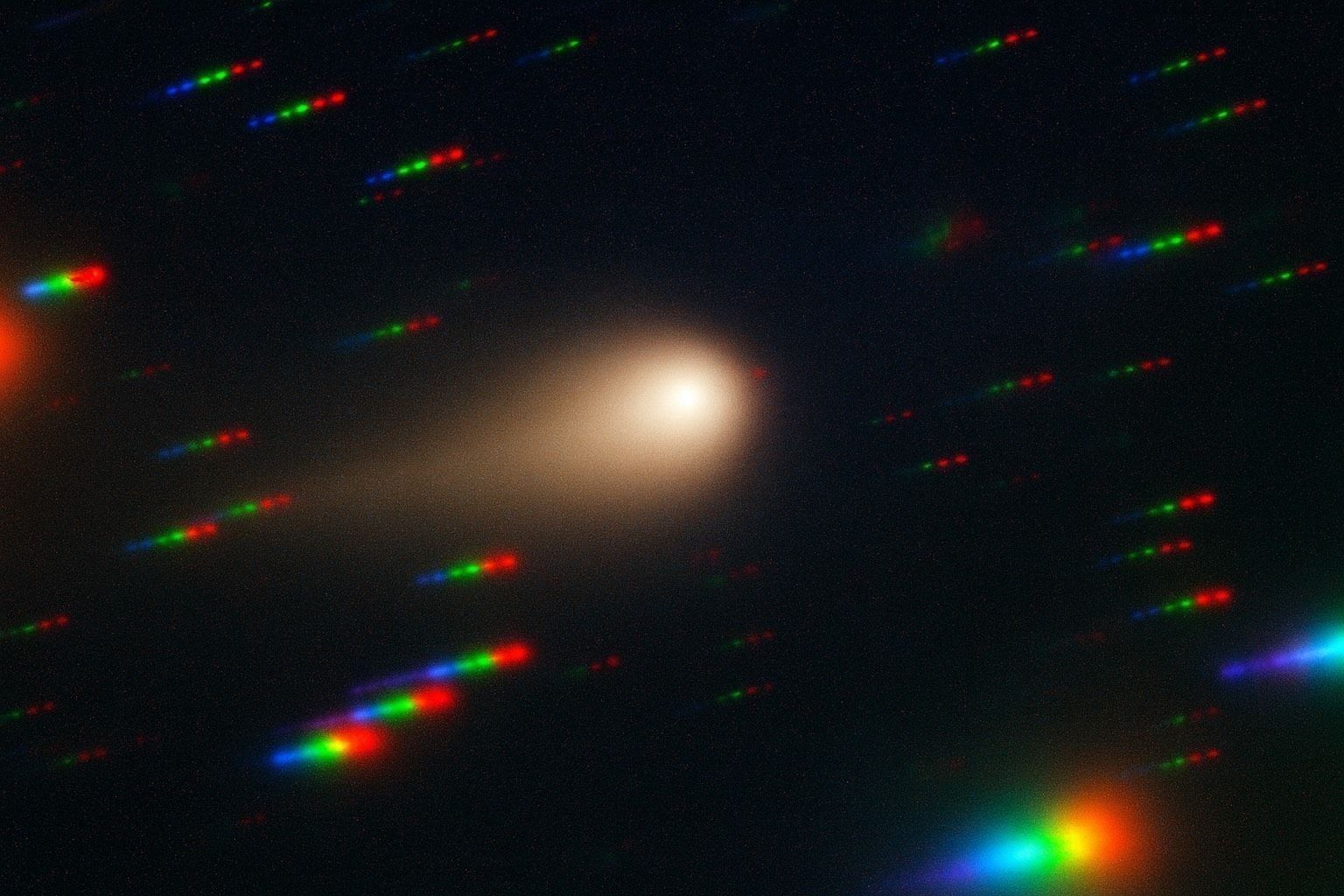
Scientists have measured water streaming from interstellar comet 3I/ATLAS after its late-October pass around the Sun, using a solar-monitoring spacecraft to estimate how fast the object was shedding ice into space.
The timing matters because most early work on 3I/ATLAS focused on its approach, when sunlight was ramping up the comet’s activity. Post-perihelion data are harder to capture as objects fade and move farther from Earth, leaving a narrow window to document how a fresh interstellar visitor “winds down.” Phys
Interstellar objects are rare: 3I/ATLAS is only the third confirmed body observed entering the solar system from beyond it, after 1I/‘Oumuamua in 2017 and 2I/Borisov in 2019. Scientists prize them as physical samples of other planetary systems, but they typically do not linger.
The measurements rely on the Solar and Heliosphere Observatory, or SOHO, a spacecraft that has watched the Sun for nearly three decades. A SOHO instrument called SWAN detects ultraviolet light from hydrogen, which can brighten when sunlight breaks apart water molecules flowing from a comet.
In a study posted as a preprint — research shared publicly before formal peer review — researchers used that hydrogen “glow” to back-calculate the comet’s water production. On Nov. 6, when the comet was 1.4 astronomical units from the Sun (one astronomical unit is the Earth-Sun distance), they estimated it was releasing water at a rate of 3.17 x 10^29 molecules per second. Phys
Over the following weeks the output fell steadily, dropping to between 10 and 20 trillion molecules per second by early December, the study said, a decline pattern the authors described as consistent with how ordinary solar-system comets dim as solar heating eases.
The scale of the outgassing also feeds into a central uncertainty: how big the comet’s solid nucleus is, and how much of its surface is active. The analysis cited Hubble-based size estimates ranging from about 440 meters to 5.6 kilometers across, and said the measured water production could imply an unusually high active fraction — around 20% — compared with the roughly 3% to 5% often seen in many solar-system comets.
NASA has said the comet poses no threat to Earth and remains observable from the ground with small telescopes in the pre-dawn sky, with visibility expected to extend into spring 2026 as it continues outward.
One risk is that the water estimate is indirect: it depends on modeling how sunlight drives fluorescence and how hydrogen spreads around the comet, along with corrections tied to changing solar ultraviolet output. The work is also a preprint, meaning the methods and assumptions have not yet been vetted through journal peer review.
Even so, researchers said SWAN-based techniques have been refined across decades of comet observations, and the 3I/ATLAS results add a rare post-perihelion checkpoint for comparing an interstellar comet’s behavior with the icy bodies formed closer to home.