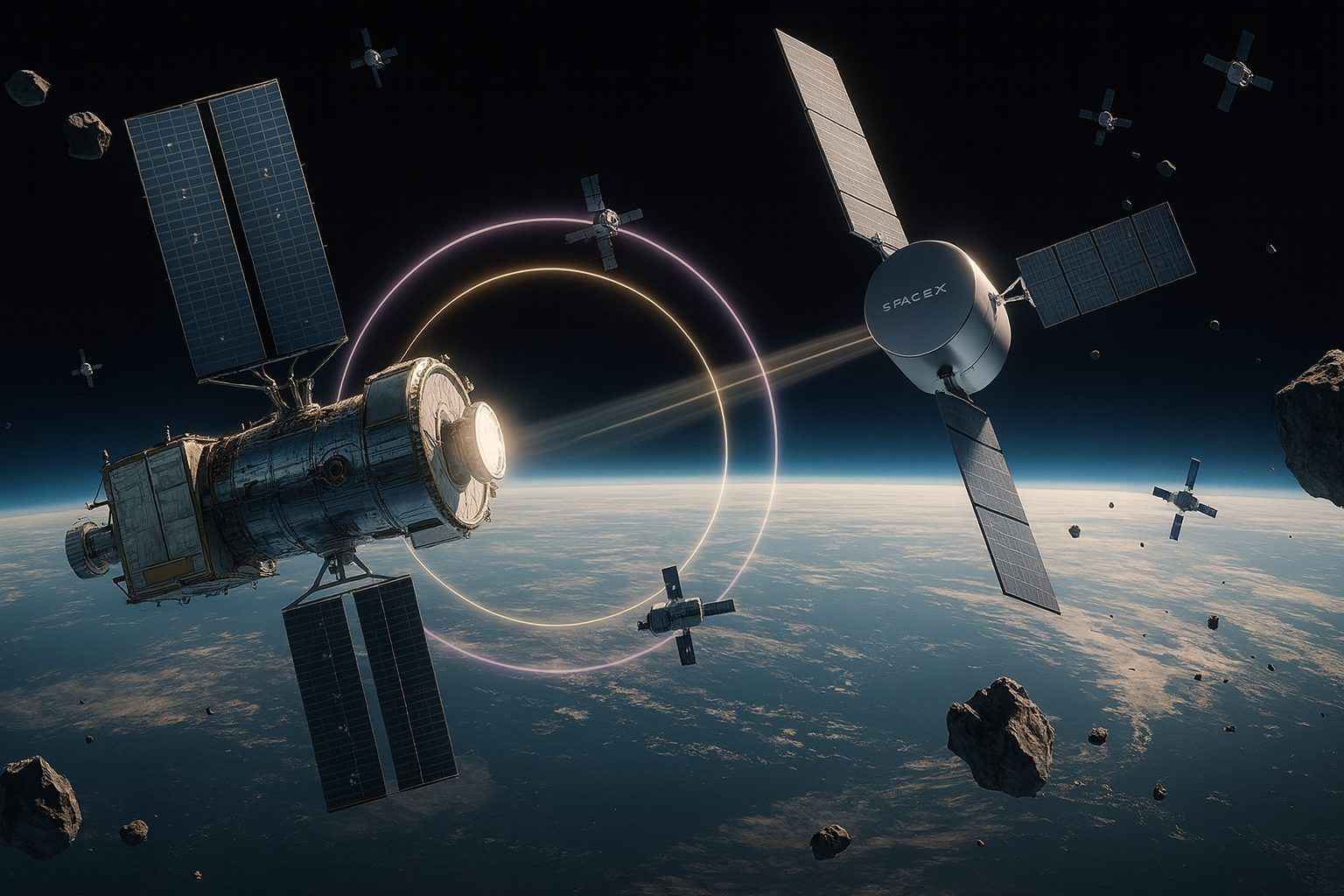
A tense new flashpoint in the race to fill low Earth orbit (LEO) with broadband megaconstellations unfolded this month after SpaceX said one of its Starlink satellites narrowly avoided a close approach with a spacecraft launched from China—missing by roughly 200 meters (about 650 feet) at an altitude of around 560 kilometers (about 350 miles).
The incident itself didn’t create debris, trigger service outages, or end with a visible confrontation in space. But the aftermath—public statements, finger-pointing over who should have shared what data, and renewed warnings about “Kessler syndrome”—is quickly turning a routine-looking conjunction event into a global reminder that space has become too busy for informal coordination. Space+2The Independent+2
On December 15, 2025, coverage across science and tech outlets sharpened the focus: SpaceX’s Starlink engineering leadership argued the near-miss was avoidable if the other operator had shared accurate trajectory information, while the Chinese launch provider said it follows mandatory pre-launch collision-avoidance procedures and stressed the encounter occurred long after its launch mission had concluded.
What happened: a 200-meter close approach involving Starlink-6079
According to SpaceX’s account, the close pass involved STARLINK-6079 (NORAD ID 56120) and one of nine spacecraft deployed during a Chinese launch from the Jiuquan Satellite Launch Center in northwestern China. SpaceX’s Starlink engineering vice president Michael Nicolls said the problem wasn’t simply “bad luck” in orbit—it was a breakdown in coordination and deconfliction with satellites already operating in LEO. Space+1
The key term at the center of the dispute is ephemeris—the positional and orbital data that helps other operators predict where a satellite will be and when it might come close to something else. Without shared ephemeris (or other forms of timely trajectory coordination), even sophisticated collision-avoidance systems can be forced to rely on incomplete information.
SpaceX has not publicly identified which specific payload among the nine came closest to STARLINK-6079, and reporting based on the available public statements indicates the exact spacecraft remains unclear.
The launch: CAS Space’s Kinetica 1 mission from Jiuquan
The launch tied to the near-miss is widely reported as a CAS Space mission using its Kinetica 1 rocket (also commonly referenced as Lijian-1), a solid-fueled commercial launcher associated with China’s fast-growing private space sector.
A China Daily report on the mission described a nine-satellite deployment that included a notable international rideshare mix: payloads for the United Arab Emirates, Egypt, and Nepal, alongside six Chinese multifunctional satellites. China Daily reported liftoff from Jiuquan at 12:03 p.m. local time and said the satellites were inserted into their preset orbits.
That timing also helps explain why different outlets reference different calendar dates for the launch: local time in China (UTC+8) can place the same liftoff on a different date in the United States or UTC-based reporting windows.
What SpaceX said: “coordination needs to change”
SpaceX’s public criticism centered on a simple point: orbital safety increasingly depends on operator-to-operator coordination, and it becomes riskier when a satellite operator (or launch ecosystem) doesn’t share the data needed to predict close approaches. SpaceX framed the event as a warning sign in an era where thousands of satellites are being launched at a pace that’s outstripping traditional norms of coordination.
The message resonated because it came from inside the company operating the world’s largest satellite constellation—one that is already managing an enormous number of predicted conjunctions every day.
What CAS Space said: procedures followed, but incident occurred after the launch mission ended
CAS Space did not accept direct responsibility for the near-collision in the statements reported by multiple outlets. Instead, it emphasized two points:
- Pre-launch deconfliction is mandatory and CAS Space selects launch windows using ground-based space awareness systems intended to avoid known satellites and debris.
- The close approach occurred nearly 48 hours after payload separation, a timeframe CAS Space suggested was beyond the period when its launch mission responsibilities would typically apply.
Importantly, the tone of the exchange—at least as captured in reporting—was not purely confrontational. CAS Space echoed the broader call for improved collaboration, and Nicolls publicly responded that he appreciated the engagement and wanted future coordination.
Why a 200-meter miss matters in low Earth orbit
In everyday life, 200 meters can feel like a comfortable buffer—two football fields, a short city block, a quick walk.
In LEO, it’s the opposite.
Satellites move at extraordinary speeds (often cited around 17,000+ mph for LEO objects), meaning the “time margin” during a close approach can be vanishingly small, and small uncertainties in tracking or maneuver planning can matter. Tom’s Hardware
A collision at orbital velocities is not like a fender bender. Even a relatively small impact can create a high-energy debris cloud, producing fragments that can strike other satellites and potentially trigger additional impacts. This is the fear behind Kessler syndrome, the cascading-collision scenario that could render parts of valuable orbital regions difficult—or, in extreme cases, impractical—to use.
That’s why the story drew immediate attention beyond the companies involved: it’s not only about Starlink vs. a Chinese payload. It’s about what happens when crowded orbital shells start producing more “near-miss” headlines than the world’s current coordination norms can handle.
The bigger pressure point: Starlink’s scale and the rising “maneuver burden”
One reason this incident landed so forcefully on December 15 is that Starlink’s scale makes it a bellwether for what space operations look like when a single system runs into the thousands—then keeps growing.
SpaceX’s own numbers underline how often avoidance decisions occur. Reporting notes that in the first half of 2025, Starlink spacecraft performed over 144,000 collision-avoidance maneuvers—an enormous operational workload that depends on having reliable tracking and predicted conjunction information.
Space.com also highlighted the broader growth curve: from fewer than 3,400 functional satellites in 2020 to around 13,000 in 2025, with nearly 9,300 Starlink satellites operating at the time of reporting.
Even if you accept that collision-avoidance tech is improving, the math is unforgiving: more satellites in similar altitude bands means more close approaches, more alerts, more coordination messages—and more opportunities for something to slip through the cracks.
Why coordination is hard: no single “air traffic control” for orbit
Aviation works because aircraft operate inside a mature, enforceable, globally connected traffic control framework.
Space does not—at least not in any fully centralized, mandatory way for the growing population of commercial and national operators in LEO.
Instead, collision avoidance in orbit often depends on a patchwork of:
- public and government tracking resources,
- operator-to-operator communications,
- mission-specific standards,
- and voluntary (or semi-voluntary) data sharing.
That’s why this near-miss is being treated as more than a one-off. It’s a symptom of a system that’s scaling faster than its governance mechanisms.
December 15 coverage: a near-miss becomes a global storyline
By December 15, the incident had moved beyond a niche spaceflight audience and into mainstream tech and science news streams.
- The Verge framed the close approach as a near-collision and highlighted SpaceX’s claim that the other operator didn’t share ephemeris data—data necessary for Starlink’s avoidance systems to work optimally.
- The Independent emphasized the risk of catastrophic debris outcomes and the renewed attention to Kessler syndrome, while also publishing more of the back-and-forth between Starlink’s engineering leadership and CAS Space.
- Gizmodo focused on the congestion narrative and the need for improved coordination, noting that the details of what happened between launch and the close approach remain unclear from the public record so far.
- Futurism amplified SpaceX’s frustration, while also reiterating that the launch carried a mixed payload set and that the confrontation reflects the growing collision risk in crowded orbital regimes.
- The Register captured the incident as part of broader Asia tech coverage, emphasizing SpaceX’s allegation that the close approach occurred without coordination and that Nicolls linked the event to the CAS Space/China Daily-described mission.
Together, the coverage converged on one shared conclusion: a collision was avoided—but the process that prevented it (or failed to prevent it, depending on your view) is not robust enough for what’s coming next in LEO.
What happens next: more satellites, more close calls, higher expectations
No collision occurred in this case, and both sides have signaled at least some interest in future coordination. But the broader challenge is only accelerating:
- China’s commercial and state-linked space ecosystems are expanding launch cadence and satellite programs.
- SpaceX continues to replenish and grow Starlink at scale.
- Other constellations and national projects are also targeting similar altitude bands.
The key question for 2026 won’t be whether near-misses happen. It will be whether the industry and governments can create predictable, enforceable, interoperable coordination rules—and whether major operators will share enough of the right data quickly enough to prevent “close approach” headlines from eventually turning into debris-field realities.
Because in a sky filling up with satellites, the next 200-meter miss might not stay a miss.