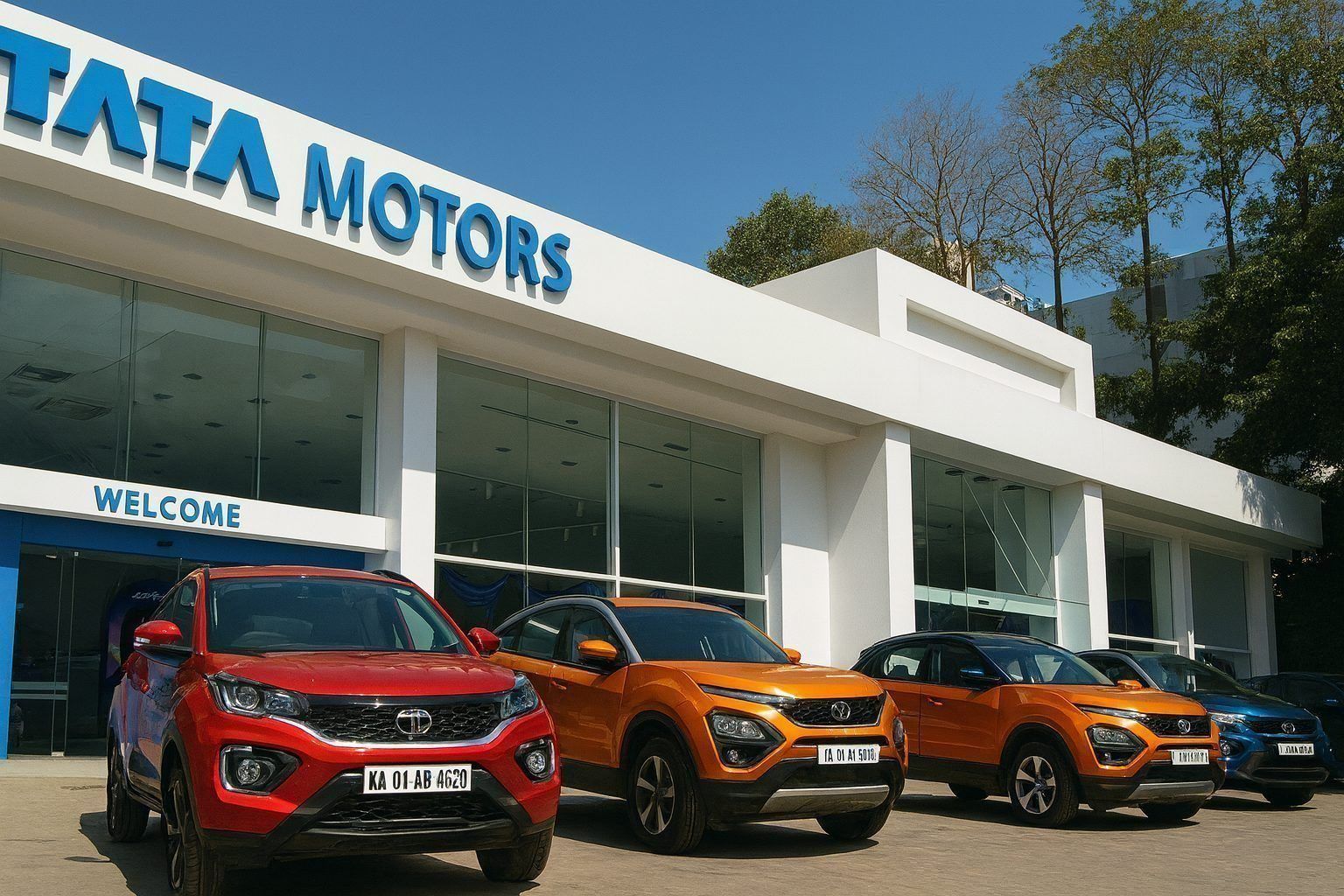
Mumbai, December 10, 2025 — The newly listed commercial vehicles arm of Tata Motors is fast emerging as Dalal Street’s new auto favourite. Tata Motors Commercial Vehicles (TMCV) has surged to fresh record levels this week, riding a 17% rally in just two weeks, a bullish initiation from Ambit Institutional Equities, and the strongest commercial-vehicle upcycle in years.Business Standard+ 1
Even after the sharp move, the CV-focused stock continues to trade at about a 6% valuation discount to rival Ashok Leyland, a gap brokerages say could narrow as earnings catch up.Business Today
Tata Motors CV share price today: near record, after a 17% two-week rally
Tata Motors’ CV entity, listed under the TMCV ticker, has been on a tear since late November. On Tuesday, December 9, the stock hit a new intra-day high of around ₹371.20 on the BSE, surpassing its earlier peak of ₹367.90 recorded on December 2.Business Standard
Market data from Moneycontrol and Trendlyne show the stock flirting with fresh 52‑week highs again in Wednesday’s session, with intraday highs around the ₹382–383 mark, even as it cools slightly to trade near ₹370.Moneycontrol+ 1
Key price action highlights:
- New record zone: 52‑week high around ₹383 as of December 10, 2025.Moneycontrol
- Short-term sprint: The stock has jumped about 17% in the last two weeks , significantly outpacing broader indices.Business Standard
- Market‑cap reshuffle: Thanks to the surge, TMCV’s market capitalization has climbed to about ₹1.36 trillion , overtaking Tata Motors Passenger Vehicles (TMPV), which stands almost ₹1.26 trillion.Business Standard
Brokerage tracking tools such as Trendlyne flag “New 52W High today” for TMCV, along with an “Analyst Buy” tag and overbought momentum readings — a sign of strong but stretched near-term sentiment.Trendlyne.com+ 2Trendlyne.com+ 2
Ambit starts coverage with ‘Buy’ and ₹430 target: up to ~19–20% upside
The latest leg of the rally has been powered by Ambit Institutional Equities, which on December 9 initiated coverage on Tata Motors Commercial Vehicles with a ‘Buy’ rating and a target price of ₹430 per share.Business Standard+ 1
That target implies roughly 19–20% upside from the ₹360–365 zone where the stock traded before the call was published.Business Standard
Ambit’s thesis remains on four big pillars:
- Market leadership in Indian CVs
- TMCV holds about 35% retail market share in the domestic CV market.
- In heavy trucks above 31 tonnes, its share exceeds 60% , making it the clear leader in high-tonnage vehicles.Business Standard+ 1
- Improving profitability and margin headroom
- Between FY19 and FY25, India CV revenue and EBITDA grew at 6% and 7% CAGR , respectively, despite a 5% decline in volumes and roughly 10 percentage points of market share loss.Business Standard+ 1
- Ambit expects 6% revenue CAGR and 7–8% EBITDA CAGR over FY25–28 , supported by a richer mix of higher-tonnage trucks, better pricing discipline and cost-efficiency measures.Business Standard+ 1
- EBITDA margins have moved meaningfully higher in recent years, with brokerages such as Ambit and Republic World pointing to double-digit CV margins (above 12%) and room for another 50–70 bps of margin expansion as non-core revenue streams scale.Business Standard+ 2Business Today+ 2
- High‑margin, non-core revenue streams lowering cyclicality
Ambit highlights the role of adjacencies — including digital fleet solutions, spares, services and other value-added offerings — as a key reason TMCV’s earnings are becoming less cyclical than a pure volume-driven truck business. These businesses typically carry above-average margins and more stable demand, helping cushion downturns in the CV cycle.Business Standard+ 2Business Today+ 2 - Global optionality via the Iveco deal
The proposed combination with Iveco is central to Ambit’s long-term optimism. The brokerage estimates that a combined TMCV–Iveco platform could command over ₹2 trillion in annual revenue and around 5.4 lakh units in volumes , leveraging TMCV’s low-cost manufacturing base and Iveco’s global technology and product portfolio.Business Standard+ 2Business Today+ 2
On valuation, Ambit assigns:
- 13.5x one‑year forward EV/EBITDA to the India CV business,
- 2.5x EV/EBITDA to Iveco based on FY27 estimates,
- A 20% holding-company discount on listed subsidiaries, and
- 1x book value for other investments.Business Standard+ 1
Put together, this yields the ₹430 target price and a 24.5x FY27E P/E , which Ambit argues is justified by strong cash flows and return ratios (free cash flow at around 8.5% of sales and ROCE above 25%).Business Standard+ 2Business Today+ 2
CV volumes are surging: 28.6% growth in November, exports up 92%
The fundamental backdrop for CVs has also turned distinctly supportive. According to Business Standard, Tata Motors’ total domestic CV volumes for November surged 28.6% year-on-year , with growth broad-based across sub-segments:Business Standard
- Heavy commercial vehicles (HCV) volumes jumped 34.2% YoY .
- Intermediate, light and medium CVs (ILMCV) grew 35% YoY .
- Small commercial vehicles, cargo and pickups rose 19% YoY .
- Exports skyrocketed 91.7% YoY , pointing to robust overseas demand.
Analysts quoted in the same report attribute the spike to:
- Better fleet use post-festive season,
- Higher freight rates,
- A consumption boost and demand tailwind following GST rate rationalization across segments.Business Standard
Brokerage notes cited by Business Standard and Republic add that TMCV remains below its FY19 volume peak, leaving room for further recovery as utilization improves and the macro cycle strengthens.Business Standard+ 2republicworld.com+ 2
Rating agency S&P Global has also assigned a stable outlook to Tata Motors, saying it expects the group to maintain a strong balance sheet and dominant share of India’s CV market, supported by infrastructure and construction spending, a growing economy and likely lower interest rates.Business Standard
Still at a 6% discount to Ashok Leyland — but with stronger growth
Despite the powerful rally and upbeat commentary, Ambit points out that TMCV still trades at about a 6% discount to Ashok Leyland on key valuation metrics such as forward EV/EBITDA.Business Standard+ 1
Yet, over FY18–25:
- TMCV delivered 7.7% revenue CAGR versus 5.7% for Ashok Leyland , and
- 8.6% EBITDA CAGR versus 7.5% for its rival, with similar free-cash-flow conversion despite weaker volumes.Business Today
Ambit therefore argues that as the CV cycle strengthens and the Iveco transaction unlocks global scale and diversification, TMCV’s valuation should move closer to, or even match, Ashok Leyland’s multiples , closing the discount.Business Today
Peer comparison tables on Moneycontrol also show TMCV and Ashok Leyland trading near each other in terms of market capitalization, with TMCV’s market cap now slightly higher and both stocks hovering near their respective 52‑week highs.Moneycontrol+ 1
From emerging confusion to CV-focused clarity
Part of the recent interest in TMCV is simply clarity. The detailed merger of Tata Motors into Passenger Vehicles (TMPV) and Commercial Vehicles (TMCV) took effect on October 1, 2025, with CV shares listing on November 12 .livemint.com+ 1
Key demerger and listing facts:
- The trucks and buses business was initially valued at about ₹260–261 per share in the demerger math.The Economic Times+ 1
- TMCV listed at ₹330–335 per share , a 26–28% premium to its implied value.livemint.com
- Tata Motors later disclosed that shareholders should allocate 31.15% of their original Tata Motors cost to the CV entity and 68.85% to TMPV for tax and accounting purposes.livemint.com
On listing and immediately after, many investors were confused by what looked like a sharp price drop in the old consolidated Tata Motors scrip — widely described as a “40% crash” — which was largely a mechanical adjustment as the CV business spun off and began trading separately.The Economic Times+ 1
Since then, TMCV has delivered strong price performance. LiveMint’s analysis of the cost split and price moves suggested that, based on the allocated cost of acquisition, CV shareholders were sitting on gains of over 50% shortly after listing, even as TMPV holders faced a notional loss versus their pre‑emerger cost.livemint.com
Passenger-vehicle arm lags as CV business steals the spotlight
While TMCV has enjoyed a rerating, the passenger-vehicle arm, TMPV, has had a tougher year. Economic Times data show Tata Motors’ passenger-vehicle stock as one of the worst-performing large PV names in 2025 , weighed down by intense EV competition and market-share pressures.The Economic Times
Over the last two weeks alone, Business Standard reports that:
- TMCV is up about 17% , while
- TMPV has fallen roughly 3% , and is trading near its 52‑week low around ₹335.Business Standard
This divergence has effectively swapped the pecking order : investors who once bought Tata Motors primarily for its PV and JLR story are now focusing on the cleaner, more cyclical but higher‑return CV franchise.
What could drive the next leg — and the key risks
Analysts and rating agencies flag several potential drivers that could keep the TMCV story in the spotlight:
1. A sustained CV upcycle
With GST rationalization, rising government capex, healthy infra and construction activity, and improving freight demand, brokerages expect positive YoY CV growth through FY26 and beyond , especially in mid- and heavy-duty trucks.Business Standard+ 1
2. Integration and upside from Iveco
If executed well, the Iveco transaction could give Tata Motors access to new markets, platforms and technologies, while using its Indian cost base to lift Iveco’s below‑par margins — a key assumption behind Ambit’s global thesis.Business Standard+ 2Business Today+ 2
3. Index and passive flows
The listing of TMCV has already triggered passive rebalancing in key indices. LiveMint notes that CV shares have temporarily increased the count of Nifty 50 constituents and that passive funds are having to adjust their holdings around the demerger.livemint.com
4. Balance-sheet comfort and ratings support
S&P’s stable outlook and expectation of continued positive free cash flow and low leverage — even factoring in the Iveco acquisition — provide a supportive backdrop for equity investors focused on downside protection.Business Standard
At the same time, there are non-trivial risks :
- CV businesses remain inherently cyclical and sensitive to macro growth, interest rates and freight demand.
- Any slowdown in infrastructure or construction spending could dent volumes and pricing power.
- The Iveco acquisition increases execution complexity; if synergies are delayed or costs overshoot, the transaction could weigh on returns, at least in the near term.Business Standard+ 2Business Standard+ 2
- After the recent run, TMCV trades near record highs, with several data providers tagging its valuation as “expensive” , even if still slightly cheaper than Ashok Leyland on select metrics.Trendlyne.com+ 2HERE Direct+ 2
Bottom line
As of December 10, 2025, Tata Motors’ CV business has decisively moved from emerging curiosity to market favorite. The combination of double-digit volume growth, improving margins, global expansion via Iveco and a valuation discount to Ashok Leyland is driving a powerful rerating story.