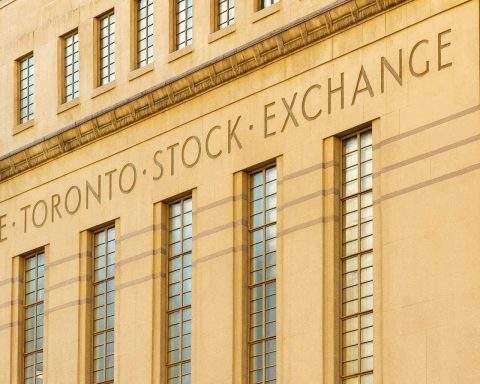
TORONTO — Bay Street is heading into the Christmas-shortened trading week with the kind of momentum that makes both optimists and risk managers feel uncomfortably alive.
On Friday, Canada’s benchmark S&P/TSX Composite Index closed at 31,755.77, up 1% on the day, in heavy volume—a fresh record close that capped a choppy but ultimately positive pre-holiday stretch. The index finished the week up 0.7%, and it has gained 28.4% year-to-date, putting 2025 on track for its biggest annual advance since 2009. Reuters
As of Sunday, Dec. 21, 2025, that backdrop sets up a very TSX-flavored storyline: commodities and financials remain the gravitational center, interest-rate expectations are still doing their little daily dance, and traders are about to enter the annual period where liquidity thins out and headlines can move prices more than they “should.”
Below is a comprehensive, publication-ready roundup of the latest TSX news, the near-term setup into the holiday week, and the key forecasts and strategist debates shaping 2026.
What just happened on the TSX: a record close after a mid-December wobble
Friday’s record close didn’t happen in a vacuum. The TSX spent part of mid-December stepping back as investors took profits after an “extremely positive year,” with energy stocks sliding alongside oil and some cyclical caution creeping in. On Dec. 16, the TSX ended at 31,263.93 (down 0.7%), marking a one-week low at the time as the energy sector fell 3.7% and oil settled 2.7% lower. Reuters
Then came the snap-back. By Friday, the market mood had turned distinctly “risk-on,” fueled by a rally in technology and metal mining shares. Reuters reported that the materials group gained 2.4% and technology rose 2.5% on the day, while oil also climbed (settling 0.9% higher at $56.66 a barrel), helping lift energy. Reuters
The result: a TSX that looks less like it’s “melting up,” and more like it’s doing what it often does when macro conditions cooperate—rotating leadership between banks, resources, and selective growth rather than relying on one narrow theme.
Rates are still the market’s main plot device (and Canada’s is at 2.25%)
If 2025 had a recurring character on the TSX, it was the interest-rate narrative—sometimes supportive, sometimes unsettling, always present.
On Dec. 10, Reuters reported the Bank of Canada held its policy rate at 2.25%, while the U.S. Federal Reserve cut rates by 25 basis points and signaled a likely pause—both broadly in line with expectations. The TSX closed at a then-record 31,490.85 that day, boosted by financials and tech (with Shopify among the notable movers). Reuters
By mid-month, the inflation story reinforced the “rates may stay steady for a while” framing. On Dec. 15, Reuters reported Canada’s annual inflation rate held at 2.2% in November, below expectations for a slight uptick. The TSX ended 31,843.44 that session, and investors were pricing in less Bank of Canada tightening for next year than they had just days earlier. Reuters
Strategists at RBC Wealth Management, looking beyond the day-to-day noise, described 2025 as a year where the Bank of Canada continued easing overall, with the last two 25 bps cuts in September and October bringing the overnight rate to 2.25%. They also noted Governor Tiff Macklem has signaled the BoC may be finished easing “for now,” unless growth or employment deteriorate more than expected. RBC Wealth Management – Asia
Holiday trading week: TSX hours and why liquidity matters right now
The market setup for the coming week isn’t just about fundamentals—it’s also about the calendar.
According to TMX Group’s holiday schedule, TSX markets are:
- Closed on Christmas Day (Dec. 25)
- Closed on Boxing Day (Dec. 26)
- Early close on Christmas Eve (Dec. 24), with TSX and TSX Venture closing at 1:00 p.m. ET (and certain related markets closing early as well) TMX Investors
Holiday schedules tend to compress liquidity and amplify the impact of:
- index rebalancing flows,
- commodity swings (especially oil and metals),
- and surprise macro headlines.
In plain English: the tape can get jumpy, even if the underlying story hasn’t changed much.
A big “under-the-hood” TSX story: index changes effective before Monday’s open
One of the most concrete, near-term catalysts is mechanical rather than emotional: S&P/TSX index changes that become effective prior to the open on Monday, Dec. 22, 2025.
A CNW announcement republished by FT Markets lists changes tied to the quarterly review: FT Markets
S&P/TSX 60 Index (effective Dec. 22):
- Added: Celestica (CLS), Fairfax Financial (FFH)
- Deleted: Algonquin Power & Utilities (AQN), Canadian Apartment Properties REIT (CAR.UN) FT Markets
S&P/TSX Composite Index (effective Dec. 22):
- Added: Allied Gold (AAUC), Bitfarms (BITF), Lithium Americas (LAC), Strathcona Resources (SCR), Silvercorp Metals (SVM), Taseko Mines (TKO), 5N Plus (VNP), Vizsla Silver (VZLA)
- Deleted: Canada Packers (CPKR) FT Markets
Lithium Americas separately confirmed its addition to the S&P/TSX Composite, framing the index as Canada’s premier equity benchmark of the largest and most actively traded TSX companies. Nasdaq
These changes matter because passive funds and benchmark-aware managers often need to buy and sell around inclusion dates—particularly in a lower-liquidity holiday week.
2026 TSX forecast: new highs expected, but many warn a correction is near-term likely
For investors who can see past the holiday lull, the bigger question is whether 2025’s powerful gains are the start of a multi-year upcycle—or a peak that needs digestion.
A Reuters poll of strategists and portfolio managers published in late November found a base-case optimism for 2026:
- Median forecast: 32,125 for the end of 2026 (nearly 5% above the level used in the poll’s reference point), and 33,925 by mid-2027. Reuters
But that optimism comes with an asterisk big enough to require its own paragraph.
In the same Reuters poll, 11 of 15 respondents who answered a separate question said a correction was likely or very likely over the coming three months. Reuters
Why the tension? Because several forces are pulling in opposite directions:
- Lower rates and potential fiscal support can underpin risk assets. Reuters+1
- But valuations have already re-rated higher, making it harder to repeat 2025’s pace. Reuters+1
- And some strategists argue key tailwinds—like a surge in gold prices—may be closer to “mature” than “fresh.” Reuters+1
Valuation reality check: TSX looks pricey vs its own history, less so vs the S&P 500
RBC Wealth Management’s 2026 outlook puts hard numbers on something many investors feel intuitively:
- The S&P/TSX was cited at 15.9x price-to-earnings, above its long-term average multiple of 14.7x.
- But the S&P 500 was cited at 21.3x, versus its long-term average of 16.6x. RBC Wealth Management – Asia
RBC’s interpretation is nuanced: premium multiples raise the hurdle for growth and earnings delivery, but the TSX’s more modest premium (relative to U.S. large caps) could offer some insulation if there’s a broader equity retracement. RBC Wealth Management – Asia
They also published sector attribution for the TSX’s 2025 year-to-date total return (as of Nov. 21), showing that materials and financials did much of the heavy lifting. RBC Wealth Management – Asia
That’s… extremely on-brand for Canada.
The TSX’s “Canada problem”: it’s not the economy, it’s a part of the economy
One of the most important interpretive skills for the Toronto Stock Exchange is remembering what it is and what it isn’t.
BMO’s 2026 outlook notes that Canadian equities were approaching a roughly 30% total return for 2025, and argues the TSX can act as a leading indicator—while also stressing that the TSX is not representative of the broader Canadian economy (because it’s heavily tilted toward banks, energy, and materials). BMO Economics
In other words: the TSX can be doing great even if some households and sectors are struggling—and the reverse can also happen.
Commodities, AI, and the “resource push” thesis: why 2026 bulls keep pointing back to Canada
If you want the simplest version of the bullish 2026 TSX thesis, it’s this:
- AI buildout drives demand for electricity, metals, and industrial inputs.
- Canada supplies a meaningful slice of the resource stack.
- The TSX is structurally loaded with resource exposure.
Reuters’ strategist poll explicitly highlighted that energy and materials together account for 32% of TSX market capitalization, and that investors see Canadian energy and minerals in sustained demand tied to AI-related technologies. Reuters
This framing also connects to Friday’s market leadership—metal prices rising helped materials, and the market narrative included continued strength in gold-related themes. Reuters
Of course, commodities giveth and commodities taketh away. The same week also showed how quickly oil can drag the index around when it slips. Reuters+1
TSX company and sector news to know heading into the holiday week
Even in a macro-driven tape, single-stock moves still mattered in December—and a few stories are particularly relevant because they reflect where investor attention is clustering:
- BlackBerry shares fell 14.1% on Dec. 19 after quarterly results, a reminder that “tech” on the TSX can be both influential and volatile. Reuters
- Cannabis-linked names saw sharp moves mid-month. Reuters cited Curaleaf up 23.4% on Dec. 16 amid U.S. policy speculation, showing how U.S. regulatory headlines can ricochet into Toronto listings. Reuters
- In energy, Imperial Oil said it plans to increase capital spending and upstream production in 2026, providing a concrete example of how major TSX energy companies are positioning for softer crude but still leaning into higher-return oil sands projects and efficiency. Reuters
Add it up and you get a market that’s not just floating on macro fumes—it’s also digesting real company-level decisions about capex, costs, and growth.
The exchange itself: TMX expects a stronger IPO pipeline into 2026
One of the most consequential “Toronto Stock Exchange” stories isn’t the index—it’s the listings business.
TMX Group, which operates the TSX, told Reuters it expects a pickup in listings heading into 2026, citing a robust pipeline of companies aiming to access capital markets. Reuters also noted that Canada’s IPO market lagged the U.S. in 2025, with trade tariffs cited as one headwind, but pointed to the C$704 million Toronto IPO of Rockpoint Gas Storage as a sign that conditions may be improving. Reuters
TMX also discussed efforts to expand its U.S. footprint and explore additional trading venues (including the idea of a fixed-income alternative trading system), while remaining cautious about prediction markets. Reuters
For TSX watchers, that matters because IPO momentum and secondary issuance aren’t just “capital markets trivia”—they affect sector breadth, liquidity, and the longer-term vitality of the Canadian public market ecosystem.
What to watch next on the TSX (as of Dec. 21, 2025)
The near-term setup is a three-way collision between holiday liquidity, index mechanics, and macro expectations:
- Monday’s index changes (Dec. 22) could produce outsized flows in a market with fewer natural counterparties. FT Markets+1
- Oil and metals remain key swing factors for TSX leadership, as shown repeatedly this month. Reuters+2Reuters+2
- BoC policy expectations appear less hawkish than earlier in December, reinforced by inflation holding at 2.2% and the BoC’s current 2.25% stance. Reuters+2Reuters+2
- Strategists broadly see new highs in 2026 as plausible, but many also flag correction risk in the near term—especially after a year where the TSX’s gain is already historically large. Reuters+1
The TSX enters the final stretch of 2025 with undeniable momentum—and with the kind of crosscurrents that make forecasts both essential and slightly comedic. (Markets have a sense of humor. It’s just not always the kind you enjoy.)