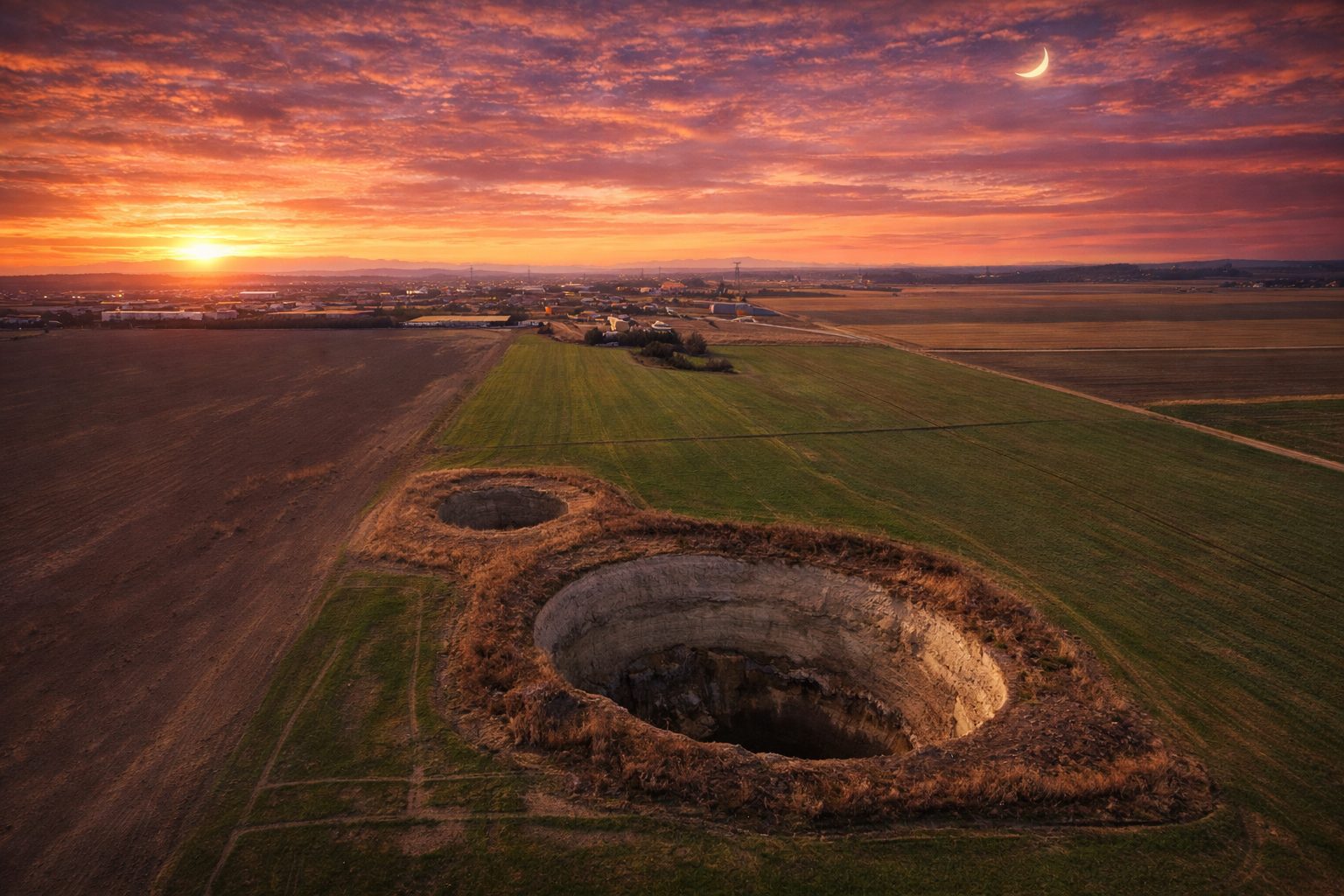

KONYA, Türkiye — December 23, 2025 — In the vast, wheat-and-corn country of central Türkiye, farmers are staring at a new kind of weather report: the ground itself. Across Konya province—often described as the country’s agricultural engine—hundreds of sinkholes have opened in fields that feed families and supply markets. The count in the wider Konya basin is now approaching 700, according to researchers tracking the phenomenon, and the acceleration is intensifying fears that the region’s water crisis is turning into a geological one.
The epicenter is Karapınar, where maize, wheat, and sugar beet fields are increasingly “pockmarked” by deep, sudden collapses—sometimes more than 10 in a single field. Beyond the farmlands, observers note another stark sign of drying conditions: in nearby mountainous areas, large, ancient sinkholes that once held water have mostly dried up. Reuters
A fast-moving threat with slow-building causes
Sinkholes are not new to karst landscapes, but what is changing in Konya is their frequency—and the human pressures behind them. Local experts tie the recent surge to a combination of climate-driven drought and intensive groundwater extraction for irrigation. One of the most alarming shifts is the speed at which groundwater levels are falling: researchers cited in today’s reporting say the decline has reached 4 to 5 metres per year, far faster than the roughly half-metre per year seen in the early 2000s.
That drop matters because groundwater isn’t just “water storage” beneath the soil—it can also help support underground structures. When aquifers are overdrawn, voids and weakened layers may become more vulnerable to collapse, particularly in regions with soluble rock and cavities.
By the numbers: what today’s reporting shows
- Total sinkholes: nearing 700 across the Konya basin Reuters
- Groundwater decline: now 4–5 metres per year, versus about 0.5 metre per year in the early 2000s Reuters
- Wells: roughly 120,000 unlicensed wells versus about 40,000 licensed wells, according to a local geology professor Reuters
Those well numbers hint at the bind farmers face: when rainfall is unreliable, irrigation becomes survival—but more wells can mean faster depletion, which can raise the risk of further collapses.
“You hear it first”: farmers describe the fear on the ground
For farmers, the sinkholes are not abstract climate indicators—they are immediate hazards. One Karapınar farmer, Mustafa Sık, has seen two sinkholes open on his land in the past two years. He recalled that the second collapse formed in August 2024 while his brother was working nearby, accompanied by what he described as an “extremely loud, terrifying rumbling sound.” Reuters
Geologists later surveyed his fields and identified two additional areas where sinkholes could form, though experts emphasize that predicting the precise time of collapse remains extremely difficult. As Sık put it: “Are we worried? Of course, we are very worried.” Reuters
What exactly is happening beneath Konya’s fields?
In Türkiye, sinkholes are often referred to as “obruk”—a term commonly used for collapse-type sinkholes in karst terrain. Scientific literature on the Konya Closed Basin and surrounding plains has long emphasized a crucial point: sinkholes can be hard to predict and can form abruptly, even after years of gradual subsurface change. ScienceDirect+1
Earlier research focusing on the Karapınar area described a landscape containing older “paleo-sinkholes” formed naturally over long periods, alongside newer, human-influenced sinkholes tied to the expansion of deep wells and pumping beyond sustainable aquifer yields. ScienceDirect
More recent peer-reviewed work continues to connect intensive groundwater use to land deformation across parts of the basin, including subsidence and the emergence of sinkholes in areas where they were previously less common. One study notes satellite-based measurements showing average subsidence on the order of millimetres per year, with cumulative ground lowering over time in specific locations—signals consistent with stressed aquifer systems.
Is Karapınar the only hotspot? Risk maps show a wider pattern
While Karapınar is the most visible flashpoint, the sinkhole issue spans the broader Konya Closed Basin. Earlier this month, reporting citing Turkish disaster-management mapping described 684 sinkholes across Konya, Karaman, and Aksaray, with a heavy concentration in Karapınar district. That assessment also categorized sinkholes by formation type, including “cover collapse” (sudden, deeper collapses) and “cover subsidence” (more gradual sinking). Türkiye Today
Officials referenced in that coverage said the recorded sinkholes were primarily in rural/agricultural areas and did not identify one directly threatening a settlement at the time—though the broader warning remains: the region is deforming, and hazards can shift with water use and climate conditions.
The other Dec. 23 development: a new project aims to reduce risk and build an early-warning system
Alongside the international attention on today’s sinkhole reporting, local authorities in Konya announced new funding and planning aimed at adaptation.
On December 23, 2025, Turkish media reported that Karatay Municipality is leading a 28 million TL project—supported through an EU-related climate grant framework and involving partners including Konya Technical University and the Bahri Dağdaş International Agricultural Research Institute—to address drought, falling groundwater levels, and the sinkhole risk in the Konya basin.
According to those reports, the program includes:
- Pilot demonstration areas to promote more efficient irrigation and climate-adapted farming models Habertürk+1
- Trials of lower water-footprint crops suited to semi-arid conditions Habertürk+1
- A plan described as Türkiye’s first operational “obruk” early warning system, integrating groundwater, rainfall, soil moisture and sinkhole-related hazard information into a web-based monitoring platform intended to support farmers and local planners Habertürk+1
If implemented effectively, such monitoring could help move the region from reacting to collapses after the fact to managing risk proactively—especially when paired with water policy and enforcement.
Why this matters beyond Konya
Konya’s farming belt is not a marginal region. When drought and groundwater depletion collide with physical land collapse, the impact can extend across:
- Food supply and prices (through crop losses and rising irrigation costs)
- Rural safety and property (as collapses threaten people, equipment, and infrastructure)
- Long-term water security (as deeper pumping often becomes more expensive, energy-intensive, and environmentally damaging)
And the sinkholes themselves are a warning flare: even if a collapse happens in a single field, its underlying causes—water balance, climate variability, and regulation—operate at basin scale.
What to watch next in 2026
The key question for Türkiye’s “breadbasket” is whether the region can slow the feedback loop that turns drought into groundwater depletion—and groundwater depletion into land instability.
Expect the next phase of this story to focus on:
- Enforcement and incentives around unlicensed wells and water withdrawals Reuters
- Crop and irrigation shifts toward lower water demand Habertürk+1
- Monitoring and mapping, including whether early-warning tools can be made operational and trusted by farmers Habertürk+1
For the farmers of Karapınar, the fear is immediate and personal. For the wider country, Konya’s sinkholes are becoming something larger: a visible, widening crack in the assumption that groundwater can be pumped indefinitely—without consequences above ground.
Related articles: Stock Market