
U.S. stocks climb as Dow gains, outweighing AI chip sector losses

U.S. stocks climb as Dow gains, outweighing AI chip sector losses

NEW YORK, July 27, 2026, 16:05 EDT — Wall Street advanced Monday, with the Dow posting a rise that helped balance declines in the AI chip segment as investors rotated across sectors.

  • Preliminary closing levels: Dow up 0.51%, S&P 500 gains 0.02%, Nasdaq slips 0.18%.
  • The equal-weight S&P advanced 0.72%, while the Russell 2000 increased 0.65%.
  • The Fed announces its decision on Wednesday, with GDP and PCE inflation figures due Thursday.

U.S. equities closed with mixed results on Monday, as main indexes masked widespread gains. The closing bell had just rung. According to initial figures, the Dow Jones Industrial Average (INDEXDJX:.DJI) rose 0.51% to 52,209.69. The S&P 500 (INDEXSP:.INX) edged up 0.02%. The Nasdaq Composite (INDEXNASDAQ:.IXIC) slipped 0.18%.
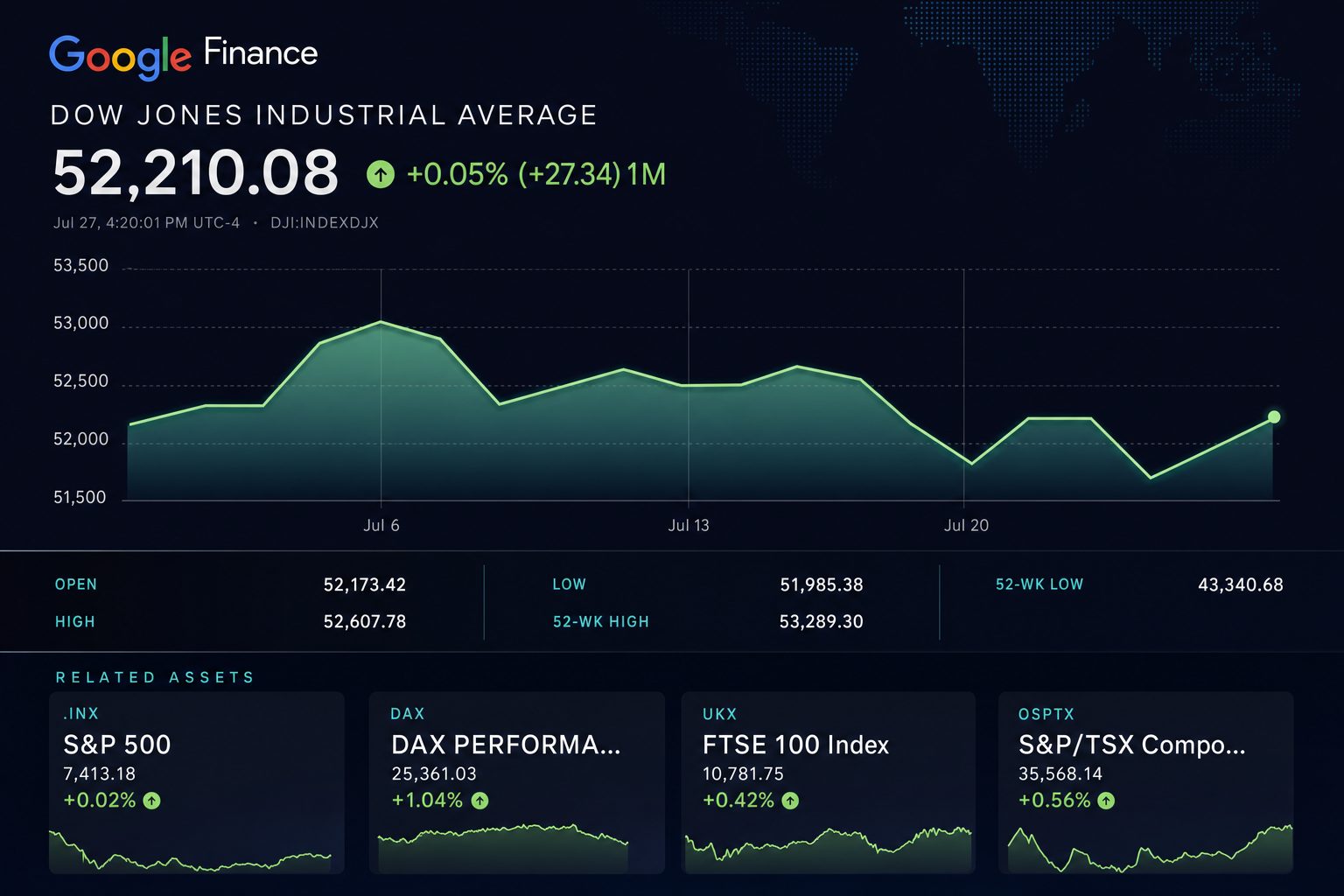
Gains were more pronounced among stocks below the megacap group. The equal-weight S&P advanced by 0.72%. The Russell 2000 (INDEXRUSSELL:RUT) increased 0.65%.

U.S. stocks climb as Dow gains, outweighing AI chip sector losses

After two sessions, the divergence became clearer. The equal-weight index advanced 1.50% from Thursday’s close, while the cap-weighted S&P posted just a 0.07% increase. That left a differential of 1.43 percentage points.

The gap is significant for positioning. Equal-weight includes identical firms, each around 0.2% at each rebalance. This removes much of the influence from megacaps. As a result, Monday’s moves appeared as rotation rather than widespread risk-off behavior.

“Today represents a continuation of the rotational market that we’ve seen,” said Bill Merz. He heads capital-markets research at U.S. Bank Asset Management Group. During the session, advancing stocks led decliners by a ratio of 1.6-to-one. Reuters

The final spread was notably large, according to early index readings.

BenchmarkPreliminary levelDay changeVersus S&P 500
S&P 5007,413.26up 0.02%
Dow Jones Industrial Average52,209.69rises 0.51%up 0.49 point
Nasdaq Composite24,932.08drops 0.18%down 0.20 point
Russell 20002,949.13gains 0.65%up 0.63 point
S&P 500 Equal Weight8,714.17adds 0.72%up 0.70 point

Chip stocks weighed on the market. Nvidia slipped 4.9% in late deals, while Advanced Micro Devices dropped 7.3%.

The PHLX Semiconductor Index ended the session down 2.23% at 11,554.88. The index has dropped 21.2% from its peak on June 22, marking it as the sector under the most pressure in the market.

China added to the mounting pressure. CXMT Corp opened strongly in its Shanghai debut. Meanwhile, another report indicated that China started producing local deep-ultraviolet chip tools. Both moves pointed to stiffer competition for U.S. suppliers.

Other groups went in the opposite direction. Consumer staples increased by 1.7%, and health care climbed nearly 1%. Brent crude dropped about 8% over the session. The decline in oil prices reduced one inflation concern but did not halt declines among chip stocks.

The move came after major indexes posted declines over the past week. The S&P slipped 0.6%, the Dow lost 0.4%, the Nasdaq dropped 2.1%, and the Russell was down 1.1%. The Nasdaq’s decline was more than three times greater than the S&P’s.

The Federal Reserve will begin a two-day meeting on Tuesday, with an announcement scheduled for Wednesday at 2 p.m. EDT. Rate futures indicate a 62% probability rates will remain unchanged, and a 38% likelihood of a 0.25 point hike.

Preliminary GDP results for the second quarter and June’s personal income statistics will be published Thursday at 8:30 a.m. The June PCE inflation numbers will also be released alongside the income report.

Upcoming corporate earnings will reveal if the rotation maintains momentum. Microsoft , Amazon.com , Meta Platforms and Apple are set to release results this week. Data from London Stock Exchange Group show that S&P earnings growth is projected at 39%. A significant portion of this rise comes from AI-related stocks.

Equal-weight has become the clearer indicator of market breadth. Additional advances may help absorb another megacap pullback. A decline would once again highlight the concentration within the index.

Risks: An unexpected Fed rate increase, disappointing megacap forecasts or fresh conflict in the Middle East may halt the rotation. The S&P is valued at close to 20 times projected earnings, offering little buffer against further rate or energy shocks.

How did the main U.S. indexes close on Monday?

The S&P 500 slipped 0.30% to 7,389.76 on July 27. The Nasdaq Composite dropped 0.59% to end at 24,828.52. The Dow Jones Industrial Average rose 0.17%, closing at 52,036.47. Consumer staples advanced 1.7%, and health care gained about 1%. This signals sector rotation rather than a broad market downturn. Reuters

Is the Federal Reserve expected to increase interest rates on Wednesday?

The federal funds target is now set between 3.50% and 3.75%. Futures on Monday showed a 62% chance the rate will stay unchanged. There was a 38% market probability assigned to a 25-basis-point hike. The July 28–29 meeting ends Wednesday at 2 p.m. Eastern. A rate increase would bring the new target range to 3.75%–4.00%. The outcome remains highly market-sensitive. Federal Reserve

What economic data releases could have the biggest impact on stocks this week?

Thursday’s agenda features second-quarter GDP figures and June PCE inflation data. Economists anticipate annualized GDP expansion at 2.1%. Projections for headline PCE show a 0.1% monthly decline, while the yearly rate is seen rising 3.7%. Core PCE is forecast at a 0.2% monthly gain and 3.3% increase year-on-year. Friday brings the employment cost index, expected to post a 0.8% quarterly rise. An inflation reading above forecasts may reinforce market expectations for more rate hikes. MarketWatch

What makes megacap technology earnings particularly significant this week?

Roughly one in three S&P 500 firms are set to release earnings this week. Microsoft and Meta will announce results after Wednesday’s closing bell. Apple and Amazon are due to report after markets close on Thursday in New York. Analysts forecast that S&P 500 companies’ combined second-quarter earnings will climb 39% from a year ago. Much of this robust anticipated growth comes from companies tied to AI. Investors may focus more on spending plans and profit margins than on whether results top estimates. Reuters

Could the decline in semiconductor stocks pose a wider risk to the overall market?

The Philadelphia semiconductor index slid 3.5% on Monday. The index is currently trading 22% beneath its record closing level from June 22. Nvidia retreated 4.9% and Advanced Micro Devices shed 7.3%. However, the semiconductor gauge is still up 61% so far in 2026. This reflects a sharp pullback within an overall upward annual trajectory. Continued declines could add pressure on the Nasdaq and the S&P 500. Reuters

Do declines in oil prices and Treasury yields offer significant relief?

On Monday, U.S. crude dropped 7.51% to $82.56 per barrel. Brent slipped 8.14%, trading near $88.90 per barrel. The 10-year U.S. Treasury yield retreated to 4.647%, down from 4.679% seen Friday. These shifts have eased short-term pressure on equity valuations that are sensitive to inflation. Still, the current U.S.-Iran pause does not represent a lasting settlement. Renewed hostilities could swiftly push oil and bond prices in the opposite direction. Reuters

Does market breadth appear stronger than headline indexes indicate?

On Monday, advancing S&P 500 stocks led decliners by about 1.6-to-one. Despite this, the index declined, as heavyweight technology shares had more influence. The S&P 500 posted 28 new highs and three new lows. Market breadth was softer on the Nasdaq, with 88 stocks hitting highs and 150 at lows. This split points to targeted buying over widespread risk-taking. Reuters

Are current levels making U.S. stocks appear overvalued?

The S&P 500 is trading at about 20 times projected forward earnings, according to LSEG, which is roughly in line with its 10-year average. While the market isn’t seen as undervalued, it aligns with this recent trend. Analysts anticipate a 39% surge in second-quarter index earnings compared to a year ago, an estimate that largely relies on robust performances from AI-related stocks. If guidance disappoints, valuations could come under pressure. Reuters

Iwona Majkowska is a financial markets journalist at TS2.tech, specializing in stocks, artificial intelligence and technology. A graduate of the Warsaw School of Economics, she previously worked in equity research and financial analysis before focusing on market reporting. Her daily coverage helps investors follow major developments across U.S. and global markets. Follow Iwona Majkowska on Google News.

Stock Market Today

  • Profitable Stocks Face Risks: BFAM, WH, NESR Under Scrutiny
    July 27, 2026, 5:02 PM EDT. Bright Horizons (BFAM), Wyndham (WH) and NESR (NESR) are profitable, but present issues including decelerating growth, cost increases and inefficient capital use. BFAM posts 16.3% top-line growth, which trails the sector average; WH posts weaker returns on capital with flat revenue per room figures; NESR confronts elevated spending and narrowing EBITDA margins. With valuations at roughly 14.5-15x forward P/E, these firms call for careful evaluation.
Gossamer Bio shares surge after FDA filing update; cash concerns and dilution still loom
Previous Story

Gossamer Bio shares surge after FDA filing update; cash concerns and dilution still loom

Dow Jones Rises 262 Points; Broad Blue-Chip Strength Counters Semiconductor Weakness
Next Story

Dow Jones Rises 262 Points; Broad Blue-Chip Strength Counters Semiconductor Weakness