
New York, August 6, 2026, 08:08 EDT
- Gross bookings for the second quarter exceeded the LSEG LON:LSEG consensus estimate by 1.7%.
- Mobility operating profit increased by 28%, even though reported revenue was up by just 1%.
- The midpoint for adjusted EPS in the third quarter reached 86 cents, coming in three cents under the LSEG consensus estimate.
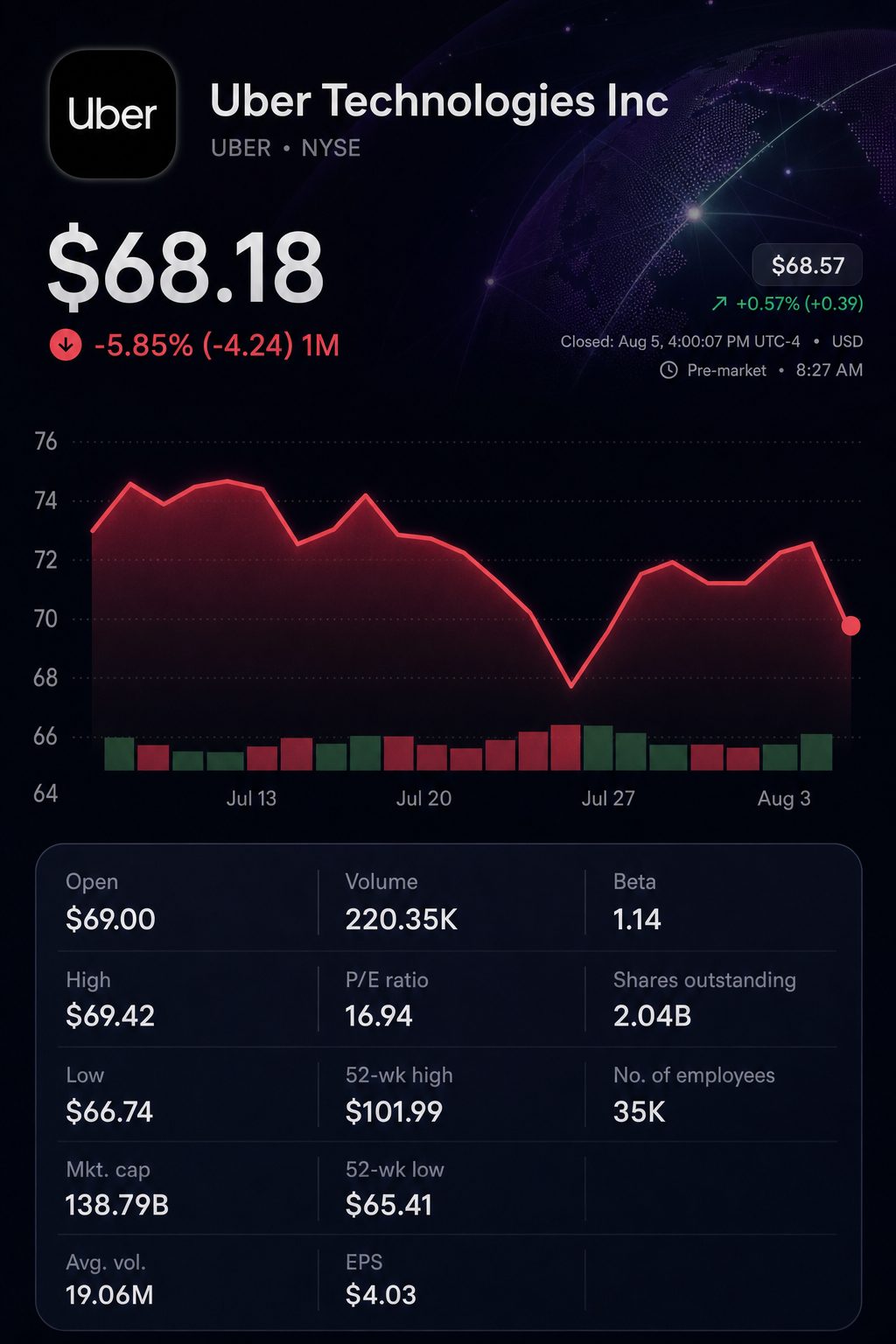
Uber Technologies NYSE:UBER stock ended Wednesday’s session down 5.3% at $68.18. Investor concerns over a cautious profit forecast and over $10 billion in robotaxi investments offset robust bookings. U.S. cash markets had yet to open Thursday, with premarket activity underway.
The main concern for investors involves how cash is deployed, rather than underlying demand. Uber faces the challenge of financing autonomous vehicle launches, along with a $14.8 billion acquisition involving Delivery Hero ETR:DHER. Profit growth must also continue to exceed booking increases.
Headline revenue fails to fully capture the performance of the ride segment. A $1.1 billion UK accounting adjustment reduced reported growth by roughly eight percentage points, shifting driver payments to contra-revenue but leaving business fundamentals intact. Mobility bookings increased 22%, and operating income for the segment improved by 28%.
Second-quarter results summary
| Metric | Reported | Analyst consensus | Variance |
|---|---|---|---|
| Gross bookings | $58.022 billion | $57.060 billion, LSEG | +1.7% |
| Revenue | $14.191 billion | $14.240 billion, LSEG | -0.3% |
| Adjusted EPS | $0.81 | $0.80, FactSet | +1.3% |
Sources: Data from Uber, LSEG consensus as published by Reuters, and FactSet NYSE:FDS consensus from MarketWatch. Variances calculated with unrounded data.
Bookings exceeded expectations by $962 million, while revenue fell short by $49 million. Third-quarter earnings guidance gave a more decisive signal.
Uber reported 3.87 billion trips, an increase of 18%, while monthly active consumers climbed 16% to 208 million. CEO Dara Khosrowshahi stated, “Uber’s platform advantage continues to compound.” The number of first-time users added was the highest in five years. Uber Investor Relations
Origin of profit leverage
| Segment | Bookings growth | Revenue growth | Operating-income growth | Operating income/bookings | Year-on-year change |
|---|---|---|---|---|---|
| Mobility | 22% | 1% | 28% | 7.64% | up 36 basis points |
| Delivery | 26% | 28% | 38% | 3.84% | up 32 basis points |
Uber’s reported segment numbers are used to determine operating-income margins.
Mobility revenue as a percentage of bookings declined by 527 basis points, calculations show. The operating-income margin increased by 36 basis points. This divergence signals accounting factors rather than a decline in ride margins.
Delivery continued as the primary driver of profits. Bookings increased by 26%, while segment operating income climbed 38%. The operating-income margin grew by 32 basis points.
The forward bar narrowed. Management’s bookings midpoint was in line with consensus, but adjusted EPS missed expectations.
Market benchmark for third-quarter outlook
| Metric | Uber guidance | Midpoint | LSEG consensus | Midpoint gap |
|---|---|---|---|---|
| Gross bookings | $58.25-$60.25 billion | $59.25 billion | $59.21 billion | +$40 million |
| Adjusted EPS | $0.84-$0.88 | $0.86 | $0.89 | -$0.03 |
| Adjusted EBITDA | $2.86-$2.96 billion | $2.91 billion | Not disclosed | up 3.2% from Q2 |
The EBITDA comparison is sequential rather than versus consensus.
Consensus estimates varied. A frequently referenced EPS figure stood at 87 cents, just a cent above the actual. LSEG’s projection was 89 cents, magnifying the apparent shortfall.
Management anticipates that currency effects will reduce reported bookings growth by one percentage point. The midpoint continues to suggest sequential bookings growth of 2.1% and EPS growth of 6.2%.
Uber intends to invest over $10 billion into robotaxis across multiple years. The expenditures cover equity interests, support for fleets, and vehicle purchases. CEO Khosrowshahi anticipates ongoing collaboration with Waymo, a subsidiary of Alphabet NASDAQ:GOOGL, in Austin and Atlanta.
Adam Ballantyne, a shareholder at Cambiar Investors, described the amount as “in line with my own thinking.” He anticipates funding in the billions of dollars across four to five years. Reuters
Magnitude of capital commitments
| Capital item | Amount | Relative to $10.1 billion trailing FCF |
|---|---|---|
| Delivery Hero total equity valuation | $14.8 billion | 1.47 times |
| Robotaxi investment plan | More than $10 billion | More than 0.99 times |
| Available cash plus short-term investments | $5.4 billion | 0.53 times |
| Free cash flow for Q2 | $2.79 billion | 0.28 times |
The total purchase, following previous investments, amounts to $13.7 billion. The transaction and the AV initiative cover separate timeframes and must not be combined.
Nevertheless, each initiative matches Uber’s annual free cash flow. The company intends to finance the purchase through a mix of available cash and additional borrowing. Uber is aiming for gross leverage to remain under two times, with the deal expected to be finalized in the second half of 2027.
Initial notes showed four analysts maintained buy-equivalent ratings while one remained neutral. However, four out of five lowered their price targets, with Mizuho as the only firm to lift its target.
Initial analyst ratings, August 6
| Broker | Rating | New target | Previous target | Upside versus $68.18 |
|---|---|---|---|---|
| Mizuho Financial Group NYSE:MFG | Outperform | $112 | $110 | 64.3% |
| Wells Fargo NYSE:WFC | Overweight | $89 | $100 | 30.5% |
| Barclays NYSE:BCS | Overweight | $106 | $107 | 55.5% |
| BNP Paribas EPA:BNP | Outperform | $106 | $108 | 55.5% |
| Daiwa Securities Group (TYO:8601) | Neutral | $72 | $80 | 5.6% |
| Consensus, 50 analysts | Buy | $102.20 | — | 49.9% |
The moves occurred early Thursday. Upside calculations are based on Wednesday’s closing value.
Wells Fargo maintained a target of $89, representing a 31% premium to Wednesday’s closing price. Daiwa’s neutral $72 target implied just a 5.6% upside. The discrepancy highlights lasting optimism for the long term, but little consensus on the short term.
Risks: A softened supply of drivers in Brazil and currency movements could dampen reported growth, while funding for autonomous vehicles might postpone earnings per share improvements. The Delivery Hero agreement increases leverage as well as regulatory and integration risk. Any shifts in the relationship with Waymo would heighten uncertainty for the platform.
Demand remains strong. The upcoming challenge is to turn more than 20% growth in bookings into higher EPS, while also financing two significant initiatives.