
NEW YORK, August 7, 2026, 18:08 EDT — U.S. regular session ended; after-hours trading underway.
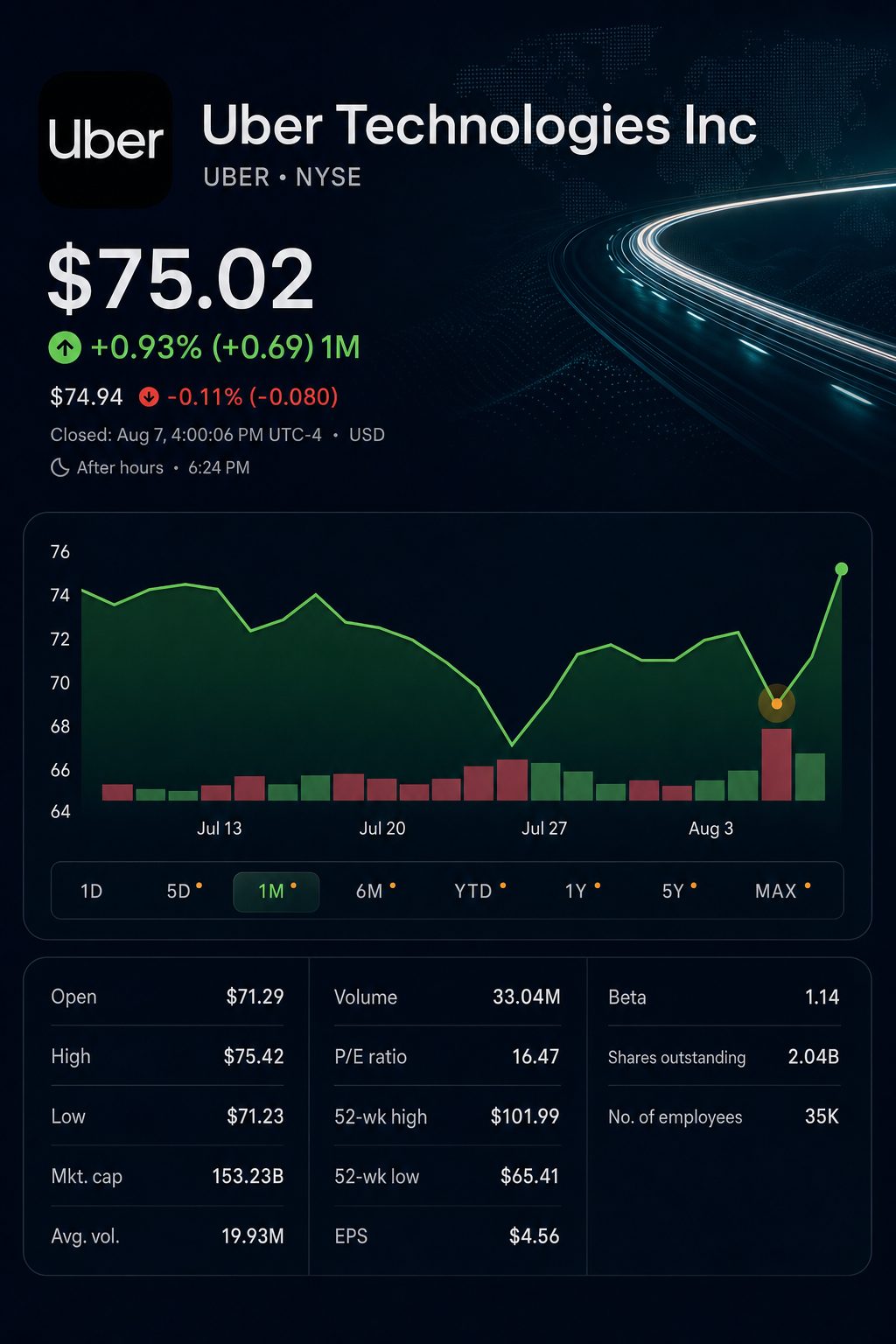
- Uber shares finished at $75.02, rising 6.4%, boosting their gain for the week to 6.6%.
- Trailing free cash flow topped $10 billion, closely aligning with the total value of Uber’s multi-year commitment to autonomous vehicles.
- Among seven firms surveyed after results, the mean target dropped 8.1% to $97.43, still 29.9% higher than Friday’s closing price.
Uber Technologies, Inc. NYSE:UBER ended Friday at $75.02, marking a 6.4% rise. Shares closed 6.6% higher than July 31, although they fell 5.3% on Wednesday. The stock bounced back with a 10.0% gain over Thursday and Friday.
Analysts lowered their long-term valuations, prompting the change. Of the seven firms listed below, six reduced their price targets. All maintained positive ratings, with no switches to neutral or negative.
The division brings the main investor focus into sharper relief. Is existing cash sufficient to maintain financial independence while still allowing room for buyback activity? Chief Financial Officer Balaji Krishnamurthy stated that trailing free cash flow had “exceeded $10 billion for the first time.” At a market capitalization of $153.8 billion as of Friday, this calculates to a trailing free-cash-flow yield of at least 6.5%. Uber Investor Relations
| Brokerage | Rating retained | Old target | New target | Change |
|---|---|---|---|---|
| Mizuho | Outperform | $110 | $112 | +1.8% |
| Wells Fargo | Overweight | $100 | $89 | -11.0% |
| Susquehanna | Positive | $110 | $90 | -18.2% |
| Barclays | Overweight | $107 | $106 | -0.9% |
| D.A. Davidson | Buy | $107 | $100 | -6.5% |
| Bernstein | Outperform | $110 | $95 | -13.6% |
| Cantor Fitzgerald | Overweight | $98 | $90 | -8.2% |
| Average for seven firms | Positive recommendations | $106.00 | $97.43 | -8.1% |
The sample includes target actions disclosed after the August 5 results. Average changes are calculated using precise, unrounded numbers.
Friday trading provided positive momentum, though the movement was not limited to Uber. Lyft NASDAQ:LYFT climbed 7.2% following its earnings release. DoorDash NASDAQ:DASH was up 1.4%. The wider U.S. market also moved higher as softer payroll numbers helped to lessen worries over interest rates.
| Relevant platform stock | Friday close | Daily move | Market value |
|---|---|---|---|
| Uber | $75.02 | up 6.4% | $153.8 billion |
| Lyft | $17.46 | up 7.2% | $7.0 billion |
| DoorDash | $216.26 | rising 1.4% | $95.0 billion |
Friday’s prices and market valuations are sourced from the most recent U.S. market feed.
The quarter demonstrated robust operating leverage, with gross bookings increasing by 24% and non-GAAP operating income up 40%. Diluted shares decreased 3.5%, allowing adjusted EPS to grow faster than net income.
| Q2 operating measure | 2025 | 2026 | Change |
|---|---|---|---|
| Gross bookings | $46.76 billion | $58.02 billion | up 24% |
| Revenue | $12.65 billion | $14.19 billion | up 12% |
| Non-GAAP operating income | $1.53 billion | $2.14 billion | up 40% |
| Free cash flow | $2.48 billion | $2.79 billion | up 13% |
| Diluted weighted shares | 2.126 billion | 2.050 billion | down 3.5% |
Uber released its financial results. The decrease in shares is based on its diluted weighted average calculations.
Revenue climbed at a slower pace than bookings, as adjustments to the business model cut the reported growth rate by eight percentage points. The non-GAAP operating margin increased to 3.7% of bookings, up from 3.3%.
Delivery posted the quickest profit growth, with segment operating income up 38% to $1.06 billion. Mobility advanced 28% to $2.22 billion, holding its position as the primary profit driver.
The outlook was murkier. The midpoint for third-quarter bookings was roughly in line with the LSEG consensus. The midpoint for adjusted EPS fell 3.4% short of consensus. Additionally, currency headwinds are projected to reduce reported bookings growth by about one percentage point.
| Q3 measure | Uber guidance | Midpoint | LSEG consensus | Midpoint gap |
|---|---|---|---|---|
| Gross bookings | $58.25–$60.25 billion | $59.25 billion | $59.21 billion | +0.1% |
| Non-GAAP EPS | $0.84–$0.88 | $0.86 | $0.89 | -3.4% |
LSEG gathered the consensus data. Differences are determined using midpoints.
The autonomous-vehicle pledge is not a one-time cash outlay. According to Krishnamurthy, it is spread across several years. Uber plans to utilize equity investments, fleet backing and vehicle pledges. For every dollar Uber puts in, partners have contributed an additional $2.50.
Adam Ballantyne, senior analyst at shareholder Cambiar Investors, said the $10 billion estimate matched his expectations. Spreading the amount over his four-to-five-year outlook amounts to $2.0 billion to $2.5 billion each year, equal to around 20% to 25% of current trailing free cash flow. This figure is for illustrative purposes and does not constitute company guidance.
The scale is still limited. Uber reported that autonomous vehicles account for under 0.5% of its approximately 300 million trips each week. Its AV operations are active in seven cities, with ambitions to reach 15 cities by the end of the year. CEO Dara Khosrowshahi noted that Waymo, a subsidiary of Alphabet NASDAQ:GOOGL, continues to be a key partner as Uber broadens its collaboration with additional companies.
The key question for the market next week is if Uber remains above Tuesday’s pre-earnings close of $71.99. Investors are also looking for additional updates to estimates and more information on AV profit effects. Management has not provided a specific figure for that impact.
Risks: Third-quarter EPS outlook falls short of consensus. Competition is driving up two-wheeler supply expenses in Brazil. Autonomous investment could use up cash before deployments generate significant revenue.






![Australia Stock Market Today 28/08/2026 [UPDATE: 11:35 AEST] [Xero Surges 8% as PEXA Crashes on FY27 Outlook]](https://ts2.tech/wp-content/uploads/2026/08/AU-market-dashboard-2026-08-28-1133-480x384.jpg "Australia Stock Market Today 28/08/2026 [UPDATE: 11:35 AEST] [Xero Surges 8% as PEXA Crashes on FY27 Outlook]")