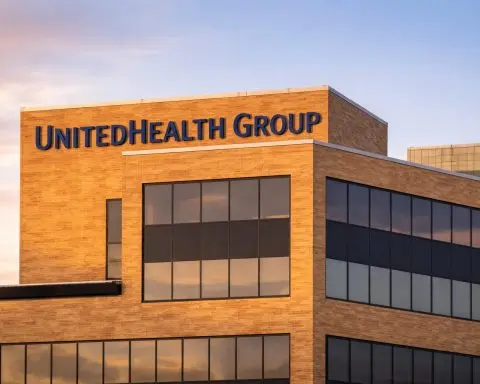
UnitedHealth Group Incorporated (NYSE: UNH) is back under intense scrutiny from Wall Street and regulators after one of the most turbulent stretches in its history. As of Thursday, December 4, 2025, UNH stock is trading around $333–340 per share, giving the company a market capitalization just over $300 billion and leaving the shares more than 45% below their 12‑month high near $623.
The past year has brought a catastrophic cyberattack, a criminal and civil investigation by the U.S. Department of Justice (DOJ), a leadership shake‑up that saw longtime executive Stephen Hemsley return as CEO, and the shocking killing of a top UnitedHealthcare executive — with a new court hearing landing exactly one year later, on December 4, 2025.
At the same time, the underlying business continues to grow. UnitedHealth just delivered a Q3 2025 “beat and raise” quarter, increased its 2025 earnings outlook, and announced a fresh dividend. Analysts broadly see double‑digit upside over the next 12 months — but algorithmic and technical models are still flashing caution.
Here’s how UNH stock looks right now, and what changed on December 4, 2025.
UNH Stock Price Today: Rebound From the Lows, Still Deep in a Drawdown
Intraday on December 4, UNH is trading around the mid‑$330s, after opening at roughly $340.13 according to MarketBeat.
Key snapshot metrics from MarketBeat’s price‑performance data:
- 52‑week high: $622.83
- 52‑week low: $234.60
- Market cap: ~$308 billion
- P/E (trailing): ~17.8
- Beta: ~0.43 (much less volatile than the market)
A Star Tribune review of UnitedHealth’s roller‑coaster year notes that since the Dec. 4, 2024 ambush killing of UnitedHealthcare CEO Brian Thompson, the stock has fallen from around $610 to near $308 at its worst point — “an unprecedented decline” that culminated in the CEO change back to Hemsley and the suspension of prior 2025 guidance. Star Tribune
Even with the recent rebound, UnitedHealth shares remain:
- Roughly 45–50% below their 2024/early‑2025 peaks.
- Down about 25–30% year‑to‑date, versus strong double‑digit gains for the S&P 500.
That disconnect — a still‑profitable, still‑dominant health‑care giant trading at a big discount to its old premium — is exactly what’s driving the split between bullish analysts and nervous technical models.
What’s New on December 4, 2025?
Several fresh developments landed on or just before December 4, and they frame today’s debate around UNH stock.
1. A High‑Profile Bullish Call: “Time to Buy This Healthcare Fortress”
On the morning of December 4, Seeking Alpha published a detailed analysis arguing that UnitedHealth is now a Buy, with “the worst seemingly behind” and a clear path to margin recovery and earnings growth from 2026 onward. Seeking Alpha
The author’s key points:
- 2025 headwinds — elevated medical cost ratio, Medicare Advantage pressure, regulatory scrutiny — are being addressed via repricing, plan exits, and portfolio optimization.
- They estimate an intrinsic value near $843 per share, implying more than 150% upside from current levels (one of the most aggressive published valuations).
- They expect buybacks to resume in late 2026, with capital release from subsidiaries supporting a multi‑year earnings up‑cycle.
It’s a strongly bullish, fundamentals‑driven view — and it lands just as many investors are trying to decide whether the 2025 drawdown marks capitulation or the middle of a longer reset.
2. “Strong Sell” From a Quant Model and Bearish Technical Signals
In sharp contrast, the AI‑driven platform Intellectia classifies UNH as a “Strong Sell” as of December 4. Intellectia
Their technical summary:
- Short‑term forecast: modest gains over the next day to week, but weakness over the next few weeks.
- 7 key technical indicators: 5 bearish vs. 2 bullish, including negative readings on MACD, CCI, and momentum oscillators.
- Moving averages:
- Short‑term (5‑day) above 20‑day — supportive.
- But 20‑day below 60‑day and 60‑day below 200‑day, signaling a still‑intact medium‑ and long‑term downtrend.
The model’s 2030 price projection around $384 suggests only mid‑teens upside over five years — far more conservative than Wall Street’s typical 12‑month targets.
3. Fresh Hedge Fund Buying: Quantbot and Others Add UNH
MarketBeat’s December 4 filing write‑up shows that Quantbot Technologies LP, a quantitative hedge fund, boosted its UNH holdings by 261% in Q2, ending with 16,377 shares worth about $5.1 million at the time of the filing.
Other recent 13F‑based stories show wealth managers such as Pursue Wealth Partners LLC and CW Advisors LLC also ramping up positions, and MarketBeat estimates that roughly 88% of UNH shares are held by institutions and hedge funds.
That institutional buying on weakness supports the “value opportunity” narrative — but institutions can be early (or wrong) just like everyone else.
4. A Somber Anniversary: Murder Case Back in Court
December 4, 2025 is also the one‑year anniversary of UnitedHealthcare CEO Brian Thompson’s killing outside his Minnesota home. AP reports that accused shooter Luigi Mangione appeared in court on Thursday as lawyers argued over evidence — including a backpack containing a handgun and notebooks criticizing insurers — that prosecutors want to show at trial.
The case is personal and criminal rather than corporate, but it has amplified public anger toward health insurers and kept UnitedHealth’s name in some of the grimmest headlines of the year.
Fundamentals: Q3 2025 Results and 2025–2026 Outlook
Despite the chaos, UnitedHealth’s business remains enormous — and still growing.
Q3 2025: Revenue Up, Profit Down, Guidance Raised
In its October 28, 2025 earnings release, UnitedHealth reported:
- Revenue: $113.2 billion (up 12% year‑over‑year).
- GAAP EPS: $2.59.
- Adjusted EPS: $2.92 (above Wall Street estimates around $2.80–2.79).
- Profit: about $2.35 billion, down ~61% from the prior year’s quarter due largely to higher medical and cyber‑related costs.
- Medical care ratio (MCR): 89.9% — the highest in at least five years, but better than the ~90.7% some analysts feared.
Segment highlights:
- UnitedHealthcare revenue grew 16% to $87.1 billion, serving 50.1 million U.S. consumers (up ~795,000 year‑over‑year).
- Optum revenue rose 8% to $69.2 billion, driven mainly by Optum Rx pharmacy services.
Crucially, management raised 2025 guidance, now targeting:
- At least $14.90 in GAAP EPS
- At least $16.25 in adjusted EPS
This is a modest bump from the prior $16.00 adjusted EPS guide and above consensus expectations of about $16.20, signaling that Hemsley believes the worst of the cost shock may have peaked.
At today’s price near $334, that implies a forward P/E of roughly 20–21x 2025 adjusted earnings, versus the mid‑ to high‑20s multiples UNH often commanded in calmer years.
Medicare Advantage and ACA Reset
To deal with higher medical costs, lower reimbursement rates, and regulatory pressure, UnitedHealth is shrinking its Medicare Advantage footprint and repricing plans:
- UnitedHealth plans to exit Medicare Advantage plans in 109 U.S. counties in 2026, affecting about 180,000 members, largely in rural markets.
- Across all plan changes, analysts estimate roughly 1 million MA beneficiaries will lose UnitedHealthcare coverage in 2026 as the company culls unprofitable products.
- MarketWatch reports that UnitedHealth is also raising Affordable Care Act (ACA) premiums by about 26% in some markets as part of a wider effort to “restore its swagger.” MarketWatch+1
AP notes that Hemsley and his team are promising steady growth in 2026 and faster expansion by 2027, with a full 2026 outlook expected in January.
Put differently: UnitedHealth is trading market share for margin, hoping tighter underwriting and higher prices will rebuild profitability even if membership shrinks.
Dividend, Board Refresh, and Capital Allocation
Quarterly Dividend: 2.6–2.7% Yield
On November 7, 2025, UnitedHealth’s board authorized a $2.21 per‑share quarterly dividend, payable December 16 to shareholders of record on December 8.
At current prices, that implies:
- Annualized dividend: $8.84
- Dividend yield: roughly 2.6–2.7%
- A continuation of UnitedHealth’s multi‑year dividend growth track record.
For long‑term income investors, that yield is higher than it’s been for most of the last decade, thanks mainly to the share price decline rather than unusually rapid dividend increases.
Scott Gottlieb Joins the Board
On November 18, 2025, UnitedHealth added former FDA commissioner Dr. Scott Gottlieb to its board of directors.
Gottlieb:
- Led the FDA from 2017–2019, focusing on drug competition, transparency, and safety.
- Has served at CMS and on federal health IT advisory bodies.
- Currently works as a physician, a senior fellow at the American Enterprise Institute, and a partner at New Enterprise Associates.
CEO Stephen Hemsley praised him as an “innovator” with a deep understanding of integrated healthcare and technology, signaling that UnitedHealth wants visible regulatory and policy credibility on its board at the same time it faces DOJ scrutiny and public anger. Reuters+3UnitedHealth Group+3credyapp.com+…
Regulatory, Legal, and Cyber Overhangs
Here is where the bull and bear cases really diverge.
DOJ Antitrust and Medicare Fraud Investigations
UnitedHealth is facing multiple DOJ investigations:
- In 2024, Reuters reported that the DOJ opened an antitrust probe into UnitedHealth’s vertical integration, particularly the relationship between its insurance arm and Optum’s physician and services businesses.
- In February 2025, the Wall Street Journal revealed that the DOJ was scrutinizing Medicare Advantage billing practices; the report said the probe targeted potential overbilling for risk‑adjusted payments.
- In May 2025, WSJ sources said a criminal investigation into possible Medicare fraud was underway; Reuters noted UnitedHealth shares fell about 8% after the news.
- By July 2025, UnitedHealth formally acknowledged in an SEC filing that it was cooperating with both civil and criminal DOJ requests, a shift from earlier statements that it was unaware of any new probes.
In August, the DOJ also published a proposed final judgment in an antitrust case involving UnitedHealth, underscoring that the company’s expansion through acquisitions remains under intense federal scrutiny.
These investigations may take years to resolve and could result in fines, mandated changes to business practices, or limits on further acquisitions — all difficult to model precisely, which is part of why investors assign UNH a lower multiple today.
Change Healthcare Cyberattack: 190 Million People Affected
The February 2024 ransomware attack on UnitedHealth’s Change Healthcare subsidiary remains one of the most damaging cyber incidents in U.S. healthcare history.
According to the HIPAA Journal’s detailed timeline and UnitedHealth’s own updates:
- On January 25, 2025, UnitedHealth updated its estimate of impacted individuals to about 190 million, nearly double the previous 100 million figure.
- Attackers gained access through a Citrix server without multi‑factor authentication, using compromised credentials; OCR (the HHS Office for Civil Rights) is investigating potential HIPAA Security Rule violations.
- Change Healthcare’s systems were offline for weeks, prompting UnitedHealth to extend roughly $8.5 billion in loans under a temporary funding program to keep providers afloat, with billions still being recovered.
- Dozens of class‑action lawsuits and at least one state attorney general lawsuit (Nebraska) have been filed against Change Healthcare, Optum, and UnitedHealth Group for alleged security failures and delayed notification.
While UnitedHealth says it has not yet seen evidence of large‑scale misuse of the stolen data, the sheer magnitude of the breach and the regulatory process around it remain material overhangs.
Securities and Shareholder Litigation
Securities‑litigation firms such as Hagens Berman have launched class actions on behalf of shareholders, arguing that UnitedHealth misled investors about its risk controls, the Change cyberattack, and regulatory exposure before the stock’s massive 2025 sell‑off.
These cases typically take years to resolve and may lead to settlements, but they also contribute to management distraction and headline risk.
Wall Street’s View: Consensus Targets Signal Upside
Despite all that, sell‑side analysts remain broadly positive on the stock.
Across major aggregators, as of early December 2025:
- MarketBeat:
- Average 12‑month target: $397.12
- Target range: $198 – $675
- Implied upside: about 18–19% from recent prices near $334.
- Consensus rating: “Moderate Buy” (18 Buy, 9 Hold, 3 Sell). MarketBeat+2MarketBeat+2
- TipRanks:
- Average target: $393.95
- Range: $260 – $440
- Implied upside: roughly 16% from the last price around $340.
- Analyst breakdown: 17 Buy, 3 Hold, 1 Sell.
- StockAnalysis.com / other forecasters:
- Average target around $408 (22% implied upside), with a broad consensus rating of “Buy.” StockAnalysis+1
- Yahoo Finance:
- 1‑year median target estimate of about $388.52, suggesting mid‑teens upside.
In the last several weeks:
- Wolfe Research raised its UNH price target from $330 to $375 and kept a Buy rating; the stock jumped about 5% on the news as investors cheered the implied vote of confidence in margin recovery and Optum growth.
- Truist boosted its target from $310 to $365 and reiterated a Buy in September, citing improving 2026–2027 earnings visibility.
- KeyCorp, Bernstein, TD Cowen and others have nudged price targets higher, generally clustering between $350 and $440, while a handful of brokers — including Deutsche Bank and Oppenheimer — have trimmed ratings or targets amid concern about regulatory risk and margins.
Overall, traditional Wall Street research expects low‑double‑digit earnings growth resuming by 2026 and sees current levels as an opportunity rather than a value trap — but those targets also depend on no severe DOJ outcome and continued progress on costs.
Bull vs. Bear: What the Market Is Arguing About
Bringing it all together, here’s how the UNH debate looks as of December 4, 2025.
Bullish Arguments
- Still‑massive scale and growth: Revenues are growing double‑digits even in a tough environment, with Q3 2025 sales up 12% and UnitedHealthcare membership expanding.
- Guidance raised, not cut: After the spring’s guidance withdrawal, UnitedHealth has re‑established and then raised 2025 EPS guidance, signaling management confidence in a 2026 recovery.
- Valuation re‑rating opportunity: Shares trade far below historical premium multiples; Seeking Alpha’s December 4 analysis argues that UNH is at a “multi‑year low multiple” with potential upside of more than 100% if margins normalize. Seeking Alpha+1
- Dividend and institutional support: A 2.6–2.7% dividend yield, a long dividend‑growth record, and high institutional ownership suggest many long‑term investors remain committed.
- Strategic pruning: Exiting unprofitable Medicare Advantage and ACA products should improve margins, even if enrollment drops by about 1 million MA members.
Bearish Arguments
- Regulatory and legal minefield: Ongoing DOJ civil and criminal investigations, antitrust challenges, and potential penalties from the Change Healthcare breach are hard to quantify and could cap the valuation for years.
- Public and political backlash: The Change breach, allegations of aggressive risk‑coding in Medicare Advantage, and the highly publicized murder of Brian Thompson have combined to make UnitedHealth a symbol of what critics dislike about U.S. insurance, raising the odds of tighter regulation or payment cuts.
- Margin pressure not fully resolved: Q3 showed that the medical care ratio remains elevated near 90%, and Zacks and others note that even a “beat and raise” couldn’t prevent the stock from sliding about 10% after earnings — investors are still fixated on profitability. MarketWatch+2Yahoo Finance+2
- Technical downtrend and quant signals: AI and technical models like Intellectia’s call UNH a “Strong Sell,” citing a still‑bearish medium‑ and long‑term trend structure and multiple negative indicators despite short‑term momentum. Intellectia
Bottom Line: How to Read UNH Stock on December 4, 2025
As of today, UnitedHealth Group stock sits at the intersection of three storylines:
- A fundamentally profitable, system‑critical business that still dominates Medicare Advantage and employer insurance, generates over $400 billion in annual revenue, and expects earnings to re‑accelerate in 2026 and beyond.
- A political and regulatory target, facing DOJ investigations, massive data‑breach litigation, and growing skepticism about the power of vertically integrated insurers.
- A stock in valuation limbo, trading well below prior peaks, with Wall Street analysts broadly calling for 15–22% upside over the next year, while at least one algorithmic model labels it a strong sell based on technicals.
For investors, the key questions now are:
- Will margins and earnings truly normalize by 2026–2027, as Hemsley and bullish analysts expect?
- How severe will any DOJ or regulatory actions be?
- And is the current discount a once‑in‑a‑decade opportunity in a “healthcare fortress” — or a fair price for a business whose halo has permanently dimmed?
Those answers will depend as much on politics, regulation, and trust as on the next quarter’s EPS.