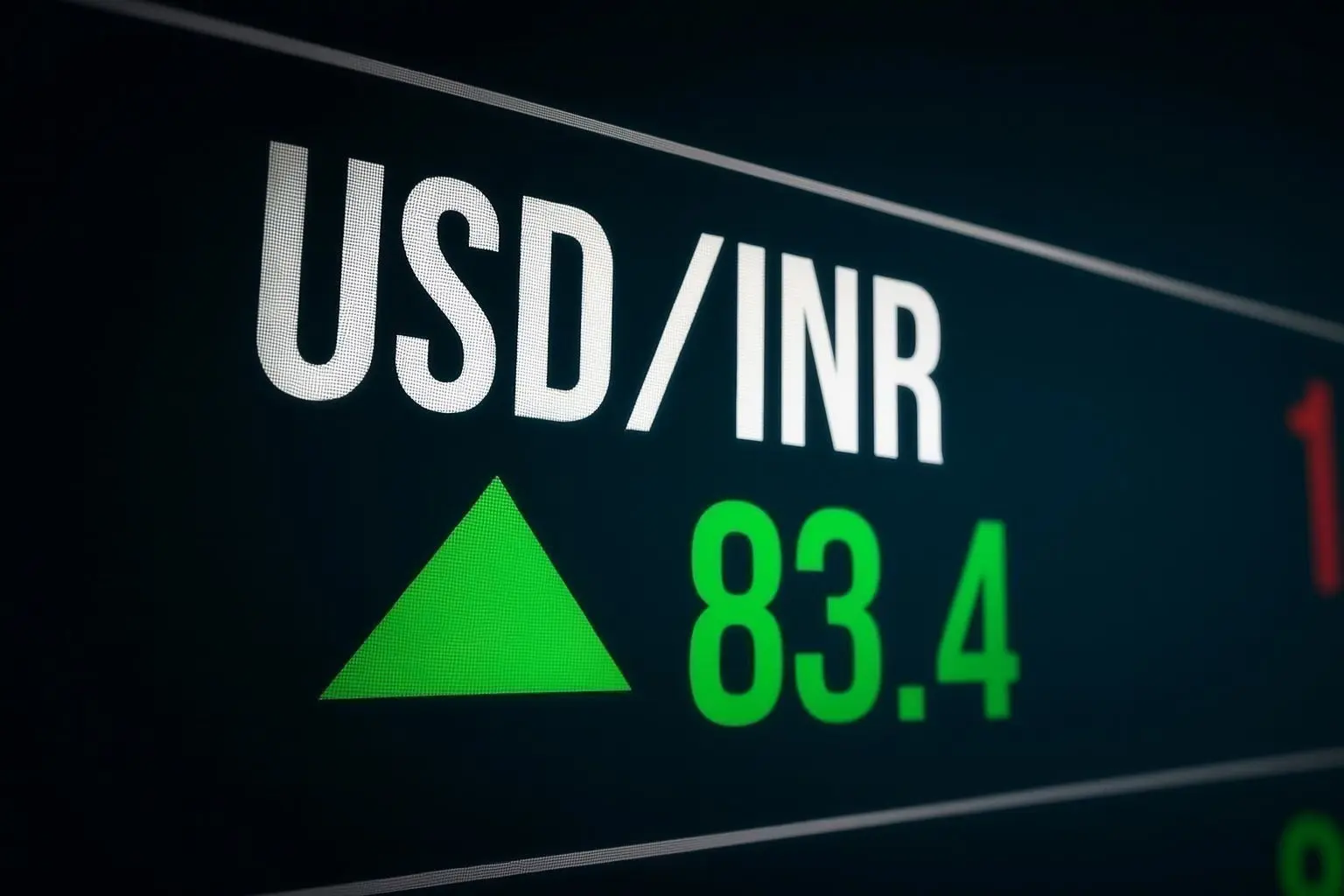
The Indian rupee had a historic week against the U.S. dollar, finishing Friday at ₹90.4150 per $1 after briefly touching a fresh all‑time low of ₹90.55. That move pushed the widely watched USD/INR pair to record highs—and by definition dragged INR/USD lower (one rupee worth roughly $0.0111 at the week’s close). Reuters
What made last week stand out wasn’t just the price. It was the mix of forces behind it: renewed anxiety around U.S.–India trade negotiations and tariffs, persistent portfolio outflows and corporate dollar demand, and a market increasingly convinced the Reserve Bank of India (RBI) will focus on limiting volatility, not defending a single “line in the sand.” Reuters+2Reuters+2
Below is a detailed recap of INR/USD (USD/INR) prices from Dec 8–14, 2025, the main news and analyst takes published during the period, and the key catalysts traders will be watching in the upcoming week (Dec 15–19, 2025).
Where INR-USD ended last week (Dec 8–14, 2025)
Headline close: The rupee ended Friday (Dec 12) at ₹90.4150 per $1, marking about a 0.5% weekly decline and the second weekly fall in a row. Reuters
Intraday record: It hit ₹90.55—a new all‑time low—before stabilising as traders cited RBI support. Reuters+1
Mid-market range trackers: One popular mid‑market tracker showed the USD/INR rate fluctuating last week between roughly 89.793 (low on Dec 10) and 90.6155 (high on Dec 12), underscoring how quickly the pair repriced once 90 broke. Wise
Why this matters for INR/USD: When USD/INR rises, the rupee buys fewer dollars. At ₹90.4150, INR/USD is about $0.01106 per ₹1 (around 1.106 U.S. cents).
USD/INR last week: day-by-day price action (Dec 8–12)
Monday, Dec 8: Rupee weakens; pressure narrative returns
The rupee closed at ₹90.07 per $1 on Monday. Reuters
A key theme in early-week coverage: traders expected continued pressure from weak flows, with attention turning to the U.S. Federal Reserve’s decision later in the week—and to whether there’d be any progress on the U.S.–India trade front. Reuters
Tuesday, Dec 9: A brief rebound as inflows and exporter sales help
The rupee snapped back and closed at ₹89.8750. Reuters
Reuters coverage highlighted the market’s sensitivity to positioning and flow: modest inflows and exporter selling offered breathing room, but the broader bearish bias remained tied to the same macro drivers—trade uncertainty and capital movement. Reuters
Wednesday, Dec 10: Choppy trade; markets brace for the Fed
Wednesday was more volatile than the close suggests: USD/INR moved in an 89.77–90.08 band before ending at ₹89.9650. Reuters
The “wait for the Fed” mood was clear in reporting, with the dollar index drifting ahead of the decision and Asian FX broadly subdued. Reuters
Thursday, Dec 11: New record low; RBI presence noted
Thursday delivered the week’s most important technical and psychological development: the rupee hit a then‑record low of ₹90.4675 and later closed at ₹90.3675. Reuters
Coverage pointed to corporate outflows (near‑term dollar payments) overpowering the supportive impulse from the post‑Fed dollar move, while traders again flagged likely RBI intervention to reduce overshoot. Reuters+1
Friday, Dec 12: Another record at 90.55; closes 90.4150
Friday saw USD/INR push to a fresh all‑time high of ₹90.55 before the rupee finished at ₹90.4150, ending the week down about 0.5%. Reuters+1
This is where the market’s new base case crystallised: a gradual drift weaker is possible, but central bank action may keep volatility contained. Reuters+1
What drove USD/INR higher last week (and INR/USD lower)
1) Trade headlines and tariff uncertainty stayed front and centre
Multiple reports throughout the week tied rupee underperformance to the absence of a clear breakthrough in U.S.–India trade negotiations, alongside the drag from steep U.S. tariffs on Indian goods (with reporting citing tariffs “up to 50%” on some key exports). Reuters+1
Reuters also noted that trade negotiations had collapsed in late July, later resuming with a U.S. trade delegation visiting India during the week, and highlighted a phone call between Prime Minister Narendra Modi and U.S. President Donald Trump. Reuters+1
Why FX traders care: trade uncertainty hits the rupee through expectations of weaker exports, shakier equity sentiment, and less reliable capital inflows—especially at a time when global investors have become more selective about EM risk.
2) Portfolio outflows and corporate dollar demand kept the “bid” under USD/INR
Reuters reporting during the period repeatedly described a market weighed down by portfolio outflows and near-term corporate dollar payments, which can overwhelm supportive macro news when concentrated in time. Reuters+1
One Reuters report noted foreign investors had pulled nearly $2.5 billion from Indian stocks and bonds this month (as of that reporting window), reinforcing the flow pressure narrative. Reuters
3) The RBI’s posture: smoothing volatility, not defending a level
Several pieces converged on a similar description: the RBI is intervening, but not aggressively enough to force a reversal—more “leaning against the wind” than building a hard wall at a specific number. Reuters+1
A Times of India report (citing a Bloomberg account) portrayed the RBI’s approach as intentionally hard to predict—varying instructions and intensity to curb speculation without rapidly burning reserves or tightening domestic liquidity too sharply. The Times of India
4) The Fed delivered a cut, but also a “not-so-dovish” message
The U.S. Federal Reserve’s decision midweek mattered for USD/INR in two ways:
- The Fed cut rates (reported as a 25 bp move) but signalled a more restrained path ahead, shaping the dollar’s reaction. Reuters
- It also communicated liquidity management steps—including plans to purchase shorter-term Treasuries as needed—while Reuters reported a move to start technical Treasury bill buying to manage reserves and money-market conditions. Federal Reserve+1
That combination helped push the dollar around, but it did not remove the rupee’s key domestic/flow headwinds—so USD/INR stayed elevated. Reuters+1
5) India inflation stayed low, leaving room for easier financial conditions
India’s November retail inflation was reported at 0.71%, up from 0.25% in October, but still exceptionally low—keeping the “easy policy/liquidity support” conversation active. Reuters
Lower inflation can be supportive for growth, but in FX it also feeds into expectations of lower yield support for the currency—especially if global rates are not falling as quickly as domestic rates.
6) The rupee’s underperformance became a regional story
Reuters described the rupee as Asia’s worst-performing currency this year, down more than 5% against the dollar, and also flagged a sharp divergence versus the Chinese yuan (including a record low vs CNY). Reuters
News and analysis highlights from Dec 8–14 (what the market latched onto)
RBI liquidity operations are about to become the week-ahead story
Two RBI actions dominated “what next” commentary:
A) $5 billion USD/INR buy/sell swap auction (Dec 16)
The RBI announced it will conduct a $5 billion USD/INR Buy/Sell Swap for 36 months, with the auction on Dec 16 (10:30–11:30 IST). The spot/near leg is Dec 18, 2025 and the far leg is Dec 18, 2028. Moneycontrol
Moneycontrol reported estimates that the operation could inject roughly ₹45,000 crore of rupee liquidity into the system. Moneycontrol
B) OMO bond purchases (Dec 18 upcoming, after Dec 11 tranche)
On Dec 11, Moneycontrol reported the RBI injected ₹50,000 crore via OMO purchases after receiving bids worth ₹1,11,615 crore, and reiterated the plan for a second ₹50,000 crore tranche on Dec 18. Moneycontrol
Why FX traders care: liquidity operations can influence money-market rates, hedging costs, and near-term USD/INR microstructure—especially when intervention is simultaneously shaping spot.
The “forecast split” widened: 90 now, but 93 or 86 later?
Analyst projections published in the period were notably diverse:
- Standard Chartered expected pressure to persist and forecast the rupee to weaken to 93 per $1 over the next 12 months. Reuters
- Jefferies projected the rupee would hover around 90 per $1 over the next 6–12 months, assuming manageable external balances and improved inflows. Reuters
- MUFG was cited by Reuters as seeing USD/INR potentially settling below 90 next year, a more constructive view than the near-term tape suggests. Reuters
- BMI (Fitch Solutions) projected around ₹90/USD by end‑December 2025 and roughly ₹90.5/USD in 2026 (as reported by The Economic Times). The Economic Times
- Bank of America warned rupee weakness could transmit a “five‑channel” macro shock (sentiment, growth, inflation, external balances, fiscal), but also said its strategists see scope for 86 per $1 by end‑2026 if conditions stabilise and the trade issue is resolved. The Economic Times
Takeaway: last week’s record low did not create a single unified forecast. Instead, it pulled more institutions toward a “higher-for-longer USD/INR” range near term, while leaving longer-horizon views dependent on the dollar cycle and trade outcomes.
“Undervalued” signals started appearing in the discussion
Reuters noted the RBI’s trade-weighted real effective exchange rate (REER) at 97.47 versus a neutral 100, framing the currency as “undervalued” by that measure. Reuters
This doesn’t guarantee a reversal, but it helps explain why some strategists can hold a medium-term recovery view even as spot prints new lows.
Upcoming week (Dec 15–19): 6 catalysts that could move USD/INR
1) RBI’s $5 billion FX swap auction (Dec 16) — and what it signals
The structure matters: the RBI buys dollars spot from banks and sells them back forward, while banks bid a premium (in paisa terms). Moneycontrol
In practice, markets will watch:
- demand strength (how aggressively banks bid),
- the implied premium (which can ripple into forward pricing),
- and whether it changes the RBI’s day-to-day stance in spot.
2) RBI’s second OMO tranche (Dec 18)
After the RBI injected ₹50,000 crore on Dec 11, traders will watch whether Dec 18 demand is similarly strong and how that affects money-market conditions. Moneycontrol
3) Trade headlines: any signal of relief—or escalation
Given how heavily the tariff and trade narrative featured in last week’s reporting, even small headlines can move sentiment quickly. Reuters+1
If markets sense a credible path to de-escalation, USD/INR could stabilise or retrace. If not, the “grind higher” story remains intact.
4) Dollar direction after the Fed: rates and liquidity
After the Fed’s cut and its liquidity operations (including reported T-bill buying), traders will be watching whether the dollar remains soft or rebounds—because USD/INR has recently been reacting more to India-specific flows than to the broader dollar tape. Reuters+2Reuters+2
5) Oil and import demand
Reuters flagged Brent crude around $61.7 during the period—helpful on the margin for India’s external balance, but still only one input into USD demand. Reuters
6) Flows and positioning: the “90-handle” psychology
Once a major psychological level breaks, hedging behaviour can change. Importers tend to hedge more, exporters may hold back, and traders become more sensitive to stop-loss cascades—dynamics Reuters and market participants referenced as the rupee made successive new lows. Reuters+1
So what’s the USD/INR forecast for the week ahead?
Based on the reporting and forecasts published between Dec 8 and Dec 14, the dominant near-term view is not an imminent rupee rebound—it’s a controlled depreciation story.
- Reuters reporting on Friday described bankers and analysts expecting the rupee to keep drifting lower in the near term, with RBI intervention limiting volatility. Reuters
- Reuters also captured the idea that without a trade breakthrough, the rupee could remain under pressure, even as some measures suggest it is undervalued on a trade-weighted basis. Reuters
Practical “base case” scenario (consensus of commentary)
- Bias: mildly weaker INR (higher USD/INR), unless trade headlines improve.
- Volatility: likely managed by RBI activity, especially if moves become disorderly. Reuters+1
- Key risk: a renewed push to fresh highs if flows stay negative and hedging demand accelerates.
Why forecasts differ so much right now
The spread between Standard Chartered’s 12‑month 93 view, Jefferies’ 6–12 month 90 view, and BofA’s end‑2026 86 view is ultimately a debate about:
- how quickly the U.S. dollar cycle turns, and
- whether the trade/tariff shock is temporary or structural. Reuters+2Reuters+2
Bottom line: what last week tells us about next week
Last week (Dec 8–14) showed that once 90 was decisively in play, USD/INR could reprice quickly to new records—even when the global dollar narrative briefly turned softer.
For the upcoming week (Dec 15–19), the rupee’s path will likely hinge on two RBI liquidity events (Dec 16 swap, Dec 18 OMO) and trade headlines, against the backdrop of a post‑Fed dollar market that is being influenced by both rates and liquidity management. Reuters+3Moneycontrol+3Moneycontrol+3