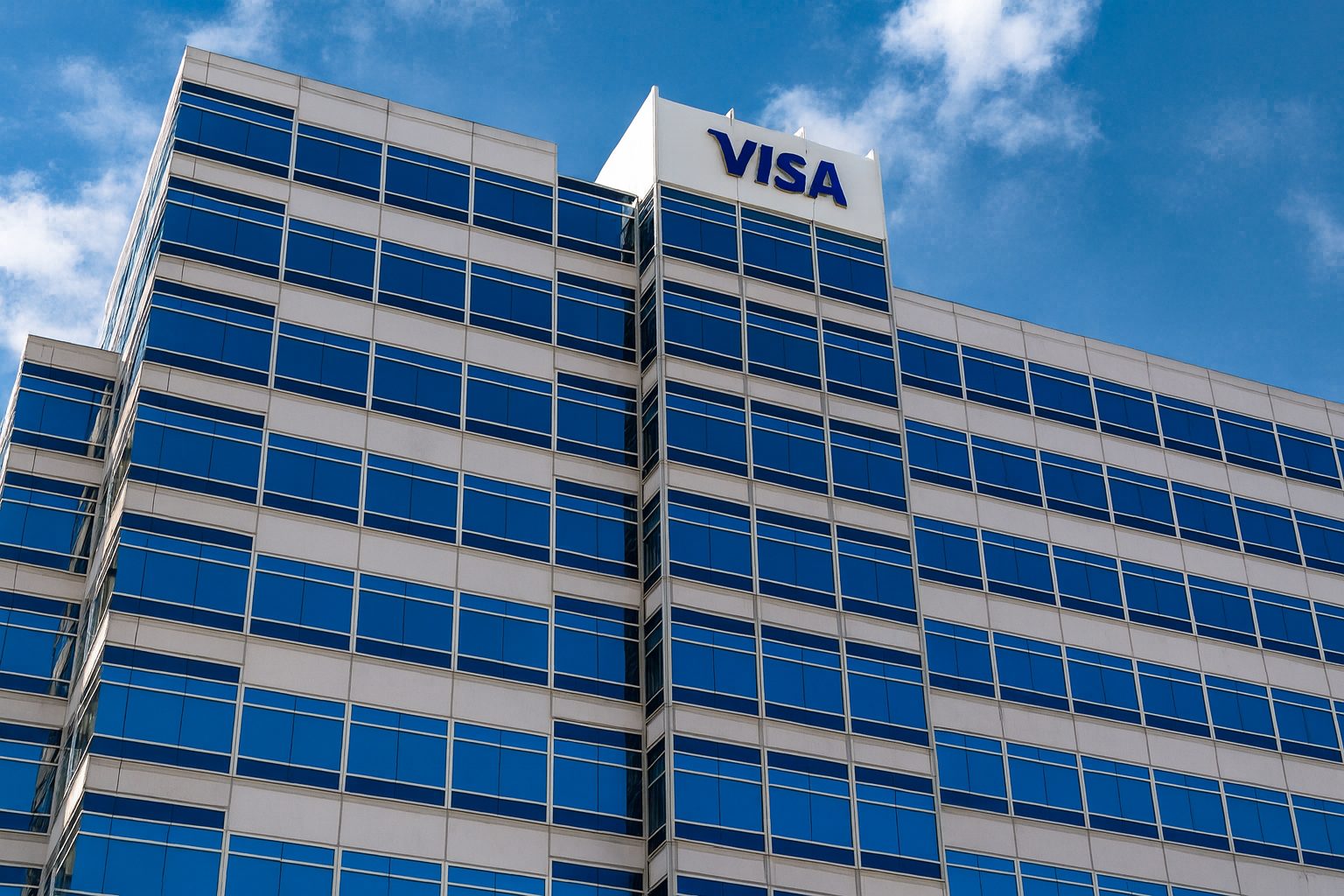
Visa Inc. stock is back in the spotlight on Monday, December 15, 2025, as investors digest two fresh company updates that sit at the heart of Visa’s long-term growth story: digital money movement (stablecoins) and global travel spending. Add in a string of recent analyst upgrades and a still-evolving swipe-fee settlement narrative, and Visa stock has plenty of moving parts heading into 2026.
Visa shares traded around $347 intraday, within a roughly $344–$350 range, and remain below their 52-week high near the mid-$370s.
Visa stock price check: where shares stand on Dec. 15, 2025
As of Monday’s session, Visa (V) was trading near $347 per share, after a recent rebound that has narrowed some of the 2025 performance gap versus the broader market. Monday’s intraday range was roughly $343.97 to $349.97, with a 52-week range near $299 to $376.
That price action matters because Visa is increasingly being framed by analysts as a “high-quality compounder” that temporarily fell out of favor—creating what some see as an attractive setup if regulatory and litigation risks remain contained. Barron’s
What’s driving Visa stock today: two Visa updates investors are watching
1) Visa launches a global Stablecoins Advisory Practice
Visa announced today it is launching a Stablecoins Advisory Practice under Visa Consulting & Analytics (VCA). The company says the goal is to help banks, fintechs, merchants, and other businesses with stablecoin market fit, strategy, implementation planning, and integration—essentially packaging Visa’s payments know-how and crypto/stablecoin experience into a consulting-style offering.
Why now? Visa points to the scale and momentum in the category: the company cites a stablecoin market cap above $250 billion, and says Visa’s own stablecoin settlement volume has accelerated to a $3.5 billion annualized run rate as of November 30.
Visa also highlights what it’s already built:
- It began piloting stablecoin settlement using USDC in 2023.
- It now has 130+ stablecoin-linked card issuing programs across 40+ countries.
- The advisory practice will be supported by VCA’s network of consultants and specialists, with services including training programs, market-entry planning, use-case sizing, and technology enablement.
Why investors care: this is not just “crypto curiosity.” Visa is signaling that stablecoins are shifting from a niche payments experiment to a real-world toolkit for treasury, settlement, and cross-border flows—areas where Visa can sell software, services, and infrastructure even if stablecoins change the rails behind the scenes. Visa Investor Relations+1
2) Visa expands its global travel program with a Dubai launch
In a separate update dated today, Visa announced an expansion of its global travel program, adding Dubai as a flagship city (alongside Paris and London) to offer cardholders curated benefits and experiences across travel categories like hotels, dining, and retail.
The release includes VisaNet-based spending snapshots that connect directly to one of Visa’s most important growth engines—cross-border and travel-related payments:
- VisaNet data cited by Visa shows repeat visitors to Dubai spend about $890 per trip vs. $540 for first-time travelers, and that returning visitors spend 45% more per trip.
- Visa also cites growth in Dubai-related spending categories (e.g., entertainment spend up 69% vs. 2024, dining up 20%, apparel/fashion up 25%).
Why investors care: even in a world of mobile wallets and new fintech brands, Visa’s “tollbooth” economics still get a meaningful lift from travel and cross-border volume, where yields and growth can be attractive. Visa’s travel program expansion reads as both a marketing play and a data-driven effort to deepen cardholder usage where spend intensity is high. Visa Middle East+1
Analyst forecasts and price targets: what Wall Street expects for Visa stock
The tone from Wall Street has turned more constructive in December—especially around the idea that stablecoins could be an opportunity rather than a threat.
Recent upgrades and the stablecoin “reframe”
- Bank of America upgraded Visa to Buy (from Neutral) with a $382 price target, arguing that concerns about stablecoins displacing card payments are likely overdone and that Visa’s positioning in stablecoins can be additive.
- HSBC also upgraded Visa to Buy and raised its target to $389 (from $335), according to reports summarizing the note.
Consensus targets: roughly low-$400s, with wide dispersion
Across widely-followed market datasets, the consensus 12-month target for Visa clusters around ~$399–$403:
- MarketBeat shows an average target of $402.52 (with a $450 high).
- TipRanks shows an average target of $401.26 (high $450, low $315).
- MarketWatch displays an average target price around $401.93, with an average recommendation in “Buy” territory. MarketWatch
- StockAnalysis shows an average target near $398.88 and a “Strong Buy” consensus label. StockAnalysis
How to read this: The market is effectively saying Visa is a durable franchise that deserves a premium multiple—but not everyone agrees on how much premium is justified given litigation/regulatory headlines and the evolving payment landscape.
The fundamental backdrop: what Visa said in its latest earnings
The most recent full-quarter results (reported Oct. 28, 2025) underscored that Visa’s core engine is still running: consumer and business spend on Visa’s network remains resilient, with steady growth in volumes and revenues.
In Visa’s fiscal Q4 2025 (quarter ended Sept. 30):
- Net revenue rose 12% to $10.72 billion.
- Adjusted EPS was $2.98 (adjusted net income $5.80 billion).
- Global payments volume rose 9% on a constant-dollar basis.
- Cross-border total volume grew 12% (a touch slower than the prior-year pace, per Reuters).
- Visa said it expects low double-digit net revenue growth in fiscal 2026 on a constant-dollar basis (with analysts clustered around ~11%).
Visa also emphasized that it had not seen a meaningful impact from tariff-related dynamics on cross-border payments at that time.
Why this matters for the stock: Visa’s investment case has historically been built on (1) steady transaction growth, (2) operating leverage and high margins, and (3) capital return. When the macro environment is noisy, investors tend to re-check whether “everyday spend” is holding up—and Visa’s results suggested it was. Reuters
Capital return: dividends and buybacks remain part of the Visa story
Visa continues to return meaningful cash to shareholders via dividends and repurchases.
- Visa’s most recent quarterly dividend payment was $0.67 per share, paid Dec. 1, 2025 (with an ex-dividend date in mid-November).
- Visa also has a large buyback cadence; earlier in 2025, the company announced a $30 billion multi-year share repurchase program.
For long-term investors, these shareholder returns can be a key part of total return—especially when revenue growth is steady rather than explosive.
Key risks and overhangs: the swipe-fee settlement and regulatory pressure
Even with today’s upbeat product and strategy headlines, Visa’s stock narrative still includes material policy and litigation risk—most notably around U.S. “swipe fees.”
The revised $38 billion merchant settlement (not final)
In November 2025, Visa and Mastercard announced a revised $38 billion settlement with merchants in long-running litigation over interchange/merchant discount fees. Reuters reported the revised deal would:
- Reduce average swipe fees by 0.1 percentage point for five years
- Allow merchants more choice on what card categories to accept
- Cap standard consumer rates at 1.25% for eight years (per Reuters’ description of the terms)
Visa’s own 8-K filing on the settlement describes key terms including a 10 bps reduction of the U.S. combined average effective credit interchange rate for five years, more flexibility around “Honor All Cards,” and capping standard consumer credit rates at 125 bps through the term of the agreement, subject to court approval. SEC+1
Why this matters: Even if Visa can absorb near-term economics, investors are focused on whether the settlement ultimately resets pricing power, merchant steering, and acceptance rules in ways that could change network economics over time. The outcome depends on court approval and ongoing stakeholder reactions.
Stablecoins: opportunity, but regulation and central-bank pushback are real
Today’s stablecoin announcement lands amid a fast-moving global debate over stablecoin regulation and financial stability. Recent coverage highlights how stablecoins could reshape banking and payments, while also raising concerns from regulators and central banks about systemic risk.
For Visa, the strategic bet appears to be: even if stablecoins change how money moves behind the scenes, Visa can stay relevant by providing network-scale compliance, settlement tooling, and commercial integrations—and by selling advisory and value-added services around it.
Outlook for Visa stock: what could move shares next
With Visa stock now trading in the mid-$300s, here are the most likely catalysts investors will track into early 2026:
- Adoption signals for the Stablecoins Advisory Practice: watch for named client wins, deeper product integrations, and measurable revenue contribution from advisory/value-added services tied to digital assets.
- Cross-border and travel momentum: Visa’s Dubai travel program announcement is a reminder that travel is still a high-value usage arena—any acceleration in cross-border volumes can support upside narratives.
- Settlement headlines and court milestones: developments around the proposed swipe-fee settlement—and whether merchant opposition changes the timeline or terms—can create volatility.
- Street target revisions: with consensus targets clustered around ~$400, Visa may need either stronger-than-expected growth or greater clarity on legal/regulatory risks for sustained multiple expansion.
- Corporate calendar: Visa’s investor relations materials indicate an Annual Meeting of Shareholders scheduled for Jan. 27, 2026 (8:30 a.m. PST), a potential checkpoint for governance items and investor messaging.