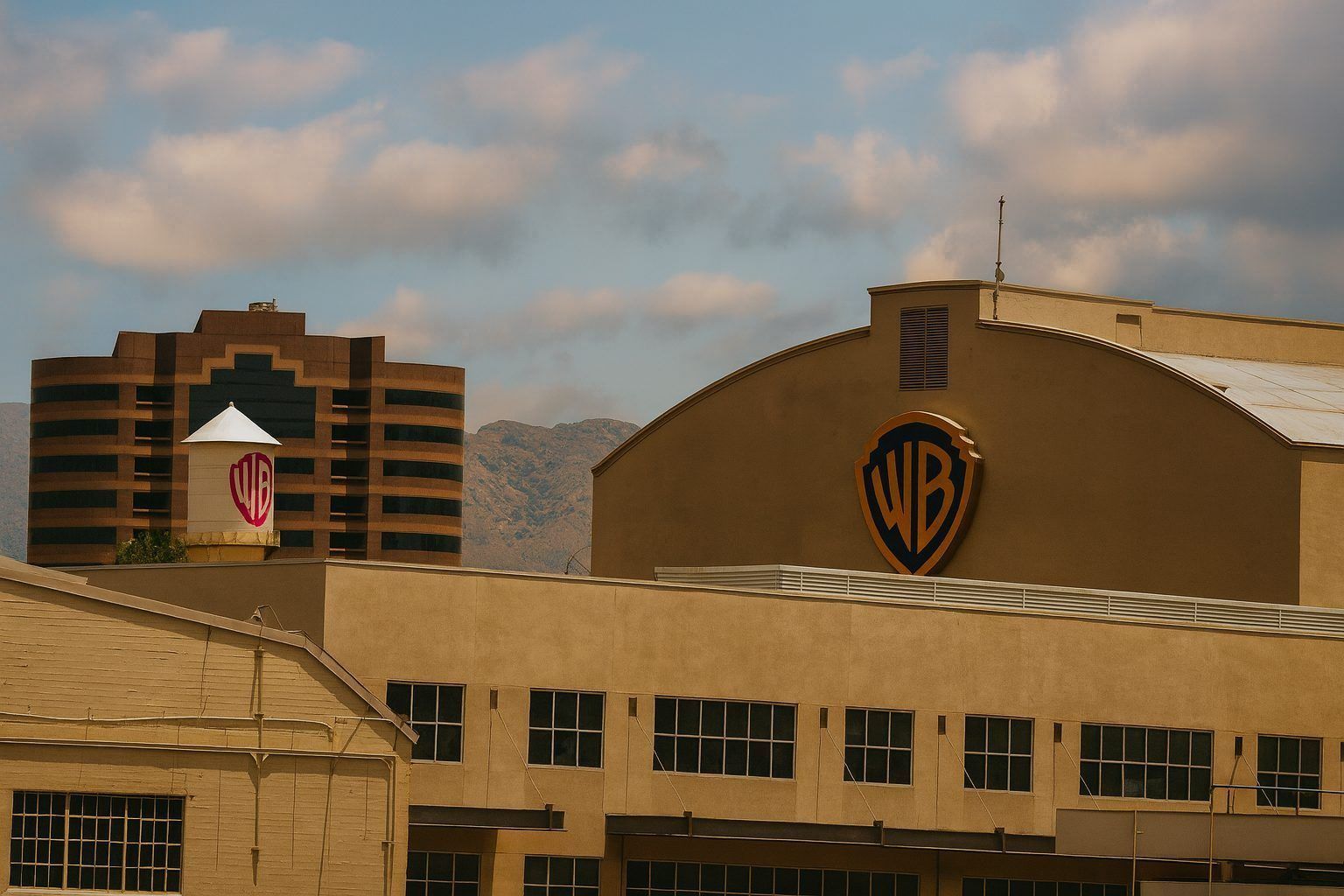
Date: December 9, 2025
Quick Take
- Paramount Skydance has launched a $108.4 billion all‑cash hostile tender offer for Warner Bros. Discovery at $30 per share, aiming to derail Netflix’s earlier $72 billion agreement to buy WBD’s studios and streaming assets.
- WBD’s board has acknowledged the Paramount offer but is still officially backing the Netflix deal and urging shareholders not to take action until it issues a formal recommendation within 10 business days.
- The stock is trading around $27 per share, close to its 52‑week high of about $28.17 after rallying on the takeover battle.
- Wall Street’s 12‑month consensus target is just $22.35, implying roughly 18% downside from current levels despite a “Moderate Buy” average rating from 27 analysts. MarketBeat
- Quant models are wildly split: one long‑range model sees WBD falling sharply in 2026 before more than doubling by 2040–2050, underscoring the uncertainty around the franchise’s long‑term value.
1. What Is Warner Bros. Discovery, Inc. Series A Stock (WBD)?
Warner Bros. Discovery, Inc. is a global media and entertainment company spanning film, TV, streaming and gaming, with brands such as Warner Bros., DC, HBO, Max, Discovery Channel, CNN, TNT Sports and others.
Its publicly traded Series A common stock trades on the Nasdaq under the ticker WBD and is the primary vehicle through which investors gain exposure to the company. Nasdaq and MarketWatch both list it specifically as Warner Bros. Discovery, Inc. Series A Common Stock (WBD).
Operationally, WBD reports through three main segments:
- Studios – film and TV production, including the Warner Bros. Motion Picture Group and TV divisions.
- Networks / Global Linear Networks – legacy cable channels like CNN, TNT, TBS, Discovery, HGTV and Food Network.
- Direct‑to‑Consumer (DTC) – streaming services including Max (formerly HBO Max) and discovery+.
WBD is already mid‑way through a strategic reorganization that splits the company into Streaming & Studios and Discovery Global (Global Linear Networks), with a separation targeted for mid‑2026.
2. Stock Snapshot: Price, Valuation and Volatility
According to MarketBeat and WBD’s own investor relations data, WBD closed at $27.23 on December 8, 2025, and was trading slightly higher in early pre‑market activity on December 9.
Key valuation and trading metrics from recent MarketBeat data:
- Share price: ~$27
- Market cap: about $67.5 billion
- P/E ratio: ~143, reflecting depressed near‑term earnings
- PEG ratio: around 1.0 (price/earnings relative to growth)
- 1‑year range: low of $7.52, high of $28.17
- Beta: ~1.6, meaning the stock tends to be more volatile than the broader market
That sharp move from single‑digit lows to near $30 illustrates how dramatically sentiment has shifted as takeover speculation intensified in 2025.
3. The Netflix Deal: A $72 Billion Agreement Under Pressure
On December 5, 2025, Netflix announced a cash‑and‑stock deal to acquire Warner Bros. Discovery’s studios and streaming businesses—including Warner Bros. film and TV operations, HBO, Max and TNT Sports—in a transaction valuing those assets at about $72 billion (roughly $82.7 billion enterprise value).
Under the announced terms:
- WBD shareholders would receive $23.25 in cash and $4.50 in Netflix stock per WBD share, a total of $27.75 per share for the studios and streaming division.
- The company’s cable networks would be spun off into a separate public entity called Discovery Global, completing the split between linear TV and streaming/studios.
Regulators and unions immediately flagged competition concerns. The Writers Guild of America and other critics argue that letting the world’s largest streamer combine with one of Hollywood’s major studios could concentrate too much power over content and talent.
Financially, the deal includes hefty break‑up fees:
- If regulators kill the Netflix–WBD deal or Netflix walks away, Netflix would owe WBD about $5.8 billion.
- If WBD backs out for a competing buyer, it would owe Netflix around $2.8 billion.
Those penalties help explain why WBD’s board is treading carefully now that a rival suitor has appeared.
4. Paramount Skydance’s $108.4 Billion Hostile Bid
On December 8, 2025, Paramount Skydance unveiled a hostile tender offer to acquire all of WBD for $30 per share in cash, implying roughly $108.4 billion in enterprise value—about $18 billion more in cash than the Netflix offer.
Key elements of the Paramount proposal:
- Price: $30 per WBD share, in cash. SEC filings indicate this is a 139% premium to WBD’s “undisturbed” stock price of $12.54 on September 10, 2025. SEC
- Scope: Paramount wants 100% of WBD, including the cable networks, not just the studios and streaming assets targeted by Netflix.
- Financing: Backed by equity from the Ellison family and RedBird Capital, plus commitments from Affinity Partners and Middle Eastern sovereign wealth funds, alongside about $54 billion in debt arranged by major banks such as Bank of America and Citigroup.
- Tactics: Paramount bypassed WBD’s management and board to appeal directly to shareholders via a hostile tender, arguing that its offer is simpler, faster to close and less exposed to antitrust risk than Netflix’s.
The move escalates what was already one of Hollywood’s most consequential M&A sagas in decades. Reuters, the Financial Times and other outlets describe the offer as “hard to refuse” given the large premium and all‑cash structure. Reuters+2Financial Times+2
5. How WBD’s Board Is Responding
Warner Bros. Discovery confirmed in its own press release that it has received Paramount Skydance’s unsolicited tender offer and will review it “consistent with its fiduciary duties” and in consultation with advisors. Warner Bros. Discovery+1
Crucially, the board has not withdrawn or changed its recommendation in favor of the Netflix transaction and has advised shareholders not to take any action regarding the Paramount offer until it publishes a formal view within 10 business days.
That means shareholders now face a multi‑step process:
- Board recommendation – WBD will issue a Schedule 14D‑9 filing outlining whether it recommends accepting or rejecting Paramount’s tender or taking another path.
- Regulatory lens – Both deals require significant antitrust review in the U.S. and internationally. Politicians across the spectrum have already weighed in, criticizing media consolidation and, in Paramount’s case, the involvement of foreign investors.
- Shareholder vote and tender deadline – Reports suggest WBD shareholders will have a window (currently indicated as early January) to decide whether to tender into Paramount’s bid, though timelines can change.
Until that plays out, the stock will likely trade as a live arbitrage bet on competing deal outcomes.
6. Q3 2025 Results: Fundamentals Behind the Drama
Beneath the M&A headlines, WBD’s third‑quarter 2025 results present a mixed but improving picture.
From the company’s earnings release and shareholder letter:
- Revenue: $9.0 billion, down about 6% year‑over‑year on a currency‑adjusted basis, though roughly flat when excluding the impact of the 2024 Olympics in Europe.
- Streaming & Studios (S&S): Revenue up about 7% ex‑FX, and adjusted EBITDA up nearly 60% ex‑FX versus the prior year, reflecting strong box‑office and content performance.
- Global Linear Networks: Maintained healthy adjusted EBITDA margins of roughly 44%, showing that legacy cable still throws off sizable cash despite cord‑cutting.
- Guidance: Management expects at least $2.4 billion of adjusted EBITDA from Studios and $1.3 billion from Streaming for full‑year 2025.
- Free cash flow: About $701 million in Q3 alone, even including roughly $500 million of separation‑related cash costs tied to the upcoming corporate split.
- Debt and leverage: WBD repaid approximately $1.2 billion of debt during the quarter, including $1 billion on a bridge facility, and ended with net leverage of about 3.3x.
On the bottom line, WBD reported a loss of $0.06 per share in Q3, missing consensus expectations of a $0.04 loss. Revenue also slightly lagged analyst estimates. Net margin was around 1.3%, and return on equity roughly 1.3%, underlining how thin profitability still is.
Analysts collectively expect WBD to post a full‑year 2025 loss of about $4.33 per share, reflecting heavy content investment, restructuring costs and interest expense.
7. Institutional and Insider Activity
One of the big stories beneath the surface has been shifting institutional ownership:
- Goldentree Asset Management sold more than 3.7 million WBD shares in the second quarter, cutting its position by about 61.8% to roughly 2.33 million shares (around 0.09% of the company). WBD still represents about 2.6% of Goldentree’s portfolio.
- Other major institutions—including Norges Bank, Independent Franchise Partners, Nuveen, Sound Shore Management and Apollo Management—have established or expanded WBD positions, contributing to nearly 60% institutional ownership overall.
On the insider front:
- CFO Gunnar Wiedenfels sold roughly 222,000 shares at an average of $22.50 at the end of October, trimming his stake by nearly 20% but still holding close to 919,000 shares.
- Chief Accounting Officer Lori C. Locke sold about 5,000 shares at around $24.14, retaining over 120,000 shares.
Insider selling doesn’t automatically signal bearishness—executives routinely diversify—but it does give arbitrageurs another data point when weighing takeover odds and standalone value.
8. Wall Street Ratings and Price Targets
Wall Street is anything but unanimous on WBD.
Consensus View
MarketBeat’s tracking of 27 analysts over the past year shows:
- Consensus rating: Moderate Buy (rating score ~2.59 on a 1–4 scale)
- Breakdown: 3 Strong Buy, 11 Buy, 12 Hold, 1 Sell
- 12‑month average price target:$22.35
- High / low targets:$30 (high) vs $10 (low)
At today’s price near $27, that average target implies about 18% downside, meaning many analysts value WBD below the market’s current takeover‑fueled pricing.
Fresh Analyst Moves in December
Recent rating and target changes highlight how news‑driven this name has become:
- Deutsche Bank raised its price target from $26.00 to $29.50 and reiterated a Buy rating after the Netflix transaction, valuing Discovery Global at around $2.35 per share and the studios/streaming assets at Netflix’s $27.75 deal price, then discounting for the time to close.
- Benchmark lifted its target from $25 to $30 and kept a Buy rating, effectively aligning with Paramount’s offer price.
- Barrington Research downgraded WBD from Outperform to Market Perform on December 5, signaling concern that much of the takeover premium may already be in the stock.
- Seaport Global cut WBD from Buy to Neutral on December 9 without issuing a new price target, adding to the mixed short‑term outlook as the bidding war heats up.
In short, deal math rather than organic fundamentals is now driving most target changes.
9. Quant and Long‑Term Forecasts: A Wide Cone of Uncertainty
Beyond Wall Street, quantitative forecasting sites paint an even more volatile picture.
StockScan, which uses statistical and machine‑learning models, projects:
- 2026 average price: about $9.36, with estimates ranging from roughly $1.03 to $17.70—a modeled decline of around 66% from the current $27.23.
- 2027 average: roughly $13.02, still well below the present price.
- 2035 average:$39.33, ~44% higher than today.
- 2040 average: around $53.38, implying nearly a doubling from current levels.
- 2050 average: roughly $61.26, more than 120% above today’s price.
These long‑dated forecasts are highly theoretical—they assume WBD continues trading as a standalone entity and don’t fully account for transformative M&A like the Netflix or Paramount deals. Still, they underscore a key point for investors: there is no consensus at all on WBD’s long‑term intrinsic value.
10. What the Takeover Battle Means for WBD Shareholders
Right now, owning WBD is less about predicting subscriber additions or box‑office hits and more about handicapping M&A outcomes.
Scenario 1: Netflix Deal Goes Through
If regulators approve Netflix’s acquisition and WBD rejects Paramount’s offer:
- Shareholders would receive the agreed mix of cash and Netflix shares for the Streaming & Studios assets, plus stock in the spun‑off Discovery Global entity.
- The total value would hinge on Netflix’s share price at closing and how the market prices Discovery Global’s cable networks.
- WBD would also benefit from the break‑up fee if regulators—not WBD—scuttle the transaction, but that’s a less likely “tail event” scenario. Finviz
Scenario 2: Paramount Wins the Bidding War
If Paramount’s $30‑per‑share tender succeeds and regulators approve:
- WBD holders would receive $30 in cash per share, crystallizing a premium of a few dollars above where the stock currently trades.
- Netflix would be owed a $2.8 billion break‑up fee, payable by WBD/Paramount, adding to the acquisition’s already heavy leverage burden.
- The combined Paramount–WBD entity could emerge as a stronger rival to Netflix and Disney, but that upside would accrue to Paramount shareholders, not former WBD investors.
Scenario 3: Both Deals Collapse
If antitrust regulators or politics derail both the Netflix and Paramount deals:
- WBD would continue its planned split into Streaming & Studios versus Discovery Global, supported by ongoing cost cuts and debt reduction.
- The share price could re‑rate sharply lower as the takeover premium evaporates, forcing investors to value WBD on fundamentals—where consensus targets currently sit well below $27.
11. Key Risks and Catalysts to Watch
For anyone tracking Warner Bros. Discovery’s Series A stock, here are the main things to monitor over the coming weeks and months:
- WBD Board Recommendation – The forthcoming 14D‑9 filing on the Paramount tender offer will be a major catalyst, signaling whether the board leans toward Netflix, Paramount or a renegotiated outcome.
- Regulatory Signals – Statements from the U.S. Department of Justice, FTC, EU regulators and key lawmakers about media consolidation, streaming power and foreign investment will shape odds for both deals.
- Shareholder and Arbitrage Activity – Large institutional moves (similar to Goldentree’s major sale) and activist involvement could influence the board’s stance and bid levels.
- Fundamental Performance – Upcoming quarters will show whether momentum in Streaming & Studios EBITDA and free cash flow continues, which affects both standalone valuations and bargaining power in negotiations.
- Competing Bids or Revised Terms – Additional sweeteners from Netflix or Paramount—or a surprise third bidder—could further reprice the stock.
12. Bottom Line
As of December 9, 2025, Warner Bros. Discovery’s Series A stock (WBD) is trading less like a traditional media equity and more like a live option on a blockbuster takeover battle.
- The Netflix agreement sets a floor of sorts, but it’s partly stock‑based and faces regulatory complexity.
- The Paramount Skydance offer is richer, all‑cash and explicitly hostile, yet also heavily leveraged and politically sensitive.
- Analysts and quant models disagree sharply on long‑term value, reflecting deep uncertainty about streaming economics, cable’s decline and the ultimate structure of the company.
For investors, that means elevated risk and elevated opportunity. Short‑term price swings will likely be dominated by deal headlines, while the long‑term story still depends on whether WBD—or whichever company ends up owning it—can translate its iconic IP into durable, profitable growth.
Disclaimer: This article is for informational purposes only and does not constitute financial, investment or legal advice. Always do your own research or consult a licensed financial advisor before making investment decisions.