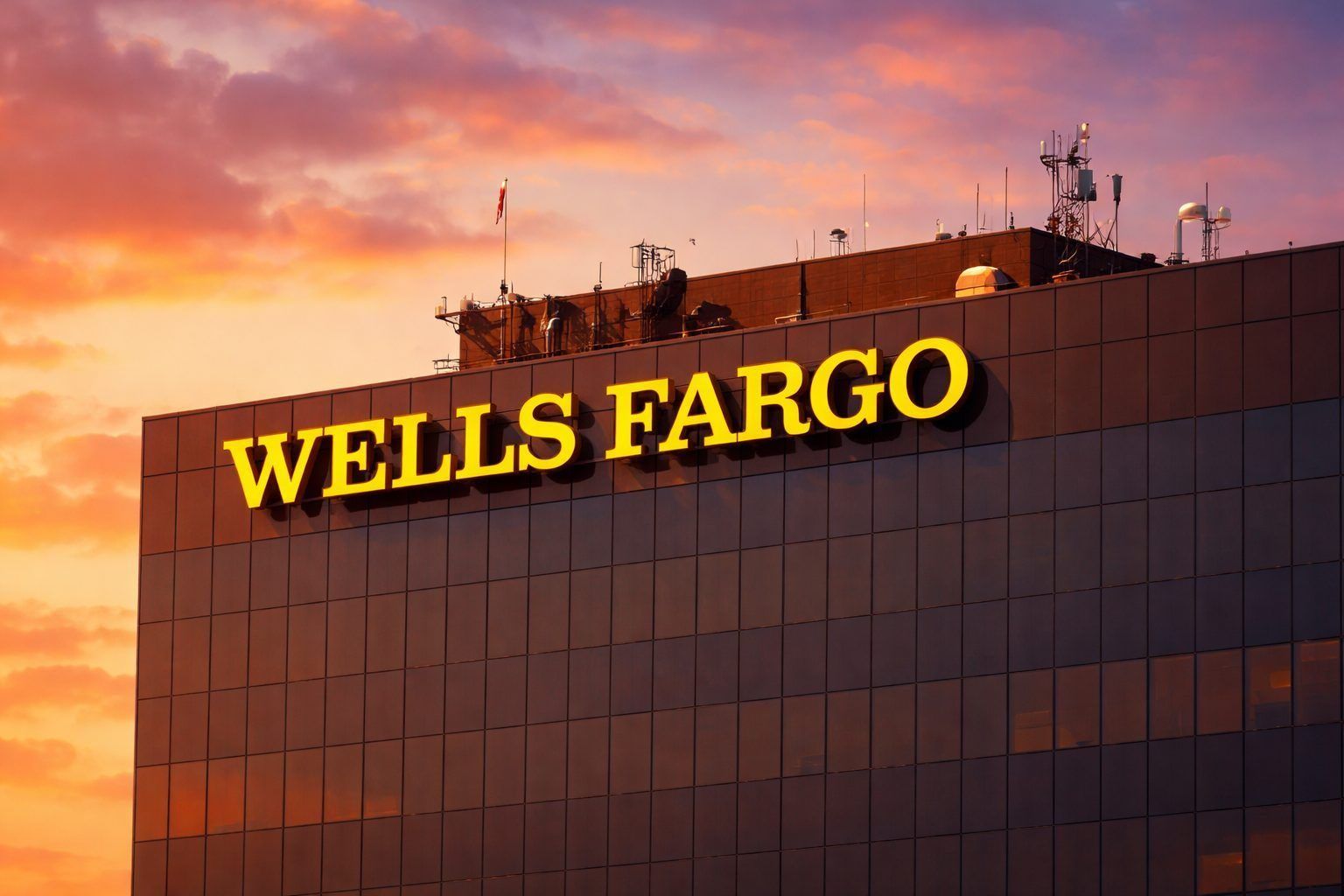

Dec. 18, 2025 — Wells Fargo & Company (NYSE: WFC) stock traded lower on Thursday even as broader markets cheered a cooler U.S. inflation print and falling Treasury yields. By mid-to-late afternoon, shares were around $91.74, down about 0.9% on the day after opening near $93.25 and swinging between roughly $91.37 and $93.88.
For investors tracking Wells Fargo stock into year-end — and into the bank’s next earnings report — today’s setup is all about the tug-of-war between (1) a shifting rate outlook, (2) a re-rating story that accelerated after the Federal Reserve lifted Wells Fargo’s long-standing asset cap, and (3) Wall Street’s still-bullish (but increasingly differentiated) views on how much upside remains.
Why Wells Fargo stock is moving today: softer inflation, lower yields, and a changing Fed path
Markets rallied Thursday after the U.S. Consumer Price Index for November came in softer than expected, with CPI up 2.7% year over year versus economists’ 3.1% forecast, according to Reuters. Treasury yields fell in response, with the 10-year around 4.12% in the Reuters wrap.
That macro mix can be a double-edged sword for big banks like Wells Fargo:
- Lower yields / more cuts priced in can pressure net interest income (NII) over time, especially if deposit costs don’t fall as quickly as asset yields.
- But easier financial conditions can also support loan demand, improve capital markets sentiment, and help credit hold up — typically supportive for cyclical financials.
Reuters also noted policy expectations remain fluid: the Fed has signaled only one cut next year, while traders have been betting on more — and political commentary around future Fed leadership has added another layer of uncertainty.
Against that backdrop, it’s not unusual to see bank stocks trade mixed on a “rates down, growth up” day.
The big analyst headlines for WFC on Dec. 18: Truist turns more bullish; Baird stays cautious
A major reason Wells Fargo stock is on investors’ radar today is fresh analyst action.
Truist raises Wells Fargo price target to $100 (keeps Buy)
Truist raised its WFC price target to $100 from $90 and reiterated a Buy rating, citing updated modeling after management commentary at recent conferences. Truist also lifted its FY27 EPS view to $8.15 from $7.85, pointing to an improving efficiency ratio.
Baird raises target to $90, but maintains Neutral
RW Baird also adjusted its price target to $90 from $84 while keeping a Neutral rating, per the MarketScreener/MT Newswires item posted Thursday morning.
What this split tells investors: the Street broadly agrees Wells Fargo’s multi-year clean-up has unlocked new optionality — but analysts differ on whether the stock is now priced for “good” or for “great.”
Wells Fargo stock forecast: what the consensus looks like right now
MarketScreener’s compiled analyst consensus (sourced from major data providers) shows Wells Fargo with a mean consensus of “Outperform”, coverage of 26 analysts, and an average target price around $95.38 versus a recent close around $92.59 (implying modest upside at that snapshot). MarketScreener
In other words, the “average” view still leans constructive — but compared with earlier phases of the re-rating story in 2025, the consensus now implies less dramatic upside unless Wells Fargo delivers clearer acceleration in earnings power.
The fundamental story behind Wells Fargo’s 2025 run: the asset cap is gone — now growth has to show up
The single biggest structural change for Wells Fargo this year was the end of its regulatory growth freeze.
In early June, Reuters reported the Fed lifted Wells Fargo’s $1.95 trillion asset cap after seven years, allowing the bank to pursue growth more freely and marking a major win for CEO Charlie Scharf’s multi-year overhaul.
By October, Reuters covered Wells Fargo beating Wall Street estimates for third-quarter profit and raising a key profitability target after the asset cap removal — a signal that management sees a clearer path to higher returns.
This is why many investors stopped treating WFC as merely a “turnaround discount” and started treating it as a normalized large-bank compounder — if execution continues.
Near-term forecast: Wells Fargo’s own guidance for NII and expenses
While macro headlines can dominate day-to-day trading, Wells Fargo’s own guidance still anchors many models.
In its third-quarter 2025 materials, Wells Fargo said it expects:
- 2025 net interest income to be roughly in line with 2024 NII of $47.7 billion
- 4Q25 net interest income around $12.4–$12.5 billion
- 2025 noninterest expense around $54.6 billion (raised from prior guidance), with 4Q25 noninterest expense around $13.5 billion wellsfargo.com
This is why bond yields and the rate path matter so much: even with an improved franchise narrative, investors will keep asking whether NII is stabilizing, re-accelerating, or getting squeezed again if rate cuts arrive faster than expected.
Capital return remains a core pillar: buybacks and dividends
Wells Fargo has been leaning hard into shareholder returns as its regulatory posture improves.
- Reuters reported in April that Wells Fargo’s board authorized a new share repurchase program of up to $40 billion, to begin after completing the existing program.
- Wells Fargo also announced a quarterly common stock dividend of $0.45 per share (payable Dec. 1, 2025, to holders of record Nov. 7).
For WFC investors, buybacks matter for more than optics: they can meaningfully lift EPS if the bank is buying stock at reasonable multiples — especially if organic balance-sheet growth is still ramping post-cap.
Current company news shaping the 2026 narrative: investment banking push, AI efficiency drive, and fee pressure
1) Wells Fargo’s investment banking ambitions are getting louder
Reuters reported this month that Wells Fargo has been expanding its investment banking operation, recruiting more than 125 managing directors since 2019, and improving its position in M&A league tables after the asset cap was lifted. CEO Charlie Scharf has stated an ambition to be among the top five global investment banks.
A separate Financial Times report highlighted how major deals are driving fee competition and noted Wells Fargo’s presence in large financing/advisory arrangements tied to high-profile M&A activity.
Stock implication: if capital markets activity stays healthy, Wells Fargo’s fee lines (investment banking, advisory, markets) could become a more important earnings swing factor than they were during the constrained years.
2) Efficiency is the next battleground: job cuts + AI rollout
On Dec. 9, Reuters reported Scharf said Wells Fargo expects more workforce cuts and higher severance in the fourth quarter, and that the bank will roll out AI gradually in 2026 and beyond as part of an efficiency push. Reuters also reported Wells Fargo had about 275,000 employees when Scharf joined in 2019 versus a bit over 210,000 as of Sept. 30, 2025.
Stock implication: investors will likely reward credible cost reduction — but will scrutinize whether cuts impact revenue momentum, customer experience, and risk controls.
3) Fee headlines are back (and politically charged)
A Reuters analysis published Dec. 16 found overdraft and NSF fee income across large banks ticked up overall, but Wells Fargo’s fee income fell 10% (with Truist also declining sharply). The report tied the shifting landscape to regulatory and political changes around proposed fee caps that were later scrapped.
Stock implication: fee income is a sensitive topic for big consumer banks. A decline can be framed as customer-friendly (or competitive), but it can also pressure noninterest revenue if not offset elsewhere.
4) Balance-sheet housekeeping: debt redemption
On Dec. 12, Wells Fargo announced it will redeem certain floating-rate junior subordinated debentures due 2027 on Jan. 15, 2026, at 100% of principal plus accrued interest.
What to watch next: Wells Fargo earnings date, key report card items, and likely market reaction zones
Wells Fargo’s investor relations calendar lists Q4 2025 earnings on Jan. 14, 2026.
For WFC stock, the next earnings report is likely to focus on a few high-impact questions:
- NII trajectory vs guidance
Does Wells Fargo land inside its $12.4–$12.5B 4Q NII range — and how does it frame 2026 if rate-cut expectations grow? wellsfargo.com - Expense discipline vs investment spending
Can the bank invest in growth (cards, wealth, CIB) while still delivering credible efficiency gains? Reuters+1 - Credit quality
Any notable shifts in delinquencies, charge-offs, and reserving — especially if growth slows or pockets of consumer stress emerge. - Capital return pace
How aggressively will Wells Fargo execute buybacks under the $40B authorization and sustain (or grow) dividends? Reuters+1
Wells Fargo stock outlook for 2026: the bull case, base case, and key risks
A growing body of market commentary suggests Wells Fargo has moved into a new chapter: asset-cap removal + improved profitability + bigger ambitions in fee businesses.
For example, Trefis argued this year has been “pivotal,” pointing to asset-cap removal and a strong third-quarter earnings beat as signals that Wells Fargo is transitioning toward a renewed growth phase (while also noting WFC’s strong 2025 performance). Trefis
Meanwhile, broader investor commentary has emphasized tailwinds like regulatory progress and excess capital potential — themes often linked to buybacks and dividends.
Bull case for WFC stock
- Rate cuts are gradual enough to avoid a sharp NII squeeze.
- Fee income grows (investment banking, wealth, cards) and offsets consumer fee pressures.
- Efficiency gains (including AI-led productivity) widen operating leverage.
Base case
- Wells Fargo delivers steady earnings, strong capital return, and modest growth — aligning with consensus “Outperform” but limiting upside to incremental beats and multiple stability. MarketScreener
Key risks investors are pricing
- Faster-than-expected rate cuts compress margins/NII more than anticipated.
- Regulatory or political shifts reintroduce uncertainty around consumer banking fees and oversight.
- Cost-cutting disrupts business momentum or increases operational risk.
- A downturn raises credit losses and dampens loan growth.
Bottom line: Wells Fargo stock is no longer just a turnaround — it’s being priced as a performance story
On Dec. 18, Wells Fargo stock is acting like what it has become in 2025: a major bank whose valuation increasingly depends on execution — not just on the removal of constraints.
Today’s softer CPI and falling yields changed the market’s tone, while new analyst notes pulled focus back to Wells Fargo’s medium-term earnings power: Truist moved its target to $100, while Baird lifted to $90 but stayed neutral — a neat snapshot of a market that likes the story, but is debating how much is already in the price.