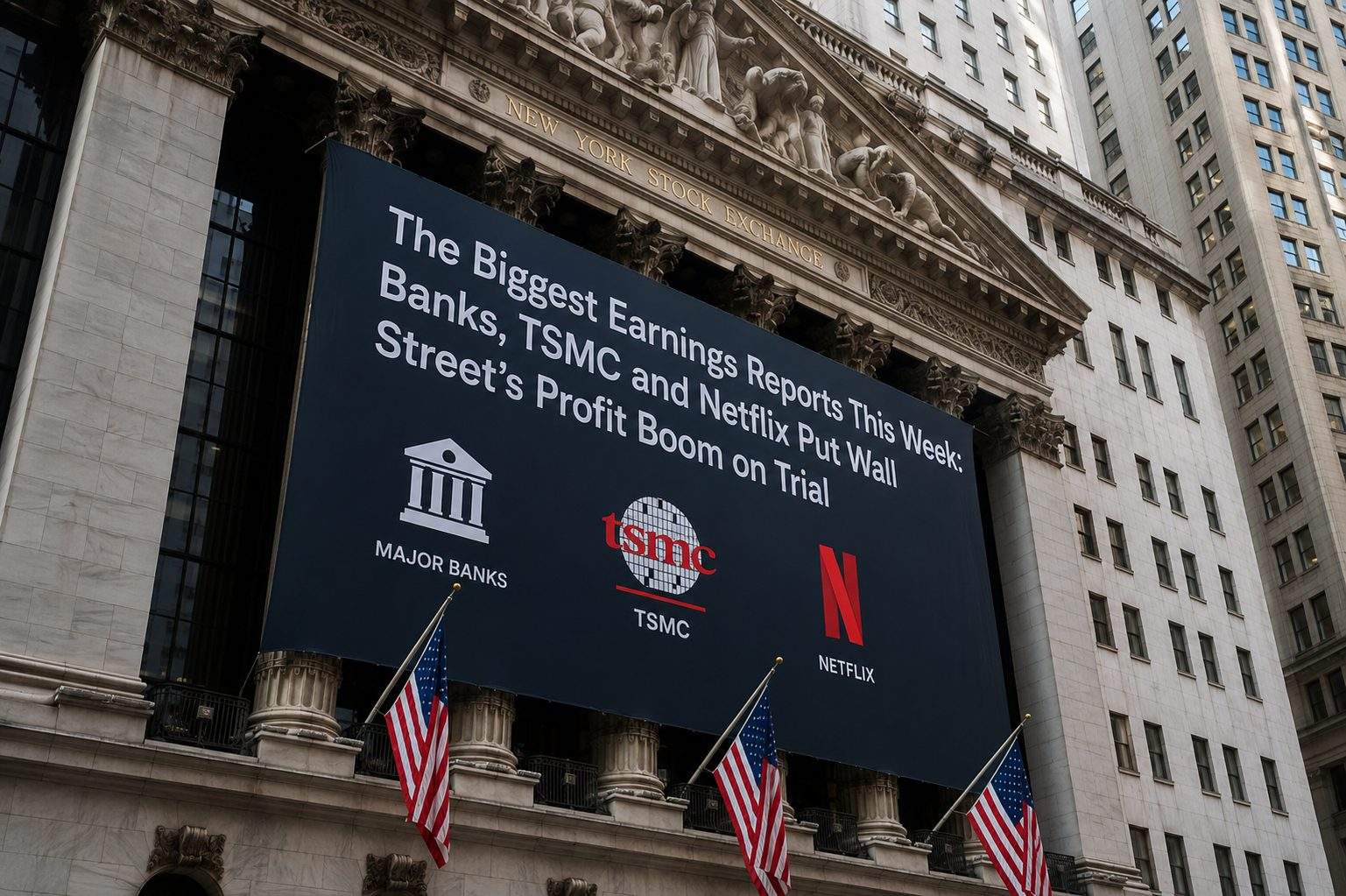

New York, July 12, 2026, 17:15 (EDT)
The market’s central question is whether the profit surge can broaden beyond artificial-intelligence chips and energy without exposing weaker credit. The evidence points to a cautious yes: analysts expect S&P 500 second-quarter earnings to rise 23.4% from a year earlier, and this week’s bank slate will test loan demand and consumer health. The answer still hinges on Taiwan Semiconductor Manufacturing Co. NYSE:TSM defending its high-growth, heavy-investment outlook. Guidance — management’s forecast for coming quarters — matters more now than another round of backward-looking beats.
The bar has moved sharply. The second-quarter growth estimate stood at 15.2% at the start of the year; it has since climbed above 23%. First-quarter profit growth reached 29.4%, led by gains of 65.5% for technology and 115% for energy. Banks, healthcare, chip equipment and streaming now have to show that two sectors are not carrying the whole earnings cycle.
With U.S. cash markets closed Sunday, Friday’s close is the launch point. The S&P 500 finished at 7,575.39 and gained 1.2% last week. The Nasdaq added 1.7%, while the Dow slipped 0.5%. That split leaves the most expensive growth shares under greater pressure to produce firm forecasts, not just meet quarterly estimates.
The calendar is front-loaded, with the largest releases concentrated from Tuesday through Thursday.
| Reporting window | Major companies | What investors will test |
|---|---|---|
| Tuesday, July 14, before the open | JPMorgan Chase NYSE:JPM, Bank of America NYSE:BAC, Citigroup NYSE:C, Wells Fargo NYSE:WFC, Goldman Sachs NYSE:GS | Trading, deal fees, loan demand, deposit costs and credit losses |
| Wednesday, July 15 | ASML Holding NASDAQ:ASML, Morgan Stanley NYSE:MS, Johnson & Johnson NYSE:JNJ, BlackRock NYSE:BLK | Chip-equipment orders, capital markets, healthcare demand and investment flows |
| Thursday, July 16 | TSMC, UnitedHealth Group NYSE:UNH and GE Aerospace NYSE:GE before the open; Netflix NASDAQ:NFLX after the close | AI spending, medical costs, industrial demand, streaming engagement and margins |
Tuesday is the cleanest breadth test. Analysts cited by the Financial Times expect investment-banking fees at the major Wall Street lenders to rise 27% to $11.1 billion, while industry estimates gathered by Reuters point to market-revenue growth of at least 15% for the largest global banks. Jamie Vickers of Coalition Greenwich said equities should be the “primary engine of growth.” The less flashy figures may matter more: net interest margin — the gap between loan yields and deposit costs — and provisions set aside for bad loans. Financial Times
TSMC is the week’s valuation hinge. Its April forecast called for second-quarter revenue of $39 billion to $40.2 billion and a gross margin of 65.5% to 67.5%. It also projected full-year dollar revenue growth above 30% and indicated that capital spending would land near the high end of its $52 billion-to-$56 billion range. Current estimates put revenue near $39.9 billion and profit growth at roughly 46%, meaning a result close to the top of the old range is already anticipated. A plain beat may not be enough without firmer orders or a higher outlook.
ASML and Netflix offer two very different growth checks. Consensus compiled by Kiplinger puts ASML revenue growth at 15.3% and earnings-per-share growth at 16.6%; Susquehanna analyst Mehdi Hosseini said customers were “paying premiums to secure allocation.” Netflix is expected to post revenue growth of 13.6% and EPS growth of 9.7%. Bernstein analysts Laurent Yoon, Martin Boruchowicz and Andrew Chung wrote that “there’s a lot riding on Q2.” For ASML, the issue is whether chipmakers are turning AI demand into equipment orders. For Netflix, it is engagement and the cost of sustaining growth. Kiplinger
UnitedHealth’s update is the week’s medical-cost check. The company reported first-quarter revenue of $111.7 billion, adjusted EPS of $7.23 and raised its 2026 adjusted EPS floor above $18.25. Investors will focus on the medical care ratio — the share of premium revenue spent on patient care — and whether the full-year forecast still has room after another quarter of claims data.
The hidden lever is guidance. Reuters data put the S&P 500 at about 20 times forward earnings — share price divided by forecast profit — down from 21 times in late May. By calculation, a 5% cut to earnings forecasts with stock prices unchanged would lift that multiple to roughly 21.1. It would erase all of the market’s recent valuation relief. A modest downgrade could therefore hurt more than an ordinary quarterly miss; steady or higher estimates would allow stocks to advance without immediately becoming more expensive.
But the downside case is that macro data swamp the results. U.S. consumer inflation lands Tuesday, producer prices Wednesday and retail sales Thursday, while oil-market disruption around the Strait of Hormuz remains an inflation risk. A hot inflation print, cautious bank credit forecasts and no lift from TSMC would be a difficult combination. Michael Reynolds of Glenmede said there were “a lot of factors coming to a head all at once.” Near recent highs, the indices have limited room for an merely in-line quarter. Reuters
The likely market sequence is straightforward. Clean bank credit and intact chip guidance would keep forward estimates moving higher and give the S&P 500 room to challenge its record. Weakness in one group should trigger a rotation between sectors. Weakness in both would turn a high-bar earnings season into a broader retreat from risk.