

São Paulo, August 1, 2026, 19:08 (BRT)
- Nu rose 1.7% last week, lagging three comparable peers that advanced between 4.2% and 5.7%.
- Credit increased by 40% in Q1 on a currency-neutral basis. Deposits climbed 22%, while risk-adjusted net interest margin declined by 100 basis points.
- Shareholders will gather on August 6. Second-quarter earnings will be announced on August 13, after the U.S. market closes.
U.S. cash markets did not open over the weekend. Shares of Nu finished Friday at $14.33, a decline of 1.1% for the session.
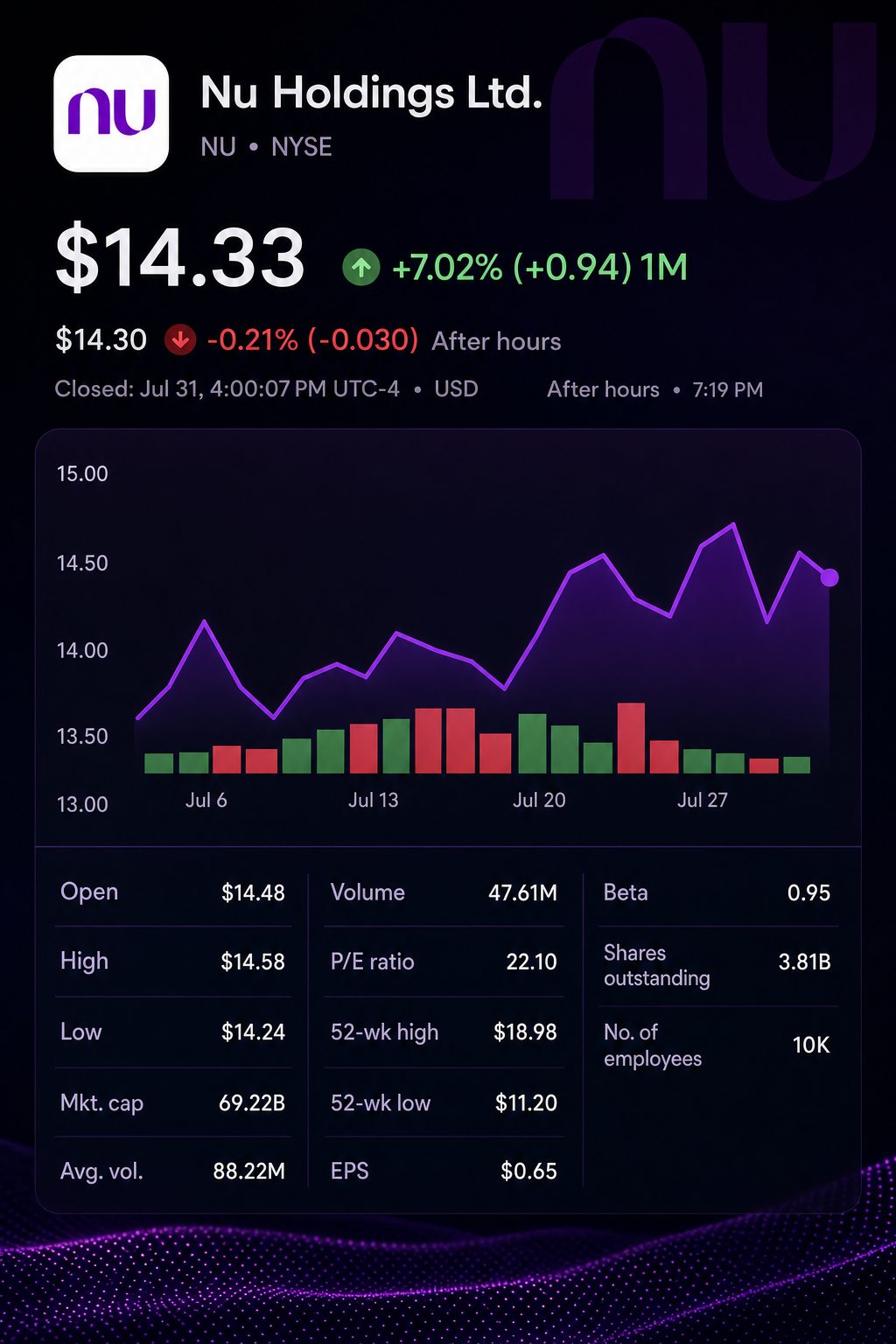
The stock ended the week up 1.7%, underperforming regional peers, although Nu continued to trade at a substantial valuation premium to other Brazilian payment competitors.
The criteria for investors have become more stringent. Nu is required to demonstrate that accelerating loan growth does not compromise risk-adjusted returns.
Nu posted lower returns compared to MercadoLibre Inc. NASDAQ:MELI, StoneCo Ltd. NASDAQ:STNE and PagSeguro Digital Ltd. NYSE:PAGS. The performance reflects closing prices from July 24 to July 31.
| Company | July 31 close | Weekly change | Friday change |
|---|---|---|---|
| Nu Holdings | $14.33 | up 1.7% | down 1.1% |
| MercadoLibre | $1,877.95 | rising 4.2% | off 0.4% |
| StoneCo | $11.375 | advanced 5.7% | dipped 0.5% |
| PagSeguro | $9.64 | gained 4.8% | lost 2.0% |
On Friday, trading volume reached 47.6 million shares, representing around 66% of Nu’s 65-day average. This relatively low activity makes it difficult to argue that the slowdown signaled a clear turning point.
Higher valuation increases reporting expectations. Nu is valued at 22.1 times its trailing earnings, compared with PagSeguro’s 7.2 times and StoneCo’s 4.6 times.
| Company | Trailing P/E | Multiplier compared to Nu |
|---|---|---|
| MercadoLibre | 49.6x | 2.24x |
| Nu Holdings | 22.1x | 1.00x |
| PagSeguro | 7.2x | 0.32x |
| StoneCo | 4.6x | 0.21x |
At 49.6 times earnings, MercadoLibre is still pricier. The peer group is not a precise comparison, as every firm has its own unique business composition.
Nu trades at a premium based on its growth and profit performance. Net income for the first quarter was $871 million, and return on equity came in at 29%.
The credit bridge remains mixed. Lending outpaced deposit growth by 18 percentage points, and initial delinquency rates increased.
| Metric | Q1 2026 | Prior period or growth |
|---|---|---|
| Credit portfolio | $37.2 billion | Up 40% from a year ago, FX-neutral |
| Deposits | $42.4 billion | 22% higher year on year, FX-neutral |
| Loan-to-deposit ratio | 58.3% | Previously 49.1% in Q4 2025 |
| 15-90 day NPL ratio | 5.0% | Rising 89 basis points from previous quarter |
| 90+ day NPL ratio | 6.5% | Fell by 10 basis points quarter on quarter |
| Managerial risk-adjusted NIM | 9.5% | Was 10.5% in Q4 2025 |
The loan-to-deposit ratio increased by 9.2 percentage points over the quarter. Despite headline NIM hitting 21.1%, risk-adjusted NIM declined.
Chief Executive David Vélez said Nu is able to increase limits “with resilience, not just speed.” The August results will show whether the company delivers on that statement compared with actual losses. Nu International
Below is the latest FactSet snapshot. Earnings estimates are still considered preliminary.
| Measure | Current | Prior or reference |
|---|---|---|
| Q2 EPS consensus — preliminary | $0.20 | $0.21 recorded one month earlier; $0.14 forecasted for Q2 2025 |
| FY2026 EPS consensus — preliminary | $0.84 | $0.87 noted three months previously |
| Median price target | $18.00 | $14.33 closing level on Friday |
| Consensus rating | Overweight | 17 analysts recommend Buy, 3 Hold, 1 Underweight, 1 Sell |
The median price target suggests shares could rise 25.6% from Friday’s closing level. However, analyst estimates vary between $10 and $22.
Nu will hold its annual meeting on Thursday, August 6. The agenda includes shareholder votes on the 2025 accounts and the re-election of nine directors.
The main catalyst is set for August 13, following the end of U.S. trading. Nu will hold its earnings call at 6 p.m. EDT.
Risks: Persistent early delinquencies may maintain elevated loss provisions and weigh on risk-adjusted margins. Scheduled U.S. investments might further postpone improvements in efficiency.
Customer numbers have already reached scale. The upcoming rerating will rely on improved credit conversion rather than further customer growth.
Related articles: NYSE:NU