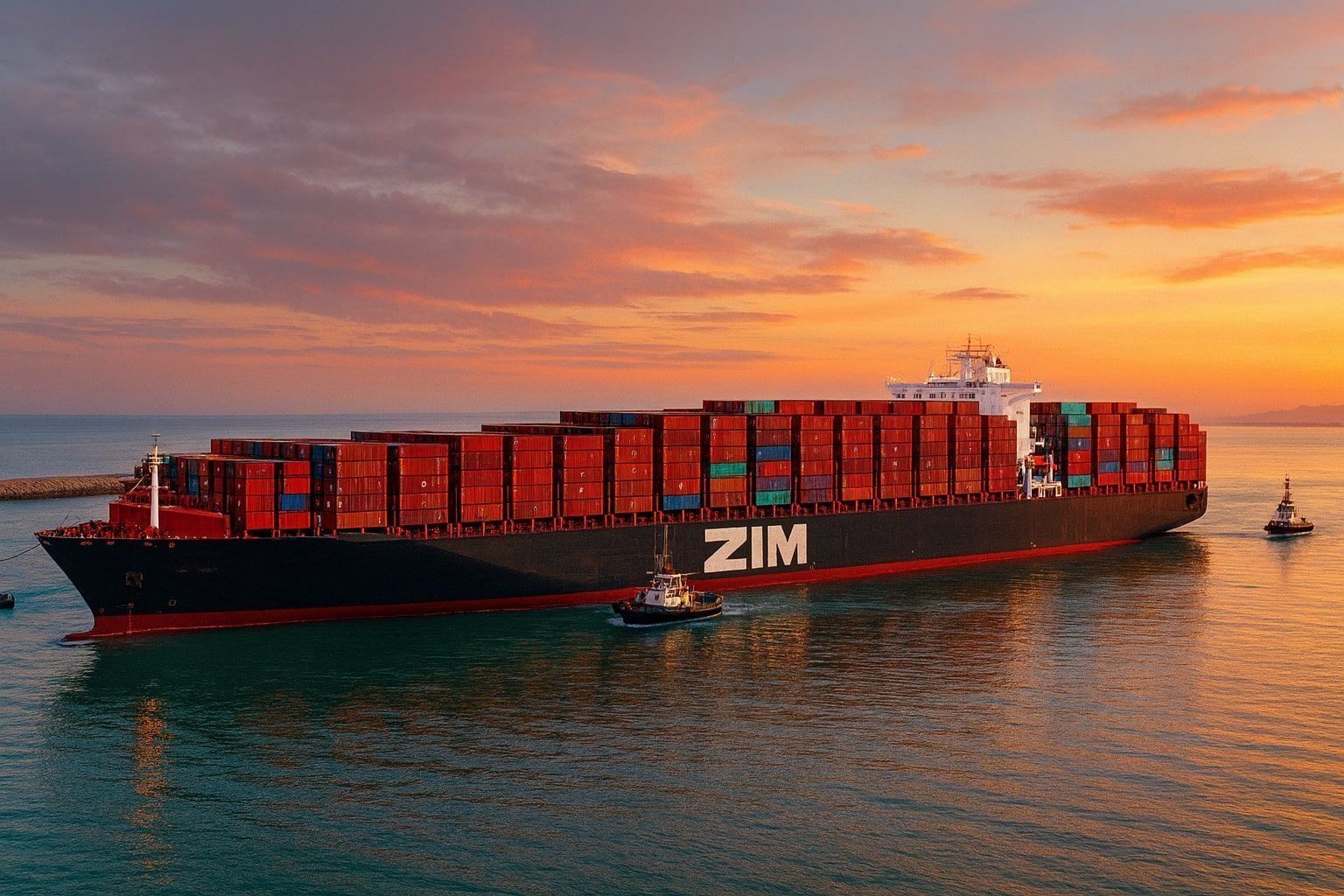
ZIM Integrated Shipping Services Ltd. (NYSE: ZIM) is back in the headlines. On 4 December 2025, the container liner’s stock jumped on reports that German shipping giant Hapag-Lloyd has made an offer for the company, adding fresh takeover speculation to an already volatile dividend-heavy shipping story. Seeking Alpha+1
At the same time, investors are digesting weaker but still solid Q3 2025 results, a sharply higher dividend, a complex tax-withholding update, and a wall of cautious analyst forecasts.
ZIM stock today: price, range and volatility
As of midday on 4 December 2025, ZIM shares were trading around $19.9 on the NYSE, giving the company a market capitalization of roughly $2.3–2.4 billion. MarketWatch
Key trading metrics:
- 52-week range: about $11.04–$23.61 per share MarketWatch
- Beta: around 1.3–1.7, meaning the stock tends to move more than the broader market MarketWatch+1
- Trailing P/E: roughly 2–3× earnings, a very low multiple that reflects highly cyclical, potentially peak-ish profits MarketBeat
Price action has been wild. A recent fundamental review noted that ZIM’s share price rose about 17.6% in a week and 37.3% over the past month, yet was still down roughly 15.5% year-to-date at the time of publication—evidence of just how quickly the market is re-pricing shipping risk. Simply Wall St
Takeover talk: Hapag-Lloyd reportedly makes a bid
The big catalyst on 4 December is M&A chatter.
- Israeli business daily Globes reported that Hapag-Lloyd has made an offer for ZIM, without disclosing terms.
- A short note on Seeking Alpha said ZIM shares were up about 3.7% pre-market on the news. Seeking Alpha
- Investing.com similarly reported that the stock rose around 4% after the takeover story hit the tape. Investing.com Australia
So far:
- There is no detailed public information on the price, structure, or conditions of the bid.
- Neither company has published a full transaction announcement.
- Any deal would likely face regulatory and political scrutiny, given ZIM’s strategic status in Israel and Hapag-Lloyd’s scale in Europe.
For now, this is a reported approach, not a signed merger agreement. The market is pricing in some chance of a premium takeout, but also a non-trivial probability that negotiations stall or never translate into a binding offer.
Earnings check: Q3 2025 shows a “normalizing” profit cycle
ZIM’s latest reported results are for the third quarter of 2025, published on 20 November.
Q3 2025 headline numbers
For the quarter ended 30 September 2025, ZIM reported: investors.zim.com+1
- Revenue:$1.78 billion, down from $2.77 billion in Q3 2024 (‑36%)
- Net income:$123 million, versus $1.126 billion a year earlier (a drop of almost 90%)
- Diluted EPS:$1.02, down from $9.34 in Q3 2024
- Adjusted EBITDA:$593 million (33% margin), versus $1.53 billion (55% margin)
- Adjusted EBIT:$260 million (15% margin), versus $1.24 billion (45% margin)
- Carried volume:926k TEUs, down 5% year-on-year
- Average freight rate:$1,602 per TEU, down about 35% from $2,480 in Q3 2024
For the first nine months of 2025, ZIM generated: investors.zim.com+1
- Revenue:$5.42 billion (vs. $6.26b in 9M 2024)
- Net income:$443 million (vs. $1.59b)
- Adjusted EBITDA:$1.84 billion (34% margin)
The message is straightforward: ZIM is still profitable and cash-generative, but its earnings are far below the shipping boom peak. Lower freight rates are doing exactly what everyone expected—compressing margins.
Q2 2025 context: a softer quarter, then a rebound
In Q2 2025, ZIM already showed signs of normalization: investors.zim.com
- Revenue: $1.64 billion
- Net income: $24 million (EPS $0.19)
- Adjusted EBITDA: $472 million
- Average freight rate: $1,479 per TEU, down 12% year-on-year
Q3 marks a sharp sequential improvement in net income ($123m vs. $24m), helped by higher rates, disciplined capacity, and an optimized fleet, even though year-on-year comparisons remain harsh.
Upgraded 2025 guidance
Despite warning that Q4 market conditions have weakened, ZIM raised its full-year 2025 guidance in November: investors.zim.com
- Adjusted EBITDA: now $2.0–$2.2 billion
- Adjusted EBIT: now $700–900 million
Previously (after Q2) it had guided to $1.8–2.2bn EBITDA and $550–950m EBIT. investors.zim.com
Management credits:
- A more modern, cost-effective fleet
- “Agile” redeployment of ships across trade lanes
- Tight cost control in a volatile, geopolitically complex environment
In other words, the company is trying to outrun falling rates with efficiency and flexibility, at least for now.
Dividend: high yield, but variable and explicitly not guaranteed
ZIM is famous (or notorious) for its outsized dividends when times are good.
Recent payouts in 2025
- Q2 2025 dividend:$0.06 per share, about $7 million total, representing 30% of quarterly net income. investors.zim.com
- Q3 2025 dividend: raised sharply to $0.31 per share, roughly $37 million, again about 30% of net income, payable 8 December 2025 to shareholders of record on 1 December. investors.zim.com
A dividend-tracking site currently puts ZIM’s forward dividend yield at around 6.3%, based on the latest $0.31 quarterly payout and the current share price. Digrin
However, ZIM’s own communications are crystal clear:
- The company runs a variable payout policy, targeting roughly 30% of annual net income.
- In the latest dividend-related IR note, ZIM stresses that “other than the dividend previously declared… there is no guarantee the Company will declare additional dividends in the future.” investors.zim.com
Given how violently earnings move with freight rates, investors should treat that 6%+ yield as a snapshot, not a promise.
Israeli withholding tax ruling: important for foreign shareholders
On 1 December, ZIM released a detailed update on Israeli withholding tax procedures for the December 2025 dividend. Key points: investors.zim.com
- By default, ZIM will withhold 25% of the dividend and remit that amount to an appointed agent (IBI Trust Management).
- The remaining 75% of the cash goes to the transfer agent and then to shareholders.
- Shareholders who are residents of countries with tax treaties with Israel may be eligible for a reduced final withholding rate, but they must file specific forms and documentation (residency certificates, declarations, etc.) with the agent.
- The deadline to complete this process is 8 January 2026; after that, the agent will not process refunds.
For non-Israeli investors, this tax layer is non-trivial. In practical terms, ZIM is a high-yield but tax-complicated dividend stock.
What Wall Street thinks: mostly “sell” with downside targets
Despite the recent share price rally and high dividend, analyst sentiment around ZIM remains broadly negative.
Consensus ratings and price targets
Different data providers line up in roughly the same range:
- TradingView:
- Average 12-month price target:$14.17
- Range: $8.70–$20.00
- Overall rating:Sell, based on 7 analysts in the past three months. TradingView
- MarketBeat (via recent institutional-flow article):
- Consensus rating:“Strong Sell”
- Consensus target: about $13.25
- Breakdown: 3 “Hold” and 4 “Sell” ratings, with underweight calls from major banks. MarketBeat
- Nasdaq / Fintel summary (17 November 2025):
- Average one-year target:$13.60
- Range: $11.62–$15.75
- Implied ~30% downside from a then‑price of $19.30 per share. Nasdaq
At the same time, that Fintel report projects: Nasdaq
- 2026 revenue: about $7.0 billion, down ~8%
- Non‑GAAP EPS:‑$1.71 (i.e., a forecast loss)
The pattern is clear: analysts expect profits to fade and possibly swing negative as the freight cycle normalizes, and they generally see the stock as overvalued relative to those normalized earnings, despite the optically low P/E on trailing numbers.
Fund flows: long-term money vs. quant selling
Two fresh 13F‑based stories on 3–4 December show how divided institutional investors are on ZIM.
OMERS boosts its stake
Canada’s OMERS Administration Corp, a large pension investor, nearly doubled its stake in ZIM in Q2 2025: MarketBeat
- Holdings increased 99.7% to 115,855 shares
- Position value: about $1.86 million, roughly 0.10% of the company
- MarketBeat notes other traditional asset managers (Cetera, Zurcher Kantonalbank, etc.) also increasing or initiating positions.
Quantbot cuts back
By contrast, Quantbot Technologies LP, a quantitative hedge fund, reduced its ZIM holdings by 46.3% in Q2: MarketBeat
- New position: 313,840 shares, down from 584,733
- Value: about $5.05 million, around 0.26% of the company
Across the shareholder base, around 21% of ZIM’s float is held by hedge funds and other institutional investors, according to MarketBeat. MarketBeat+1
The takeaway: long-horizon funds are nibbling, while more tactical players are happy to take profits, reinforcing the idea that ZIM is a contentious, high-beta shipping trade rather than a consensus favorite.
Industry backdrop: overcapacity, volatile rates and a “tough” 2026
ZIM doesn’t operate in a vacuum. Container shipping is shifting from the explosive COVID-era boom into a more familiar pattern of overcapacity and pressure on rates, punctuated by short-term shocks.
Capacity vs. demand
Recent data from a Freightos Baltic Index update citing Drewry and BIMCO implies: Freightos
- Global container fleet capacity is expected to grow 6.9% in 2025 to about 32.97 million TEUs, and a further 2.2% in 2026 to 33.7 million TEUs.
- Global container volumes are forecast to grow only 2.5–3.5% per year in both 2025 and 2026.
More ships + modest demand growth = structural oversupply, historically bad news for liner profitability.
Spot rates: short-term spikes, long-term pressure
Xeneta’s October 2025 ocean freight analysis describes: Xeneta
- Spot rates from the Far East to the U.S. West Coast up ~38% since 1 October, to roughly $2,138 per FEU.
- Far East to U.S. East Coast up ~23%, to about $3,038 per FEU.
- Far East to North Europe up 18%, and to the Mediterranean 9%, yet still far below last year’s levels.
Despite the Q4 spike, Xeneta’s Ocean Outlook 2026 still expects overall lower long‑ and short‑term rates in 2026, as the overcapacity wave persists.
A SeaRates 2026 freight-cost scenario study goes further, suggesting that depending on how the Suez Canal disruption and potential “front-loading” of U.S. imports play out, Asia–U.S. West Coast containers could cost anywhere from $1,800–2,600 per FEU in a benign scenario to $6,500–9,500+ in a stress scenario; Asia–North Europe could range from $2,400–3,600 all the way up to $8,000–12,000+. SeaRates
Meanwhile, CMA CGM’s finance chief recently warned that “2026 won’t be a great year” for container shipping, flagging a likely slowdown in trade as capacity keeps coming online. Yahoo Finance
For ZIM, this backdrop means:
- Margins will remain highly sensitive to spot rate moves, both up and down.
- Its upgraded 2025 guidance may sit near the top of the post‑boom earnings range, not a new normal.
- Execution on cost control and fleet efficiency will be crucial as industry tailwinds fade.
ZIM’s balance sheet and risk profile
Leverage and liquidity
ZIM’s Q3 release shows: investors.zim.com+1
- Net debt:$2.64 billion, down from $2.88 billion at year-end 2024
- Net leverage ratio:0.9× Adjusted EBITDA (vs. 0.8× at end‑2024)
- Total cash (including deposits and investments): about $3.01 billion
This is not a distressed balance sheet, but with a cyclical business and forecast negative EPS in some models for future years, debt still matters, especially if freight rates sink further.
Dividend track record and cyclicality
Since its January 2021 IPO, ZIM says it has paid roughly $5.7 billion in dividends—more than 25× the cash raised at IPO. investors.zim.com
That impressive figure is a double-edged sword:
- On the upside, ZIM has demonstrated a willingness to return cash aggressively when the cycle is favorable.
- On the downside, those distributions underline how extraordinary the 2021–2022 freight boom was, and why forward-looking dividend expectations must be toned down as conditions normalize.
A late-November analysis on Seeking Alpha (title: “Rich FQ4’25 Payouts Unlikely, Painful New Normal Ahead”) argues that investors expecting previous “super-dividends” to continue into 2026 will likely be disappointed, given shrinking profit pools and a tougher industry outlook. Seeking Alpha
The Hapag-Lloyd angle: catalyst or mirage?
The reported Hapag-Lloyd bid injects a new strategic angle into a story that was already a pure freight-cycle trade.
Potential positives if a deal materializes:
- Takeover premium: acquirers often pay a premium over the undisturbed share price, which could lock in gains for existing shareholders.
- Scale and synergies: integration with a larger player could improve route coverage, bargaining power with customers and suppliers, and capital efficiency.
- Balance sheet support: a stronger parent might reduce perceived credit risk.
But at this stage, investors should remember:
- Terms, price and structure are unknown.
- Regulatory approval—particularly on competition and national-interest grounds—could be complex.
- Hapag-Lloyd may walk away, revise terms, or pivot depending on market conditions.
Until a formal merger agreement is signed and filed, the Hapag-Lloyd story is a speculative catalyst, not a base-case scenario.
Bottom line: ZIM stock sits at the crossroads of M&A hope and freight reality
Putting it all together:
- ZIM stock is trading near the upper half of its 12‑month range, boosted by a reported Hapag-Lloyd bid and a powerful recent rally. Seeking Alpha+2MarketWatch+2
- The company is still solidly profitable in 2025, with upgraded guidance and strong cash generation — but earnings are down ~90% from 2024 boom levels, and most analysts expect further normalization, or even losses, in coming years. investors.zim.com+2PR Newswire+2
- The dividend is high today and tax-optimized for some investors, but it is explicitly variable and not guaranteed, and heavily tied to a volatile freight cycle. investors.zim.com+2investors.zim.com+2
- Street consensus is bearish, with price targets clustered around $13–14—well below the current price—and ratings skewed to Sell/Underweight, reflecting cautious views on 2026–2027 shipping profits. TradingView+2MarketBeat+2
- The industry backdrop of rising fleet capacity, modest demand growth and a “tough” 2026 narrative suggests that freight-rate spikes may be temporary, while structural pressure on margins persists. Yahoo Finance+3Freightos+3Xeneta+3
For investors, ZIM in December 2025 looks like:
- A high-risk, high-volatility shipping stock
- With a big, but uncertain, M&A kicker
- A juicy yet fragile dividend stream
- And fundamentals that depend heavily on how the container freight cycle evolves into 2026
Anyone considering ZIM stock should treat this as informational analysis, not personalized investment advice. Portfolio decisions around ZIM depend heavily on individual risk tolerance, time horizon, tax situation, and views on both global trade and the probability and pricing of any Hapag-Lloyd deal.