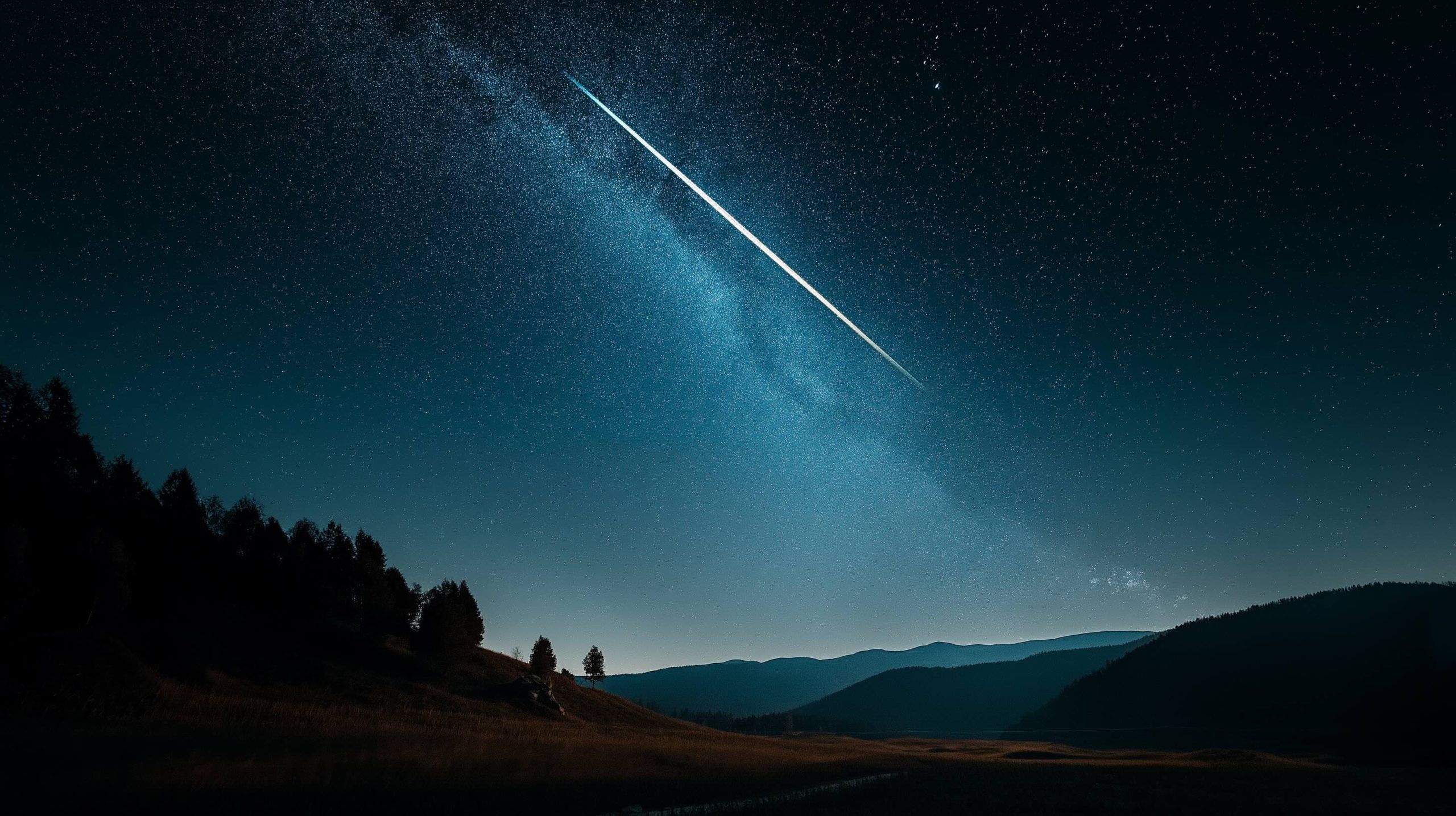

- The June Bootids peak occurs on the night of 27 June 2025 at about 04:00 PDT / 11:00 UTC as Earth intersects the dust trail of periodic comet 7P/Pons-Winnecke.
- The parent body is periodic comet 7P/Pons-Winnecke with a 6.3-year orbit and a nucleus about 5 km in diameter.
- Meteor speeds are slow for Bootids, about 18 km/s, producing long, graceful streaks.
- The typical Zenithal Hourly Rate (ZHR) is 0–10 meteors per hour, but historical outbursts reached 100+ meteors per hour in 1916, 1921, 1927, and 1998.
- The Moon on 27 June 2025 is a 9% illuminated waxing crescent with moonset mid-evening, providing negligible glare.
- The radiant lies near Beta Boötis (Nekkar) at RA 14h50m, Dec +48°, rising overhead soon after dusk for mid-northern latitudes.
- Dust in the Bootids comes from the 6.3-year ejections of 7P/Pons-Winnecke, with Jupiter’s gravity trapping some dust into resonant packets that cause bursts.
- The 1998 Bootid dust was released during the comet’s 19th-century returns, proving Bootid activity can flare decades after ejection.
- After a Jupiter encounter in 2037, Pons-Winnecke’s perihelion will drop below Earth’s orbit, potentially changing Bootid behavior in the 2060s.
- Viewing guidance advises best conditions after dusk or in pre-dawn hours, looking 30–40° away from the radiant, staying 1–2 hours, and using fast lenses (f/2.8 or faster) with 15-second exposures.
Summary
On the night of 27 June 2025, Earth will slice through the tenuous dust trail of comet 7P/Pons‑Winnecke, producing the unpredictable June Bootids meteor shower. Although the shower usually sputters along at only one or two meteors an hour, past eruptions (1916, 1921, 1927 and 1998) have surprised observers with dazzling outbursts exceeding 100 meteors an hour. This year’s peak arrives just two days after new Moon, ensuring dark skies, and the radiant in Boötes stays above the horizon all night for most of the Northern Hemisphere. Below is an in‑depth report on the science, the history, and the practical “when & where” so you can give the 2025 Bootids their best chance to impress.
Key facts at a glance
| Parameter | 2025 value |
|---|---|
| Active dates | 22 Jun – 2 Jul 2025 space.comin-the-sky.org |
| Peak (predicted) | Night of 27 Jun 2025 (≈ 04:00 PDT / 11:00 UTC) in-the-sky.org |
| Parent body | Periodic comet 7P/Pons‑Winnecke (6.3‑yr orbit, ~5 km nucleus) en.wikipedia.org |
| Typical speed | 18 km s⁻¹ — very slow, producing long, graceful streaks spaceweather.com |
| Expected ZHR | Variable 0–10; historically up to 100+ in outbursts en.wikipedia.orgspaceweather.com |
| Moon phase | 9 % waxing crescent (moonset mid‑evening) — negligible glare space.comin-the-sky.org |
| Radiant | Near β‑Boötis (Nekkar), RA 14ʰ50ᵐ, Dec +48° — overhead soon after dusk at mid‑northern latitudes in-the-sky.org |
Origins, orbit and outbursts
Comet 7P/Pons‑Winnecke sheds millimetre‑scale dust every 6.3 years, but Jupiter’s gravity corrals some clumps into resonant “packets.” When Earth strikes a dense packet we get a Bootid burst — exactly what happened in 1916, 1921, 1927 and most recently in 1998, when rates briefly hit ~100 h⁻¹ spaceweather.comen.wikipedia.org. Orbital studies show the 1998 dust was released during the comet’s 19th‑century returns, proving that Bootid activity can flare decades after ejection.
A comet on a shifting path
Pons‑Winnecke’s perihelion is currently 1.23 AU but will drop below Earth’s orbit after a 2037 Jupiter encounter, potentially changing Bootid behaviour in the 2060s en.wikipedia.org.
Why 2025 is (modestly) favourable
- Dark sky window – New Moon falls 25 June; on the 27th the slim crescent sets early, removing lunar glare for the entire peak night space.comin-the-sky.org.
- Evening‑high radiant – The radiant culminates before darkness, so Bootids are best immediately after dusk and again in pre‑dawn hours when Earth’s motion gives meteors a “head‑on” geometry in-the-sky.org.
- No major rival showers – June is generally quiet; the International Meteor Organization lists no major showers competing for attention amsmeteors.org.
“The June Bootids are usually a very weak shower that occasionally blossoms into a memorable event — that unpredictability is what keeps meteor observers watching.” — Robert Lunsford, American Meteor Society amsmeteors.org
Viewing guide
Best times
| Region | Optimal window on 27 Jun |
|---|---|
| Western N. America | 21:30–00:30 local & 03:00–04:30 pre‑dawn in-the-sky.org |
| Eastern N. America | Just after dusk; radiant still 50° up by nightfall wibx950.com |
| Europe | Late twilight to midnight; radiant >65° at 22:00 local in-the-sky.org |
| India | Post‑midnight dark window before dawn (Moon already set) timesofindia.indiatimes.com |
How to watch
- Get dark – suburban back‑yards will show a handful; a rural site multiplies counts five‑fold.
- Look 30–40° away from the radiant; side‑glance rays appear longer and easier to spot in-the-sky.org.
- Stay for 1–2 hours. Bootid activity is clumpy; patient observers reap rewards.
- Bring a reclining chair, warm layers and a red‑light flashlight. Fast lenses (f/2.8 or faster) and 15‑s exposures capture slow Bootid streaks nicely.
What (not) to expect
The American Meteor Society designates the Bootids “Class III – variable,” meaning most years produce <10 meteors h⁻¹, but rare years surprise space.comamsmeteors.org. If you crave guaranteed spectacle, the Perseids in August typically top 100 h⁻¹ m.facebook.com.
Expert and media perspectives
- NASA’s Meteoroid Environment Office notes Earth is pelted by ~48.5 t of cosmic dust daily — meteor showers simply highlight that constant drizzle space.com.
- Jamie Carter in Forbes advises aiming “a couple of hours before dawn and right after sunset” to bracket the Bootid peak forbes.com.
- Upstate New York outlets emphasise the shower’s “all‑or‑nothing” reputation and praise 2025’s moon‑free sky wibx950.comcnynews.com.
- Indian media list the Bootids among June’s nine “don’t‑miss” sky events for 2025 timesofindia.indiatimes.com.
Scientific significance
Because Bootids are so slow, their luminous efficiency is low; cameras and radar help constrain meteoroid mass. Comparing 2025 flux with the well‑documented 1998 burst will test dust‑trail models that link activity to 19th‑century ejections trapped in Jupiter’s 1:2 resonance spaceweather.com. Any uptick this year would hint that fresh dense knots persist — a boon to dynamicists forecasting future storms.
Final thoughts
The June Bootids will never rival the Perseids for reliability, but their very capriciousness is the appeal: every observer beneath a clear, moon‑free sky on 27 June becomes part of a live scientific experiment. Whether you log one meteor or twenty, you will have sampled debris shed from a five‑kilometre comet more than a century ago — a direct, naked‑eye connection to the Solar System’s dynamism. Clear skies and good luck!
This report draws on data and commentary from Space.com, In‑The‑Sky.org, SpaceWeather.com, the American Meteor Society, Wikipedia, Forbes, regional news outlets and the Times of India, with publication dates ranging from 17 June 2025 to 27 June 2025.