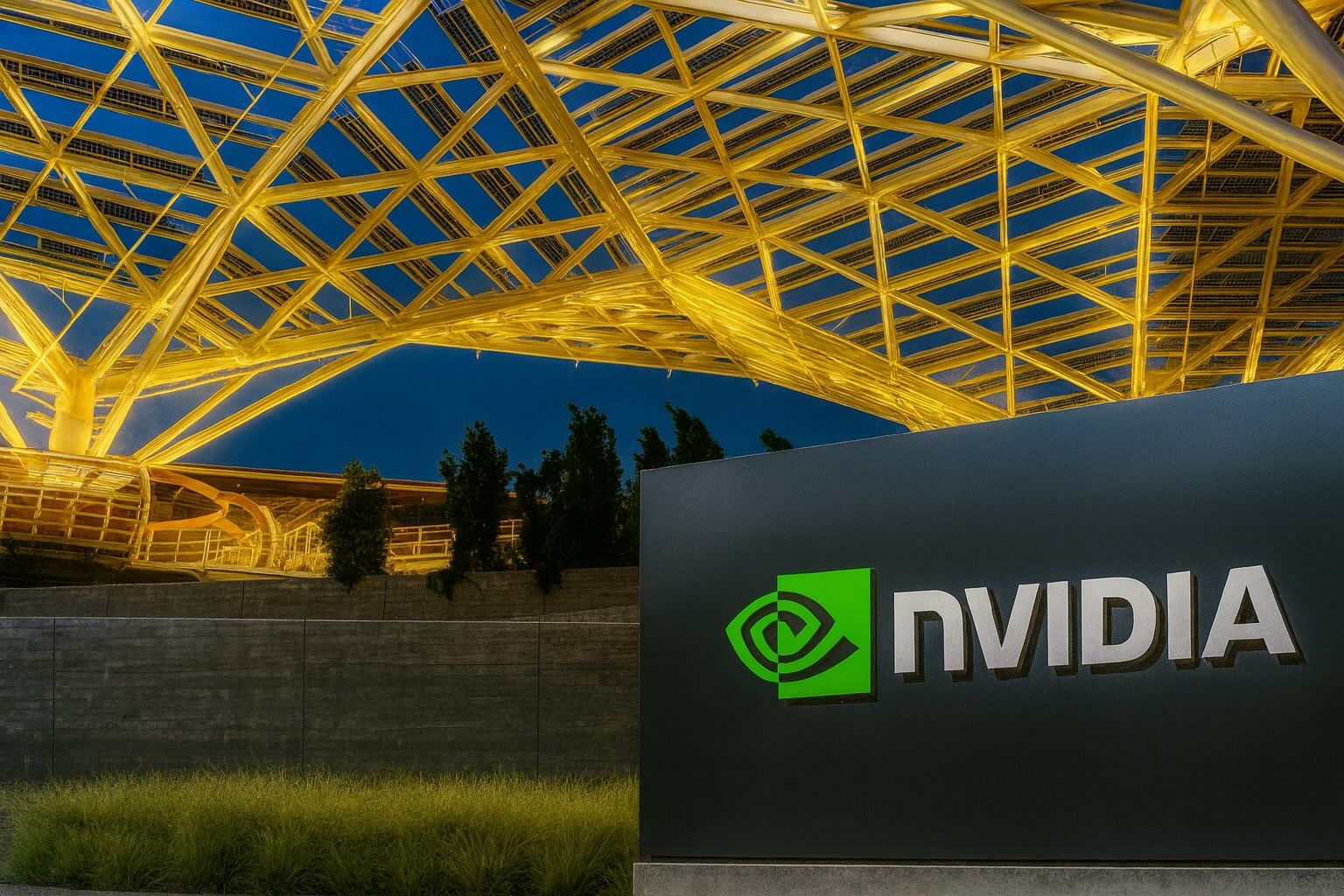

- New Highs: Nvidia’s stock NASDAQ:NVDA closed around $186 on Oct. 24 – just shy of its all-time high (~$195) – valuing the company near $4.4 trillionts2.tech. Shares then jumped to about $191.5 by Oct. 27 and nearly hit $200 intraday on Oct. 28, marking a potential record high as investors pile into the AI boommarkets.financialcontent.commarkets.financialcontent.com. NVDA is up roughly 30% year-to-date (about +58% from a year ago), vastly outperforming the S&P 500ts2.tech.
- Blowout Growth: Explosive demand for Nvidia’s AI chips drove revenue up 56% last quarter to $46.7 billion (FY2026 Q2)ts2.tech. An astonishing $41 billion (≈88% of sales) came from data-center GPUs that power generative AIts2.tech. Net income jumped ~59% with gross margins above 72%, underscoring Nvidia’s role as the “backbone” of the AI boomts2.tech. In early October, Nvidia’s market cap briefly topped $4.5 trillion, making it the world’s most valuable company at that timets2.tech.
- AI Mega-Deals: Nvidia is capitalizing on the AI frenzy with unprecedented partnerships. It inked a $100 billion deal to supply 10 GW of GPUs to OpenAIts2.tech, and is backing Elon Musk’s startup xAI’s $20 billion supercomputer project (Nvidia committing ~$2 billion)ts2.tech. The company also took a $5 billion stake in Intel to co-develop next-gen chips and joined a $40 billion consortium (with BlackRock, Microsoft, etc.) to acquire data centers for AI cloud capacityts2.tech. OpenAI CEO Sam Altman praised Nvidia’s pivotal role, noting “Everything starts with compute,” as Nvidia’s chips will power future AI breakthroughsts2.tech. These alliances sparked euphoria – Nvidia’s stock leapt ~4% on the OpenAI news and 2%+ on the xAI dealts2.tech – reflecting hopes of years of guaranteed AI hardware demand.
- AI Dominance & Gaming: Nvidia’s data-center business now dominates, but its other segments are rebounding too. Last quarter, gaming GPU sales jumped 49% year-on-year to $4.3 billion, boosted by new GeForce RTX 40/50-series cards and AI-driven featurests2.tech. This growth in gaming and Nvidia’s automotive and professional visualization units shows the company isn’t a one-trick pony – even if AI data centers remain the main driver. CEO Jensen Huang asserts the AI revolution is still in “early innings,” calling Nvidia’s upcoming Blackwell GPU “the AI platform the world has been waiting for” amid “extraordinary” demandts2.tech.
- Global Headwinds: Nvidia faces geopolitical risks as U.S.–China tech tensions heat up. U.S. export curbs on advanced chips (like Nvidia’s A100/H100 GPUs) could cut an estimated $5–$7 billion in annual sales – over 10% of Nvidia’s revenuets2.tech. Nvidia rolled out modified China-only chips to comply with U.S. rules, but China reportedly halted some orders and increased inspections of Nvidia chips in retaliationts2.tech. Rumors of tighter restrictions have sporadically rattled NVDA’s stock. On the flip side, U.S. authorities granted some relief – approving licenses for a new Nvidia “H20” chip for China and a major shipment to the UAEts2.tech – slightly easing fears of a full China cutoff. Analysts also warn that any conflict over Taiwan (home to Nvidia’s key chip supplier TSMC) could destabilize global semiconductor supply chainsrileysentinel.com, a looming risk for the entire AI industry.
- Rivals & Supply: Nvidia’s success has drawn challengers in the AI chip race. Rival AMD scored a deal to provide ~6 GW of AI chips to OpenAI (starting 2026), even offering OpenAI an option to take a 10% stake in AMDts2.tech. AMD’s stock soared 34% in one day on that newsts2.tech. Other buyers like Oracle plan to deploy tens of thousands of AMD’s upcoming MI300 GPUs in the cloudts2.tech, and OpenAI is co-developing custom AI chips with Broadcomts2.tech. While competition is heating up, analysts say it won’t upend Nvidia’s lead anytime soon – for now Nvidia sells every AI chip it can produce amid insatiable demandts2.tech. To bolster its supply, Nvidia is even partnering with Intel and global firms on new chip fabs and “AI factories” (massive data centers for AI R&D) to ensure capacity for the futurets2.techts2.tech.
- Wall Street’s Take:Analysts are overwhelmingly bullish on NVDA. Over 90% of Wall Street analysts rate the stock a “Buy,” and the average 12-month price target sits around $210–$220 (≈15–20% above current levels)ts2.tech. Some bulls see even more upside – HSBC recently hiked its target to $320 (nearly 80% above today)ts2.tech, and there’s speculation Nvidia could one day hit a staggering $10 trillion market valuationts2.tech. As one analyst urged investors: “Don’t sleep on Nvidia” in the AI erats2.tech. However, valuations are steep at ~50× earningsts2.tech, and a lone contrarian, Jay Goldberg of Seaport Global, warns the stock is “priced for perfection.” Goldberg – the only major analyst with a Sell rating on Nvidia – argues “there’s a lot more that can go wrong… than can go right,” likening the AI hype to the dot-com bubblets2.tech. His ultra-bearish price target of $100 implies a sharp drop ahead, based on fears that today’s frenetic AI spending could “tumble down” if the frenzy fadests2.tech.
- Future Outlook:Investor sentiment remains optimistic heading into Nvidia’s next earnings report on November 19, 2025ts2.tech. The company itself has guided for about $54 billion in quarterly revenue (≈54% year-over-year growth) for the quarter ending Oct. 2025ts2.tech – another potential blockbuster. Such numbers would put Nvidia on track to exceed $200 billion in annual revenue for the first time in FY2026ts2.tech, a milestone that seemed unthinkable just a couple years ago. All eyes will be on whether Nvidia’s results and guidance can meet the sky-high expectations. Another “beat-and-raise” would likely fuel the stock’s next leg higher – possibly toward that $300 markts2.tech. But any hint of cooling AI demand or other hiccups could trigger a swift sell-offts2.tech given NVDA’s rich valuation. In short, Nvidia has become the ultimate high-reward, high-risk bet on the future of AI: the company’s ride looks poised to continue at breakneck speed, even as investors debate whether the stock’s stratospheric heights are justified or headed for a reality check.
Nvidia Stock Near Record Highs
Nvidia’s stock has been on a tear in late 2025, repeatedly flirting with all-time highs. On October 27, NVDA shares closed at $191.49markets.financialcontent.com, extending a rally from about $186 at the end of the prior week. On Tuesday, October 28, the stock surged another ~3% by midday, briefly trading around the $197–$198 levelmarkets.financialcontent.com – territory that would mark a new record closing high if sustained. This latest jump solidifies Nvidia’s market capitalization well above $4 trillion, keeping it in close contention for the title of world’s most valuable company. (Notably, Nvidia even briefly surpassed Apple and Microsoft in market value when it crossed $4.5 trillion earlier in Octoberts2.tech.)
The stock’s momentum reflects investors’ almost unabated enthusiasm for Nvidia’s role at the heart of the AI revolution. NVDA has climbed about 30% in 2025 (vs. roughly 10% for the S&P 500) and sits nearly 58% higher than a year agots2.tech. In fact, Nvidia’s market surge since late 2022 has been staggering – shares have risen over 1,300% in three yearsts2.tech as Wall Street wagers that Nvidia’s chips are indispensable to the future of artificial intelligence. Thanks to its massive run-up, Nvidia now comprises roughly 7% of the entire S&P 500 index by weightts2.tech. This means NVDA’s daily moves heavily sway major stock indexes – a testament to how dominant the company has become in the market’s psyche.
Such a rapid ascent hasn’t been without volatility. In mid-October, a spike in long-term interest rates prompted a tech stock pullback, and Nvidia tumbled about 4% in a single dayts2.tech amid broader market jitters. But dip buyers quickly stepped in to “buy the AI dip,” and Nvidia’s stock rebounded within days back toward its highsts2.tech. Analysts noted this resilience shows how “entrenched Nvidia has become in the AI narrative” – each new headline about AI progress tends to send the stock higher, while any hint of trouble triggers only short-lived selloffsts2.tech. In other words, Nvidia now trades as a bellwether for AI sentiment, with investors accepting a higher risk/reward profile given the company’s unique position. At around 50× forward earningsts2.tech, Nvidia’s valuation is undeniably rich, but many bulls argue that exceptional growth justifies the premium.
AI Boom Fuels Explosive Earnings Growth
Nvidia’s financial results have validated the hype: the AI boom is translating into extraordinary growth for the company’s top and bottom lines. For the quarter ending July 2025 (Nvidia’s fiscal Q2 2026), the company reported revenue of $46.7 billion, up 56% year-on-yearts2.tech. To put that in perspective, Nvidia added over $16 billion in sales versus the same quarter a year prior – one of the fastest growth rates ever for a company of Nvidia’s sizets2.tech. Even more striking, roughly $41 billion of that quarterly revenue (about 88%) came from Nvidia’s data-center segment alonets2.tech. This is the segment that sells high-performance graphics processors (GPUs) for cloud computing and AI model training. In effect, the ongoing “AI gold rush” – as companies worldwide race to build advanced AI systems – is directly driving unprecedented demand for Nvidia’s AI chips.
This surge in sales has made Nvidia wildly profitable. The company’s gross profit margins exceeded 72%, and quarterly net income jumped around 59% year-over-yearts2.tech. With demand far outstripping supply, Nvidia enjoys exceptional pricing power on its cutting-edge GPUs, allowing it to earn rich margins. As a result, the company is generating cash at a record pace – a stark turnaround from a couple of years ago when Nvidia’s earnings were more modest. Executives have described the financial performance as “jaw-dropping.” Indeed, Nvidia’s CEO Jensen Huang remarked that the appetite for Nvidia’s latest AI hardware is “extraordinary” and represents an “exceptional generational leap” in computing technologyts2.tech.
It’s not just the numbers that impress – it’s Nvidia’s centrality to the AI ecosystem that underpins those numbers. The company’s GPUs are effectively the workhorses of modern AI. They power everything from training massive GPT-style models (like OpenAI’s ChatGPT) to running AI services in data centers around the globe. This near-ubiquity in AI projects has given Nvidia substantial influence. One portfolio manager noted that Nvidia’s rise “highlights that companies are shifting their spend in the direction of AI and it’s pretty much the future of technology”ts2.tech. In other words, organizations are redirecting budgets toward AI initiatives – and much of that money flows into Nvidia’s hardware. The market’s confidence in Nvidia is also evident in expectations for the future: Wall Street analysts collectively predict Nvidia will cross $200 billion in annual revenue in FY2026ts2.tech, which would have seemed fanciful not long ago.
Notably, while AI data-center chips now dominate Nvidia’s business (contributing the bulk of revenue), the company’s legacy divisions are seeing a comeback as well. Gaming, which historically was Nvidia’s core market, has rebounded as new graphics card lineups launch. In the recent quarter, Nvidia’s gaming segment saw a 49% year-on-year revenue jump to $4.3 billionts2.tech. Strong sales of GeForce RTX 40-series GPUs (and previews of next-gen RTX 50-series cards) have rejuvenated demand among gamers and creators, especially as Nvidia adds AI features like DLSS (AI-powered graphics enhancements) to its products. The company’s other segments – such as professional visualization and automotive AI – also contributed to growth. This diversification helps show that Nvidia is not purely an “AI one-trick pony.” Continued strength in gaming or auto (for instance, Nvidia’s DRIVE platform for self-driving cars) would reinforce that the company has multiple growth enginests2.tech, even if data-center AI remains the main act.
Major AI Deals and Partnerships Underpin Growth
To further entrench its leadership in AI, Nvidia has been striking massive deals and partnerships that all but ensure hefty revenue for years to come. In late September, the company announced a landmark agreement with OpenAI – the renowned AI lab behind ChatGPT. The deal is valued up to $100 billion over time, under which Nvidia will supply at least 10 gigawatts of its cutting-edge GPU computing power to OpenAI’s data centersts2.tech. In return, Nvidia is expected to receive a multi-year stream of orders and may also take a financial stake in OpenAI (details suggest Nvidia taking equity or revenue share as part of the partnership). OpenAI’s CEO Sam Altman underscored the importance of the collaboration, saying “Everything starts with compute,” implying that advances in AI hinge on the computing horsepower Nvidia providests2.tech. Investors greeted news of the OpenAI mega-deal with glee – Nvidia’s stock jumped about 4.4% on the announcementts2.tech, reflecting optimism that Nvidia effectively locked in one of the world’s top AI customers for the foreseeable future.
Hot on the heels of the OpenAI pact, Nvidia also unveiled a significant alliance with xAI, Elon Musk’s new AI startup. The xAI venture is reportedly raising around $20 billion to build a giant AI supercomputer (codenamed “Colossus”), and Nvidia will not only be the core supplier of GPUs but also an investor in the projectts2.tech. Nvidia is said to be committing up to $2 billion in equity via a consortium that will finance xAI’s hardware needsts2.tech. This arrangement is unusual – essentially, Nvidia is helping finance a customer’s purchase of Nvidia chips – but it guarantees that Musk’s AI initiative will use Nvidia’s platform. When details of the xAI deal emerged in early October, Nvidia’s stock rose another ~2%+ in a dayts2.tech, signaling that investors value such creative strategies to “secure” future AI chip demand. By tying itself into marquee AI projects across the industry (even via financing agreements), Nvidia is aiming to cement its GPUs at the heart of every major AI buildout.
Nvidia’s partnership spree doesn’t stop there. In a surprising cross-industry move, Nvidia announced it will invest $5 billion in Intel to co-develop next-generation computer chipsts2.tech. This partnership marries Nvidia’s AI GPU expertise with Intel’s strengths in CPUs and semiconductor manufacturingts2.tech. The collaboration could help Nvidia diversify its supply chain (potentially leveraging Intel’s foundries in the future) and create integrated platforms that pair Intel CPUs with Nvidia AI accelerators. News of the alliance even lifted Intel’s own stock by over 20% on optimism about the chipmakers working togetherts2.tech. Additionally, Nvidia joined a $40 billion consortium alongside firms like BlackRock and Microsoft to acquire Aligned Data Centers, adding 5 gigawatts of data-center capacity that could be used for cloud AI servicests2.tech. This essentially gives Nvidia a stake in the physical infrastructure that runs AI workloads, beyond just selling chips.
On a global scale, Nvidia is collaborating with governments and cloud providers to build so-called “AI factories” – ultra-large AI research supercomputing hubs. For example, in the U.K., Nvidia is helping equip a new national AI supercomputer with 300,000 of its advanced Grace Hopper and Blackwell chips as part of an £11 billion initiativets2.tech. Similar partnerships are underway in countries like Japan, where Nvidia works with tech companies to establish AI development centersts2.tech. Each of these moves underscores Nvidia’s strategy to embed itself at every layer of the AI ecosystem, from selling chips to powering entire AI data centersts2.tech. Crucially, these blockbuster deals aren’t just press releases – they translate into real revenue and backlogs. The OpenAI contract alone is believed to span multiple years of GPU shipmentsts2.tech, giving Nvidia unusually long visibility into future demand. Such assured pipelines are rare in the typically cyclical semiconductor business, and they have led some analysts to suggest Nvidia’s growth runway might be longer and more secure than skeptics assumets2.tech.
Rising Competition and Global Supply Chain Risks
Nvidia’s dominance in AI chips has not gone unnoticed – rivals are mobilizing to challenge the king. Chief among them is AMD (Advanced Micro Devices), which is positioning its upcoming MI300 series GPUs as an alternative to Nvidia’s flagship AI chips. In early October, AMD made headlines by announcing a partnership with OpenAI (separate from Nvidia’s deal) to supply some of OpenAI’s future AI accelerator needs starting in 2026ts2.tech. As part of that agreement, OpenAI even secured an option to take a 10% equity stake in AMD – an unusual move that underscored how eager OpenAI was to diversify its chip suppliersts2.tech. The day this news broke, AMD’s stock rocketed 34% higherts2.tech, as investors saw it as a breakthrough in AMD’s quest to grab a slice of the AI silicon market. Other players are also stepping up: cloud provider Oracle has said it plans to deploy 50,000 of AMD’s MI300 GPUs in its data centers once availablets2.tech. And beyond AMD, companies like Broadcom are being tapped by OpenAI to develop custom AI chips by 2026ts2.tech, an effort by OpenAI to create in-house silicon tailored to its needs.
For now, these competitive moves, while significant, haven’t dented Nvidia’s momentum. Analysts note that Nvidia’s lead in AI hardware and software ecosystems (CUDA, libraries, developer support) remains formidablets2.tech. In fact, demand is so high that Nvidia continues to sell every AI chip it can producets2.tech – a situation unlikely to change in the very near term. Nonetheless, the emergence of credible competitors means Nvidia will have to keep innovating to maintain its edge, and it could face pricing pressure or market share shifts over the longer term. The company’s rapid product launches (such as the next-gen “Blackwell” GPUs slated for 2025-26 and new AI-focused versions of its GeForce line) indicate Nvidia is keenly aware of the need to stay ahead of the pack. It’s also noteworthy that Nvidia’s investment in Intel – traditionally a rival – suggests Nvidia is shoring up alliances to address any future supply constraints or competitive gaps.
The other major cloud on the horizon for Nvidia comes from geopolitics and supply chain dependencies. A significant portion of Nvidia’s sales – roughly 20%–25% in recent years – has come from China and other export-sensitive regionsts2.tech. The U.S. government, however, is increasingly restricting China’s access to high-end AI chips due to national security concerns. Starting in late 2022, the Biden administration imposed export controls that ban the sale of Nvidia’s most advanced GPUs (like A100, H100) to China without a licenserileysentinel.comrileysentinel.com. Nvidia responded by creating slightly downgraded models (such as the H800 series) to comply with the rules, but U.S. regulators later tightened loopholes to cover those as wellrileysentinel.comrileysentinel.com. The estimated impact is substantial: current and proposed U.S. export curbs could jeopardize $5–$7 billion of Nvidia’s annual revenue that comes from Chinese customersts2.tech. For a company on track for ~$200 billion in revenue, that’s around 10–15% of sales potentially at risk.
China has not stood idle either. In 2023–2024, Chinese authorities began delaying and scrutinizing imports of Nvidia chips at customs, and reportedly paused orders of certain Nvidia AI chips to evaluate compliancets2.tech. This tit-for-tat dynamic raises uncertainty: Nvidia might face a scenario where it cannot freely sell to one of the world’s largest tech markets. Periodically, rumors of even tighter U.S. restrictions (for example, expanding the list of banned chips or curbing exports to more countries) have caused Nvidia’s stock to wobblets2.tech. The good news for Nvidia is that the U.S. government has shown some flexibility – recently granting Nvidia licenses to ship a new “H20” AI chip to China (a presumably modified high-end GPU) and approving a large sale to the United Arab Emiratests2.tech. These moves suggest a complete cutoff might be avoided if compromises are found. Still, the overall U.S.–China tech conflict remains a simmering risk for Nvidia’s growth, as geopolitical decisions could directly impact its ability to serve key markets.
Another existential risk factor is Nvidia’s heavy reliance on Taiwan’s TSMC (Taiwan Semiconductor Manufacturing Co.) to fabricate its cutting-edge chips. TSMC produces the GPUs that Nvidia designs, and TSMC’s facilities in Taiwan are central to Nvidia’s supply chain. This raises the stakes of any potential conflict over Taiwan’s political status. Analysts warn that if tensions in the Taiwan Strait were ever to escalate into a crisis, it could destabilize global semiconductor supplies practically overnightrileysentinel.com. Such a scenario would impact the entire tech industry, but Nvidia – as the leading buyer of TSMC’s advanced nodes for AI chips – would be especially vulnerable. For now, this remains a tail-risk scenario, but one that investors and companies are increasingly mindful of amidst broader “chip war” geopoliticsrileysentinel.com. Nvidia’s recent initiatives (like partnering with Intel on U.S.-based fabs, or diversifying manufacturing where possible) can be seen as steps to mitigate these long-term supply risks.
Wall Street Forecasts: Bullish Sentiment vs. Bubble Fears
With Nvidia’s stock up so sharply, Wall Street analysts have been racing to update their models – and most are still firmly in the bullish camp. According to Bloomberg and Reuters data, 47 out of 48 analysts covering NVDA have a “Buy” or equivalent positive ratingts2.tech. The consensus 12-month price target for the stock now sits in the $210–$220 rangets2.tech, about 15–20% higher than current levels. Many analysts have been lifting their targets after each earnings blowout. Some foresee much bigger gains: for instance, HSBC’s technology team recently raised their Nvidia target to $320 per sharets2.tech, which is nearly 80% above where the stock trades now. At around $320, Nvidia would be approaching a $6 trillion market cap – an almost unthinkable figure that assumes Nvidia’s AI dominance continues unabated. There are even market commentators speculating that Nvidia could eventually become the first company to reach $10 trillion in value if AI truly transforms the economy and the company maintains leadershipts2.tech.
The bullish thesis rests on Nvidia’s unparalleled positioning in an AI-centric world. These analysts point to the company’s torrid growth, its expanding total addressable market (from gaming to data centers to autos), and its execution track record. As one upbeat analyst put it, “Don’t sleep on Nvidia.”ts2.tech The argument is that Nvidia’s role in enabling AI is so crucial that the company will keep surprising to the upside. In fact, Wall Street expects Nvidia’s next earnings report (due Nov. 19) to be another blockbuster – Nvidia’s own guidance is for about $54 billion in revenue for the October quarter, which would be ~54% YoY growth for a company already of enormous sizets2.tech. If Nvidia meets or beats that, it would reinforce the notion that demand for AI silicon is still in hyper-growth mode. In turn, that could propel NVDA shares even higher. Some analysts have floated that a strong report and outlook might be the catalyst to send Nvidia’s stock toward $250 or even $300 in the coming monthsts2.tech.
However, not everyone on the Street is drinking the AI Kool-Aid. A small but vocal minority of experts caution that Nvidia’s valuation is in “bubble” territory, and that today’s AI euphoria may set investors up for disappointment. The most prominent bear is Jay Goldberg, a veteran analyst at Seaport Global. He currently holds the only Sell rating on Nvidia among major analyststs2.tech. Goldberg acknowledges Nvidia is a great company, but he believes the market is dramatically overestimating the sustainability of the AI spending boom. “I’m probably a little cantankerous by nature, so I’m skeptical of all of the hype around AI right now,” he quipped, adding, “This is not my first bubble.”ts2.tech He points out that nearly every big tech firm – from Microsoft and Google to Meta and Oracle – is plowing billions into AI capacity simultaneouslyts2.tech. That deluge of capital has lifted Nvidia to stratospheric heights, but Goldberg wonders what the real payoff will be. He draws a parallel to the telecom infrastructure boom of the late 1990s: companies like Cisco saw massive demand as networks expanded, only for the market to collapse when investments overshot actual usage a few years laterts2.tech.
“There’s a lot more that can go wrong with Nvidia than can go right,” Goldberg warnsts2.tech. He has set an ultra-bearish price target of $100 for NVDA – more than 45% below the current pricets2.tech. In his view, if AI spending growth even moderates (for example, if cloud giants pause their data center build-outs or AI start-ups scale back orders), Nvidia’s stock could be in for a sharp correction given how much optimism is baked in. Skeptics also note that Nvidia’s ~50× P/E multiple is far above historical norms for semiconductor stocksts2.tech. That leaves little margin for errorts2.tech. Any hint of a sales slowdown, an inventory glut, or a pullback in tech capital expenditures could send NVDA tumbling – as nearly happened in October when macro worries briefly knocked the stock about 10% off its highsts2.tech. Additionally, the bear case highlights those aforementioned external risks (regulatory curbs, geopolitical issues, competition) as further reasons to be cautiousts2.tech.
For now, the bulls firmly outnumber the bears on Nvidia, but the debate underscores that the stakes are extremely high. Nvidia has achieved a scale and valuation previously unheard of in tech – it became the first $4 trillion chip company in history this year – so investors are naturally wondering how much higher it can go. Even many bulls concede that volatility will likely remain elevated. In the coming months, Nvidia’s stock could swing sharply based on earnings news or shifts in the AI narrative. As one market strategist put it, owning Nvidia at this point is a conviction that the AI revolution is far from over – but it requires accepting the high-risk, high-reward nature of that betts2.techts2.tech.
Outlook: AI Momentum and the Road Ahead
Looking forward, Nvidia’s trajectory will largely depend on whether it can continue to deliver spectacular growth – and fend off the various challenges on the horizon. The next big catalyst is the company’s Q3 FY2026 earnings report expected on November 19, 2025ts2.tech. Nvidia has forecast another record quarter, and analysts are expecting nothing less. Should the results significantly beat expectations (and Nvidia issue strong guidance for the holiday quarter and into 2026), it could reignite the rally and push NVDA stock closer to the lofty targets some have set (north of $250). Another blowout report would bolster the narrative that Nvidia is “defying gravity” and justify those who say the stock can go higherts2.tech. In that scenario, talk of a $300 share price – which implies roughly a $5+ trillion market cap – may not be far-fetched in the eyes of optimists.
On the other hand, this upcoming earnings cycle also represents a test. Nvidia now has sky-high expectations to live up to. If there’s any sign that AI demand is tapering, or if supply constraints limit Nvidia’s near-term sales, the market’s reaction could be swift and unforgiving. As one analyst observed, Nvidia is “priced for perfection”ts2.tech at these levels. Any disappointment or cautious commentary could trigger a pullback, as investors would recalibrate just how fast the AI train can go. Even subtle metrics – like data-center order backlogs, gross margin guidance, or comments on Chinese demand – will be closely scrutinized for clues to Nvidia’s trajectory. Given the stock’s rich valuation, volatility is likely around earnings: a big beat might spur euphoria and a burst of buying, while a miss (or merely inline results) could prompt profit-taking.
Beyond the immediate quarter, Nvidia’s longer-term outlook remains broadly positive, albeit with a range of opinions on just how positive. The secular trends fueling Nvidia – AI adoption, cloud computing, gaming, and autonomous technology – are expected to grow for years to come. Nvidia is entrenched in all these domains. It’s hard to build advanced AI systems without Nvidia right now, and the company is diligently working to ensure that remains the case (through continuous innovation and ecosystem building). New product launches on the horizon, like the next-gen Blackwell GPUs and improved AI software frameworks, should keep Nvidia at the cutting edge. The company is also expanding into new markets (for instance, providing AI platforms for telecommunications and healthcare) which could open additional revenue streams.
Crucially, Nvidia’s leadership has expressed confidence that the current AI cycle is “far from over.” CEO Jensen Huang recently stated that we’re in the early days of a transformation as significant as the dawn of the internet, and that Nvidia’s technologies are at the heart of this shiftts2.tech. To underline that point, Nvidia showcased a prototype of “DGX Spark,” billed as the world’s smallest AI supercomputer, and touted upcoming 800-volt AI data factory projects with industrial partnersts2.tech – signals that the company sees endless opportunities to deploy its know-how. Such commentary keeps many investors excited about the future potential, not just the present results.
In summary, as of late October 2025 Nvidia stands as a stock market juggernaut riding an almost unprecedented wave of AI-driven demand. The stock’s surge to record highs reflects real achievements – explosive growth, hefty profits, and savvy deal-making – that reinforce Nvidia’s position at the center of multiple tech revolutions. Yet, the higher Nvidia climbs, the more carefully investors must consider the risks. Can the company keep outpacing the hype? The next few weeks (and Nvidia’s earnings report) may provide an answer. For now, Nvidia’s momentum is unmistakably in the bulls’ favor, and the company’s vision of an AI-powered future has Wall Street and Silicon Valley alike betting that its best days are still aheadts2.techts2.tech. Whether those lofty heights prove justified or prove fleeting is the multi-trillion-dollar question hanging over NVDA stock as it enters 2026.
Sources: Nvidia investor data; TechStock² (TS2.tech) analysists2.techts2.tech; Reutersts2.techts2.tech; RileySentinelrileysentinel.com; Benzingats2.tech; Cryptopolitants2.tech. (All linked above)
Related articles: NASDAQ:NVDA