Germany’s stock market kicked off the new week with a relief rally on Monday, 24 November 2025 (24.11.2025). The blue‑chip DAX 40 climbed around 0.7% to close just above 23,200 points, helped by a double‑digit jump in Bayer and renewed optimism about global interest‑rate cuts, even as the latest Ifo business climate index once again highlighted the fragility of Europe’s largest economy.
German stock market today: DAX reclaims 23,200 points
By the end of Xetra trading in Frankfurt on Monday:
- The DAX 40 finished about 0.7% higher, near 23,239 points, bouncing from last week’s five‑month low around 22,943.
- The MDAX mid‑cap index rose about 1.3% to roughly 28,619 points.
- The tech‑focused TecDAX gained around 1.5% to close near 3,460 points.
Intraday, the DAX traded in a relatively wide range, opening near 23,280, dipping toward 23,150 at the lows and briefly pushing close to 23,400 at the highs, as dip‑buyers stepped in whenever the index approached last week’s trough.
The rebound follows a bruising previous week in which the DAX lost roughly 3.5% and briefly sank to its lowest level since May, weighed down by a global sell‑off in richly valued technology shares and doubts about the durability of the AI‑driven rally.
Despite Monday’s gains, the index remains well below recent highs above 24,700 points, underscoring that the move so far looks more like a relief rally than a decisive trend reversal.
Mid‑ and small‑caps join the bounce
Crucially for market breadth, the rally was not confined to large caps:
- The MDAX advanced about 1.3%, adding more than 350 points compared with Friday’s close.
- The TecDAX climbed almost 1.5%, reflecting renewed appetite for German technology and software names.
- The SDAX small‑cap index also traded solidly in positive territory, according to Deutsche Börse intraday readings.
Market internals were clearly risk‑on: on the Frankfurt Stock Exchange, 431 stocks rose, 215 fell and 18 were unchanged, according to Investing.com’s closing tally.
At the same time, Germany’s DAX volatility index (VDAX) jumped more than 8% to above 23, a three‑month high, signalling that investors are still paying up for downside protection even as prices rebound.
Bayer’s stroke‑drug success dominates the session
Asundexian turns from setback to flagship story
The standout story on Monday was Bayer.
The healthcare and agrochemicals group announced encouraging Phase III results from its OCEANIC‑STROKE trial of asundexian, a once‑daily factor XIa inhibitor for secondary stroke prevention. The study showed that a 50 mg daily dose, added to standard antiplatelet therapy, significantly reduced the risk of ischaemic stroke without a meaningful increase in major bleeding — a key safety concern for blood‑thinning drugs.
The data mark a sharp reversal of fortunes for asundexian after a 2023 trial failure in atrial‑fibrillation patients had forced Bayer to write down part of the project and raised doubts about its late‑stage pipeline.
Double‑digit share price jump
Investors responded emphatically:
- Bayer shares surged about 11% on the day, closing around €30.60 and hitting a fresh 52‑week high.
- The move made Bayer the top performer in both the DAX and the STOXX 600 pan‑European index on Monday.
Given Bayer’s significant weight in the benchmark, the single stock contributed a notable portion of the DAX’s index‑point gain, helping offset weakness in cyclicals and some financials.
Beyond the immediate price reaction, the positive data ease pressure on Bayer’s new chief executive, who is juggling high debt, litigation around the glyphosate herbicide Roundup and a tough restructuring agenda. A credible new blockbuster candidate in the cardiovascular franchise could materially improve the group’s medium‑term earnings profile.
Tech and energy shares help; defence stocks drag
Bayer wasn’t the only driver of Monday’s rally. Across Europe, risk appetite improved after comments from New York Fed President John Williams, who suggested that a further U.S. interest‑rate cut “in the near term” could be justified, reinforcing market bets on a December move. Reuters
That dovish shift supported rate‑sensitive and growth sectors:
- The European technology index climbed about 1.4%, with Infineon up roughly 3% after a sharp pullback last week.
- Siemens Energy recovered strongly, gaining around 5–6% on the DAX after slumping more than 10% on Friday.
On the DAX specifically, Investing.com reported the following top gainers at the close:
- Bayer: +10.91% to €30.60
- Siemens Energy: +5.61% to €106.45
- Infineon Technologies: +3.69% to €32.87
On the losing side:
- Rheinmetall dropped 5.03% to €1,443
- Deutsche Telekom fell 1.52% to €27.20
- Deutsche Börse slipped 1.32% to €216.00
Defence names hit by Ukraine peace hopes
The weakness in Rheinmetall and other defence‑related names was no accident. Across Europe, aerospace and defence stocks fell another 2%, extending a sharp decline from Friday and taking the sector to its lowest level in more than four months.
The trigger: signs of progress in talks between the United States and Ukraine on a refined peace framework aimed at ending the war with Russia. Washington and Kyiv said after weekend discussions in Switzerland that they had produced a revised plan, prompting investors to reassess the pace of future defence spending.
In Germany, Renk, Rheinmetall and Hensoldt were all down around 4–5% during the session, making them some of the worst performers among mid‑caps and defence‑exposed stocks.
Even though analysts quoted by Reuters stressed that European rearmament plans are unlikely to be rolled back quickly — the defence index is still up nearly 50% year‑to‑date — the market reaction highlights just how sensitive these shares are to any hint of de‑escalation.
Ifo business climate dips again – but equities shrug
From a macroeconomic perspective, the main domestic data point on Monday was the November reading of the Ifo business climate index, one of Germany’s most closely watched sentiment indicators.
- The headline index fell to 88.1 in November, down from 88.4 in October and below the 88.5 expected by economists.
- Confidence worsened across most sectors, including industry, trade and construction, while services saw a modest improvement.
Ifo President Clemens Fuest noted that companies have “little faith that a recovery is coming anytime soon,” and Commerzbank economists argued that after several months of choppy readings, there is no longer any clear upward trend in sentiment. Reuters
The survey’s message aligns with earlier PMI data, which showed that German private‑sector growth has lost momentum again in the fourth quarter.
Yet equity markets largely looked through the Ifo disappointment:
- DAX futures and cash prices remained in positive territory after the release.
- Traders focused more on global rate‑cut hopes and the Bayer surprise than on near‑term growth concerns.
Economists still expect only slight growth in Q4 2025, with a more visible upturn pushed into 2026 as fiscal stimulus and infrastructure spending gradually kick in — a recovery one analyst memorably compared to a “ketchup bottle”, where nothing seems to happen for a long time and then everything arrives at once. Reuters
Corporate actions: share buybacks in the background
Beyond index moves, several share‑repurchase programmes featured in Monday’s German corporate news flow, reflecting how companies are trying to support valuations in a choppy market.
Deutsche Börse
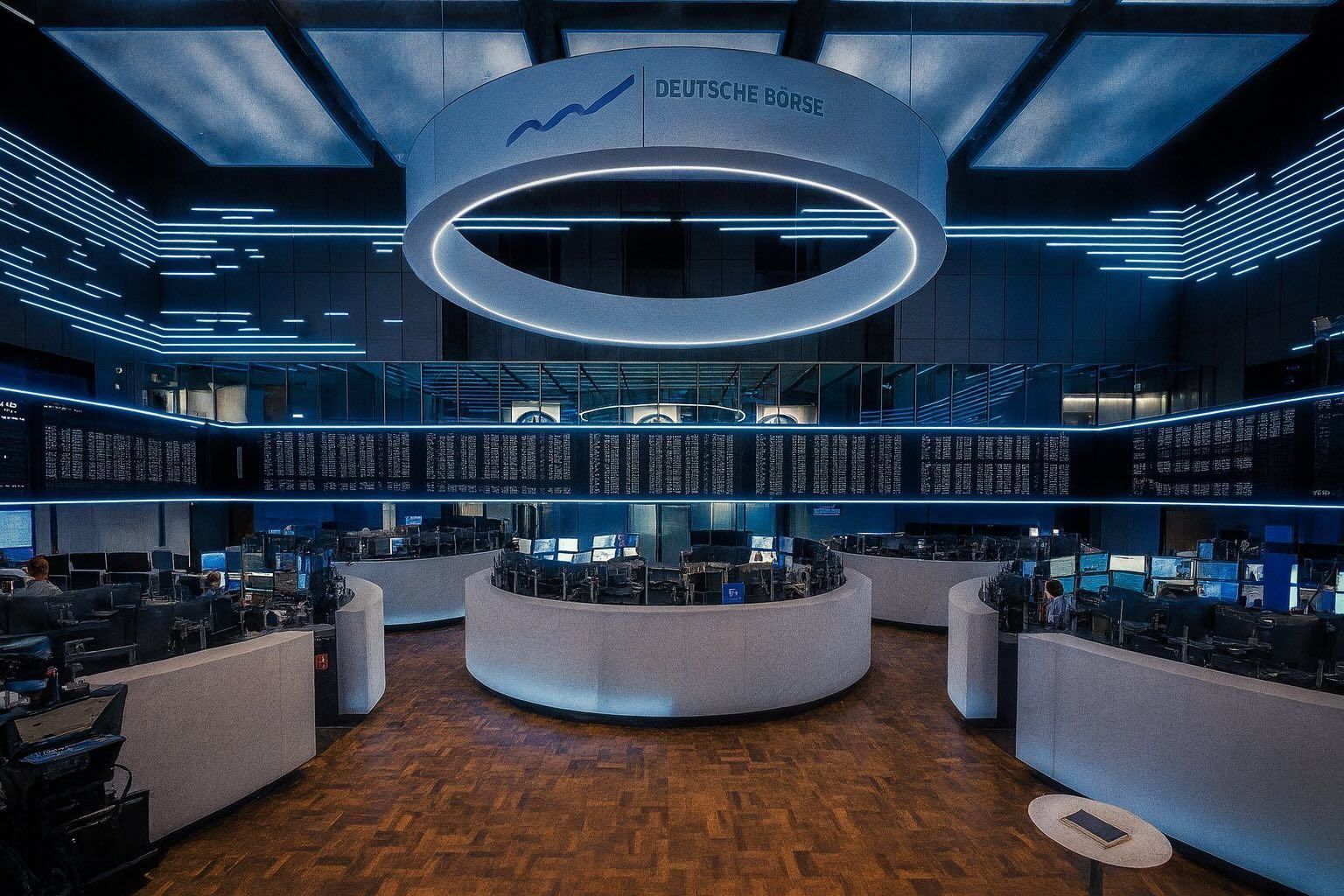
Exchange operator Deutsche Börse AG published a regulatory announcement stating that, between 17 and 21 November 2025, it repurchased 52,379 shares under its ongoing 2025 share buyback programme, which is being carried out via Xetra trading under a mandate granted at the 2024 AGM.
All for One Group SE
Mid‑cap IT and SAP services specialist All for One Group SE reported that it repurchased 4,578 shares over the same period as part of its 2025 share buyback programme, which allows for the acquisition of up to 100,000 shares (around 2% of capital) between July 2025 and July 2026.
Deutsche Post (DHL Group)
By contrast, Deutsche Post AG (DHL Group) disclosed that it bought back no shares between 17 and 21 November under its additional buyback mandate, echoing a similar update for the previous week. The company emphasised that buybacks are used opportunistically when excess liquidity permits and are balanced against investment and M&A needs.
BASF – context rather than fresh news
Chemicals giant BASF remains in the early stages of a €1.5 billion share buyback programme running from November 2025 to June 2026, part of a broader €4 billion capital‑return framework extending to 2028. Although Monday did not bring a new BASF release, the programme provides a steady backstop for the share price and is frequently cited in market commentary on German blue chips.
Collectively, these buybacks underline how listed German companies are leaning on capital‑return tools to support earnings per share and signal confidence, even as macro data remain subdued.
Why German stocks rallied despite weak data
Monday’s session in Frankfurt captured a familiar 2025 pattern: markets are trading the global interest‑rate cycle and stock‑specific catalysts more than the domestic macro picture.
Three themes stand out:
- Relief after a rough week
The DAX’s move back above 23,200 comes after its worst week in months, when global tech jitters and a hawkish repricing of U.S. rates pushed the index to a five‑month low. Monday’s rebound looks like stabilisation, not euphoria, with volatility still elevated and the index well below recent highs. - Stock‑specific catalysts still matter
Bayer’s double‑digit jump showed that strong company news can still move both individual names and the broader index, even in a macro‑dominated environment. For active investors, stock selection — especially around clinical results, earnings and corporate actions — remains crucial. - Geopolitics and policy expectations pull in opposite directions
Hopes for progress in Ukraine peace talks weighed on defence stocks, while expectations of a December Fed rate cut boosted growth and tech names. For Germany, which hosts both major defence contractors and globally exposed industrials, these cross‑currents can move different parts of the market in opposite directions on the same day.
Outlook: what to watch after 24 November 2025
Looking ahead from Monday’s close, investors in the German market will be watching:
- Upcoming U.S. data on inflation and retail sales, which could firm or challenge expectations of a December Fed cut and thus influence global risk sentiment.
- Fresh German indicators, including labour‑market and industrial‑production numbers, to see whether the Ifo’s downbeat signal is reflected in hard data.
- Further details from Bayer on asundexian as full trial results are presented at medical conferences and regulatory filings move forward.
- Whether defence stocks stabilise or continue to re‑rate lower if peace efforts gain traction.
For now, 24 November 2025 will likely be remembered as a day when the German stock market bounced back from the brink, powered by a single blockbuster pharma headline and a global shift in rate expectations — even as the underlying economic story remained stubbornly cautious.
This article is for informational purposes only and does not constitute investment advice.