
As at 1 December 2025, DroneShield Limited ASX:DRO sits at the centre of one of the most dramatic story arcs on the Australian market: an 800% rally, a governance firestorm, a 75% plunge from its peak, and yet a wall of bullish analyst price targets still pointing sharply higher.
This article summarises the latest DroneShield share price, key recent news, governance issues, and the main stock forecasts and analyses available as of 1 December 2025. It is general information only and not financial advice.
DroneShield share price snapshot on 1 December 2025
According to real‑time market data, DroneShield shares are trading around A$1.98 on the ASX, with a 52‑week range of A$0.585 to A$6.705 and a market capitalisation of roughly A$1.8 billion.
Key current metrics:
- Price: A$1.975–1.98 (Dec 1, 2025) Investing.com
- 52‑week low / high: A$0.585 / A$6.705 Investing.com
- Market cap: ~A$1.8 billion Investing.com
- EPS (TTM): about A$0.01 per share Investing.com
On 20 October 2025, when DroneShield released its October investor presentation, the shares traded at about A$4.59; today’s level around A$1.98 therefore represents a decline of roughly 57% from that date alone.
From a technical perspective, one mainstream data provider currently classifies the stock as a “Strong Sell” on short‑term indicators, while the same page shows a 12‑month analyst consensus target of A$5.15 and an overall “Strong Buy” rating based on broker research. Investing.com
That tension — bearish chart signals versus bullish fundamental expectations — sums up DroneShield’s situation on 1 December 2025.
What DroneShield actually does
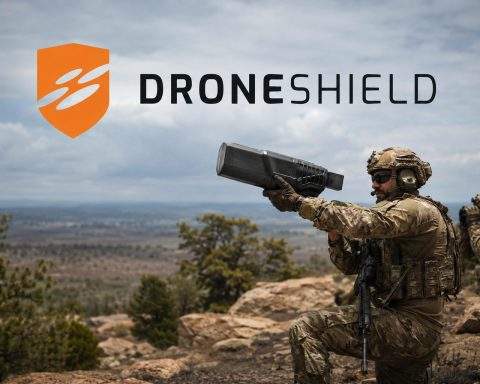
DroneShield is not a generic defence contractor. The company describes itself as the only publicly listed company exclusively focused on the counter‑UAS (uncrewed aircraft systems) sector, providing AI‑driven hardware and software to detect, track and disable hostile drones.
Key points from the company’s own materials:
- Solutions rely on radio‑frequency (RF) sensing, AI, sensor fusion and electronic warfare to detect and defeat drones.
- Products are used by military, government, law‑enforcement and critical‑infrastructure customers across land, sea and air domains.
- Management estimates the global counter‑drone market exceeds US$10 billion and is growing rapidly.
Recent strategic and operational developments reinforce this growth narrative:
- In October and November 2025, DroneShield announced a series of initiatives: a white paper and security‑assessment program for airport counter‑drone deployment, integration of ADS‑B (aircraft tracking) data into its DroneSentry‑C2 software, and the creation of a U.S. Advisory Board composed of senior military and national‑security figures.
- A November 2025 article reports the company supporting Ukrainian forces and scaling up globally, with its workforce roughly doubling to around 400 employees year‑on‑year.
- DroneShield is investing A$13 million to build a new R&D facility in Adelaide, focused on radio‑frequency electronics and systems integration, expected to add around 20 high‑skilled engineering roles by March 2026.
Fundamentally, this is a pure‑play bet on the rapid militarisation and regulation of the skies — and on DroneShield’s ability to remain a leading supplier of counter‑drone technology.
From market darling to governance crisis
A phenomenal 2025 growth story…
Until early October, DroneShield was one of the standout winners on the ASX. According to Reuters, the stock had surged about 800% year‑to‑date by early October 2025, fuelled by strong earnings and high‑profile contracts, and became a major contributor to the ASX Small Ordinaries Index’s performance.
Underneath that share‑price explosion, the business itself was scaling rapidly:
- The October 2025 Investor Presentation highlighted A$165.2 million of revenue for Q1–Q3 2025, a staggering 431% increase versus 2024, and profit before tax of A$5.2 million for the first half of 2025 — the company’s most profitable period to date.
- Management reported a sales pipeline of approximately A$2.55 billion spanning more than 300 projects across geographies and end‑markets.
- Annual R&D spend has risen to over A$50 million, with expansion of manufacturing capacity in Sydney and plans to add more capacity in Europe and the United States.
External coverage has emphasised how extreme this growth is. A profile in the Financial Times noted that DroneShield reported record quarterly revenue of A$92.9 million in Q3 2025, up from just A$7.8 million a year earlier, and that the stock had at one point traded at more than 400 times earnings as investors crowded into the “pure‑play” counter‑drone theme. Financial Times
…and then a brutal rout driven by insiders and missteps
The bull story flipped very quickly.
In November 2025, a series of events triggered what multiple outlets have called a governance crisis:
- Misleading contract announcement and trading pause
- On 10 November 2025, DroneShield announced A$7.6 million in supposed new contracts with the U.S. government for handheld systems.
- Within hours, the company withdrew the announcement, admitting that the contracts were not new business but re‑issued paper for existing orders that had already been disclosed, and requested that ASX pause trading while it corrected the market.
- Director share sales in a “misinformed” market
- Immediately around this period, CEO Oleg Vornik, Chairman Peter James and director Jethro Marks sold down large positions.
- One analysis in The Australian estimates the trio collectively dumped 49.5 million shares for about A$49.5 million, shortly after crossing a performance hurdle linked to A$200 million in revenue, slashing the company’s market value by roughly A$933 million in a single session as the share price fell 31% to A$2.25.
- The Nightly and ABC both report that some of these sales occurred on 10 November, while the market was still “misinformed” by the erroneous contract announcement. DroneShield has conceded this point in correspondence with the ASX. The Nightly+2ABC+2
- One‑day crash and deep drawdown from the highs
- On 13 November 2025, DroneShield shares fell 31.4% in a single day, making it the worst performer on the S&P/ASX 200 as investors digested director share‑sale notices released after market close the previous evening.
- Reuters calculates that from the 9 October 2025 all‑time high, the stock has since lost about 75% of its value, erasing roughly A$4.3 billion in market capitalisation.
- Leadership upheaval and short‑seller scrutiny
- Within days, DroneShield’s U.S. CEO Matt McCrann resigned, an event that triggered another double‑digit intraday decline in the shares.
- Short interest has jumped by around 62% over two weeks, according to data cited by Reuters.
- A hedge fund managed by Plato Investment Management publicly stated it had identified “17 red flags” at DroneShield and had been shorting the stock since late September. Australian Financial Review
- Public backlash and governance reviews
- In a radio segment titled “Investors raise concern over DroneShield share sale”, governance experts criticised the timing and transparency of the trades, pushing the board to commit to an independent review of continuous‑disclosure and securities‑trading policies overseen by independent directors. ABC
- CEO Oleg Vornik has since issued statements emphasising his “unwavering commitment” to the company and arguing that the sold shares were performance‑linked and approved by shareholders. However, coverage in The Australian and other outlets highlights that his total 2025 compensation — combining salary, bonus and share sales — vastly exceeds that of CEOs at much larger companies, intensifying debate about alignment with ordinary investors. The Australian
By late November, one commentator described DroneShield as a case study in how quickly an ASX “market darling” can be re‑rated when governance confidence evaporates, even if the core business is still growing. Sky News Australia
Operational momentum continues despite the sell‑off
Importantly, there is not much evidence that DroneShield’s underlying operations have collapsed — the shareholder anger is mostly about how the growth has been monetised by insiders and communicated to the market, rather than about lost customers or cancelled contracts.
Recent operational positives include:
- Follow‑on European contract
On 25 November 2025, DroneShield received a A$5.2 million follow‑on order via a long‑standing European reseller for handheld counter‑drone systems, with stock already on the shelf and cash expected in Q4 2025. The reseller has now placed 12 orders over three years totalling more than A$70 million (excluding one earlier large contract). - Global expansion and R&D footprint
The new A$13 million Adelaide R&D facility is aimed at deepening expertise in RF electronics and integration, supporting growing demand from partners and customers (including Ukraine), and adding around 20 engineers. - Thought‑leadership and airport security initiatives
DroneShield has released a white paper on best practices for counter‑drone deployment at civil airports and announced collaborations with aviation‑security specialists, positioning itself as a go‑to vendor for civil‑infrastructure protection at a time when drone incursions into airports are rising. - Recognition and talent strategy
In November the company received the U.S. Department of Labor’s HIRE Vets Platinum Medallion Award for the fourth year in a row, signalling a deliberate strategy of hiring veterans with operational experience into key roles.
The core business, in other words, still looks like a high‑growth defence technology platform. The market’s question right now is whether governance and capital‑markets discipline can be brought up to the same standard.
How analysts and models currently value DroneShield
Despite the governance overhang, most published broker and model‑based forecasts as of 1 December 2025 still imply substantial upside from current levels. These are forecasts, not guarantees, and many may not yet fully reflect the latest sentiment shock — but they are the numbers on the table.
Broker and fundamental analyst forecasts
- ValueInvesting.io (collated broker estimates)
- Average 12‑month target: A$5.25
- Range: A$5.05–A$5.57
- Implied upside: about +165% from ~A$1.98
- Consensus rating:Buy (6 analysts: 4 Buy, 1 Strong Buy, 1 Hold)
- Forecast revenue: A$210.6m in the current year, rising to A$303m next year
- Forecast EPS: ~A$0.04 this year, growing to A$0.06 next year ValueInvesting
- TradingView analyst page
- 12‑month price target: A$5.15
- Target range: A$5.00–A$5.30
- Based on two analysts’ ratings in the last three months.
- Investing.com snapshot
- Analyst target: A$5.15 (average) with +160.76% implied upside
- Analyst stance: both covering analysts are currently “Buy”, leading to an overall “Strong Buy” label. Investing.com
- Simply Wall St growth forecasts
- Forecast earnings growth: ~63.9% per year over the next three years
- Revenue growth: ~40.8% per year, significantly above the broader Australian market (~6% per year) and the wider aerospace & defence sector (~16.2% earnings growth)
- Forecast ROE: ~17.3% in three years’ time Simply Wall St
Collectively, conventional analysts are still modelling very rapid revenue and earnings growth, treating current turbulence as a governance and sentiment issue rather than a thesis‑breaking change in fundamentals.
Quantitative and AI‑driven price forecasts
A separate set of sites produce model‑driven price paths based mainly on technical patterns and statistical extrapolation. These should never be treated as advice, but they show how some quantitative tools view the stock:
- WalletInvestor
- Current reference price: ~A$2.03 (1 Dec 2025) Walletinvestor.com
- 1‑year forecast: around A$2.99 (+~48% projected)
- 5‑year forecast (to 2030): about A$7.96 (+~293%)
- Their system classifies DroneShield as an “outstanding long‑term (1‑year) investment” based on historical price patterns, while openly warning that forecasts are not guaranteed. Walletinvestor.com
- Meyka AI
- Notes a short‑term bearish pattern but a bullish long‑term trend.
- Projects A$3.45 in 2026 (+~59% vs its current base price), A$12.38 by 2030 (+~471%), and around A$18.94 over a seven‑year horizon (+~773%).
These quantitative projections underscore how extreme the perceived upside is from today’s levels — if the business can continue to execute and if governance risk does not cause a long‑lasting de‑rating.
Key risks now dominating the DroneShield investment case
For anyone analysing DroneShield after the November shock, the central questions are less about product‑market fit and more about governance, volatility and execution.
- Governance and board alignment
- The combination of a mis‑stated contract, director sales in a misinformed market, and delayed, cautious communication has drawn criticism from governance experts and regulators alike.
- The company has promised an independent review of its disclosure and trading policies, overseen by independent directors, but the outcome of that review — and whether the market finds it credible — remains unknown.
- Extreme volatility and short interest
- A stock that can rise 800% in nine months and then fall 75% in six weeks is, by definition, high‑risk.
- Short positions have spiked, and several professional investors publicly argue that DroneShield’s valuation had become disconnected from fundamentals, citing not just governance but also concentration risk and the possibility of earnings “air pockets” if large contracts are delayed. Reuters+1
- Customer and geopolitical concentration
- DroneShield focuses on sales to allied militaries, security agencies and critical infrastructure operators, and explicitly avoids sales to countries such as Russia, China and Iran.
- This strategy is consistent with Western policy but leaves the company exposed to defence‑budget cycles, export‑control regimes and changing procurement priorities in a relatively small universe of compatible customers.
- Execution risk while scaling up
- Rapid growth (400%+ revenue increases) plus heavy R&D spend and multiple capital projects (new facilities in Sydney and Adelaide, plus potential expansions in Europe and the US) inherently raise operational complexity.
- Any mis‑execution — shipping delays, cost overruns, cyber or product incidents — could impact earnings at precisely the moment the company is under heightened scrutiny.
Catalysts to watch heading into 2026
As of 1 December 2025, several near‑term events could meaningfully shift sentiment on DroneShield, in either direction:
- Next earnings release – Market data lists 3 December 2025 as the next expected earnings date. Investors will watch closely for updated guidance, commentary on governance reforms, and confirmation that the contract pipeline is converting into cash without negative surprises.
- Outcome of ASX and internal governance reviews – How DroneShield responds to ASX’s questions, and what changes it makes to trading rules and communication protocols, will be a key signal of whether the board is serious about rebuilding trust.
- Further contract announcements and margin trends – The follow‑on European order shows the sales engine is still running; investors will look for more such wins and for evidence that margins are improving as the company scales.
- Short‑interest dynamics – Persistent or rising short interest could keep volatility elevated, while a sharp reduction might suggest that sceptical funds are taking profits or reassessing the risk‑reward balance.
Bottom line: high‑growth defence stock, now priced for controversy
On 1 December 2025, DroneShield presents a highly asymmetric profile:
- Fundamentals: explosive revenue growth, a multi‑billion‑dollar pipeline, global expansion of both customers and facilities, and a product set that is tightly aligned with real‑world security threats.
- Market perception: a recent symbol of ASX governance risk, subject to intense media scrutiny, rising short interest, and deep scepticism about insider behaviour.
- Valuation and forecasts: share price near A$2, versus broker targets mostly in the A$5–5.5 range and some AI models projecting double‑ or triple‑digit percentage gains over multi‑year horizons.
For risk‑tolerant investors, DroneShield is likely to remain on the watchlist as a high‑beta, high‑uncertainty play on the global counter‑drone market. For more conservative investors, the current episode is a reminder that governance quality and capital‑markets discipline can matter just as much as growth rates — and that both need to be analysed with the same rigour as any revenue chart or price target.
Either way, DroneShield now sits squarely at the intersection of defence technology, market psychology and corporate governance — and that makes it one of the most closely watched stocks on the ASX heading into 2026.
Related articles: ASX:DRO