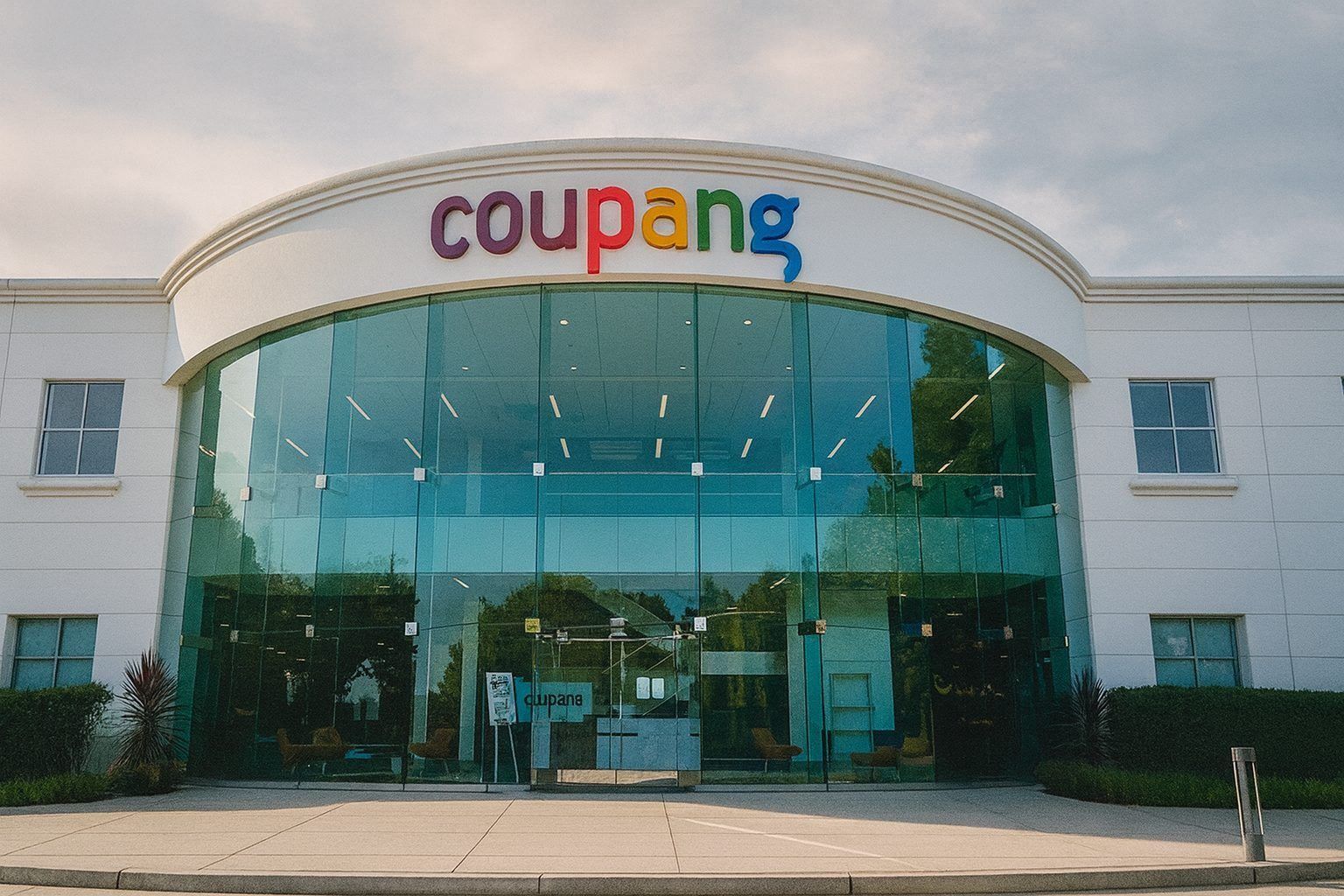

Coupang, Inc. NYSE:CPNG – often called the “Amazon of South Korea” – is under intense pressure on 1 December 2025 after revealing one of the country’s worst data breaches in more than a decade. The incident has triggered a sharp sell‑off in Coupang’s U.S.-listed shares, even as the company’s underlying business continues to post strong revenue growth and rising profits. Reuters+1
Below is a detailed, up‑to‑date look at today’s news, the data leak, recent earnings, Wall Street forecasts and what it all may mean for Coupang stock.
Key takeaways on Coupang stock today
- Share price: Around $26.9 per share in New York afternoon trading on 1 December 2025, down roughly 4–5% on the day after being down as much as about 9% in pre‑market trading.
- 52‑week range:$19.02 – $34.08, with the stock now trading well below its September high.
- Year‑to‑date: Still up more than 20% in 2025 despite the recent pullback.
- Valuation: Market cap around $49–51 billion, trailing P/E ~130 and price‑to‑sales around 1.5–1.6x, reflecting a growth‑stock premium.
- Fundamentals: Q3 2025 revenue rose 18% year‑on‑year to $9.3 billion, with margins and cash flow improving.
- Street view: Most analysts rate Coupang a Buy / Strong Buy with average 12‑month price targets clustered around $35–38, implying roughly 30–35% upside from current levels.
- Overhang: A massive data breach affecting ~33.7 million customer accounts, potential regulatory fines, and class‑action lawsuits are now the main risks investors are weighing.
What happened: South Korea’s worst Coupang data leak in years
Coupang disclosed that personal data from around 33.7 million customer accounts – almost its entire user base in South Korea – was accessed without authorization.
According to official and media reports:
- The breach began on 24 June 2025 via overseas servers and was only discovered on 18 November, meaning attackers may have had access for nearly five months.
- Exposed data includes names, email addresses, mobile numbers, shipping addresses and parts of order histories.
- Coupang and regulators say payment card details and login credentials (passwords) do not appear to have been compromised, which limits immediate financial fraud risk but not privacy concerns.
Investigators and local media have added disturbing details:
- South Korea’s Ministry of Science and ICT says attackers abused “authentication vulnerabilities” in Coupang’s servers. Reuters
- A former Chinese employee who previously worked on authentication systems is suspected of using an authentication key that remained active even after their contract ended to access customer data, according to lawmakers and media reports.
- South Korean police are tracing IP addresses and examining Coupang’s technology stack to determine whether the company violated data‑protection rules.
The breach is widely described as South Korea’s most serious data leak in more than a decade, adding political and regulatory urgency.
Coupang CEO Park Dae‑jun posted a public apology on the company’s website, acknowledging the incident and promising full cooperation with authorities as well as strengthened security measures.
Legal and regulatory fallout: potential fines and lawsuits
The financial consequences are still uncertain, but early estimates suggest they could be material:
- Reports cited by local media and Benzinga say the Personal Information Protection Commission (PIPC) could impose fines that might reach around $770 million, depending on findings.
- A potential class‑action lawsuit is forming.
- Internet postings suggest more than 10,000 customers intend to join.
- Lawyers have floated compensation claims of at least 100,000 won (≈ $68) per person, implying headline exposure in the billions of dollars if applied across all affected accounts – though actual settlements typically land far below theoretical maxima.
Beyond direct financial costs, the incident raises:
- Reputational risk in Coupang’s core Korean market, where the service is deeply embedded in everyday life.
- Questions about internal controls and governance, given that a former employee’s access apparently remained live months after leaving the company.
- Increased probability of stricter data‑protection regulation after similar large breaches at other Korean firms such as SK Telecom earlier this year.
For investors, that means the market is now trying to price not only one‑off fines, but also higher ongoing cybersecurity costs and potentially tighter compliance obligations.
How Coupang stock is reacting on 1 December 2025
On the first trading day of December:
- CPNG is changing hands at about $26.9, down roughly 4–5% intraday, after dropping around 9% in pre‑market trading when the breach headlines first hit screens.
- Trading volume is well above average, reflecting heightened investor activity.
- The stock sits near the lower half of its 52‑week range of $19.02 to $34.08 and has fallen back below its 50‑ and 200‑day moving averages, a bearish short‑term technical signal highlighted by market commentators.
- Even after today’s drop, CPNG remains up low‑to‑mid‑20% year‑to‑date, but has given back a notable chunk of gains since peaking around its 52‑week high above $34 in September.
This move comes against a backdrop of broader risk‑off sentiment in U.S. equities, with major indexes also slipping as December trading begins. Investopedia However, the magnitude of Coupang’s decline is clearly company‑specific, driven by the data‑breach narrative.
Medium‑term, the stock is still roughly 40–45% below its all‑time high, according to recent valuation commentary, which is why some analysts are now framing the sell‑off as a potential long‑term entry point.
Under the headlines: Coupang’s business and Q3 2025 fundamentals
The sell‑off is striking because it arrives just weeks after a strong Q3 earnings report that showed continued scaling of Coupang’s e‑commerce platform.
Q3 2025 results at a glance
For the quarter ended 30 September 2025, Coupang reported: Coupang+1
- Net revenues:$9.3 billion, up 18% year‑on‑year (20% in constant currency).
- Gross profit:$2.7 billion, up 20%, with gross margin improving to 29.4% (about 50 bps expansion).
- Operating income:$162 million, up 49% versus a year earlier.
- Net income:$95 million, up roughly 48%; diluted EPS of $0.05, beating analyst forecasts of $0.04 by about 25%.
- Adjusted EBITDA:$413 million, up 20% year‑on‑year.
- Cash generation: Trailing‑twelve‑month operating cash flow of $2.4 billion and free cash flow of $1.3 billion, both significantly improved from the prior year.
- Customer metrics: Product Commerce active customers reached 24.7 million, up 10% year‑on‑year, with revenue per active customer also rising.
By segment: Coupang+1
- Product Commerce (core Korean retail) generated $8.0 billion in net revenue (+16% YoY), with gross margin in this segment climbing to 32.1% and segment adjusted EBITDA reaching $705 million.
- Developing Offerings (such as fintech, international expansion and newer verticals) produced $1.3 billion in revenue (+32% YoY) but posted a segment EBITDA loss of $292 million, up from a smaller loss last year, underscoring ongoing investment.
An Investing.com transcript summarised the quarter as a clean beat on both revenue and earnings, with management reiterating an expectation of roughly 20% net revenue growth in constant currency for the full year, while emphasizing investments in AI and logistics as future profit drivers.
TTM financial profile
Looking at trailing twelve‑month figures from major data providers: StockAnalysis+2Stock Titan+2
- Revenue (TTM): roughly $30–34 billion (estimates vary slightly by provider, with one citing $33.7 billion).
- Net income (TTM): approximately $0.15–0.40 billion, implying a net margin well below 2%.
- Gross margin: around 29–30%, consistent with Q3 improvements.
- Operating margin: near 1.5–2%, reflecting early‑stage profitability for such a large‑scale operation.
- P/E (TTM): around 125–135x, and forward P/E near 60x, highlighting that Coupang is valued as a high‑growth platform rather than a mature retailer.
In short, fundamentals were trending in the right direction prior to the breach: strong top‑line growth, expanding margins and robust cash flow – but off a still‑thin profit base.
What exactly does Coupang do?
For SEO and investor context, it’s worth recapping Coupang’s business model.
- Coupang is a vertically integrated e‑commerce platform headquartered in Seattle with operations primarily in South Korea and a growing presence in Taiwan.
- It combines first‑party retail (owned inventory) with a marketplace for third‑party sellers, much like Amazon.
- Its signature “Rocket Delivery” service leverages a dense network of fulfillment centers and last‑mile infrastructure to provide same‑day or next‑day delivery to the vast majority of Korean households. Stock Titan+1
- The company has diversified into online grocery (Rocket Fresh), food delivery (Coupang Eats), luxury e‑commerce, travel, streaming and payments/fintech, all of which fall under its Product Commerce and Developing Offerings segments.
This integrated model underpins Coupang’s reputation as the dominant online retailer in South Korea, frequently described by Reuters and others as the “Amazon.com of South Korea.” The Straits Times+2The Sunday Guardian+2
Analyst ratings and price targets: Still bullish – for now
Despite the breach, the latest published forecasts from Wall Street remain broadly positive:
- MarketBeat:
- 12 analysts over the past 12 months.
- Rating mix: 4 Hold, 7 Buy, 1 Strong Buy.
- Consensus rating: “Moderate Buy.”
- Average 12‑month price target: around $35, with estimates spanning roughly $27–40 and implying about 30% upside versus current levels.
- StockAnalysis.com:
- 6 analysts.
- Consensus rating: “Strong Buy.”
- Average price target: $35.5, with a low of $28 and a high of $40 – a projected ~30–32% gain.
- TipRanks:
- 6 Wall Street analysts over the past three months.
- Rating split: 5 Buy, 1 Hold, 0 Sell.
- Consensus: “Strong Buy.”
- Average target: $37.50, with a range of $32–40, implying about 34% upside from a reference price around $27.9.
- Public.com (retail‑focused platform summarizing analyst data):
- Based on 6 analysts, Coupang carries an overall “Buy” rating.
- It cites an average target around $35.5 and shows roughly 50% Strong Buy, 33% Buy, 17% Hold in its breakdown.
Other data, such as MarketWatch’s analyst page, also points to an average target near $37 across a slightly larger analyst universe (around 15 ratings), with an overall Buy recommendation.
Recent target changes
Recent rating activity ahead of the breach included: StockAnalysis+1
- Barclays maintaining a Buy rating while lifting its target from $36 to $40.
- Bank of America Securities reiterating a Strong Buy and nudging its target from $36 to $38.
- Mizuho keeping a Hold but raising its target from $30 to $32.
CoinCentral also notes that some major brokers, such as Bank of America and Morgan Stanley, opted to hold their price targets steady even after the breach news, highlighting their focus on Coupang’s long‑term growth profile.
In summary, no major wave of downgrades has appeared yet in public data, although that could change as the financial impact of the incident becomes clearer.
Ownership profile: heavy institutional backing
One notable feature of Coupang’s shareholder base is how institutional it is:
- Recent analysis hosted on Yahoo Finance notes that approximately 64% of Coupang’s outstanding shares are held by institutional investors, underscoring strong participation from global asset managers and pension funds.
- MarketBeat’s news feed over November shows a steady stream of 13F filings where large institutions – including Norges Bank, American Century, Legal & General and several U.S. pension systems – reported meaningful positions or incremental buying, even as some others trimmed stakes.
For long‑term investors, this level of institutional ownership can cut both ways:
- It may support liquidity and research coverage, and suggests many professional investors see Coupang as a core e‑commerce holding.
- At the same time, large institutions can move in and out quickly if sentiment or risk assessments change, which can amplify volatility around events like today’s breach.
Key risks investors are now pricing in
Beyond the usual competitive and macro risks, the data breach brings several specific issues into focus.
1. Regulatory and legal uncertainty
- Fines & penalties: Estimates around $770 million in potential regulatory penalties are still speculative, but the fact that such numbers are being discussed underscores the seriousness of the case.
- Class‑action exposure: Headline damages of up to $2.2 billion (33 million accounts × 100,000 won) have been floated in media coverage, though actual court outcomes are typically much lower.
- Regulatory tightening: South Korean officials are openly talking about “structural loopholes” in personal‑data protection and the need to strengthen punitive damage systems, which could raise compliance costs across the sector. Reuters+1
2. Trust and customer behaviour
While there is no concrete evidence yet of customer flight, investors must consider:
- Whether some users shift spending to rival platforms due to privacy concerns.
- The possibility of higher marketing and loyalty costs to reassure shoppers and rebuild trust.
Given that Coupang’s differentiation is rooted in customer experience and reliability, reputational damage is particularly sensitive here.
3. Cybersecurity and internal controls
The reported use of a lingering authentication key by a former employee points to gaps in off‑boarding and credential management, an area regulators are likely to scrutinize.
For investors, the question is whether:
- The company can quickly shore up security and demonstrate best‑in‑class practices, or
- Repeated issues emerge, which could justify a permanent valuation discount.
4. Profit margin and valuation risk
Even before the breach, Coupang was trading on rich multiples relative to current profitability:
- TTM net profit margin < 2% and operating margin near 2%, yet a P/E near 130x and an EV/EBITDA multiple around 40x.
- The Developing Offerings segment is still deeply loss‑making, and continued expansion in areas like Taiwan and fintech will likely require heavy investment.
If growth slows or regulatory costs rise, multiple compression could pressure the stock even if revenue continues to expand.
The bull case after the sell‑off
Despite these risks, there is a clear bullish narrative that many analysts and institutional investors still see:
- Market leadership and structural tailwinds
- Coupang is the top e‑commerce player in South Korea, a mature but still growing online market with high digital adoption and dense urban infrastructure.
- Its logistics moat – a nationwide fulfillment network and fast delivery – remains difficult and expensive for rivals to replicate.
- Improving profitability at scale
- Q3 results showed double‑digit revenue growth alongside rising margins and strong free cash flow, indicating operating leverage is starting to show up in the numbers.
- Optionality in new verticals
- Food delivery, streaming, fintech and international expansion (notably Taiwan) provide long‑term optionality that is not fully captured in near‑term earnings.
- Analyst targets and valuation work
- Several valuation analyses – including pieces on MarketBeat and Yahoo/Simply Wall St – suggest Coupang’s intrinsic value is 20–40% above the current share price, even after factoring in execution risks.
- The stock is currently around 40% below its all‑time high, which some commentators frame as an opportunity if one believes the data‑breach fallout will be manageable.
- Institutional conviction
- The fact that roughly two‑thirds of shares are institutionally held and that many global funds have been adding positions through November suggests that large, long‑term investors still see Coupang as a key growth asset.
What to watch next
Investors following Coupang stock over the coming weeks and months may want to focus on a few key catalysts:
- Regulatory updates and fines
- Formal findings from South Korea’s privacy regulators and law enforcement.
- Any quantified guidance from Coupang on expected fines, remediation costs or legal provisions.
- Customer metrics post‑breach
- Changes in active customers, order frequency or churn in Q4 and early 2026 will be watched closely for signs of damaged trust.
- Security upgrades and governance reforms
- Details on how Coupang is overhauling its cybersecurity and access‑control systems.
- Potential board‑level changes or the creation of new risk and security committees.
- Q4 2025 earnings and 2026 guidance
- Whether Coupang can maintain ~20% revenue growth and continue expanding margins despite higher compliance spending.
- Analyst reaction over time
- Any wave of downgrades or target cuts once the full cost of the breach is clearer.
- Conversely, if regulators’ response proves less severe than feared, there could be target hikes as the overhang lifts.
Bottom line: Is Coupang stock attractive after the December 2025 sell‑off?
From a news and analysis standpoint, Coupang sits at a crossroads:
- Bearish lens:
- The company has suffered one of the worst data breaches in South Korean history, with potential fines, lawsuits and reputational damage that could weigh on growth and margins for years.
- Its valuation is still demanding relative to current profitability, leaving little room for error.
- Bullish lens:
- Coupang remains a dominant, fast‑growing e‑commerce platform with improving economics, strong cash generation and substantial institutional backing.
- Most recent analyst research still points to double‑digit percentage upside over the next 12 months, even after today’s drop.
For investors, Coupang in December 2025 is not a low‑risk story. It is a classic high‑growth, high‑valuation stock now dealing with a high‑impact cybersecurity shock. Those who believe the company can contain the fallout, restore trust and continue compounding revenue and margins may view the current sell‑off as an opportunity. More cautious investors may prefer to wait for clarity on fines, lawsuits and customer behaviour before making a decision.
Either way, the coming quarters will be pivotal in determining whether today’s breach represents a temporary setback or a long‑lasting drag on Coupang’s investment case.
Important: This article is for informational purposes only and does not constitute financial advice, investment recommendation or a solicitation to buy or sell any security. Always do your own research or consult a licensed financial adviser before making investment decisions.
Related articles: NYSE:CPNG