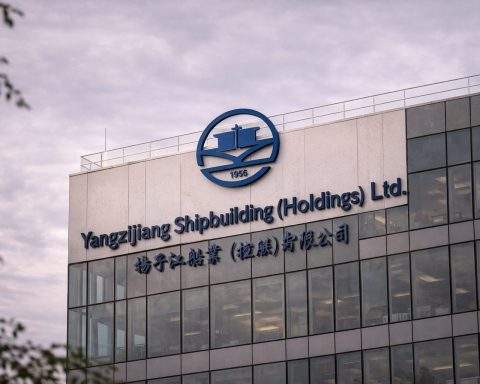

Yangzijiang Shipbuilding (Holdings) Ltd (“Yangzijiang” or “YZJ”) has gone from panic to fresh optimism in 2025. After a sharp sell-off triggered by proposed U.S. port fees on Chinese-built ships earlier this year, the Singapore‑listed stock has rebounded on the back of a huge “green” order book, strong profitability and increasingly bullish analyst targets. nextinsight.net+1
This article summarises the latest share price, news, forecasts and risks for Yangzijiang Shipbuilding as of 2 December 2025.
Yangzijiang Shipbuilding share price on 2 December 2025
At around midday in Singapore on 2 December 2025, Yangzijiang Shipbuilding shares were trading at about S$3.31, up roughly 0.9% on the day.
Key trading and valuation metrics:
- Market capitalisation: approximately S$12.9 billion StockAnalysis
- Trailing P/E: about 9.4 times earnings
- Forward P/E: about 7.9 times
- Profit margin (last 12 months): roughly 29%
- Return on equity (ROE): around 31%, indicating very high profitability on shareholder capital StockAnalysis
- 52‑week range: about S$1.80 to S$3.58, with the stock currently trading near the upper end of that band Investing.com
- 12‑month performance: share price up around 36% over the past year, with volatility (beta ~0.82) below the broader market StockAnalysis
Short‑term technical models are more cautious: one widely‑followed quantitative service classifies the stock as a short‑term “sell candidate” after a modest pullback from recent highs, even while acknowledging a positive longer‑term trend. StockInvest
From port‑fee panic to recovery: what changed in 2025
The big story for Yangzijiang this year has been geopolitics.
Early in 2025, the U.S. Trade Representative (USTR) identified China’s dominance in maritime logistics and shipbuilding as a national security concern and prepared a Section 301 action involving steep port fees on Chinese‑built or operated vessels calling at U.S. ports.
Market reaction was brutal: Yangzijiang’s share price dropped from about S$3.30 in February to roughly S$1.88 within six weeks, as investors feared that U.S. fees would choke off new orders for Chinese yards.
On 14 October 2025, the first wave of new port fees came into force:
- The U.S. announced port‑entry fees targeting Chinese‑owned, operated or built vessels, as part of its Section 301 response.
- China retaliated with its own special port charges on U.S.-linked ships calling at Chinese ports, but explicitly exempted China‑built vessels and ships entering shipyards empty for repair, a category that includes many ships built by yards like Yangzijiang.
On that October day, Business Times reported that Yangzijiang’s shares fell about 4.3% to S$3.14, as investors digested the port‑fee “tit‑for‑tat” and a separate cancellation of tanker contracts. The Business Times+1
The tone shifted decisively in November:
- On 1 November 2025, the White House announced a broader U.S.–China trade and economic deal.
- On 9 November 2025, the USTR formally suspended the Section 301 maritime action for one year, starting 10 November.
That suspension means the previously announced U.S. port fees are effectively on hold, sharply reducing the worst‑case scenario that markets had priced in earlier this year.
By early December, a new NextInsight piece captured the mood bluntly: the same port‑fee scare that once knocked the stock below S$2 has been largely defanged, while Yangzijiang’s competitive cost base and efficiency continue to attract orders.
Massive order book and the “green vessel” boom
While sentiment swung wildly, the fundamentals stayed remarkably solid.
Multiple recent reports from The Edge Singapore and other outlets highlight three structural supports: The Edge Singapore+2The Edge Singapore+2
- Huge order book
- As of the first half of 2025, Yangzijiang’s order book stood at around US$23.2 billion, covering roughly 236 vessels scheduled for delivery through 2030.
- After new contracts signed in 3Q 2025, the outstanding order book as at end‑September 2025 was still about US$22.8 billion, even after vessel deliveries and some asset disposals.
- Green‑fuel and dual‑fuel ships dominate
- Eco‑friendly or “green” vessels now account for roughly 71–74% of the order book by value, including dual‑fuel containerships and gas carriers that meet tightening IMO decarbonisation rules. The Edge Singapore+2The Edge Singapore+2
- The bulk of new wins in 2025 have been for containerships, bulk carriers and gas carriers, many designed for alternative fuels.
- Multi‑year delivery pipeline
- Newbuild slots at Yangzijiang’s yards are largely filled through 2028, with limited remaining capacity for small‑to‑mid‑sized vessels in 2029, according to CGS International.
- Management is now focused on selectively filling 2029–2030 slots with higher‑value green tonnage rather than volume for its own sake.
In short, the company may face some lumpiness in new orders over 2025–2026, but the existing backlog alone underpins earnings for several years.
2025 business update: order wins rebound after slow start
Section 301 jitters did show up in the numbers at the start of the year. Yangzijiang entered 2025 targeting US$5 billion in new orders, but by mid‑year had secured only roughly US$0.54 billion, as some shipowners delayed decisions while watching U.S. regulatory developments.
That picture changed sharply in the third quarter:
- By 9M FY2025 (ended 30 September), the group had accumulated US$2.17 billion in order wins, four times the volume achieved by mid‑year.
- The mix included 38 containerships, 10 bulk carriers and 2 gas carriers, with green vessels commanding more than 70% of the total order value.
- The company has delivered 46 vessels year‑to‑date, about 82% of its full‑year target of 56 vessels.
In parallel, Yangzijiang is investing heavily in capacity and infrastructure:
- Project Hongyuan — an expansion of its yard footprint to about 866,700 square metres, roughly 17% larger than the existing site, targeted for completion in 1H 2027.
- Development of an LNG terminal and storage facilities, also expected to be ready around 1H 2027, positioning the group further up the LNG value chain.
These moves underline the management’s confidence that demand for complex, higher‑value ships will remain robust even if standard vessel orders become more competitive.
Profitability and balance sheet: high margins, net cash
Fundamentally, Yangzijiang is not just busy – it is very profitable.
Recent financial performance
CGS International’s latest model, summarised by NextInsight, points to the following trajectory (figures in RMB millions): nextinsight.net+1
- 2023 (actual): revenue ~24,112; net profit ~4,102
- 2024 (actual): revenue ~26,542; net profit ~6,834
- 2025 (forecast): revenue ~28,203; net profit ~8,319
- 2026 (forecast): revenue ~33,958; net profit ~9,519
That implies:
- Normalised EPS growth of around 56% in 2023, ~62% in 2024, and a further 25% in 2025, before moderating but remaining solid into 2026–2027.
- ROE rising to roughly 28–29% over 2024–2026, before easing slightly as the capital base expands.
StockAnalysis, using data translated into Singapore dollars, shows for the last 12 months: StockAnalysis
- Revenue: about S$4.7 billion
- Net income: about S$1.38 billion
- Gross margin: ~32.5%
- Operating margin: ~29.8%
- Net margin: ~29.4%
Balance sheet and cash
The same dataset indicates a very strong balance sheet: StockAnalysis
- Net cash: around S$3.26 billion, after subtracting roughly S$1.08 billion of debt from S$4.33 billion in cash.
- Debt‑to‑equity ratio: ~0.22, implying modest leverage.
- Interest coverage: above 60 times, indicating very low financing risk.
This combination – high margins, high ROE, and net cash – is a key reason analysts keep highlighting Yangzijiang’s resilience, even as order growth slows from the extraordinary levels of 2023–2024.
Dividends and shareholder returns
Shareholders are also being paid along the way.
- For 2024/early‑2025, Yangzijiang paid a full‑year dividend of S$0.12 per share, with the most recent ex‑dividend date on 5 May 2025.
- At the current share price of about S$3.31, that implies a trailing dividend yield of roughly 3.5–3.6%, up significantly year‑on‑year, with a payout ratio of about one‑third of earnings.
CGS’s forecast suggests dividends could continue to grow (in RMB terms) through 2027, pushing the prospective yield into the 4.5–5.5% range if earnings follow their projected path.
On top of cash dividends, the group has also been modestly reducing its share count, with outstanding shares slipping by around 0.1% over the past year, consistent with small‑scale buybacks.
Contract cancellations and compliance risk
The main negative headline this year was the termination of tanker contracts linked to sanctions concerns.
In late September 2025, Yangzijiang announced that it had cancelled contracts for four medium‑range (MR) oil tankers worth around US$180 million after discovering indications that the buyer might be trying to circumvent U.S. sanctions.
Key takeaways from that episode:
- The revenue loss is relatively small compared with the US$22–23 billion order book.
- Management emphasised sanctions compliance and risk management over short‑term revenue, which may help with regulators and counterparties in the long run.
- The cancellation was partially offset by fresh orders and letters of intent; for example, Yangzijiang secured eight contracts worth about US$567.6 million around the same time, according to industry reports.
The incident illustrates a central risk for all Chinese yards: even with strong commercial demand, counterparty and sanctions risk can disrupt specific contracts, especially for oil‑related vessels.
Analyst ratings and price targets: still a “strong buy” consensus
Despite the noise, the analyst community is strikingly aligned on Yangzijiang.
Broker research (DBS, CGS, UOB Kay Hian)
A detailed November write‑up in The Edge Singapore summarised the latest calls from major Singapore brokers: The Edge Singapore+1
- DBS Group Research
- Rating: “Buy”
- Target price: S$3.80
- Focus: strong operational performance in 3Q 2025, rebound in year‑to‑date order wins (US$2.17bn), and an outstanding order book around US$22.8bn.
- Thesis: margins should benefit from a rising share of dual‑fuel and gas‑carrier units, and the stock offers an attractive 4–5% forward dividend yield.
- CGS International
- Rating: “Add” (effectively bullish)
- New target price: S$4.51, raised from S$3.90.
- Rationale: valuation is “undemanding” at about 8× 2026F P/E, compared with 17× for peers and a higher multiple for the MSCI Singapore index.
- Forecasts: 2025–2027 revenue rising from ~RMB 28.2bn to 36.5bn, with net profit rising from ~RMB 8.3bn to 9.9bn and ROE staying in the mid‑20s.
- They do, however, trim order‑intake assumptions to US$3bn in 2025 and US$3.5bn in 2026, citing increased competition from second‑tier Chinese yards with spare capacity.
- UOB Kay Hian
- Rating: “Buy”
- Target price: S$4.10, up from S$3.90, based on 9.3× FY2026 P/E (1.5 standard deviations above the 10‑year average).
- Highlights:
- Management is in “active negotiations” and expects to secure about US$4.5bn of new orders in 2026, assuming continued demand for containerships and opportunistic dry bulk orders.
- Shipbuilding margins are expected to remain strong at around 31% in 2026 and 30% in 2027, supported by stable USD/RMB, controlled steel prices and previously secured low‑cost equipment.
Global consensus (TipRanks, Investing.com, Simply Wall St)
Independent aggregator platforms broadly echo this bullish stance:
- TipRanks (7 analysts, past 3 months):
- Consensus rating: “Strong Buy” — 7 Buys, 0 Holds, 0 Sells.
- Average 12‑month target:S$3.94
- Target range: S$3.56–S$4.53, implying roughly 18% upside from a reference price of S$3.34.
- Investing.com (11 analysts, past 3 months):
- Consensus rating: “Strong Buy” — 10 Buy, 1 Sell, 0 Hold.
- Average 12‑month target: about S$3.80, with a high near S$4.51 and a low around S$1.60.
- Implied upside from around S$3.31 is roughly 15%, based on the average target.
- Simply Wall St, in a late‑November note, points out that Yangzijiang’s P/E multiple of about 9.3× still sits well below the machinery/shipbuilding industry average of roughly 14×, while profit is projected to grow around 30% over the next few years.
Taken together, current sell‑side sentiment views Yangzijiang as high‑quality, high‑ROE, and still attractively valued relative to both its own history and global peers, though that view assumes trade tensions remain manageable.
Valuation: why is the stock still cheap?
Given the numbers – net cash, almost 30% net margin, ROE above 30% and a multi‑year green order book – the obvious question is why Yangzijiang still trades on a single‑digit forward P/E.
Several factors help explain the discount:
- Geopolitical overhang
Trade policy can change faster than ships are built. Even though the U.S. has suspended Section 301 maritime actions for a year, there is no guarantee they will not return in modified form after November 2026. - Order‑cycle uncertainty
After an exceptional US$14.6bn of new orders in 2024, management openly concedes that hitting its US$5bn 2025 order target will be difficult, and CGS has cut near‑term order assumptions. - Intense competition inside China
State‑owned Chinese yards have merged and expanded capacity, while smaller private yards are also chasing green‑vessel work, pressuring pricing for slots in 2026–2027. - Sanctions and compliance risk
The US$180m tanker cancellation underlines that Western sanctions policy can suddenly disrupt deals, especially around oil and sensitive cargoes. - Cyclicality of shipping
Even with decarbonisation tailwinds, shipping is a cyclical industry. A sharp downturn in freight rates or global trade could lead shipowners to delay or cancel orders.
Analysts arguing the stock is undervalued essentially believe these risks are over‑discounted given the size and quality of Yangzijiang’s backlog and its cost advantage over Korean, Japanese and potential U.S. rivals.
Key risks to watch
For investors following Yangzijiang, the main checkpoints over the next 12–24 months are:
- Port‑fee and tariff policy
- Watch for any move by the U.S. to reinstate or reshape Section 301 port fees after the current one‑year suspension expires in November 2026.
- Monitor China’s own retaliatory port fees regime, which currently exempts China‑built ships but could evolve with politics.
- Order intake vs. yard capacity
- The company has enough work to stay busy to 2030, but the mix and pricing of new orders for 2028–2030 will determine whether margins stay near 30% or drift lower.
- Execution of expansion projects
- Project Hongyuan and the LNG terminal are large, multi‑year capex bets. UOB Kay Hian expects some margin softness as the new yard is integrated, before benefits materialise.
- Currency and commodity costs
- Margins are highly sensitive to steel prices and the USD/RMB exchange rate; analysts currently assume relatively benign conditions.
- Regulatory and sanctions environment
- Further tightening around Russian, Iranian or other sanctioned trades could affect specific customers, particularly in tankers.
None of these are unique to Yangzijiang, but they are the main reasons its valuation still embeds a noticeable risk premium.
Outlook: what the market is pricing in now
Putting it all together, the market today seems to be pricing in roughly the following scenario:
- Earnings continue to grow, but at a slower pace after the 2023–2024 boom, roughly in line with CGS’s forecast of mid‑teens profit growth into 2026.
- ROE remains very high (mid‑20s), thanks to the combination of green vessels, high utilisation, and a strong cost position.
- Dividends creep higher, taking the yield into the high‑single‑digits on cost for long‑term holders who bought during the early‑2025 sell‑off.
- Macroeconomic and regulatory risk stays elevated but manageable – no new shock of the same magnitude as the initial Section 301 announcement.
Consensus targets clustered between S$3.80 and S$4.50 imply mid‑teens percentage upside from current levels, but also reflect meaningful uncertainty, as shown by the range of analyst targets and one outlier Sell rating.
For now, Yangzijiang Shipbuilding sits at an unusual intersection: a high‑ROE, net‑cash industrial stock with a multi‑year “green” backlog, trading at a multiple more commonly associated with much riskier businesses. Whether that disconnect narrows or widens from here will depend less on its welders and engineers, and more on the next chapters of trade policy and global shipping demand.
Related articles: SGX:BS6