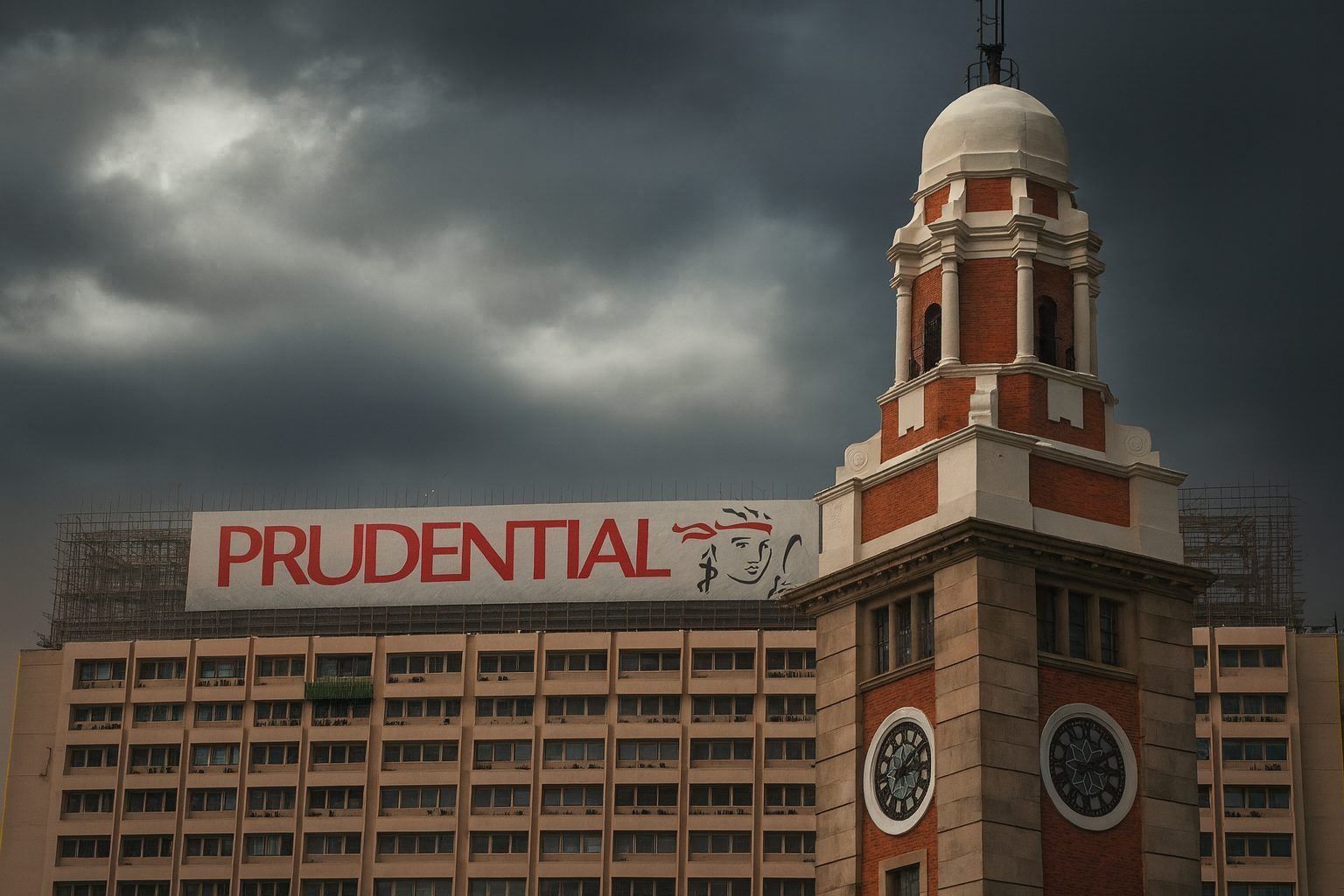

London, 2 December 2025 – Prudential plc’s share price has quietly staged one of the FTSE 100’s standout comebacks. After spending much of 2022–23 in the market’s sin bin, the Asia‑ and Africa‑focused insurer now trades close to its 52‑week high, backed by double‑digit profit growth and one of the most aggressive capital‑return programmes in the sector.
The key question for investors today: has the market already priced in the recovery, or is there still upside left in Prudential stock?
Prudential plc share price today: near highs after a 70% rebound
At the close on 2 December 2025, Prudential plc’s London‑listed shares (LON: PRU) were quoted around 1,095p–1,096p, up about 0.5% on the day. That leaves the stock only a shade below its 52‑week high of 1,109p and far above its 52‑week low of 595.2p, implying a roughly 70% gain over the past year.
Hargreaves Lansdown data show: Hargreaves Lansdown+2London Stock Exchange+2
- Market capitalisation: about £27.8bn
- P/E ratio: roughly 18.1 times trailing earnings
- Dividend yield: about 1.6% on recent payouts
- 1‑year share price performance: +69.9%
- 6‑month performance: +29%
On the Hong Kong line (2378.HK), Prudential has been even punchier, delivering a year‑to‑date total return of around 86%, handily beating the FTSE 100 benchmark.
Despite that rally, several major research houses still argue that the shares trade at a discount to intrinsic value – which is where the story gets interesting.
Business momentum: double‑digit profit growth across Asia and Africa
Prudential’s rebound isn’t happening in a vacuum; it rests on a solid run of operational numbers.
Half‑year 2025: strong growth and rising earnings
In its half‑year 2025 results, covering the six months to 30 June, Prudential reported: Investegate+1
- New business profit (TEV basis): up 12% to $1.26bn
- Operating free surplus from in‑force insurance and asset management: up 14% to $1.56bn
- Adjusted operating profit before tax: up 6% to $1.64bn
- Adjusted EPS: up around 13% to 49.3 US cents per share
Group embedded‑value equity rose to about $35bn, and IFRS shareholders’ equity increased to roughly $18.1bn, reflecting both profit growth and capital discipline.
Q3 2025: guidance on track, margins higher
The Q3 2025 business performance update showed that momentum continued into the second half: Prudential plc+1
- Q3 new business profit:$705m, up 13% year‑on‑year
- Q3 APE sales:$1.72bn, up 10%
- New business margin: improved to 41%, up 1 percentage point
Over the first nine months of 2025, new business profit grew 12%, with new business margins also expanding.
Regionally, the picture is mixed but broadly positive: Prudential plc+1
- Hong Kong delivered another quarter of double‑digit profit growth, helped by a tilt toward health and protection products.
- Mainland China (via CITIC Prudential Life) saw strong growth in both agency and bancassurance channels.
- Indonesia slowed as civil unrest and normalisation after a prior boom weighed on volumes, though margins improved as sales shifted to higher‑margin traditional products.
- Malaysia, Singapore and “growth markets and other” all reported double‑digit or improving new business profit, supported by recovery in agency channels and growing bancassurance partnerships.
- Eastspring, the asset‑management arm, increased funds under management to $286.4bn, helped by net inflows and market gains.
The Hong Kong Insurance Authority also designated Prudential Corporation Asia Limited as a Domestic Systemically Important Insurer (D‑SII), a regulatory badge that reflects scale but, according to the company, does not alter its capital management plans.
Capital returns: a $2bn buyback now, $1.1bn more to come
The other pillar of the Prudential story is capital return on a grand scale.
The $2bn buyback programme
Prudential launched a US$2bn share buyback programme in December 2024. By 26 June 2025, the company had completed the first two tranches, repurchasing more than 83m shares at an average price of about 743p, for total consideration of roughly £618m.
On 1 July 2025, the insurer kicked off the third and final tranche, worth US$500m, under an arrangement with Merrill Lynch International running until no later than 24 December 2025.
By the end of Q3, Prudential reported it had repurchased about 184m shares under the programme, for a total of $1.75bn – and reiterated its expectation of completing the full $2bn by year‑end.
Fresh buybacks for 2026–27
In August, alongside its half‑year results, Prudential went further, announcing additional buybacks totalling $1.1bn – $500m in 2026 and $600m in 2027 – on top of the existing $2bn. The group also guided to more than 10% annual growth in ordinary dividends per share for each of 2025–27.
Management now expects to have returned over $5bn to shareholders between 2024 and 2027 via buybacks and dividends, excluding any extra cash from planned disposals.
Ongoing daily buybacks and shrinking share count
In late November, Prudential disclosed that it had repurchased 292,129 shares on 28 November 2025 at prices between £10.845 and £10.95, with an average of £10.908, and intends to cancel these shares.
A separate “Total Voting Rights” announcement confirms that, as of 28 November 2025, the company had 2,555,788,178 ordinary shares in issue, each carrying one vote. Investing.com+4Research Tree+4Investegate+4 That figure will continue to edge down as the buyback chews through stock into December.
For context, Prudential’s own shareholder information page lists just over 2.556bn shares in late November, underscoring how quickly buybacks are trimming the share count.
ICICI Prudential AMC IPO: extra capital on the horizon
A key part of Prudential’s capital story sits in India.
Prudential plans to partially monetise its stake in ICICI Prudential Asset Management, its Indian joint‑venture asset manager, via an IPO. Reuters reporting suggests the IPO could raise around $1.2bn at a $12bn valuation, with up to 10% of the business sold by a Prudential subsidiary.
UK Investor Magazine, citing Morningstar analysis, estimates that the combination of the $2bn buyback and the partial ICICI AMC divestment could deliver roughly $4.1bn to shareholders, equivalent to about 15% of Prudential’s current market cap.
Morningstar also projects that operating free surplus generation could rise from about $2.6bn to $4.4bn by 2027, potentially allowing Prudential to restore its dividend to around $0.46 per share, roughly double current levels.
Analyst ratings: strong buy consensus and double‑digit upside
Despite the share price rebound, analysts remain broadly bullish.
Broker and platform consensus
- TipRanks shows 9 analysts covering Prudential over the past three months, all with Buy ratings, producing a “Strong Buy” consensus. Their average 12‑month target is about 1,260.6p, implying around 16–17% upside from a recent price of 1,081p, with a range from 1,122p to 1,350p. TipRanks
- Investing.com aggregates 14 analysts and arrives at a “Buy” consensus, with an average target of roughly 1,261.8p, a high of 1,610p and a low of 1,000p – again suggesting mid‑teens percentage upside from current levels. Investing.com
UBS: Prudential cheap vs Asian peers
A detailed note from UBS, reported by Proactive Investors in early November, argues that Prudential still trades at a discount to Asian peers like AIA, even after factoring in its Eastspring asset‑management arm.
Key UBS points include: Proactiveinvestors NA
- Reaffirmed “Buy” rating with a 12‑month target price of 1,295p, about 20% above the then‑current 1,075p.
- A valuation using a Traditional Embedded Value (TEV) approach: roughly $40bn for insurance operations plus $3.1bn for Eastspring, less holding‑company costs.
- Prudential trading at about 1.2x TEV, compared with 1.5x for AIA and around 1.0x for FWD, suggesting a relative discount that UBS sees as an opportunity for long‑term investors.
Morningstar and other independent views
Morningstar, quoted by UK Investor Magazine, describes Prudential shares as an “exciting buying opportunity”, estimating they trade about 16.5% below its fair‑value estimate. It highlights the combination of accelerating free surplus, rising dividends and large‑scale buybacks as not fully priced in by the market. UK Investor Magazine
A Yahoo Finance UK piece from October went even further, suggesting the share price was around 45% below an estimated fair value, based on a discounted cash‑flow framework, and questioning whether the stock was a “no‑brainer buy” at those levels. Yahoo Finance
Fresh commentary: is Prudential stock still cheap below £11?
On 2 December 2025, a new piece on The Motley Fool UK argued that Prudential’s sub‑£11 share price still looks like a bargain, noting that the company expects new business profit and earnings per share to grow by more than 10% in 2025, in line with management guidance.
The writer’s discounted‑cash‑flow exercise suggested the shares remain below intrinsic value even after the rally, though they emphasised the usual caveats about macro uncertainty and emerging‑market exposure.
Recent analysis on Seeking Alpha also strikes a balanced note: Prudential is described as a leading insurer across Asia and Africa with strong growth prospects, but one that operates in volatile end markets, with meaningful exposure to economic cycles, regulation and currency swings in those regions.
Valuation snapshot: what the numbers imply
Taking the various strands together, today’s valuation can be sketched roughly as follows:
- Earnings multiple: A P/E of about 18x sits above some UK insurers, but Prudential is now effectively an Asia‑Africa growth story, so it tends to be compared more with companies like AIA than with slower‑growth European peers.
- Dividend yield: Around 1.6% feels modest for a financial stock, but management has flagged 10%+ annual dividend growth through 2027 and Morningstar expects the payout to roughly double over time if free‑surplus projections hold.
- Buyback impact: A $2bn programme (nearly 7–8% of the market cap at launch) plus an extra $1.1bn in 2026–27 and proceeds from the ICICI AMC IPO together amount to double‑digit percentage shrinkage of the share base and a meaningful boost to per‑share metrics.
- Embedded‑value angle: UBS’s TEV‑based fair value of 1,295p and independent targets around 1,260p line up remarkably closely, suggesting the Street broadly views the shares as mid‑teens percent undervalued after the rebound.
In short, Prudential is no longer “dirt cheap”, but many analysts still see room for upside if management delivers on growth, capital return and the Indian IPO.
Key risks: why the discount might persist
Of course, markets don’t hand out discounts for fun. Several risk factors help explain why Prudential hasn’t simply re‑rated to peer valuations:
- Macro and geopolitical risk in key markets
Prudential’s growth engine is concentrated in Greater China, ASEAN countries and Africa, regions with higher long‑term growth but also more political and economic volatility. Slowdowns in China, local regulatory changes, civil unrest (as seen in Indonesia in Q3) or currency depreciation can all hit sales and earnings. - Regulatory and capital requirements
Being labelled a systemically important insurer in Hong Kong underscores Prudential’s importance to the region’s financial system, but it can also mean stricter capital and oversight requirements over time. - Execution risk on capital returns
The story depends heavily on sustained free‑surplus generation and smooth completion of the ICICI AMC IPO. Delays, lower‑than‑expected proceeds, or weaker surplus growth could reduce the scope for buybacks and dividend increases. - Market expectations already rising
After a roughly 70% 12‑month share price gain and a move close to the 52‑week high, sentiment has clearly improved. Any disappointment – whether on growth, capital returns or regulatory news – could see the share price wobble. - Complexity and communication
Traditional Embedded Value, surplus ratios, D‑SII labels, different listing lines – Prudential is not a simple story. That complexity can justify a valuation discount, especially when investors can opt for more straightforward plays.
Outlook: what to watch next for Prudential stock
Looking ahead into 2026, several catalysts will help determine whether Prudential’s share price pushes through the current highs or stalls:
- Full‑year 2025 results, scheduled for March 2026, where investors will look for confirmation that the group remains on track to meet its 2025 guidance and 2027 financial targets.
- Progress on the ICICI Prudential AMC IPO, including final stake size, pricing and how aggressively Prudential recycles the proceeds into buybacks or other capital returns.
- Continuation of daily buybacks and updated share‑count / voting‑rights announcements, which will reveal how much capital has actually been returned and how accretive it has been.
- Macro developments in China and ASEAN, particularly any improvements (or setbacks) in consumer sentiment, regulatory treatment of foreign insurers, and capital‑market conditions.
From a big‑picture perspective, Prudential plc has morphed from a lumbering UK life insurer into a growth‑oriented pan‑Asian protection and savings platform with a very explicit promise: grow double‑digit, return a lot of cash, and close the valuation gap to peers.
Whether the market fully buys that story will decide if today’s sub‑£11 share price is the middle of the rerating – or close to the top.
Related articles: LSE:PRU