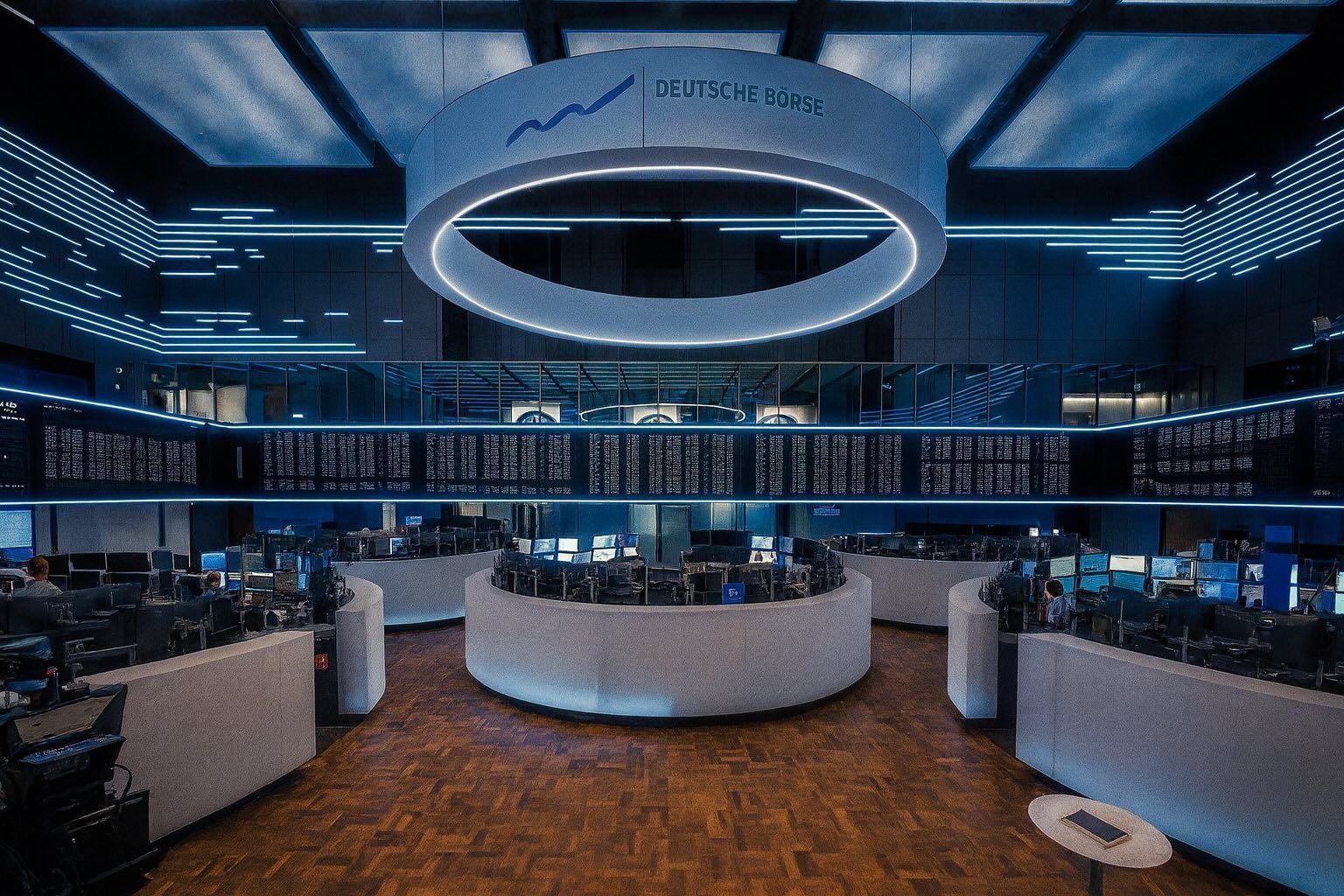
Frankfurt’s stock market turned green again on Tuesday, 2 December 2025, as the DAX 40 clawed back part of Monday’s losses, powered by a spectacular rally in Bayer and a calmer reaction than feared to fresh eurozone inflation data.
Quick snapshot – German stock market on 2 December 2025
- DAX 40 closed around 23,780 points, up roughly 0.8% after Monday’s 1.0% drop to 23,589.44.
- MDAX mid‑caps traded about 0.25% higher near 29,550, recovering from Monday’s 1.54% slide.
- TecDAX tech stocks edged lower, ending the day down about 0.16% at 3,541.9 points.
- Eurozone inflation for November surprised slightly higher at 2.2% year‑on‑year, with Germany estimated around 2.6%, reinforcing expectations that the ECB will hold rates at 2% at its December meeting.
- Market breadth remained mixed: Bayer jumped 11–15% intraday, while other heavyweight names such as Rheinmetall, Adidas and Vonovia traded lower.
DAX 40 Today: Rebound After a Weak Start to December
After a poor start to the month on Monday – when the DAX fell 1.04% to 23,589.44 points, dragged down in part by an Airbus‑related sell‑off – Tuesday brought a more constructive tone.
By the middle of the session, German media reported the index up about 0.5% around 23,704, and European market coverage from Reuters likewise flagged Germany as one of the better performers in a broadly flat European session.
End‑of‑day data from Investing.com show the DAX finishing at 23,780.07, with an intraday range between roughly 23,603 and 23,780 points, for a daily gain of about 0.81%.
In the background:
- The DAX’s 52‑week range currently sits between 18,489.91 and 24,771.34, with a 12‑month gain of roughly 18–19%, underlining how close German blue chips remain to record territory despite the recent wobble.
- Within Europe, the STOXX 600 was only up about 0.1%, but banks jumped roughly 0.9%, and Germany’s DAX and France’s CAC 40 outperformed with gains around 0.5% by late morning, according to Reuters.
So while Tuesday’s rally did not fully erase Monday’s decline, it re‑anchored the DAX in the upper half of its recent range, suggesting that the pullback still looks more like a pause in an ongoing bull market than the start of a deeper correction.
MDAX and TecDAX: Mid‑Caps Firmer, Tech Slightly Softer
Below the headline index, the picture was more nuanced:
- The DAX Midcap Index (MDAX) traded around 29,549.67 points, up 0.25% on the day, with a range of about 29,320–29,555, after closing Monday at 29,475.82.
- The TecDAX lagged, ending at 3,541.89, down 0.16%, following a 1.24% drop on Monday.
That combination – large caps and mid‑caps up, tech slightly down – fits Tuesday’s broader European pattern, where banks and cyclicals outperformed, while healthcare and some growth names underperformed.
Bayer’s Roundup Breakthrough Dominates the DAX
The single biggest story in Frankfurt today was Bayer.
What happened?
- A U.S. policy shift triggered the move: the Trump administration formally urged the U.S. Supreme Court to hear Bayer’s appeal in thousands of lawsuits over whether its Roundup weedkiller causes cancer.
- That move significantly improves Bayer’s chances of getting a clearer, potentially more favourable legal framework around its legacy Monsanto litigation, which has already forced the company to book multi‑billion‑euro provisions in recent years.
Market reaction
The impact on the stock was explosive:
- Trading Economics, via TradingView, reports that Bayer surged as much as 15% in early deals, the biggest intraday jump in more than two decades, pushing its year‑to‑date gain to around 80%.
- Mid‑session snapshots from German portals showed Bayer up about 11–12%, with the share price around €33–35 on Xetra.
- A dedicated analysis on TechStock² notes the stock trading around €34–35, up roughly 13% intraday, and frames the move as a potential “trend‑changing” rally for a name that has become a symbol of legal overhang in the DAX. TechStock²
Given Bayer’s heavyweight status, this single stock move contributed a large chunk of the DAX’s overall gain – which also explains why index‑level performance looked stronger than the underlying breadth.
Is this the start of a re‑rating?
Analysts and commentators are cautiously optimistic:
- The legal news does not end the Roundup saga, but it raises the odds of a more predictable outcome than repeated jury trials in U.S. state courts.
- TechStock² highlights that, even after today’s spike, Bayer trades at depressed valuation metrics versus its European pharma peers, precisely because of litigation risk. The key question is whether today marks the beginning of that “litigation discount” closing, or just a relief rally before more volatility. TechStock²
For the broader German market, the Bayer story matters because it reduces one of the DAX’s most visible idiosyncratic risks – at least for now – and reinforces the narrative that European value names can still deliver big upside catalysts when the news flow finally turns.
Mixed Signals from SAP, Vonovia and Other Heavyweights
SAP: Cloud and AI strength vs. legal and regulatory overhang
SAP SE, the DAX’s largest component by market cap, “edged higher” in Tuesday’s session, according to a fresh deep‑dive from TS2.tech. TechStock²
Key themes in that analysis:
- Strategically, SAP is doubling down on cloud and AI, including its EU AI Cloud and sovereign‑cloud offerings that target European governments and critical industries wary of over‑reliance on U.S. hyperscalers.
- The company has been simplifying its portfolio, including the sunsetting of its Business ByDesign product, in order to focus resources on higher‑growth cloud suites.
- Financially, Q3 2025 results showed:
- Revenue of €9.08bn, slightly below consensus of around €9.17bn.
- Cloud revenue up 22% year‑on‑year, its slowest cloud growth since late 2023 but still solid.
The medium‑term story remains constructive:
- SAP guides to 26–30% growth in non‑IFRS operating profit and nearly doubled free cash flow between 2024 and 2025, as cloud margins improve.
- Consensus across major brokers is firmly in “Buy” territory, with 12‑month price targets often 30–40% above current levels, reflecting optimism about AI‑driven upselling and high‑margin recurring revenue. TechStock²
But TS2.tech also underlines the risks that investors were mulling today:
- Ongoing legal battles – including disputes with o9, Celonis and Teradata, plus an EU antitrust probe into maintenance practices – create a non‑trivial tail risk of fines or behavioural remedies.
- Short‑term technical services classify SAP as a “sell candidate” after a sharp run‑up, even as long‑only fundamental investors stay bullish. TechStock²
In short, SAP’s share price uptick today fits into a bigger story: the stock looks like a quality, AI‑leveraged compounder, but one that is still digesting a big rally and a growing list of legal questions.
Vonovia: Bond redemption, analyst split and housing macro
Vonovia SE, Germany’s biggest listed residential landlord and a DAX 40 member, sat at the crossroads of interest‑rate expectations and housing policy – even as its share price slipped in intraday trading. TradingView notes Vonovia down about 1.2% in early trade, one of the index laggards despite positive corporate news.
A detailed TS2.tech report lays out what investors were digesting on 2 December:
- Balance sheet and funding
- Vonovia recently placed €2.25bn in new bonds, with strong oversubscription, and carries an equity base of €31.6bn and an equity ratio of 34.4%.
- Ratings agency Fitch affirmed a ‘BBB+’ rating with Stable Outlook in late November, citing progress on deleveraging and the resilience of its German housing portfolio.
- Today’s headline was the early redemption of a 4.75% social bond, signalling that Vonovia is using better funding access to simplify its debt stack and push leverage lower.
- Valuation and analyst views
- At a share price around €25.5, Vonovia trades at roughly 0.57x its EPRA NTA per share, a steep discount to asset value.
- Consensus data compiled in the article show an average target price near €35, implying almost 40% upside.
- Most major banks are firmly bullish (Berenberg, Goldman Sachs, JPMorgan, UBS and others with targets between €33 and €46), but Deutsche Bank cut its target from €30 to €28 and keeps a “Neutral” rating, arguing that the recent rebound leaves “hardly any room left to the upside”.
- Macro & politics
- TS2.tech stresses that Vonovia’s story is inseparable from Germany’s structural housing shortage and an increasingly interventionist regulatory environment – from rent caps to scrutiny of heating and modernization costs.
For the German market, Vonovia embodies the broader question raised by today’s inflation and rate data: if the ECB keeps rates higher for longer, the fundamental recovery in real estate could be partially offset by higher discount rates and political pressure, keeping valuations depressed even as operations improve.
Other notable movers
Midday data from finanzen.net show a broad but shallow advance in many DAX constituents:
- BASF gained around 2.7%, benefiting from the risk‑on tone and hopes that a soft landing and firmer industrial cycle will support chemicals demand.
- Bayer remained the standout, up over 11% at midday, as discussed above.
Meanwhile, TradingView highlights Rheinmetall (-1.9%), Adidas (-1.6%) and Vonovia (-1.2%) as prominent decliners early in the day, reflecting profit‑taking in defence and consumer names and ongoing caution on rate‑sensitive property.
Macro Backdrop: Inflation at 2.2% and ECB in “Wait and See” Mode
Tuesday’s trading unfolded against an important macro backdrop: the release of eurozone flash inflation data for November.
Inflation surprise – but not a shock
According to Eurostat and Reuters:
- Eurozone headline inflation rose to 2.2% in November, up from 2.1% in October and slightly above economist forecasts of 2.1%.
- Core inflation (excluding food and energy) remained at 2.4%, but services inflation stayed sticky, underlining persistent domestic price pressures.
- The Financial Times reports that German inflation ticked up to about 2.6%, from 2.3% in October.
Bond markets took the data in stride:
- TradingView notes that two‑year German yields were almost unchanged around 2.07%, and the report “helped cement the case for no near‑term ECB rate cuts.”
What it means for the ECB – and German equities
The European Central Bank has already held its deposit rate at 2% for three consecutive meetings, and October’s press conference described policy as being in a “good place,” with a strictly data‑dependent approach.
Today’s numbers support the market view that:
- A rate cut at the December 18 meeting is very unlikely.
- Discussions about easing could resurface in early 2026 if inflation drifts below target as cheaper energy feeds through, but for now rates are expected to remain above pre‑pandemic norms.
For German stocks, this has a sector‑specific impact:
- Banks benefit from the prospect of “higher for longer” rates, which support net interest margins – consistent with Tuesday’s 0.9% rally in European bank stocks.
- Rate‑sensitive sectors like real estate and some growth/tech names (Vonovia, parts of the TecDAX) remain more volatile and valuation‑constrained, even when fundamentals are stabilising.
Strategic Outlook: What Forecasters See for DAX and European Equities
While today’s move was driven by company‑specific catalysts and fresh inflation data, medium‑term strategists continue to paint a broadly constructive picture for German and European stocks.
Deutsche Bank and others turn more positive on Europe
In October, Deutsche Bank upgraded European equities to “overweight” versus the U.S., arguing that:
- Valuations in Europe – including Germany – are much less demanding after years of underperformance.
- Earnings growth of 10–12% for major indices through 2026 looks achievable.
- A fiscal boost from Germany and improving sentiment could support 12–16% upside for key European indices (including the STOXX 600 and, by extension, large benchmarks like the DAX) through 2026.
Earlier in the year, another Reuters analysis of the European equity bull market highlighted four key themes: attractive valuations, bank strength, AI‑related tech upside, and re‑shoring/industrial policy tailwinds – all areas where German corporates are heavily represented.
Position of the DAX within that narrative
With the DAX:
- Up nearly 19% over 12 months,
- Sitting within 4–5% of its 52‑week high near 24,771 points, and
- Still trading at a discount to U.S. benchmarks on standard valuation ratios,
today’s rebound fits the idea that pullbacks are being used as entry points in a still‑intact European equity uptrend – even if stock‑specific issues (like Bayer’s litigation or SAP’s antitrust risk) can dominate single‑day performance.
Key Levels and Risks to Watch After 2 December 2025
Technical reference points
Based on recent price history:
- Immediate support for the DAX sits around 23,400–23,450 (the low from Monday, 1 December).
- First resistance is now the recent closing high region around 23,800–24,000.
- Medium‑term resistance is defined by the 52‑week and record highs near 24,770 points.
A sustained move above 24,000 would likely revive talk of new all‑time highs, while a break below 23,400 could signal that the early‑December pullback is turning into something deeper.
Fundamental risk factors
Heading into the rest of December and 2026, investors in German equities will be watching:
- Bayer litigation path
- Whether the U.S. Supreme Court actually agrees to hear the Roundup appeal – and, if so, how the case is framed – will be crucial for justifying or extending today’s re‑rating.
- SAP’s legal and regulatory overhang
- Progress in the o9, Celonis and Teradata cases, plus the EU antitrust probe, could influence both sentiment and the company’s ability to bundle and monetise its cloud offerings.
- Vonovia and the housing policy debate
- The balance between a structural housing shortage and mounting regulatory pressure – including potential rent caps and scrutiny of heating costs – will shape whether the current discount to book gradually closes or becomes the “new normal” for German property stocks.
- ECB policy and inflation trajectory
- If inflation eases back toward or below 2% in 2026, the path of rate cuts (if any) will be critical for financials vs. real estate and growth sectors.
- Global risk sentiment
- Today’s TradingView note pointed out that crypto volatility and Japanese bond swings were already making investors cautious: global risk‑off episodes can still hit the DAX disproportionately, given its exposure to cyclicals and export‑driven names.
What Today’s Session Means for Investors
For investors following the German stock market today, 2 December 2025, a few big messages stand out:
- The DAX rebound and Bayer’s explosive rally show that stock‑specific catalysts still matter a lot in a market trading near record levels.
- Macro data – notably the 2.2% eurozone inflation print and stable rate expectations – are supportive but not euphoric, favouring banks and quality cyclicals over the most rate‑sensitive parts of the market.
- Structural stories like SAP’s cloud & AI push and Vonovia’s deleveraging and regulatory navigation remain central to the medium‑term DAX outlook, even when the day’s price moves are modest.
- Major houses such as Deutsche Bank still see double‑digit upside for European indices into 2026, suggesting that dips – like Monday’s – are more likely to be viewed as buying opportunities than exit signals, as long as earnings hold up.
As always, this overview is for information and news purposes only and does not constitute investment advice. Anyone considering exposure to the DAX or individual German stocks should weigh these developments against their own risk tolerance, time horizon and, ideally, professional financial guidance.