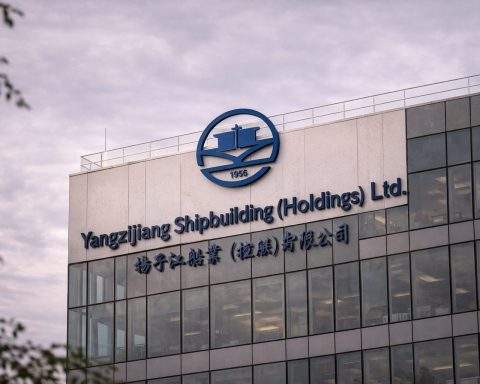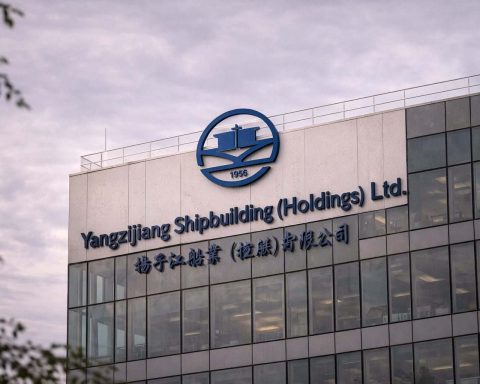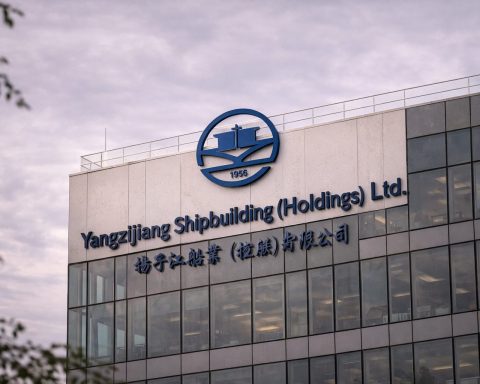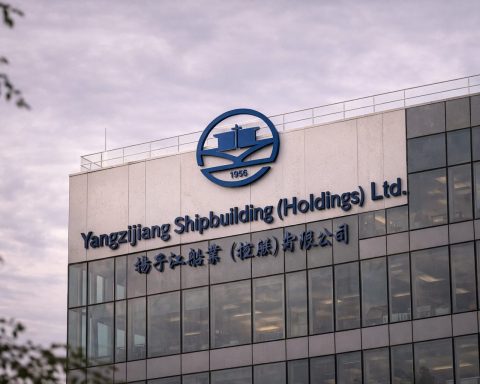

Yangzijiang Shipbuilding (Holdings) Ltd SGX:BS6 remains one of the most closely watched Singapore-listed industrials, as investors weigh a record order book, “green” ship demand and easing US–China port-fee tensions against cyclical risks in global shipping.
Yangzijiang Shipbuilding share price today (4 December 2025)
As of Thursday morning in Singapore, Yangzijiang Shipbuilding shares are trading around S$3.42–3.45, with recent quotes at S$3.43 at 09:20 SGT and S$3.42 at 11:40 SGT.
Based on recent data:
- Market capitalisation: about S$13.4 billion
- 12‑month trading range: roughly S$1.80 – S$3.58
- Trailing P/E: about 9–10 times earnings
- Net profit margin (TTM): ~29%
Over the past year the stock has climbed more than 30%, recovering from a sharp sell-off earlier in 2025 when the US first floated steep port fees on Chinese-built vessels.
Despite that rebound, the current price still trades at a notable discount to analyst target prices and to many global shipbuilding peers on earnings multiples.
From US port-fee scare to relief rally
The key macro story around Yangzijiang in 2025 has been geopolitics rather than welding torches.
Early this year, the US Trade Representative (USTR) launched a Section 301 investigation into China’s dominance in maritime logistics and shipbuilding, coupled with a plan to impose significant port-entry fees on Chinese-owned, operated or built vessels calling at US ports.
Markets reacted nervously:
- Yangzijiang’s share price slid from about S$3.30 in February to below S$2.00 within weeks, as investors feared a collapse in new orders for Chinese yards.
Tensions escalated in October when China introduced retaliatory port fees on US-linked ships, while simultaneously exempting China-built vessels and empty ships entering Chinese yards for repairs – a category that includes many hulls built by yards like Yangzijiang.
The risk picture changed dramatically in November:
- On 6–9 November 2025, Washington announced a one‑year suspension of the Section 301 port-fee action from 10 November as part of a broader trade understanding with Beijing.
- China’s Ministry of Transport followed by suspending its own special port charges on US-linked ships for the same period.
For Yangzijiang, the net result is that the worst‑case scenario – punitive, long‑lasting fees directly hitting customers of Chinese yards – has been parked for at least a year. This de‑risking has underpinned a strong recovery in sentiment, captured in recent bullish broker reports and a steady recovery in the stock price through October and November.
Record order book and the “green vessel” pivot
While the headlines were dominated by port fees, the company continued to lock in long‑dated work.
New orders in 2025
According to Yangzijiang’s 3Q 2025 business update, the group has so far in 2025:
- Secured 50 newbuilding orders
- With a total contract value of about US$2.17 billion
- Comprising 38 containerships, 10 bulk carriers and 2 gas carriers (LPG)
- With deliveries scheduled between 2027 and 2029.
Earlier in the year, a LinkedIn update from industry outlet Beyond Shipping highlighted that between January and early September, Yangzijiang had already booked 36 vessel orders worth around US$1.46 billion, after a slow first half caused by port‑fee uncertainty.
Order book visibility
The latest figures from Yangzijiang’s Q3 update and independent maritime press paint a picture of exceptional revenue visibility:
- Orders on hand:245 vessels
- Order book value: roughly US$22.8 billion (about 8.8m CGT)
- Delivery schedule: stretching out to 2030
- Mix by vessel type: 126 containerships, 46 bulk carriers, 26 gas carriers and 47 tankers.
Crucially, around 71% of this order book by value consists of “green” or clean‑energy vessels, including dual‑fuel container ships and gas carriers designed to meet tightening IMO decarbonisation rules.Seatrade Maritime News+1
Analysts at DBS, CGS International and UOB Kay Hian estimate that the existing backlog alone covers more than four years of shipbuilding revenue, something rarely seen in such a cyclical sector.
Capacity expansion: Hongyuan yard and beyond
To support this long pipeline, Yangzijiang is expanding its yard footprint:
- The Yangzi Hongyuan yard, a roughly RMB 3 billion project, is under construction and expected to complete around end‑2026, with first deliveries around mid‑2027.
- Hongyuan will add capacity mainly for medium‑sized gas carriers and other complex vessels, giving the group optionality to accept higher-value orders rather than chasing volume.
Management has indicated that remaining delivery slots for 2029 are largely in the small‑ to mid‑size segment, and they are selectively filling these with better-margin projects.
Financial performance: margins at new highs
Behind the order headlines, Yangzijiang’s profitability has quietly hit record levels.
1H 2025 results
In its 1H 2025 results released in August, the company reported:
- Revenue: RMB 12.9 billion (down 1.3% year‑on‑year)
- Gross profit: RMB 4.45 billion (up 27.6% y/y)
- Net profit attributable to shareholders: RMB 4.18 billion (up 36.7% y/y)
- Gross margin: 34.5%
- Net margin: 32.5%
Higher margins were driven mainly by lower steel costs, improved contract pricing and efficient execution of high-value dual‑fuel containership projects.
Trailing 12‑month metrics
Aggregated data from StockAnalysis and other financial platforms for the last 12 months show:
- Revenue: ~S$4.7 billion
- Net income: ~S$1.4 billion
- Net profit margin: about 29–30%
- Return on equity (ROE): approaching 28–29%
- Net cash position: around S$3.3 billion, with a modest debt-to-equity ratio near 0.2x.
These numbers put Yangzijiang near the top of the global shipbuilding pack in terms of profitability and balance-sheet strength.
Dividends
Shareholders are being rewarded:
- The group paid a full‑year dividend of S$0.12 per share in 2025 (for FY 2024), with an ex‑dividend date of 5 May 2025.
- At today’s share price, that implies a trailing dividend yield of roughly 3.5–3.7% on the Singapore listing, while OTC investors in YSHLF see a similar TTM yield of about 3.5%.
DBS’s latest model suggests dividends (in RMB terms) could continue rising through 2027, pushing the prospective yield well above 4% if earnings track current forecasts.
Analyst ratings and price targets as of 4 December 2025
Singapore broker research
Recent Singapore broker calls have turned distinctly more bullish following the Q3 business update and the easing of US port‑fee risks:
- CGS International
- Rating: “Add”
- Target price:S$4.51 (up from S$3.90)
- Rationale: strong multi‑year order book, 71% green-vessel mix, and margin expansion justify a 10x FY 2027 P/E, still at a discount to Korean and Chinese peers trading around 14–17x.
- UOB Kay Hian
- Rating: “Buy”
- Target price:S$4.10 (from S$3.90)
- The house expects Yangzijiang to secure about US$4.5 billion of new orders in 2026, and has raised its 2026–27 earnings forecasts after lifting shipbuilding margin assumptions to 31% in 2026 and 30% in 2027.
- DBS Group Research
- Rating: “Buy”
- Target price:S$3.80
- DBS expects margins to remain above 30%, with dividend yields potentially rising to 5–6% over the next two years on the back of strong cash generation.
Global consensus
Beyond local houses, international coverage has also grown:
- Investing.com’s consensus (ticker YAZG) shows:Investing.com
- Overall rating: “Strong Buy”
- 10 Buy, 0 Hold, 1 Sell in the past three months
- Average 12‑month target price:S$3.80, implying ~10.6% upside from a reference price of S$3.44
- High target: S$4.51, low target: S$1.60
- MarketScreener’s analyst consensus (for the renminbi listing) aggregates 11 analysts with a “Buy” recommendation, an average target of 20.75 CNY, about 11.7% above the last close.MarketScreener
- Growbeansprout, using SGX data, reports a consensus Singapore‑dollar target price of S$4.511, implying around 31–32% upside from a spot price of S$3.43 on 4 December 2025.
In short, across both local and international coverage, the picture is broadly the same: high-teens to low‑30% upside implied by target prices, with analysts almost uniformly positive on the name.
Short‑term technical picture
Quantitative service StockInvest, which focuses on technical signals, currently classifies Yangzijiang as a “buy candidate”:StockInvest
- Closing price on 3 December 2025:S$3.40, up 0.89% on the day
- The stock sits in the middle of a “wide and weak rising trend” in the short term
- Their model projects a 6.6% gain over the next three months, with a 90% probability the price will trade between S$3.48 and S$3.91 at the end of that period
- Near‑term support is seen around S$3.37, with resistance around S$3.45–3.52
Technicals, in other words, are moderately constructive but not euphoric – consistent with a stock grinding higher rather than spiking.
Key risks investors should watch
Despite the rosy numbers, Yangzijiang’s investment case is not risk‑free. Major downside drivers highlighted by brokers and industry observers include:
- Trade-policy whiplash
- The current one‑year suspension of US and Chinese port fees is just that: a suspension, not a cancellation. Future negotiations could re‑ignite tariff or port‑fee risks for Chinese-built ships.
- Competitive pressure from other Chinese yards
- Second‑tier Chinese yards have expanded capacity and are chasing orders aggressively, which could compress pricing and margins for standard vessels.
- Steel prices and input costs
- The recent surge in margins was helped by relatively benign Chinese steel prices. A spike in raw‑material or labour costs could erode profitability.
- Execution risk on new yards
- Integrating the new Hongyuan yard may temporarily soften margins as the facility ramps up, before economies of scale and learning-effects kick in.
- Cyclical nature of shipping
- Container and bulk-commodity cycles have historically been volatile. A sharp downturn in freight rates or a global recession could lead to order cancellations or fewer high-value contracts.
Investors therefore need to balance unusually strong visibility and profitability against the reality that shipbuilding remains a cyclical and politically exposed business.
Is Yangzijiang Shipbuilding stock attractive at today’s price?
Putting all the strands together:
- The stock trades at roughly 9–10x trailing earnings and a modest premium to book value, despite ROE near 28–29%, substantial net cash, and a multi‑year, largely “green” order book.StockAnalysis+2GuruFocus+2
- Dividend yields around 3.5% (with potential to rise) provide a tangible cash return while investors wait for the order book to translate into earnings over 2026–2030.
- Analyst sentiment is overwhelmingly positive, with most target prices between S$3.80 and S$4.51, well above today’s S$3.4x levels.
- The US–China port‑fee truce has, at least temporarily, removed the most dramatic tail risk hanging over Chinese yards.
On the other hand, the one‑year nature of the policy pause and the inherently cyclical nature of shipping mean the stock is not a one‑way bet.
For investors comfortable with China exposure, shipbuilding cyclicality, and policy risk, Yangzijiang Shipbuilding today looks like a rare combination of:
- High profitability
- Strong balance sheet
- Long‑dated “green” growth drivers
- And a valuation that still sits well below many global peers.
For more cautious investors, the prudent approach may be to treat Yangzijiang as a core cyclical holding within a diversified portfolio rather than a stand‑alone conviction bet.
Either way, as of 4 December 2025, Yangzijiang remains one of the most important bellwethers for both Chinese industrial competitiveness and the global decarbonisation of shipping – and its share price will likely keep tracking not just steel and freight, but also the ebb and flow of great‑power politics
Related articles: SGX:BS6