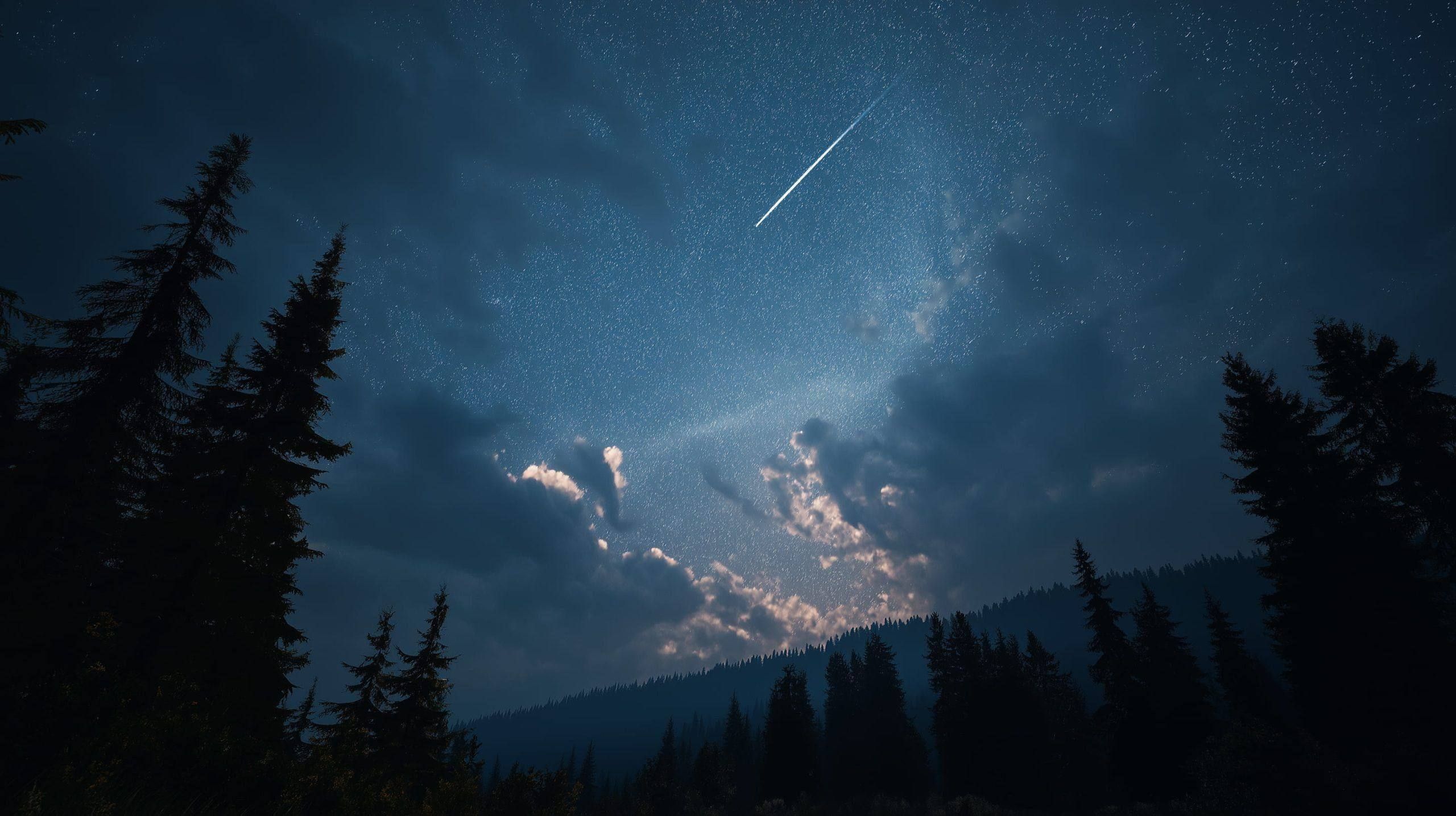

The night sky on Thursday, December 4, 2025 is unusually busy. Skywatchers around the world are getting:
- The final full supermoon of 2025, the Cold Supermoon
- The official start of the Geminid meteor shower, often the year’s best shower
- A geomagnetic storm that could fuel northern lights at lower latitudes than usual
- Bright views of Jupiter and Saturn, with fainter outer planets nearby
- A rare, ongoing story in the background: interstellar comet 3I/ATLAS being tracked by NASA
Below is your complete, news-driven guide to what’s happening, why it matters, and how to see it tonight, wherever you are.
1. Cold Supermoon 2025: Last Full Moon of the Year Goes Big
Exact timing and why this full moon is special
Tonight’s full moon is both December’s “Cold Moon” and a supermoon—the last full moon of 2025 and the last supermoon of the year.
Astronomical services and observatories agree that the Moon reaches full phase at about 23:14 UTC on December 4, 2025. That’s 6:14 p.m. Eastern Time (EST), 11:14 p.m. in the U.K. (GMT), and early morning on December 5 in much of Asia.
Because this full moon occurs less than half a day after lunar perigee (the Moon’s closest point to Earth), it qualifies as a supermoon. At perigee, the Moon is roughly 357,000 km from Earth instead of a more typical ~384,000 km.
NASA and multiple outlets note that a supermoon can appear up to about 14% larger and around 30% brighter than the smallest full moon of the year (a so‑called “micromoon”). The Washington Post+4Space+4EarthSky+4 In practice, you’ll notice the brightness more than the size—especially if your sky is dark and clear.
Why it’s called the “Cold Moon” — and why it rides so high
This full moon is traditionally called the Cold Moon, Long Night Moon, or Moon Before Yule, reflecting the long, dark, cold nights around the December solstice.
Because the Sun is taking its lowest path across the sky in the Northern Hemisphere, the full moon—opposite the Sun—takes the highest nighttime path of the year. EarthSky points out that tonight’s full moon mimics the height of the June Sun in northern latitudes, staying up longer and cruising very high overhead.
In the Northern Hemisphere, expect:
- Moonrise around local sunset
- The Moon very high around midnight
- Moonset around sunrise
In the Southern Hemisphere, the effect is reversed: the full moon takes a low path, echoing a low winter Sun for northern observers.
Where to look and what you’ll see
Astronomy guides place the December 2025 full moon in the constellation Taurus the Bull, with some nice celestial landmarks nearby.
If your skies are clear and not too light‑polluted:
- Look east around sunset to watch the Moon rise.
- You may notice a yellow or orange tint as it climbs, caused by Earth’s atmosphere scattering blue light (Rayleigh scattering).
- The “moon illusion” will likely make the Moon look larger when it’s low on the horizon, especially near buildings or trees. This is a brain trick, not a real size change. Space+2Country Living+2
EarthSky and other guides highlight that tonight the Moon lies near bright star Aldebaran in Taurus and not far from Capella in Auriga, while Jupiter shines as a brilliant “star” nearby in the evening sky. EarthSky+2Space+2
And there was already drama earlier today: according to BBC Sky at Night, the nearly full Moon occulted the Pleiades star cluster around 03:00 UTC, with Uranus sitting about 4.6° south of the Moon at that time—a treat for telescopic observers.
2. Geminid Meteor Shower 2025: Tonight Marks the Start
Activity dates and peak
The Geminid meteor shower—routinely billed as the best meteor shower of the year—begin its activity today, December 4, and runs roughly through December 20, with a broad peak on the nights of December 13–14.
Timeanddate and Star Walk both note that, under dark skies, the Geminids can produce up to 120–150 meteors per hour at peak, with bright, often colorful “shooting stars.” Time and Date+2Star Walk+2
This year, conditions are especially promising: the Moon will be a thin waning crescent by the peak, minimizing moonlight interference.
What you can expect tonight
Although the peak is still about 10 days away, tonight marks the start of the Geminid activity window. That means:
- You may already spot occasional early Geminids late tonight and in the pre‑dawn hours.
- Rates will still be relatively low—perhaps a handful of meteors per hour in good conditions—but any bright Geminid can be spectacular.
The Geminids appear to radiate from the constellation Gemini, near the bright stars Castor and Pollux, which rise higher as the night goes on.
How to watch the Geminids
Professional and amateur guides consistently give the same advice: Time and Date+2Star Walk+2
- Go somewhere dark – Away from city lights if possible.
- Look up and be patient – You don’t need a telescope or binoculars; they reduce your field of view.
- Face generally toward Gemini but not directly at it—meteors can streak across any part of the sky.
- Give your eyes 20–30 minutes to adapt to the dark.
- Dress warmly and plan to watch for at least an hour for a good chance at seeing several meteors.
Even if tonight’s Geminid rates are modest, starting to watch now gives you a feel for the sky before the big show around December 13–14.
3. Northern Lights Watch: Geomagnetic Storm in Progress
G2–G3 geomagnetic storm watch
Space weather is also active this week. NOAA’s Space Weather Prediction Center (SWPC) has issued a G2 (Moderate) geomagnetic storm watch for December 3–4 (UTC) after a coronal mass ejection (CME) associated with an X1.9 solar flare on December 1 was observed heading toward Earth.
NOAA’s aurora dashboard and Kp forecasts suggest the greatest expected Kp index is around 5–6, indicating G1–G2 storm levels, with the possibility of brief G3 (Strong) conditions if the CME and high‑speed solar wind arrive together.
Space.com’s aurora forecast piece, published December 3, notes that the setup could make northern lights visible across 15 U.S. states—including Alaska, Washington, Idaho, Montana, the Dakotas, Minnesota, Wisconsin, Michigan, Iowa, New York, Vermont, New Hampshire and Maine—overnight December 3–4, with potential for the auroral oval to expand further south if conditions intensify.
Why now? Solar Cycle 25 is near peak
We’re currently in the maximum phase of Solar Cycle 25. NASA and NOAA reported in 2024 that the Sun reached solar maximum earlier and more strongly than forecast, with sunspot numbers exceeding expectations and multiple powerful X‑class flares.
That elevated activity continues into late 2025, bringing more frequent geomagnetic storms and aurora displays—along with increased risks for satellites, power grids and radio communications.
How to look for auroras tonight
If you live in a high‑latitude region (northern U.S., Canada, Northern Europe, Scotland, Scandinavia, Iceland, or similar latitudes in the Southern Hemisphere):
- Check local cloud forecasts first.
- Aim to observe between local 10 p.m. and 2 a.m., the usual sweet spot for auroras.
- Get a dark, north‑facing view with a clear horizon and minimal light pollution.
- Use aurora apps or the SWPC aurora dashboard for real‑time Kp and oval updates.
For those farther south, tonight isn’t guaranteed to bring auroras—but with a G2/G3‑level event on tap during solar maximum, it’s worth an occasional check of the northern horizon if your skies are clear.
4. Planets in Tonight’s Sky: Jupiter Steals the Show
Jupiter: The main planetary attraction
BBC Sky at Night calls Jupiter the standout planet of December 2025. The gas giant is: Sky at Night Magazine+2Sky at Night Magazine+2
- Very bright and easy to spot with the naked eye
- Located in Gemini, not far from the twin stars Castor and Pollux
- Climbing to a high altitude (near 60°) when due south for mid‑northern latitudes later in the night
Even a small telescope can reveal:
- Jupiter’s cloud belts and zones
- The famous Great Red Spot (depending on rotation)
- The four Galilean moons—Io, Europa, Ganymede and Callisto—changing positions night to night
NASA’s December skywatching guide also highlights a close conjunction of the Moon and Jupiter on December 7, just a few nights from now.
Mercury and Venus: Morning sky targets
According to Sky at Night and Star Walk: Sky at Night Magazine+2Star Walk+2
- Mercury is a morning planet this month and will reach its best visibility around December 7, shining brightly (around magnitude –0.4) low in the southeastern sky before sunrise. It’s already visible in early December for sharp‑eyed observers.
- Venus is technically also a morning star but is too close to the Sun this month to be easily observed, heading toward superior conjunction in early January 2026.
Saturn, Uranus and Neptune
- Saturn sits in Aquarius, low in the southwest after dark for many northern observers. Sky at Night notes that around this time the planet’s rings are almost edge‑on, making them tough to see in small telescopes—Saturn can look nearly ringless through modest apertures.
- Uranus lies in Taurus, south of the Pleiades, near the region the Moon swept past earlier today. At about magnitude +5.6, it’s just on the edge of naked‑eye visibility in truly dark skies but much easier with binoculars.
- Neptune is in Pisces, dim at around magnitude +7.9 and best seen with binoculars or a telescope. It’s not far from Saturn in the sky.
Constellations to enjoy around the supermoon
Even with the bright Moon washing out faint stars, the main winter constellations still shine through for Northern Hemisphere observers:
- Orion rising in the east later in the evening
- Taurus with bright Aldebaran and the Hyades
- The compact Pleiades star cluster (though it was partially occulted by the Moon earlier today for some locations) Sky at Night Magazine+2EarthSky+2
In the Southern Hemisphere, summer constellations like Eridanus, Fornax and Horologium are well placed, though the supermoon will reduce the visibility of fainter stars.
5. Interstellar Comet 3I/ATLAS: A Telescopic Bonus Story
While you won’t see it with the naked eye tonight, one of the most intriguing ongoing stories in the night sky is interstellar comet 3I/ATLAS.
NASA’s December skywatching bulletin notes that 3I/ATLAS will make its closest approach to Earth around December 19, and Star Walk estimates its brightness at about magnitude 13, putting it within reach of small to medium telescopes under dark skies.
Star Walk and other guides recommend looking in the constellation Leo in the early morning hours as the month goes on.
In a new update published this week, NASA reported that the Psyche spacecraft turned its multispectral imager toward 3I/ATLAS in September, tracking the comet for eight hours from about 33 million miles (53 million km) away. These observations help scientists refine the comet’s trajectory and study its unusual behavior as only the third known interstellar object to pass through our solar system.
For now, 3I/ATLAS is a target for experienced astrophotographers and advanced amateurs, but its presence adds an extra layer of excitement to December’s sky news.
6. How to Make the Most of Tonight’s Sky (No Telescope Required)
Whether you’re under city lights or on a dark rural hilltop, you can enjoy tonight’s show.
1. Focus on the supermoon
- Head outside around local sunset and look east.
- Watch the Cold Supermoon clear the horizon and brighten as the sky darkens.
- If you can, come back out near local midnight to see how high it climbs, especially in the Northern Hemisphere.
2. Scan for early Geminids
- After full darkness, especially after local 10 p.m., recline or lie back and look generally up and toward the east, where Gemini is climbing.
- Don’t stare only at one point—Geminids can streak across any part of the sky.
- Even a few early meteors can be memorable, especially with the Moon lighting the landscape.
3. Check for auroras if you’re far north
- If you live at high latitudes, keep an eye on space weather alerts and the aurora oval for your region.
- If the Kp index climbs and your skies are clear, step outside, look north and watch for subtle glows or arcs that can suddenly explode into curtains of light.
4. Spot the planets
- After dark, look for Jupiter as a very bright “star” high in the eastern to southern sky, depending on your time of night. Sky at Night Magazine+1
- Slightly earlier in the evening, try to find Saturn low in the southwest (for mid‑northern latitudes).
- If you’re an early riser, aim for Mercury just before dawn in the southeast over the coming mornings as it moves toward its December 7 best morning appearance.
Bottom line
Tonight, December 4, 2025, the night sky delivers a rare combination:
- A brilliant Cold Supermoon, riding high and bright
- The opening night of the Geminid meteor shower
- An ongoing geomagnetic storm that could power auroras for lucky high‑latitude observers
- A rich cast of planets, led by dazzling Jupiter
- And, behind the scenes, a once‑in‑a‑generation interstellar comet under close scientific watch
You don’t need any equipment—just your eyes, warm clothes, and a bit of patience. If clouds cooperate where you are, tonight is a very good night to look up.