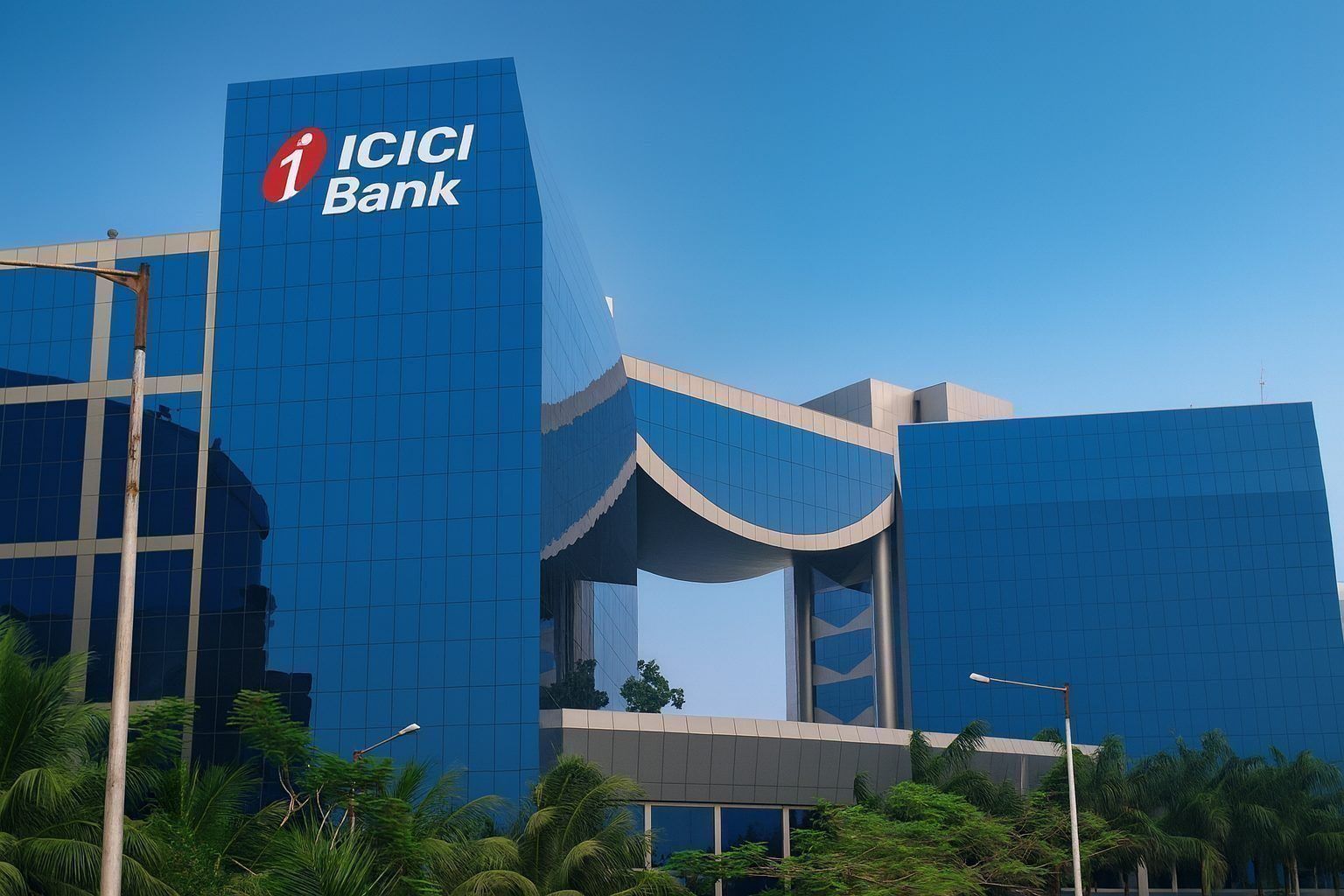

ICICI Bank Limited (NSE: ICICIBANK, BSE: 532174, NYSE: IBN) spent Friday, December 5, 2025 trading just above the ₹1,390 mark as investors weighed a fresh Reserve Bank of India (RBI) rate cut, renewed “systemically important bank” status and a solid second-quarter earnings print.
Below is a detailed look at what is moving the stock today, how the fundamentals stack up, and what analysts are forecasting over the next 12 months.
ICICI Bank share price today: hovering around ₹1,390
In afternoon trade on December 5, 2025, ICICI Bank shares were quoted around ₹1,389–1,391 on the NSE, modestly higher than Thursday’s close of about ₹1,386.5.
A live update from a brokerage desk put the stock at ₹1,389.90 earlier in the day, effectively flat versus the previous close, underlining a quiet session after a volatile week.
Key near-term share-price context:
- The stock is only slightly below its all‑time high of about ₹1,494 hit on July 31, 2025.
- Weekly returns are marginally negative (about –0.4%), suggesting a pause rather than a reversal in the uptrend.
- A six‑month beta of roughly 1.4 indicates that ICICI Bank is more volatile than the broader market.
Based on current prices, ICICI Bank’s market capitalisation is close to ₹9.9–10 trillion (around US$110 billion), keeping it firmly in the club of India’s largest financial institutions.
Fresh news shaping ICICI Bank on December 5, 2025
1. RBI rate cut: support for growth, questions on margins
The big macro headline for banks on Friday was the RBI’s 25 basis point policy rate cut, with bank stocks reacting in mixed fashion. A market report noted that major lenders such as SBI, HDFC Bank, ICICI Bank and Kotak Mahindra Bank saw intraday gains of up to 2% after the Monetary Policy Committee decision.
Rate cuts are a double‑edged sword for banks:
- Positive: cheaper funding can stimulate credit growth in retail and corporate segments.
- Negative: lending rates also trend lower, putting pressure on net interest margins (NIMs) unless deposit costs adjust quickly.
ICICI Bank has so far managed to keep its NIM around 4.3% even after earlier rate cuts this year, helped by a strong mix of retail and SME loans. Reuters How margins behave over the next few quarters in a lower‑rate environment will be a key driver for the stock.
2. RBI reaffirms ICICI Bank as a D‑SIB
Earlier this week, the RBI confirmed that State Bank of India, HDFC Bank and ICICI Bank will continue to be classified as Domestic Systemically Important Banks (D‑SIBs).
For ICICI Bank, this means:
- It must hold an additional 0.20 percentage points of Common Equity Tier 1 (CET1) capital over and above standard requirements.
- It remains under closer regulatory scrutiny, reinforcing its “too important to fail” status within India’s financial system.
From an investor’s perspective, the D‑SIB tag is mildly capital‑consuming but generally supportive of confidence: it signals that regulators view ICICI as central to financial stability and expect it to maintain thick capital buffers.
3. Ongoing capital strength and Moody’s rating stance
Corporate filings and data providers show that ICICI Bank’s overall capital adequacy ratio stands around 17%, with CET1 of about 16.35% as of September 30, 2025 — comfortably above the RBI’s minimum requirements of 11.70% and 8.20% respectively.
On the external rating side, Moody’s recently affirmed ICICI Bank’s Baa3 rating with a stable outlook, underscoring the bank’s solid capitalisation and asset quality metrics.
4. Small share allotment under employee stock scheme
On December 5, ICICI Bank disclosed that it had allotted 23,226 equity shares of face value ₹2 each under its Employees Stock Unit Scheme 2022.
The number of shares is negligible relative to the bank’s multi‑billion share base, so the dilution impact on existing shareholders is essentially immaterial. But it does show continued use of stock‑linked compensation to align employees with long‑term shareholder value.
5. Value‑unlock angle: SEBI clears ICICI Pru AMC IPO
Regulators have also approved the roughly ₹10,000‑crore IPO of ICICI Prudential Asset Management Company, one of India’s largest mutual fund houses jointly promoted by ICICI Bank and Prudential.
While the issue will largely comprise a stake sale by the foreign partner, the listing of another group business is seen by the market as:
- A potential medium‑term value‑unlock for the ICICI group structure.
- A visibility booster for the bank’s fee and distribution income streams.
6. Broader market backdrop: profit‑taking after record highs
Earlier in the week, banking names, including ICICI Bank, saw some profit‑taking as benchmark indices eased slightly from record levels. A Reuters report highlighted that financials dropped about 0.8% on December 2, with ICICI Bank down around 1.3% on the day.
That context makes Friday’s relatively calm trading session look like consolidation after a strong multi‑month rally.
Fundamentals after Q2 FY26: steady growth, cleaner book
The latest available quarterly numbers are for Q2 FY26 (quarter ended 30 September 2025). Across multiple sources — the bank’s financial results and major financial media — a consistent picture emerges.
Key highlights:
Earnings and income
- Standalone net profit grew about 5.2% year‑on‑year to roughly ₹12,359 crore, modestly beating analyst expectations.
- Net interest income (NII) rose around 7–7.5% year‑on‑year to roughly ₹21,530 crore, driven by about 10% growth in domestic loans.
- Non‑interest income (excluding treasury) grew in double digits, though treasury income was weaker due to higher bond yields.
Balance sheet growth
- Total deposits at the end of September 2025 were about ₹16.1 trillion, up 7.7% year‑on‑year.
- Total advances increased roughly 10–10.3% year‑on‑year to a little over ₹14 trillion, with domestic loans growing slightly faster than the overall book.
- The CASA (current plus savings account) ratio stood near 39%, helping to keep funding costs relatively low.
Asset quality
- Gross NPA ratio improved to about 1.58% as of September 30, 2025, down from around 1.97% a year earlier.
- Net NPA ratio declined to roughly 0.39%, versus just above 0.40% a year ago.
- Provisions for the quarter fell by about a quarter year‑on‑year, reflecting the cleaner loan book.
Capital and returns
- Overall capital adequacy is around 17%, with CET1 at approximately 16.35%, significantly above regulatory floors.
- Return on assets (ROA) is in the mid‑2% range, placing ICICI among the more profitable large Indian banks.
Taken together, the latest quarter reinforces the narrative of ICICI Bank as a high‑quality, growth‑oriented private lender with improving asset quality and strong capital buffers.
Valuation check: premium, but how stretched?
Depending on the data source and whether you look at the Indian listing or the NYSE ADR, ICICI Bank currently trades at roughly:
- 17–19x trailing earnings (P/E).
- Around 3x book value (P/B) on the domestic listing, with some sources citing 3.1x and others closer to 2.8–2.9x based on different dates and methodologies.
Some analytics platforms view the stock as expensive relative to certain peers. For instance, one valuation service recently flagged ICICI Bank as “overvalued/expensive” versus Axis Bank, pointing to a P/E just above 20 on its methodology. marketsmojo.com
However, looking at history:
- A five‑year average P/E for ICICI Bank has been around the high‑teens to about 19x.
- Current multiples are near, or even slightly below, those historical averages according to long‑term valuation trackers.
In other words, the stock is not obviously cheap, but the premium is broadly in line with its track record as a high‑ROA, high‑quality private sector lender.
What analysts are forecasting for ICICI Bank stock
1. Street consensus on the Indian listing
Consensus data collated from multiple platforms remains broadly positive:
- One widely followed portal shows an average 12‑month target price of about ₹1,690 per share, with a high estimate around ₹1,910 and a low near ₹1,440 based on roughly 39 analysts. The stock is classified as a “Strong Buy”, with the vast majority of analysts on the Buy side. investing.com+1
- Another platform which tracks 5 “Wall Street” analysts covering the Indian listing reports an average target of ₹1,701, implying roughly 22% upside from current levels, again with a “Strong Buy” consensus. tipranks.com+1
2. Targets for the US‑listed ADR (IBN)
For the ADR, US‑based research also leans bullish:
- A Zacks compilation of analyst estimates shows an average 12‑month target in the high‑$30s to low‑$40s, suggesting about 30% upside from a recent price around $30.6.
Short‑term algorithmic models are characteristically more aggressive:
- One crypto‑style quantitative site projects the ADR could test around $33.1 within the next five days — a gain of roughly 7–8% — while acknowledging the recent week’s modest decline.
As always with these automated forecasts, the numbers should be treated more as scenario illustrations than reliable predictions.
3. Technical target zones
Technical and swing‑trading sites tracking the NSE ticker paint an overall bullish long‑term trend:
- One such service cites an uptrend with nearby upside levels around ₹1,487–₹1,500 as medium‑term resistance/target zones, suggesting that a sustained rally could retest or exceed the previous high.
How the market views ICICI Bank within India’s banking pack
ICICI Bank is consistently singled out in strategy notes and market outlooks:
- A recent strategy piece from a global broker forecasting the Nifty 50 at 29,300 by 2026 cited ICICI Bank as one of its top financial picks for the medium term, alongside names like Axis Bank and UltraTech Cement.
- Domestic brokerage lists around Diwali and Muhurat trading season prominently featured ICICI Bank among preferred long‑term ideas for the banking and financials space.
The combination of:
- Mid‑teens loan growth,
- Sub‑2% gross NPAs,
- ROA above 2%, and
- Strong capital ratios
means ICICI Bank is often grouped with HDFC Bank at the top of the quality spectrum, trading at a premium to most public‑sector lenders but at a narrower premium versus historical peaks.
Key triggers to watch over the next 6–12 months
Investors tracking ICICI Bank after today’s RBI move will likely focus on several catalysts:
- Margin trajectory in a falling‑rate cycle
With another 25 bps cut in the books and scope for more easing if growth wobbles, the crucial question is whether ICICI can keep NIMs near the 4.2–4.3% zone. Management commentary in forthcoming quarters will be closely scrutinised. - Credit growth mix
Domestic loan growth around 10% is healthy but not blistering. How much incremental growth comes from higher‑yield retail and SME segments versus large corporates will influence both margins and risk. - Asset quality resilience
Current GNPA and NNPA levels are among the best in the bank’s history. Any uptick in slippages — especially in unsecured retail or SME portfolios — would likely be punished by the market, given the premium valuation. - Group events and subsidiaries
The ICICI Pru AMC IPO, along with the performance of other subsidiaries like ICICI Prudential Life and ICICI Lombard, can impact investor perception of the group’s embedded value beyond pure banking. - Global and domestic risk sentiment
ICICI’s sizeable ADR float and foreign shareholding make it sensitive to global risk‑on/risk‑off episodes. Profit‑taking in financials earlier this week is a reminder that macro shocks or valuation worries can quickly spill over into high‑beta bank stocks.
Risks investors should keep in mind
Despite the broadly positive story, several risks are worth flagging:
- Valuation risk: Trading near three times book and high‑teens earnings, ICICI Bank is not priced as a turnaround story; it is priced as a quality compounder. Any negative surprise on growth or asset quality could compress multiples.
- Interest‑rate and NIM pressure: A faster pass‑through of rate cuts to loan yields than to deposit rates, or intense competition for deposits, could squeeze NIMs.
- Regulatory and capital requirements: D‑SIB classification, higher capital buffers and evolving prudential norms may limit how aggressively the bank can lever up or return capital via dividends and buybacks.
- Macro slowdown: A sharper‑than‑expected slowdown in India or global shocks could hit credit demand and lead to higher NPAs, especially in cyclical corporate segments.
Bottom line: how ICICI Bank looks after today’s RBI move
As of December 5, 2025, ICICI Bank sits in an interesting sweet spot:
- The stock is consolidating just below record highs after a strong run.
- Fundamentals look robust: mid‑single‑digit profit growth, double‑digit NII growth, improving asset quality and strong capital ratios.
- Regulators have reaffirmed its systemic importance, and rating agencies maintain stable outlooks.
- Most sell‑side analysts continue to see double‑digit upside over the next 12 months, though valuation screens suggest little room for complacency.
For investors and traders watching ICICI Bank on Google News or Discover, today’s action is less about dramatic price swings and more about positioning for the next chapter: how a high‑quality private bank navigates a lower‑rate world while defending margins and growth.