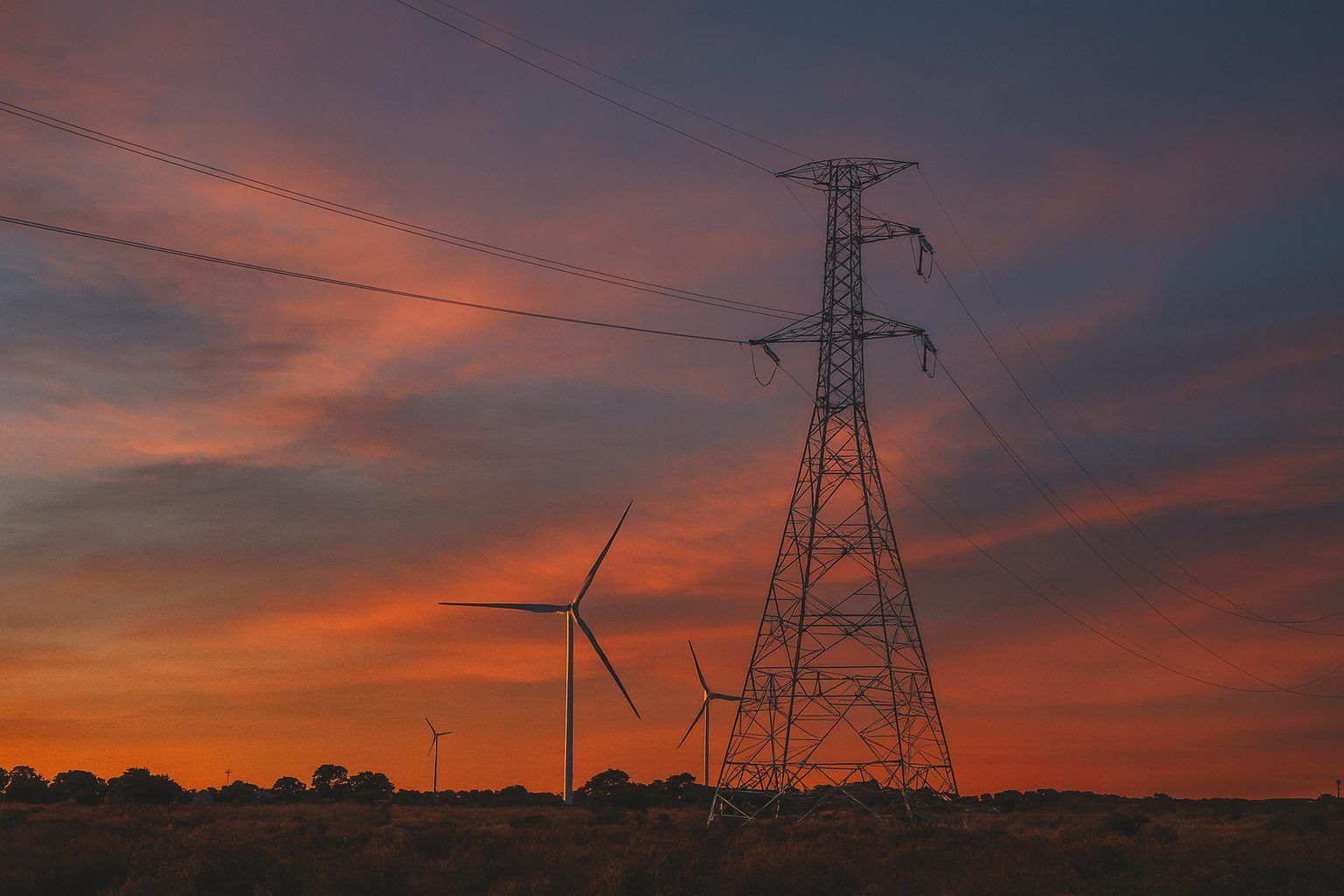

Local opposition in Perth’s north collides with Western Australia’s fastest‑moving clean‑energy build‑out – and a national milestone for wind and solar.
A planning battle on the same day as a clean‑energy milestone
On 5 December 2025, the City of Wanneroo formally escalated its fight against Western Power’s plans for a new high‑voltage transmission line through East Wanneroo – just as Western Australia and the wider national grid were celebrating record levels of renewable energy.
The council has unanimously backed a motion from Mayor Linda Aitken to oppose a proposed 132kV overhead line between Wangara Substation and Neerabup Terminal, part of Western Power’s flagship Clean Energy Link – North project. The city wants the route shifted further east, away from current and planned suburbs, or placed underground.
At the same time, new data shows Western Australia’s main electricity grid – the South West Interconnected System (SWIS) – sourced 55.78% of its power from renewables in November, while the National Electricity Market (NEM) on the east coast passed 50% renewables for the second month in a row.
The clash in Wanneroo neatly captures the tension at the heart of Australia’s energy transition: communities broadly support cheaper, cleaner power – but not always the poles and wires needed to deliver it.
What Wanneroo is fighting: the Wangara–Neerabup transmission line
Western Power’s proposal is for a new double‑circuit 132kV line running from Wangara Substation to Neerabup Terminal in Perth’s north. On its community consultation site the utility describes it as a 24km overhead line, while a June 2025 engineering fact sheet puts the length at about 26.5km, indicating the design is still being fine‑tuned.
Key details include:
- The line begins near the Wanneroo Road–Ocean Reef Road intersection and runs east along Ocean Reef Road.
- It then turns north along Sydney Road, passing through land between Lake Gnangara and Jandabup Lake, before entering Neerabup Terminal off Neaves Road in Pinjar.
- Steel poles rather than lattice towers are proposed, with Western Power stating that existing road reserves and infrastructure corridors were favoured to reduce overall community impact.
According to Western Power, the line is essential to increase energy flows between Perth and the Mid West, enabling more wind and solar projects to connect and strengthening the backbone of the SWIS as coal exits the system.
Construction is scheduled to start in early 2026, with completion in 2027, a timetable that aligns with broader Clean Energy Link – North contracts announced earlier this year.
The council’s case: amenity, housing and “a shock” for East Wanneroo
PerthNow reports that the City of Wanneroo only fully grasped the proposed route at a recent council forum, prompting what Mayor Linda Aitken described as a “shock” reaction when councillors saw the line cutting through the heart of future East Wanneroo neighbourhoods. PerthNow+1
In response, councillors unanimously authorised the mayor to:
- Write to Western Power and Western Australia’s Energy and Decarbonisation Minister Amber‑Jade Sanderson;
- Call for the overhead alignment to be shifted further east “as far as practicable,” away from existing and planned residential areas;
- Push for undergrounding of the line where it passes close to homes, mirroring another section of the Clean Energy Link that will run underground between Padbury and Wangara.
Local concerns cluster around three main issues:
- Visual impact and amenity
Residents fear a prominent lattice of poles and wires across what is currently semi‑rural land but earmarked for new communities under the East Wanneroo District Structure Plan. - Property values and land sterilisation
The mayor has pointed out that high‑voltage transmission lines typically require clear corridors, with Western Power’s own materials indicating a 10‑metre setback on each side. In practice, that can render a roughly 20‑metre‑wide strip unsuitable for housing, reducing the number of lots that can be developed along the route. - Perceived inconsistency
Wanneroo argues that if a 6km section connecting Padbury Substation to Wangara can be undergrounded because of its proximity to homes, a similar approach should be considered for the East Wanneroo segment.
East Wanneroo itself is a major growth front for Perth. Stage one of the development is already underway, with planning documents suggesting roughly 50,000 new homes over the next half‑century across the wider area. That puts enormous pressure on both housing supply and infrastructure, making decisions about where to route transmission lines especially contentious.
Western Power’s position: essential infrastructure, chosen after route studies
For its part, Western Power says the Wangara–Neerabup link is a cornerstone of the Clean Energy Link – North program, designed to unlock high‑quality wind resources in the Mid West and improve reliability across Perth’s fast‑growing northern corridor.
The utility stresses that:
- Multiple route options were studied, with the chosen path making maximum use of existing road reserves and infrastructure corridors to “minimise broader community impacts”, while balancing cost and technical feasibility. hdp-au-prod-app-wp-letstalkpower-files.s3.ap-southeast-2.amazonaws.com+1
- Visual amenity, environmental impacts and cultural heritage were “paramount considerations” with detailed assessments undertaken before settling on the preferred route. hdp-au-prod-app-wp-letstalkpower-files.s3.ap-southeast-2.amazonaws.com
- Consultation has taken place with the City of Wanneroo, the Department of Planning, Lands and Heritage and other agencies since at least mid‑2025.
PerthNow notes that under Western Australian law, Western Power can construct and maintain electricity infrastructure without formal council planning approval, provided that works are necessary for safe and reliable supply and comply with safety and environmental standards.
In other words, Wanneroo cannot directly veto the line – but it can increase political pressure on the Cook Government and Western Power to shift or redesign it.
Why the line exists at all: Clean Energy Link – North and WA’s coal exit
The Wangara–Neerabup line is just one segment of the AU$1.6 billion Clean Energy Link – North development, a package of 330kV and 132kV upgrades and new lines connecting Northern Terminal in Malaga through to Neerabup and onwards towards the Mid West.
The program is designed to:
- Relieve congestion on the existing northern transmission spine;
- Connect more large‑scale wind and solar projects in the Mid West and beyond;
- Support the WA Government’s plan to retire state‑owned coal generation by 2030 and replace it with renewables firmed by gas and storage.
In its own fact sheet, Western Power frames Clean Energy Link – North as one of the biggest infrastructure and technology transformations in Western Australia’s history, describing the combined wind, solar and transmission investments as critical to delivering cheaper, lower‑emissions power for homes and industry.
WA’s record‑breaking month: 55.78% renewables on the SWIS
While locals in Wanneroo worry about poles and wires, the state government has been celebrating the results those same networks are starting to deliver.
A media statement from Premier Roger Cook and Energy and Decarbonisation Minister Amber‑Jade Sanderson confirms that in November the SWIS reached a record 55.78% share of renewable energy, beating the previous high of 49% set the year before.
Key points from the November figures include:
- It is the first time renewables have supplied a majority of energy over an entire month to WA’s main grid.
- The result was driven by strong output from wind farms, rapidly growing rooftop solar and improved integration thanks to new big batteries.
- Average wholesale power prices for major customers in November were almost 30% lower than in October, a drop the government directly links to higher renewable penetration.
The state is also rolling out a Residential Battery Scheme offering rebates and no‑interest loans for household batteries, with a goal of enabling around 100,000 homes to store and self‑consume more of their solar energy.
Premier Cook has repeatedly described WA as a future “renewable energy powerhouse,” arguing that transmission projects like Clean Energy Link will continue to push down prices while supporting new industries such as green hydrogen and critical minerals processing. Western Australian Government+1
National context: Australia tops 50% renewables, but transmission is lagging
The Western Australian records come as the broader National Electricity Market (covering the eastern states and South Australia) also passes a symbolic threshold.
Analysis published by RenewEconomy shows that across November the NEM achieved an average 50.1% share of renewables, the second consecutive month above 50%.
Western Australia actually out‑performed the east:
- The SWIS reached around 55% renewables for the month – entirely from wind and solar, with no hydro component.
- At times, wind and solar generation in WA were high enough to cover all of local demand, with excess power stored in big batteries so that some coal and gas units could be kept online for system stability.
On the east coast, the Australian Energy Market Operator (AEMO) reports that renewables’ share of generation averaged 42.7% in Q3 2025, up from 39.3% a year earlier, while an instantaneous record of 78.6% renewables was set in September.
Yet despite these records, national analysis shows serious headwinds:
- Large‑scale renewable investment in 2025 is tracking at its lowest level in a decade, with only about a quarter of the annual capacity needed to hit the federal target of 82% renewables by 2030 currently committed.
- A leaked WA government document earlier this year suggested that utility‑scale wind and solar on the SWIS had largely stalled since 2021, and that rooftop solar is doing much of the heavy lifting even as coal closures loom.
Both state and federal energy planners point to transmission bottlenecks as a key reason projects are backing up in the pipeline – which is exactly what Clean Energy Link is supposed to solve.
Why undergrounding is so controversial – and expensive
From a local perspective, the solution seems simple: if the line is so important, why not bury it where it passes close to homes?
Energy planners and economists, however, warn that large‑scale underground transmission is far more expensive than overhead lines:
- Independent studies for Australian networks suggest that high‑voltage underground lines can cost 3 to 20 times more than equivalent overhead options, depending on terrain and design.
- Western Power’s own indicative pricing guide lists the cost of undergrounding 500 metres of 66kV/132kV transmission line at around AU$3.88 million, implying multi‑million‑dollar increments for each kilometre.
For a route in the order of 25km, that can translate into hundreds of millions of dollars in additional capital cost – dollars that ultimately have to be recovered from electricity consumers.
That does not mean undergrounding is off the table. In dense urban areas or particularly sensitive landscapes, regulators may judge the higher upfront cost worthwhile when visual impact, cultural heritage, tourism or biodiversity are at stake. But it does explain why transmission providers tend to reserve underground cables for limited sections, such as the 6km Padbury–Wangara stretch already planned for Clean Energy Link – North.
Wanneroo’s demand to extend undergrounding – or shift the line east toward future freeway corridors – therefore poses both technical and economic questions for Western Power and the WA government, particularly given wider concerns about transmission cost blowouts across Australia.
Community voices and political pressure
The Wanneroo dispute is not occurring in a vacuum. Across Australia, local resistance to new transmission lines has become one of the most persistent challenges in decarbonising the grid.
In WA, residents’ groups in the East Wanneroo district and around Neerabup have been using social media to share maps, fact sheets and drone imagery of the proposed corridor, often questioning whether earlier consultations were sufficiently visible or accessible to affected landowners.
For state politicians, the optics are complicated:
- On one hand, record renewable output and falling power prices are political wins, strongly linked to big grid upgrades like Clean Energy Link.
- On the other, a local government in metropolitan Perth is publicly accusing the state‑owned network of prioritising cost savings over neighbourhood amenity and long‑term housing plans.
The City of Wanneroo’s motion effectively invites the Cook Government to prove that community concerns will be given real weight – not just acknowledged after route decisions are made.
What happens next?
Unless the state government intervenes or Western Power voluntarily alters its plans, the Wangara–Neerabup line is still scheduled to begin construction in early 2026, with commissioning in late 2027.
Over the coming months, several things will bear watching:
- Formal negotiations
Expect further meetings between the City of Wanneroo, Western Power and state ministers as the council presses its case for an eastern realignment or undergrounding of critical sections. - Environmental and planning approvals
The project is progressing through environmental referrals and other regulatory processes, which may impose additional conditions or mitigation measures related to wetlands, wildlife and Aboriginal heritage. - State‑wide transmission politics
As investment in large‑scale renewables continues to under‑shoot national targets, pressure will grow on governments to streamline transmission approvals – even as local communities push back. Expect Wanneroo to be cited in broader debates about how to share the benefits and burdens of decarbonisation.
The bigger picture: clean energy is winning – but the “wires war” is just beginning
The story unfolding in Wanneroo is increasingly common in advanced economies:
- Clean energy records are being broken month after month.
- Batteries and rooftop solar are transforming how grids operate and how households use power.
- But the physical corridors required to move that electricity – high‑voltage lines, substations, easements – are sparking local backlash.
For Western Australia, which now boasts the world’s biggest isolated grid running on more than half wind and solar in a spring month, the stakes are high.
If projects like the Wangara–Neerabup line stall, the state risks hitting a ceiling on how much cheap renewable energy it can actually use. If they proceed without community buy‑in, trust in the energy transition could erode.
Related articles: Renewable Energy


![Australia Stock Market Today 24/08/2026 [UPDATE: 10:38 AEST] [Miners Lift ASX as Banks Blunt Opening Gain]](https://ts2.tech/wp-content/uploads/2026/08/AU-market-dashboard-2026-08-24-1038-480x384.jpg "Australia Stock Market Today 24/08/2026 [UPDATE: 10:38 AEST] [Miners Lift ASX as Banks Blunt Opening Gain]")
![Asia Stock Market Today 24/08/2026 [UPDATE: 09:01 SGT] [Samsung Slides as SK hynix Splits Seoul Chip Trade]](https://ts2.tech/wp-content/uploads/2026/08/Asia-market-dashboard-2026-08-24-0859-480x384.jpg "Asia Stock Market Today 24/08/2026 [UPDATE: 09:01 SGT] [Samsung Slides as SK hynix Splits Seoul Chip Trade]")