
On December 5, 2025, astronomers around the world are laser‑focused on one object: interstellar comet 3I/ATLAS, only the third known visitor from another star system to sweep through our solar neighborhood. Fresh Hubble images, new spacecraft observations and a provocative study about possible “ice volcanoes” are turning this icy wanderer into the most closely watched comet in years. NASA Science+1
This article pulls together the latest developments up to December 5, 2025, and explains what they tell us about where 3I/ATLAS came from, what it’s made of, and how (and whether) you can see it in the sky.
1. What is interstellar comet 3I/ATLAS?
3I/ATLAS was first spotted on July 1, 2025 by a telescope in the ATLAS (Asteroid Terrestrial-impact Last Alert System) network in Rio Hurtado, Chile. Follow‑up observations showed that its path is strongly hyperbolic – instead of looping around the Sun like normal comets, it’s on a one‑way, open trajectory that clearly originates outside our solar system.
That makes 3I/ATLAS:
- The third confirmed interstellar object, after 1I/ʻOumuamua (2017) and comet 2I/Borisov (2019).
- A rare chance to sample the chemistry of another planetary system without leaving home.
Key orbital milestones:
- Perihelion (closest to the Sun): October 29, 2025, at about 1.36 AU (≈126–130 million miles / 203 million km).
- Closest to Earth: Expected on December 19, 2025, at about 1.8 AU (≈170 million miles / 270 million km).
NASA stresses that 3I/ATLAS poses no threat to Earth; even at its closest it stays more than 700 times farther away than the Moon.
From Hubble and other observations, astronomers estimate the nucleus is somewhere between 440 meters and 5.6 kilometers wide, making it possibly larger than 2I/Borisov.
Dynamical studies comparing its speed to the motions of stars in the Milky Way suggest 3I/ATLAS could be older than our Sun, perhaps 3–11 billion or even 7–14 billion years old, depending on the model – turning it into a literal time capsule from the early galaxy.
2. Today’s headlines: What’s new on December 5, 2025?
Several fresh stories and analyses about 3I/ATLAS landed today or in the past 48 hours:
- India Today highlighted Hubble’s new view of the comet and India’s role in a global observing campaign, including spectroscopy from the 1.2‑meter Mount Abu telescope.
- A finance‑oriented piece from Meyka framed the Psyche and Hubble observations in terms of planetary defenseand NASA’s strategy for tracking interstellar objects.
- Harvard astronomer Avi Loeb published new Medium posts discussing the latest Hubble image and an ESA Juice spacecraft navigation camera shot of 3I/ATLAS, arguing that the comet’s teardrop‑shaped coma and “anti‑tail” match predictions from his model of a swarm of fragments moving ahead of the main body. Medium+1
These stories build on a packed week of official releases and peer‑review‑in‑progress research: a Dec. 4 NASA Hubble blog, a Dec. 3 NASA Psyche update, ESA’s Juice image release, and new work suggesting 3I/ATLAS may be erupting with cryovolcanoes.
Let’s dig into each thread.
3. Hubble’s new image: A teardrop comet with a sunward “anti‑tail”
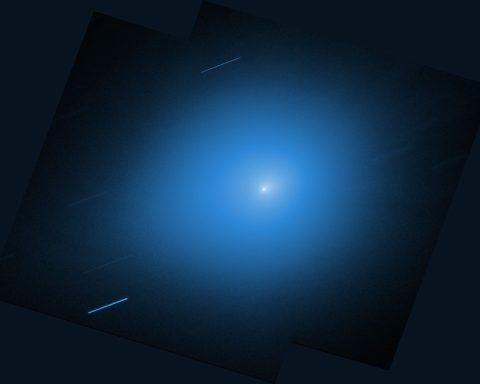
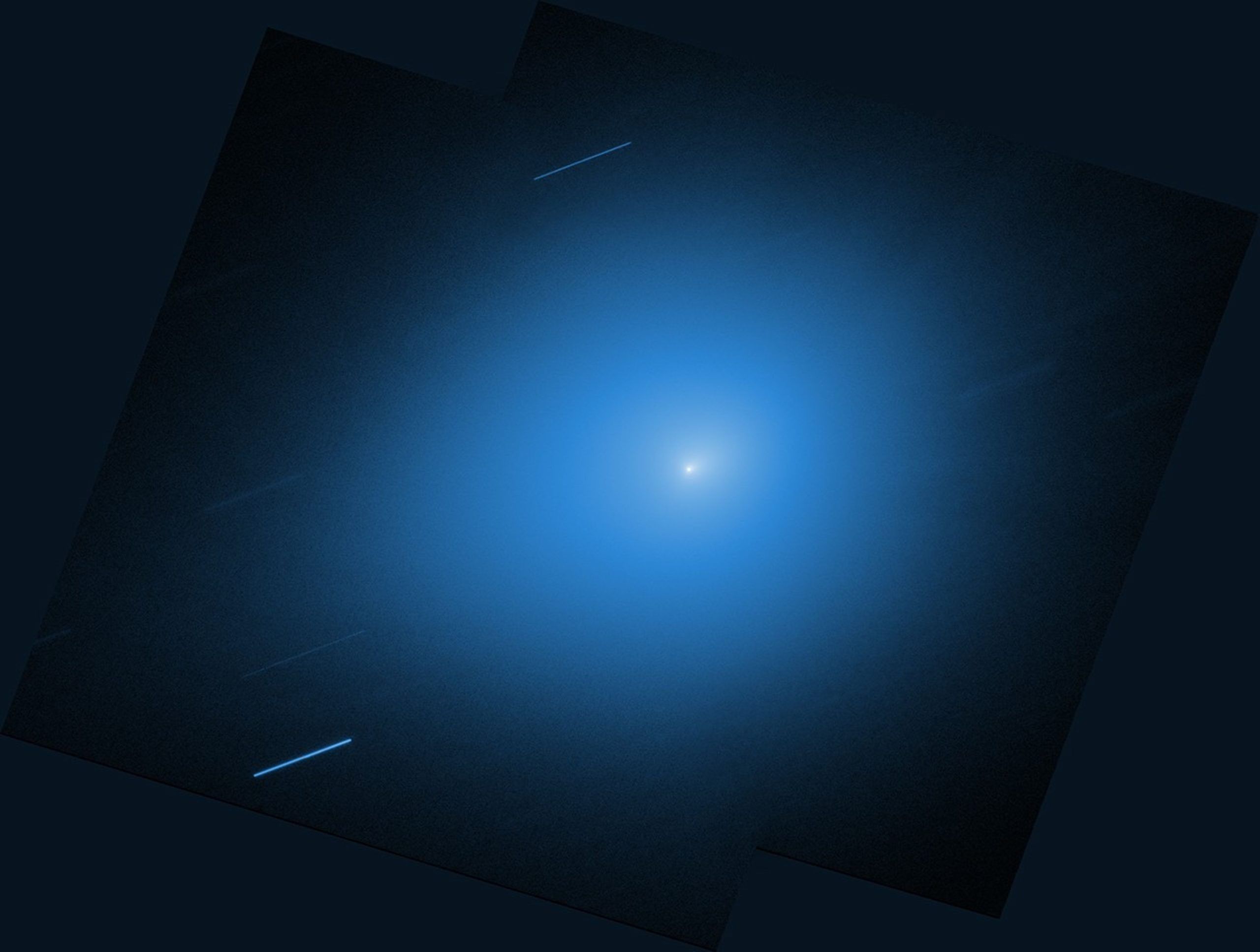
On December 4, NASA released a new image from the Hubble Space Telescope, taken on November 30 with its Wide Field Camera 3. At that moment, 3I/ATLAS was about 178 million miles (286 million km) from Earth, cruising outward after swinging past the Sun.
The Hubble frame shows:
- A bright, compact nucleus surrounded by a bluish teardrop‑shaped coma.
- Background stars as streaks, because Hubble tracks the moving comet rather than the stars.
- A striking “anti‑tail”: an apparent extension of dust and gas toward the Sun, rather than away from it.
In a new essay, Avi Loeb notes that the post‑perihelion coma appears roughly 40,000 km in radius, with the anti‑tail stretching about 60,000 km sunward. He links this to a prediction from his recent paper: that a swarm of macroscopic, non‑volatile fragments would drift tens of thousands of kilometers closer to the Sun than the main body by late November, if they separated near perihelion.
Mainstream comet specialists point out that sunward “anti‑tails” can arise naturally from viewing geometry and dust dynamics – they’ve been seen in solar‑system comets as well – so the Hubble image does not by itself prove anything exotic. NASA’s official write‑up simply emphasizes that 3I/ATLAS “looks and behaves like a comet” and that observations will continue for months as it exits the inner solar system. NASA Science+2Star Walk+2
4. ESA’s Juice spacecraft: Early tease of an active, double‑tailed comet
On December 4, the European Space Agency (ESA) released a tantalizing navigation camera view of 3I/ATLAS taken by its Jupiter Icy Moons Explorer (Juice) mission on November 2, 2025.
From about 41–60 million miles away, Juice’s NavCam 2 – designed primarily for guidance, not science imaging – captured:
- A bright coma, clearly marking the comet as an active object.
- Hints of two distinct tails:
- A plasma tail of ionized gas swept directly away from the Sun.
- A fainter dust tail curving along the comet’s trajectory.
Even more exciting than the teaser image is the hidden data: Juice used five science instruments to observe 3I/ATLAS during a campaign from early to mid‑November, shortly after perihelion. But because the spacecraft is using its high‑gain antenna as a heat shield, it’s stuck downlinking via a smaller antenna – meaning most of the science data won’t reach Earth until February 2026.
Loeb’s new Medium post about the Juice image echoes ESA’s excitement, highlighting the visible glowing halo and potential double tail, while stressing that the real scientific payload will come from Juice’s spectrometers and imagers once the delayed data arrives.
5. Psyche’s long‑distance assist: Pinning down the comet’s path
On December 3, NASA revealed that its Psyche mission – en route to a metal‑rich asteroid of the same name – turned its multispectral imager toward 3I/ATLAS on September 8–9, 2025. Over eight hours of observations, Psyche tracked the comet from about 33 million miles (53 million km) away.
According to NASA:
- Psyche’s cameras recorded the comet as a faint, moving point with a surrounding coma, sensitive enough to measure subtle changes in brightness.
- The data help refine the trajectory of 3I/ATLAS and characterize the size and density of its coma.
Meyka’s December 5 “NASA News Today” piece frames this as part of a broader planetary defense rehearsal: by tracking an interstellar object precisely with multiple spacecraft, NASA can sharpen its ability to predict the paths of any future visitors that might pose a threat, even though 3I/ATLAS itself is harmless. Meyka+1
6. Is 3I/ATLAS erupting with “ice volcanoes”?
One of the most eye‑catching recent claims is that 3I/ATLAS may be undergoing cryovolcanism – eruptions of icy material akin to “ice volcanoes.”
A new preprint (Nov. 24) by Josep M. Trigo‑Rodríguez and colleagues, highlighted by Live Science and IFLScience, uses observations from the Joan Oró Telescope and other facilities in Spain to study 3I/ATLAS before perihelion.
Their key findings:
- As the comet approached the Sun, its brightness surged and it entered a more intense sublimation phase around 378 million km from the Sun.
- High‑resolution images show spiraling jets of gas and dust – interpreted as cryovolcanic plumes venting from the surface.
- By comparing the comet’s reflected light (its spectrum) to pristine carbonaceous chondrite meteorites from NASA’s Antarctic collection, they argue that 3I/ATLAS resembles a metal‑rich, primitive carbonaceous body, similar to trans‑Neptunian objects (TNOs) in our own outer solar system.
In this model, sunlight warms the comet enough for carbon dioxide ice and other volatiles to sublimate. Liquid water or brines then penetrate the interior, corroding iron‑ and nickel‑rich grains and triggering chemical reactions that power bursts of gas and dust – the “ice volcanoes.” Live Science+1
If confirmed through future observations, this would suggest that planet‑forming processes can produce very similar icy bodies in different star systems, and that 3I/ATLAS is basically a TNO‑like world from another sun.
Important caveats:
- The study is still a preprint and not yet peer‑reviewed.
- Cryovolcanism is a plausible, but not yet proven, explanation for the observed jets.
Still, the idea neatly complements independent evidence that 3I/ATLAS is rich in metals and volatiles, and that its coma chemistry differs from typical water‑dominated comets in our own system.
7. Global campaign: Hubble, Gemini, Mars orbiters and Indian telescopes
Short version: nearly every major observatory that can look at 3I/ATLAS, is looking at it.
Hubble, JWST and NASA’s solar‑system fleet
NASA has assembled a small armada of telescopes and spacecraft to observe 3I/ATLAS, including Hubble, the James Webb Space Telescope, TESS, Swift, SPHEREx, and a long list of planetary missions: Mars Reconnaissance Orbiter, MAVEN, Perseverance, Europa Clipper, Lucy, Psyche, PUNCH, Parker Solar Probe, and ESA/NASA’s SOHO and STEREO.
Highlights include:
- Mars flyby (Oct. 2–3, 2025): Mars orbiters like ExoMars TGO and Mars Reconnaissance Orbiter captured the comet as a fuzzy dot, while NASA later released long‑anticipated images after a government shutdown delayed processing.
- Solar‑viewing missions such as SOHO, STEREO and NOAA’s GOES‑19 coronagraph watched 3I/ATLAS as it passed closest to the Sun on October 29, revealing its coma and tail against the solar corona.
Gemini and real‑time spectroscopy
In a December 2 feature, Space.com described a live online observing session where educators and the public “shadowed” scientists using the Gemini North Telescope on Maunakea to follow 3I/ATLAS in real time. Space
Key takeaways from Gemini work:
- Pre‑perihelion data from Gemini South showed a bright coma and powerful jets dominated by carbon dioxide and cyanogen, unlike the water‑dominated comae of many solar‑system comets.
- Post‑perihelion spectra from Gemini North are probing how the coma chemistry evolves as the comet cools and recedes.
India’s Mount Abu observatory joins in
Today’s India Today story underscored that this is truly a global campaign. Between November 12 and 15, scientists at India’s Physical Research Laboratory (PRL) used the 1.2‑meter telescope at Mount Abu to image 3I/ATLAS and take spectra. Their observations show a near‑circular coma, hinting at relatively symmetric outgassing, and add southern‑Asia coverage to the worldwide data set.
IAWN astrometry campaign
The International Asteroid Warning Network (IAWN) has also announced a special comet‑tracking campaign for 3I/ATLAS running from November 27, 2025, to January 27, 2026. It’s explicitly described as a training exercise and precision‑tracking drill, not a response to any danger; 3I/ATLAS’s closest‑approach distance is about 270 million km, leaving “zero scenarios” where it could hit Earth. Star Walk
8. Alien spaceship or natural comet? What scientists actually think
Ever since its discovery, 3I/ATLAS has attracted sensational headlines asking whether it might be an alien probe. Some of this stems from Avi Loeb’s willingness to entertain technological explanations if natural models struggle, as he previously did for 1I/ʻOumuamua.
However:
- NASA, ESA and most comet researchers describe 3I/ATLAS as a natural interstellar comet, based on the clear presence of a coma, tails, volatile‑driven outgassing and a hyperbolic orbit consistent with an ejected icy body.
- A new Live Science article explicitly notes that while online speculation about aliens is rampant, the evidence strongly supports a natural origin in an unknown star system.
- According to India Today, U.S. Congressman George Whitesides addressed the rumors directly in a recent House Science Committee briefing, saying there is no evidence 3I/ATLAS is an alien spaceship.
Loeb’s models – such as the idea of a swarm of fragments producing the anti‑tail, or heartbeat‑like brightness variations from pulsing jets – are part of the normal scientific process of proposing hypotheses and comparing them to data.
But as of December 5, 2025, there is no observational requirement for an artificial explanation. Every major dataset so far can be understood in terms of an unusually active, metal‑ and CO₂‑rich comet from another star system, possibly undergoing cryovolcanism.
9. How and when to see 3I/ATLAS in the sky
If you’re hoping to see 3I/ATLAS with your own eyes (well, your own telescope), here’s what the latest guidance says.
Closest approach to Earth
- Date: December 19, 2025
- Distance: ~170 million miles / 270 million km (~1.8 AU) NASA Science+2EarthSky+2
NASA’s “What’s Up: December 2025” column calls this the best opportunity to catch the comet, as it climbs into the pre‑dawn eastern sky near the star Regulus in Leo. NASA Science
How bright will 3I/ATLAS get?
Star Walk’s detailed tracking article and amateur observations indicate that: Star Walk+2Star Walk+2
- The comet brightened from magnitude 17 at discovery to around 12–14 by September.
- Around perihelion, it unexpectedly surged to about magnitude 7–8, becoming visible to many space‑based observatories.
- As it emerges into the morning sky in late November and December, it’s expected to hover around magnitude 11–12, possibly a bit brighter if its activity remains elevated.
That’s far too faint for the naked eye or small binoculars, but within reach of small to medium amateur telescopesunder dark skies.
Practical observing tips (December 2025)
Based on NASA and Star Walk guidance: NASA Science+2Star Walk+2
- Instrument:
- Aim for at least a 20–30 cm (8–12‑inch) telescope; NASA suggests ~30 cm for a comfortable view near closest approach.
- When:
- Look before dawn, roughly 1–2 hours before sunrise in early to mid‑December.
- Where:
- In mid‑December, look east to northeast, near Regulus in the constellation Leo. Exact positions are best obtained from a planetarium app or software that tracks 3I/ATLAS.
- Conditions:
- Choose a dark site with a clear eastern horizon.
- Avoid bright Moon nights; around New Moon on December 19, conditions will be best.
If you don’t have a telescope, many observatories and clubs are planning public viewing nights and livestreams, similar to the Gemini/Shadow the Scientists event described by Space.com.
10. Why 3I/ATLAS matters – and what comes next
3I/ATLAS is more than just a pretty fuzzball:
- It’s a sample of another planetary system’s building blocks, likely billions of years old and shaped by a different stellar environment.
- The comet’s unusual metal‑rich, possibly cryovolcanic nature suggests that the chemistry of small icy bodies may be surprisingly universal across the galaxy.
- Coordinated observations from across the solar system are stress‑testing our ability to detect, track and characterize interstellar objects, a key part of future planetary defense.
Looking ahead:
- Juice’s high‑quality instrument data should arrive in February 2026, giving detailed compositional and plasma measurements.
- Continued monitoring from Hubble, Webb and ground‑based telescopes will refine estimates of the comet’s size, mass, rotation and jet structure.
- Missions like ESA’s planned Comet Interceptor are being designed to intercept a future interstellar visitor directly, perhaps turning the next 3I‑class object into a target for a close‑up flyby.
For now, though, 3I/ATLAS is giving us something we almost never get: a live, multi‑mission, multi‑continent look at a comet born under another Sun – and as of December 5, 2025, that story is only just beginning.
Related articles: Space Exploration