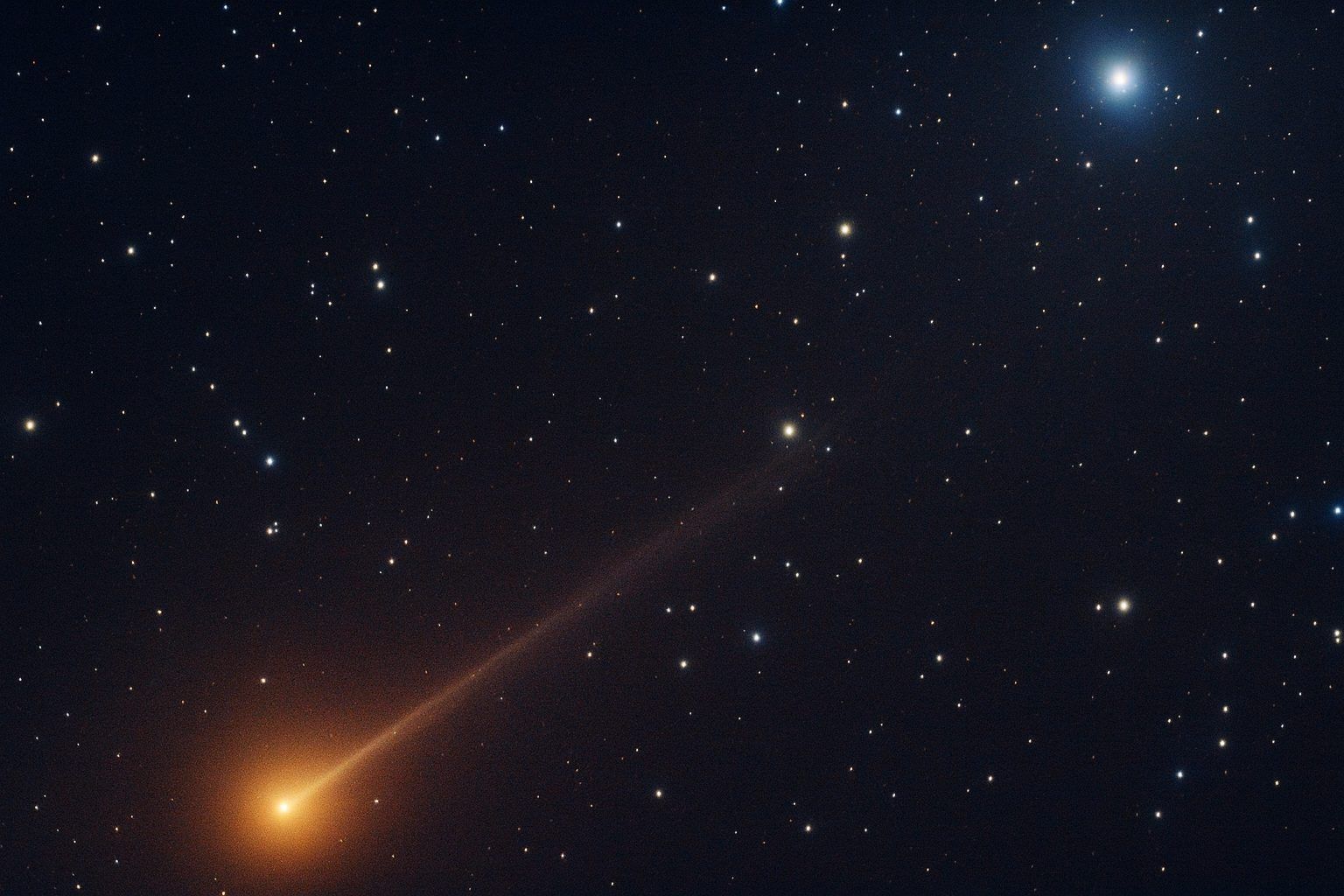

As of December 6, 2025, astronomers around the world are racing to squeeze every possible observation out of interstellar comet 3I/ATLAS – only the third known object ever seen passing through our solar system from another star. Fresh images from NASA’s Hubble Space Telescope, ESA’s Jupiter Icy Moons Explorer (Juice), heliophysics probes, Mars missions, ground-based observatories and new radio detections are painting a picture of a surprisingly active, chemically complex “visitor” that remains no danger to Earth but a gold mine for science. European Space Agency+4NASA Science+4NASA Science+4
A rare interstellar visitor: what 3I/ATLAS actually is
3I/ATLAS, formally designated C/2025 N1 (ATLAS), was discovered on July 1, 2025 by the NASA‑funded Asteroid Terrestrial‑impact Last Alert System (ATLAS) survey telescope in Rio Hurtado, Chile. Archival images show it had already been in view since early May, but at first it was just a faint speck drifting against the stars.
Orbital calculations quickly revealed that its path is hyperbolic – it’s moving too fast to be bound by the Sun’s gravity and will never return once it leaves. That marks it as interstellar, and makes 3I/ATLAS only the third such object known, after 1I/ʻOumuamua (2017) and 2I/Borisov (2019).
Key “vitals” from NASA’s updated 3I/ATLAS Facts and FAQs page:
- Size: Hubble data suggest the nucleus is between 440 meters and 5.6 kilometers across.
- Speed: When discovered, it was moving at about 137,000 mph (221,000 km/h). It sped up to around 153,000 mph (246,000 km/h) near the Sun, and will depart at roughly the same speed it arrived with.
- Perihelion (closest to the Sun):October 30, 2025, at about 1.4 AU (210 million km) – just outside the orbit of Mars.
- Closest to Earth:December 19, 2025, at roughly 1.8 AU (170 million miles / 270 million km) – nearly twice the Earth–Sun distance.
NASA stresses there is no impact risk: 3I/ATLAS “won’t come close to Earth at all” by planetary-defense standards. NASA Science+1
Before perihelion, the comet made a relatively close flyby of Mars on October 3, passing only 29 million km (0.19 AU) from the Red Planet – close enough for orbiters and even the Perseverance rover’s cameras to catch it.
From Earth, 3I/ATLAS slipped behind the Sun in late October and is now re‑emerging into the pre‑dawn sky just as it heads toward its closest pass by Earth on December 19 and then on toward a close encounter with Jupiter on March 16, 2026, where it is expected to pass only about 53 million km (0.36 AU) from the giant planet.
After that, trajectory models show it will move beyond the orbits of Jupiter, Saturn and Uranus over the next couple of years, fading from view as it returns to interstellar space.
Hubble’s new portrait: a teardrop coma and a puzzling “anti‑tail”
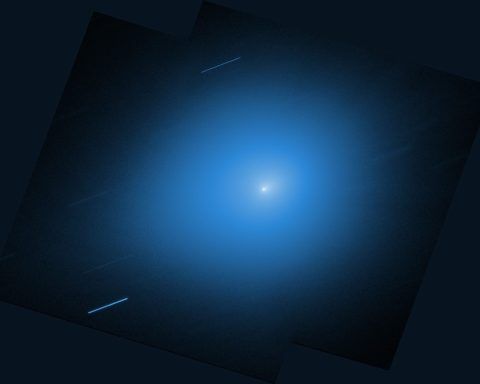
On December 4, NASA and ESA released a striking new image from the Hubble Space Telescope, taken with its Wide Field Camera 3 on November 30, 2025, when 3I/ATLAS was about 286 million km (178 million miles) from Earth. Hubble tracked the comet as it moved, so background stars appear as streaks while the comet sits sharp at the center.
Both NASA and ESA describe a bright central coma surrounded by a teardrop‑shaped halo. What’s especially eye‑catching is a sunward‑pointing “anti‑tail”, a streak of dust and gas that appears to extend toward the Sun rather than away from it – an effect that can arise from perspective and the way dust grains spread along the comet’s orbit. ESA Hubble+1
Harvard astrophysicist Avi Loeb, in a new essay analyzing this Hubble image, estimates that the coma’s glow extends roughly 40,000 km from the nucleus, while the anti‑tail stretches to about 60,000 km. He notes that a previous pre‑perihelion Hubble image from July 21, 2025 also showed a sunward elongation, and argues that this pattern matches a theoretical prediction he made for a swarm of macroscopic, non‑volatile fragments that may have separated from the comet and moved slightly ahead of it along its orbit due to small non‑gravitational forces.
Loeb’s detailed model suggests that, if such fragments were shed around perihelion, they should end up tens of thousands of kilometers closer to the Sun than the main nucleus by late November – exactly where the anti‑tail is seen.
However, NASA’s own updated FAQ emphasizes that measured non‑gravitational accelerations are small and fully compatible with ordinary outgassing, and that 3I/ATLAS’s “characteristics, color, speed, and direction are all consistent with what we expect from a comet.” NASA Science+1
The full Hubble dataset from the November observations, including ultraviolet spectroscopy, has not yet been fully released. Those spectra should help determine what gases dominate the coma and whether 3I/ATLAS’s chemistry truly differs from that of typical solar‑system comets.
ESA’s Juice spacecraft: a surprise catch with a navigation camera
While Earth‑based telescopes were blinded by the Sun around perihelion, ESA’s Jupiter Icy Moons Explorer (Juice) had a privileged off‑axis view. In early November, Juice used five science instruments – including its high‑resolution JANUS camera and spectrometers MAJIS and UVS, plus the SWI submillimeter instrument and PEP particle package – to observe 3I/ATLAS as it swept through the inner solar system.
Because Juice is currently using its high‑gain antenna as a heat shield while close to the Sun, it can only downlink data slowly through a smaller medium‑gain antenna. That means most of the science data from the 3I/ATLAS campaign won’t arrive on Earth until February 18 and 20, 2026.
Impatient to know whether they had “caught” the comet at all, the team pulled down just a quarter of a single frame from the spacecraft’s Navigation Camera (NavCam) – an engineering camera designed for pointing and guidance, not high‑resolution science. The teaser image, taken on November 2, 2025, stunned them: a bright interstellar comet surrounded by a glowing coma, with a clear plasma tail and a fainter possible dust tail visible even in the grainy NavCam view. European Space Agency+2European Space Agency+2
The NavCam exposure was recorded just two days before Juice’s closest approach to the comet on November 4, at a distance of about 66 million km.
Loeb, writing about the Juice image, stresses how valuable this vantage point is. When 3I/ATLAS reached perihelion on October 29 at about 203 million km from the Sun, it was hidden directly behind the Sun as seen from Earth, but not from Juice’s off‑axis position.
He also points out that while Juice won’t arrive in the Jupiter system until July 2031, 3I/ATLAS will race past Jupiter in March 2026, underscoring just how much faster this interstellar visitor is compared with even our most capable spacecraft.
The real prize will come when Juice’s full instrument suite data are downlinked in February – including high‑resolution JANUS images, infrared and ultraviolet spectra, and direct measurements of dust and charged particles in the comet’s environment.
A fleet of spacecraft is tracking 3I/ATLAS
Far from being observed by one or two telescopes, 3I/ATLAS has triggered a multi‑mission campaign unprecedented for an interstellar object.
Heliophysics missions: STEREO, SOHO and PUNCH
NASA’s STEREO‑A spacecraft, designed to study the Sun, observed 3I/ATLAS between September 11 and October 2 using its Heliospheric Imager‑1 (HI1) camera. At first, the comet was expected to be too faint to detect, but mission scientists stacked and aligned many long‑exposure frames, revealing 3I/ATLAS as a faint, fuzzy orb sweeping through the field of view at about 130,000 mph (209,000 km/h).
The STEREO campaign marks the first time heliophysics missions have knowingly imaged an interstellar object, and it’s being complemented by observations from NASA’s new PUNCH mission and the joint NASA/ESA SOHO solar observatory, which also see the comet in wide‑field coronagraph images.
Mars orbiters: triangulating the orbit
Meanwhile, the close Mars flyby on October 3 allowed the ExoMars Trace Gas Orbiter (TGO) and other Mars missions to image 3I/ATLAS from a completely different vantage point. By combining those data with Earth‑based astrometry, ESA teams were able to improve the precision of the comet’s orbit by about a factor of ten, according to reports in Universe Today and Live Science.
This is the first time data from a spacecraft orbiting another planet have been accepted into the International Astronomical Union’s official orbit solution for a small body – an important demonstration for future planetary‑defense tracking techniques.
NASA’s own Facts and FAQs page now lists a remarkable array of missions involved in monitoring 3I/ATLAS, including Hubble, Webb, SPHEREx, Lucy, Perseverance, MAVEN, MRO, Parker Solar Probe, Psyche, PUNCH, SOHO and STEREO, underscoring just how high the scientific stakes are for this rare visitor.
“Ice volcanoes” and primitive chemistry: what the cryovolcanism study claims
One of the most attention‑grabbing headlines this week came from a new preprint led by Josep M. Trigo‑Rodríguez and colleagues, summarized by Live Science on December 1. The team used the Joan Oró Telescope at Montsec Observatory in Spain, along with other regional facilities, to monitor 3I/ATLAS as it approached the Sun.
Their images show spiral jets and complex structures in the coma that they interpret as evidence of cryovolcanism – essentially “ice volcanoes” erupting as internal ices heat up and vent gas and dust into space. Activity ramped up markedly when the comet got within about 378 million km of the Sun and began brightening rapidly. Live Science+1
In their interpretation, solar heating drives solid carbon dioxide (dry ice) and other ices to sublimate. This allows oxidizing liquids to percolate into the comet’s interior and react with reactive iron‑ and nickel‑rich grains and sulfides, generating pressure that vents through localized cryovolcanic eruptions.
To probe composition, the team compared their spectroscopic data with carbonaceous chondrite meteorites – primitive, metal‑rich rocks collected in Antarctica that are thought to preserve some of the earliest material in our own solar system. They find that 3I/ATLAS’s reflectance spectrum looks surprisingly similar to some of these samples, suggesting the comet may be rich in metals and complex organics despite its interstellar origin.
Based on current size estimates (roughly 0.44–5.6 km across), the authors suggest that if 3I/ATLAS is about 1 km wide, it could weigh on the order of 600 million metric tons.
Crucially, the study is still a preprint and has not yet been peer‑reviewed. But if its conclusions hold up, they point to a striking result: despite forming in another star system – possibly billions of years before the Sun – 3I/ATLAS may strongly resemble the trans‑Neptunian objects and primitive meteorites in our own cosmic backyard.
Radio detections strongly favor a natural comet
For weeks, public debate has swirled around the question of whether 3I/ATLAS could be artificial – a probe or “mothership” from another civilization. A key piece of evidence weighing against that idea arrived in mid‑November from South Africa’s MeerKAT radio telescope.
As reported by Wired and other outlets, MeerKAT detected hydroxyl (OH) absorption lines at 1665 and 1667 MHz from the direction of 3I/ATLAS on October 24, just before perihelion. These are exactly the radio signatures expected when water vapor from a comet’s ices is broken apart by sunlight – a standard tracer of cometary activity that has been observed in many solar‑system comets.
The radio data show that the comet’s non‑gravitational acceleration – the slight deviations from a purely gravitational orbit – can be explained by normal outgassing of ices, echoing NASA’s own conclusion that the measured perturbations are “small and compatible” with this process. NASA Science+1
Together with the growing body of optical and infrared data, the radio results strongly support the view that 3I/ATLAS is a natural comet from another star system, not a spacecraft.
Why some scientists still explore exotic possibilities
Despite this, speculation hasn’t disappeared – in large part because some of 3I/ATLAS’s behavior is undeniably unusual, and because a prominent astrophysicist, Avi Loeb, has chosen to publicly explore more exotic hypotheses.
The “heartbeat” and the Jupiter Hill‑sphere coincidence
Tabloid coverage has highlighted Loeb’s discussion of a 16.16‑hour periodic modulation in the comet’s brightness, described as a kind of “heartbeat”. Loeb has suggested in interviews and essays that this pattern could, in principle, be produced by controlled jets rather than simple rotation – although most comet researchers consider rotating jets from natural activity a simpler explanation. New York Post+2Live Science+2
In a separate Medium essay titled “An Extraordinary New Anomaly of 3I/ATLAS”, Loeb points out that current orbital solutions predict a closest approach to Jupiter on March 16, 2026 of about 53.445 ± 0.06 million km, while Jupiter’s Hill radius (its gravitational sphere of influence) on that date is calculated to be 53.502 million km. The near‑match between these numbers – equal within about one part in a thousand – leads him to speculate about the possibility of deliberate “fine‑tuning” by thrusters, in a thought‑experiment where 3I/ATLAS serves as a “mothership” seeding the Jupiter system with devices. Medium+2Medium+2
It’s an imaginative scenario, but it remains highly speculative. Orbital solutions for newly discovered objects often shift as more data come in, and small non‑gravitational effects from outgassing can naturally nudge a comet’s trajectory without implying artificial control – exactly the behavior NASA’s FAQ describes for 3I/ATLAS.
Seeding life, or just delivering clues?
Loeb has also argued, both in interviews and in media coverage, that interstellar rocks like 3I/ATLAS might occasionally deliver hardy life or pre‑biotic chemistry to worlds like Earth, and that over billions of years such encounters could influence the course of life.
Mainstream scientists generally agree that interstellar comets carry valuable organic chemistry and may play a role in seeding planetary systems with volatiles – but they emphasize that current data on 3I/ATLAS are fully consistent with a natural object, and that extraordinary claims (like alien spacecraft) require equally extraordinary evidence.
In practice, the debate is likely to be settled not in headlines but through continued observation: high‑resolution images from Hubble and Juice, detailed spectroscopy, further radio monitoring, and careful tracking of the comet’s path past Jupiter in 2026.
How and when to see 3I/ATLAS from Earth
For observers on Earth, the next two weeks are prime time to try spotting an interstellar comet.
According to NASA’s FAQ and recent sky‑watching guides:
- 3I/ATLAS emerged from behind the Sun in late October and is now visible again in the pre‑dawn sky, with astrometric observations from ground‑based observatories resuming on October 31.
- It should remain observable with small telescopes through spring 2026, gradually fading as it recedes.
- Its closest approach to Earth will be on December 19, 2025, at about 1.8 AU. That’s still far, but close enough for a good view in amateur instruments.
A recent observing guide in IFLScience notes that the comet’s current magnitude is around 10–11, meaning you’ll likely need at least good astronomy binoculars and dark skies to glimpse it, and a 30 cm (12‑inch) telescope to see it clearly as a fuzzball.
For now, the best strategy is:
- Look east to northeast before dawn,
- Aim just below Regulus in the constellation Leo, where NASA suggests the comet will appear over the coming mornings, and
- Use tracking tools such as NASA’s “Eyes on the Solar System” or real‑time ephemeris sites to get precise coordinates for your location and date. NASA Science+1
Even if it appears only as a faint smudge, you’d be looking directly at debris from another star system, older than our Sun and on a one‑time fly‑through of our neighborhood.
What comes next: Jupiter flyby, Juice data, and the long goodbye
Looking beyond this month’s Earth flyby, astronomers are already planning the next phases of the 3I/ATLAS campaign.
- February 18 & 20, 2026: ESA’s Juice mission is scheduled to downlink its full 3I/ATLAS dataset, including high‑resolution JANUS images and spectra from MAJIS and UVS, plus composition data from SWI and particle measurements from PEP. These data should reveal the detailed makeup of the comet’s gas and dust and how it interacts with the solar wind.
- March 16, 2026: 3I/ATLAS will pass within about 53 million km of Jupiter, skimming the edge of the planet’s Hill sphere. Depending on how much material it has lost near the Sun, Jupiter’s gravity could slightly alter its outbound trajectory, a possibility discussed in both technical notes and popular coverage. WIRED+3IFLScience+3IFLScience+3
- Some researchers have proposed that NASA’s Juno spacecraft and other Jovian missions look for any unusual debris or outgassing during this flyby, which would test both conventional and exotic theories about the comet.
From Earth’s perspective, NASA notes that 3I/ATLAS should remain observable to small telescopes until roughly spring 2026, then disappear into another solar conjunction. It may become accessible again to large professional telescopes from late 2026 into 2027, by which time it will be beyond the orbits of Saturn and Uranus and rapidly fading.
In the longer term, 3I/ATLAS will simply become another faint speck in interstellar space. But the multi‑mission data set it leaves behind – from Hubble, Juice, Mars orbiters, heliophysics probes, radio arrays, and dozens of ground‑based telescopes – will become a benchmark for understanding not just this comet, but how planetary systems across the galaxy build and eject icy bodies like it.
For now, in the first week of December 2025, the story of 3I/ATLAS is still unfolding. The comet is bright, active, and under intense scrutiny – a once‑in‑a‑generation chance to study a frozen relic from another star at close range before it disappears into the dark for good.
Related articles: Space Exploration