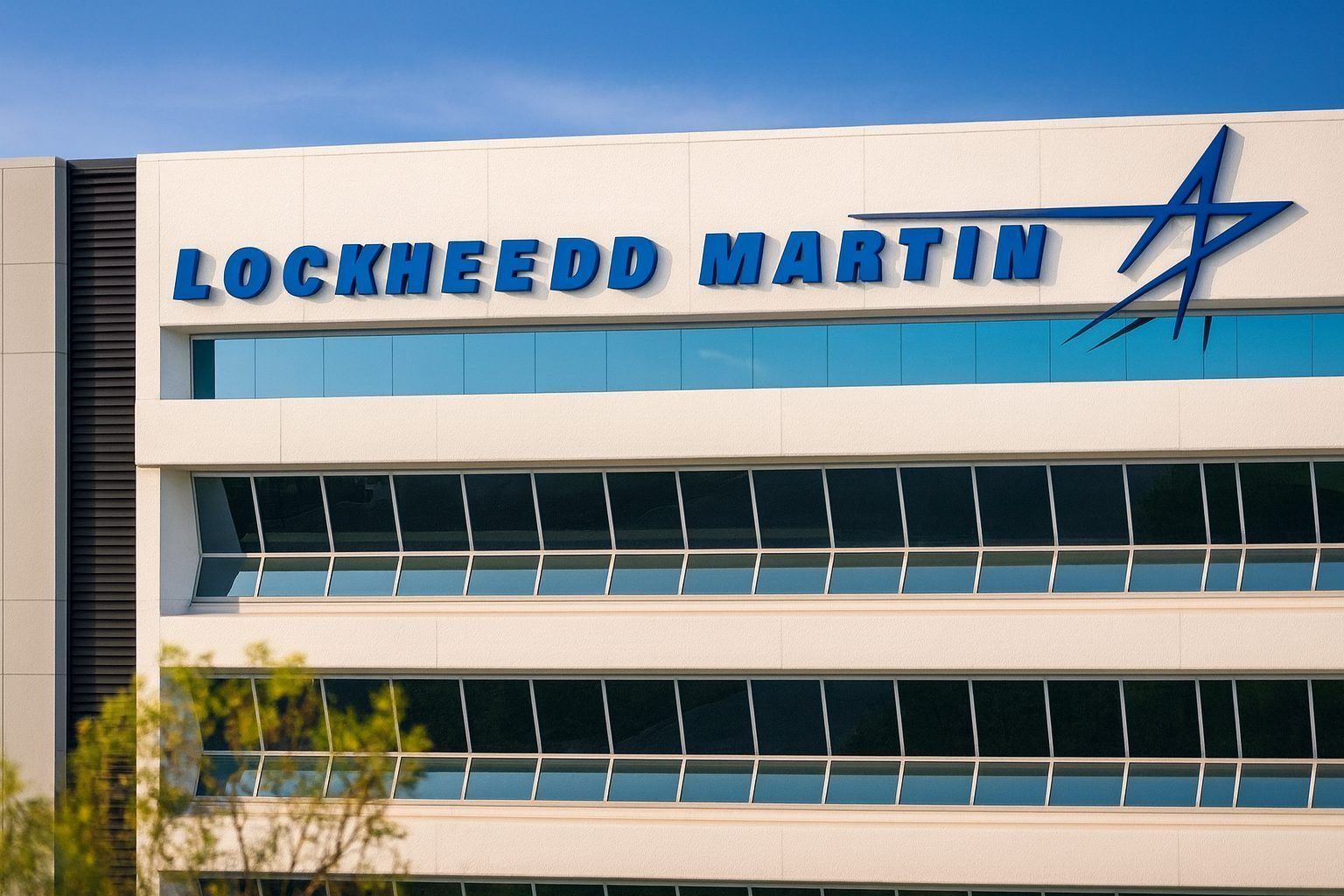

Lockheed Martin Corporation NYSE:LMT is ending the week with a flurry of news: fresh Pentagon contracts, expanding hypersonics and missile capacity, a record backlog, and a higher dividend – all against a share price that has lagged the broader market in 2025.
Below is a detailed look at what’s happening with Lockheed Martin stock as of December 6, 2025, and how recent news and Wall Street forecasts are shaping the investment narrative.
Lockheed Martin stock snapshot today
As of the latest trade on December 6, 2025, Lockheed Martin shares are trading around $452, up roughly 0.9% on the day.
That price comes after a volatile stretch:
- Earlier this week, alternative data provider QuiverQuant flagged a single‑day 3% drop in LMT, with over $400 million in trading volume – a reminder that defense names can still move sharply despite their “defensive” label.Quiver Quantitative
- A separate analysis notes that, at about $446–$450 per share, Lockheed’s stock is negative year‑to‑date, even though its five‑year total shareholder return exceeds 40% – suggesting long‑term compounding is intact while recent momentum has cooled.
Even with that softer near‑term performance, MarketBeat’s screen of “defense stocks to watch today” lists Lockheed Martin among the most actively traded defense names by dollar volume on December 6.MarketBeat
At today’s price, the new annualized dividend of $13.80 per share (see below) implies a yield of roughly 3%, offering income on top of potential capital appreciation.
Not investment advice: All figures are informational only and not a recommendation to buy or sell LMT. Consider your own objectives or consult a qualified adviser.
Fresh contract wins and industrial moves driving the story
1. New F‑35 funding and long‑lead contracts
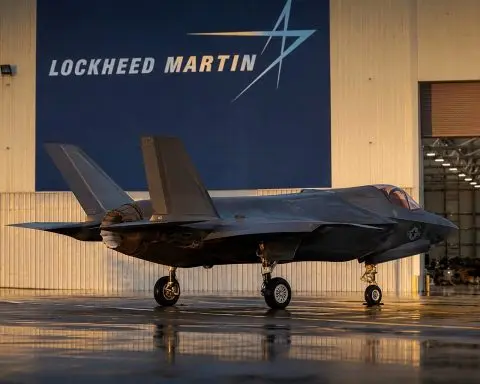
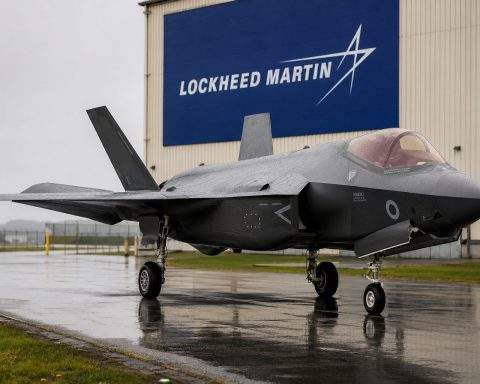
The F‑35 Lightning II remains the backbone of Lockheed’s growth story, and the past few months have reinforced that:
- $1.14 billion Navy contract modification (announced this week) will fund long‑lead components for future F‑35 production under Lots 20 and 21, backing 198 additional jets.
- In late September, the Pentagon also awarded about $12.5 billion for nearly 300 of the newest F‑35 jets (Lots 18–19), part of a broader agreement valued at more than $24 billion.
These awards build on a record Q3 backlog of $179 billion, more than two and a half years of sales at current run‑rates.
For equity investors, these deals matter because:
- They lock in multi‑year revenue visibility across Lockheed’s largest program.
- They support scale economies in aeronautics and sustainment.
- They strengthen the company’s negotiating leverage with suppliers in a tight defense industrial base.
2. F‑16 deliveries to Argentina
On December 5, Argentina received its first six F‑16AM/BM fighters as part of a 25‑aircraft procurement from Denmark’s surplus inventory.
Although this specific transaction runs through a European seller, it showcases:
- The continuing life of the F‑16 ecosystem, where Lockheed remains central to upgrades and sustainment.
- Ongoing demand for Lockheed‑designed aircraft among U.S. partners in Latin America.
3. Global missile and rocket manufacturing expansion
This week, Lockheed Martin also:
- Opened a new missile manufacturing facility at Port Wakefield in South Australia, built in under seven months and dedicated to Guided Multiple Launch Rocket System (GMLRS) production. It is the first such facility for GMLRS outside the U.S., initially targeting around 300 missiles per year with ambitions to scale much higher.
- Marked the 250th C‑130J Super Hercules tail assembly produced in its joint venture with Tata in India, underscoring an increasingly globalized and resilient supply chain for key airlift platforms.
At the strategic level, these moves deepen Lockheed’s role as a missile and munitions provider to U.S. allies, not just the Pentagon.
4. Golden Dome missile defense and Space Force opportunities
The U.S. Space Force recently awarded several small “Golden Dome” contracts to companies including Lockheed Martin. These are early prototype awards for a layered missile defense architecture that could be worth tens of billions of dollars over time.Reuters+1
Lockheed’s inclusion positions it for:
- Future large‑scale missile defense contracts.
- Further integration between its space, missile, and command‑and‑control franchises.
Hypersonics, AI and autonomous systems: how tech is reshaping the LMT thesis
New hypersonic integration facilities
Three days ago, Lockheed opened a 17,000‑square‑foot hypersonic systems integration lab at its Huntsville, Alabama campus. The facility is part of a $529 million capital investment program that includes hundreds of thousands of square feet of new or planned space.
The lab will:
- Support testing, simulation, and integration of hypersonic weapons (capable of flying at more than Mach 5 and evading traditional defenses).
- Help Lockheed compete in the arms race with China and Russia over next‑generation strike systems.
AI‑driven hypersonics and STAR.OS
Simply Wall St highlights that, in recent weeks, Lockheed has both:
- Opened new hypersonic weapons integration facilities in Huntsville.
- Successfully tested its STAR.OS AI platform in live unmanned mission‑contingency scenarios, demonstrating AI‑enabled command‑and‑control across air and ground systems.
Their analysis argues that:
- The investment case for LMT remains rooted in high‑end defense hardware and cash generation, but AI‑enabled autonomy could be a meaningful incremental catalyst.
- AI software embedded into platforms like the F‑35, missiles, and UAVs may help offset pressure from legacy fixed‑price programs and cost overruns.
Skunk Works autonomous UAV demonstration
Lockheed’s Skunk Works division recently showcased AI‑driven mission‑contingency management on an autonomous UAV, underscoring how the company is weaving AI into contested, multi‑domain operations.
Combined with the hypersonics investments, these demos suggest:
- A pivot from being primarily a hardware prime contractor to a hardware‑plus‑software integrator, particularly in AI, autonomy, and multi‑domain C2 (command and control).
- New potential software and services revenue streams that could carry higher margins over time.
Q3 2025 earnings: beat, record backlog and higher guidance
Lockheed’s third‑quarter 2025 results, released on October 21, provide the fundamental backdrop for today’s news flow.
According to the company’s official earnings release:PR Newswire+1
- Sales: $18.6 billion, up from $17.1 billion in Q3 2024 (about 9% growth).
- Net earnings: $1.6 billion.
- EPS: $6.95 per share, beating analyst estimates around $6.35 and improving slightly from $6.80 a year ago.
- Cash from operations: $3.7 billion, with free cash flow of $3.3 billion.
- Shareholder returns: $1.8 billion returned in the quarter via dividends and buybacks; buyback authorization increased by $2 billion to a total of $9 billion.
- Backlog: A record $179 billion, driven by major awards for CH‑53K heavy‑lift helicopters, PAC‑3 missile interceptors, JASSM/LRASM cruise missiles and F‑35 production.
Crucially, the company raised its full‑year 2025 guidance:
- Sales: Now expected between $74.25–$74.75 billion, up from $73.75–$74.75 billion.
- Diluted EPS: Now $22.15–$22.35, up from $21.70–$22.00.
At today’s price near $452, that implies a forward P/E of roughly 20x 2025 earnings – not distressed, but arguably reasonable for a company with decades‑long program visibility and a high‑single‑digit sales growth outlook.
Several commentators, including a recent Yahoo/24/7 Wall St analysis, framed Q3 as Lockheed “delivering steady defense profits” while peers like Boeing still burn cash ramping production.Yahoo Finance+1
Dividend growth and income profile
On October 9, Lockheed’s board authorized a fourth‑quarter 2025 dividend of $3.45 per share, a 5% increase from the prior payout. This marks the company’s 23rd consecutive year of dividend raises, with the payment scheduled for December 30, 2025 to shareholders of record as of December 1.
Key implications for income‑oriented investors:
- The new rate annualizes to $13.80 per share.
- At roughly $452 per share, the forward dividend yield is around 3%.
- Lockheed pairs this dividend with an active share‑repurchase program, now authorized up to $9 billion in total buybacks.
This combination of dividend growth + buybacks is a central pillar of the LMT equity story.
What Wall Street and models are forecasting for LMT
Analyst price targets
Different platforms paint a broadly similar picture: modest upside from current levels, with a bias toward positive ratings.
- MarketBeat: 25 analysts have a 12‑month average price target of about $515.50, with a high of $630 and a low of $425. That implies roughly 14% upside from a reference price around $452.
- TradingView: Aggregated analyst data shows an average target near $535.82, with estimates ranging from about $430 to $630.
- TipRanks: Over the last three months, 12 Wall Street analysts have set an average target of $534.67, with a high of $630 and a low of $430. That represents about 19% upside versus a recent price around $448.
Separately, coverage summarized on Yahoo Finance notes that UBS recently maintained a “Neutral” rating while trimming its price target slightly (from $514 to $513), highlighting some skepticism about near‑term multiple expansion despite solid fundamentals.Yahoo Finance
Fundamental fair‑value estimates
On the fundamentals‑driven side:
- A Simply Wall St discounted cash flow (DCF) analysis recently estimated that Lockheed is about 20–30% undervalued relative to its intrinsic value, depending on exact assumptions.
- In its AI‑and‑hypersonics narrative, Simply Wall St also projects $81 billion in revenue and $7.1 billion in earnings by 2028, with a fair value of about $528 per share, implying mid‑teens upside from current levels.
Meanwhile, the Zacks consensus for full‑year 2025 currently calls for:
- EPS of about $22.22.
- Revenue of $74.4 billion, roughly 4–5% above 2024 levels, even as EPS is modeled lower due to prior‑year items and charges.
Quantitative long‑term price forecasts
Algorithmic and statistical models – not Wall Street analysts – add another perspective:
- Forecasts published by Meyka suggest LMT could reach around $505 in 2026 and $616 by 2030, implying double‑digit percentage gains over the medium term. Longer‑range projections show potential for the stock to approach $710 within seven years, though these come with significant uncertainty.
These model‑driven forecasts should be viewed as scenarios, not guarantees. They do, however, align directionally with the idea that steady defense demand + rising dividend + buybacks could support incremental total returns if execution stays on track.
Investor flows and sentiment: who’s buying LMT?
Recent regulatory filings and sentiment data show a mix of institutional accumulation and retail debate:
- MarketBeat instant alerts highlight that Stenger Family Office LLC opened a new position in Lockheed Martin, while SCS Capital Management LLC also acquired shares.
- Epoch Investment Partners increased its stake by about 7.3% in the second quarter, signaling ongoing institutional confidence in the name.
- Social‑media and alternative‑data tracking from QuiverQuant shows a surge in online discussion about LMT tied to rising defense contracts and global defense spending, with many users citing the stock as a potential beneficiary of heightened geopolitical tensions.
On the other hand, commentary such as “Lockheed Martin Shares: A Tale of Technological Promise and Market Caution” emphasizes that:
- While the company is delivering on high‑tech capabilities (hypersonics, AI, advanced missiles), valuation and political risk keep some investors on the sidelines.
This mix of optimism and caution is consistent with LMT’s recent price action: strong fundamentals, but a stock that is not “cheap” in an absolute sense and remains sensitive to headlines.
Key risks and watchpoints
Even with the positive news, several risks could impact Lockheed Martin stock:
- Program execution and cost overruns
- Reuters notes that in Q2 2025, Lockheed absorbed a $1.6 billion charge, largely tied to its Aeronautics segment and Sikorsky helicopter programs, which hit earnings and the share price.
- Q3 margins recovered, but complex fixed‑price contracts still pose downside risk if schedules slip or costs rise.
- Defense budget and political dynamics
- While defense demand is robust, future U.S. and allied budgets – and program mix – remain subject to politics. If priorities shift away from high‑end systems, Lockheed’s growth profile could slow.
- On a positive note, Boeing’s defense chief recently clarified that President Trump’s “equity stake” industrial policy is not aimed at major primes like Lockheed Martin, but rather at smaller suppliers, reducing the near‑term risk of forced government ownership stakes diluting shareholders.Reuters
- Competition in hypersonics, AI and missile defense
- Golden Dome prototypes and other next‑gen programs are competitive, with Northrop, Anduril and others in the mix.
- Lockheed’s early investments in AI and hypersonics strengthen its bid, but winning (and executing) large follow‑on contracts is not guaranteed.
- Valuation risk
- At roughly 20x forward earnings with mid‑single‑digit sales growth, LMT trades at a premium to some industrials and value names, leaving less room for error if earnings stumble or sentiment turns.
What it all means for Lockheed Martin stock right now
Putting it together:
- Fundamentals: Q3 showed strong revenue growth, a solid EPS beat, robust free cash flow and a record backlog, along with raised 2025 guidance.
- Pipeline: New F‑35 funding, F‑16 deliveries, Golden Dome work and expanded missile production in Australia and India support long‑duration demand across air, missile and space domains.
- Technology: Fresh investments in hypersonics and AI‑enabled autonomy through STAR.OS and Skunk Works UAV demonstrations elevate Lockheed’s role as an integrator of hardware and software, not just a traditional airframe prime.
- Shareholder returns: A higher dividend, an ongoing buyback, and a decades‑long dividend growth streak bolster the total‑return profile.
- Valuation and outlook: Across major platforms, analysts are targeting the mid‑$500s over 12 months, implying mid‑teens upside, while some DCF and quantitative models see potential for 20–30% or more over the medium term – assuming execution and defense demand remain favorable.
For long‑term investors focused on defense, aerospace and national security themes, Lockheed Martin remains a core, cash‑generative franchise with substantial contract visibility. The flip side is that the market already recognizes much of this strength, so future returns are likely to depend on:
- Continued program execution without major new charges.
- Lockheed’s ability to turn AI, hypersonics and missile defense leadership into higher‑margin growth.
- The trajectory of global defense spending, especially in the U.S. and among key allies.
Again, this overview is informational only and not personalized financial advice. Anyone considering LMT stock should weigh these factors against their own risk tolerance, time horizon and portfolio needs.
Related articles: NYSE:LMT