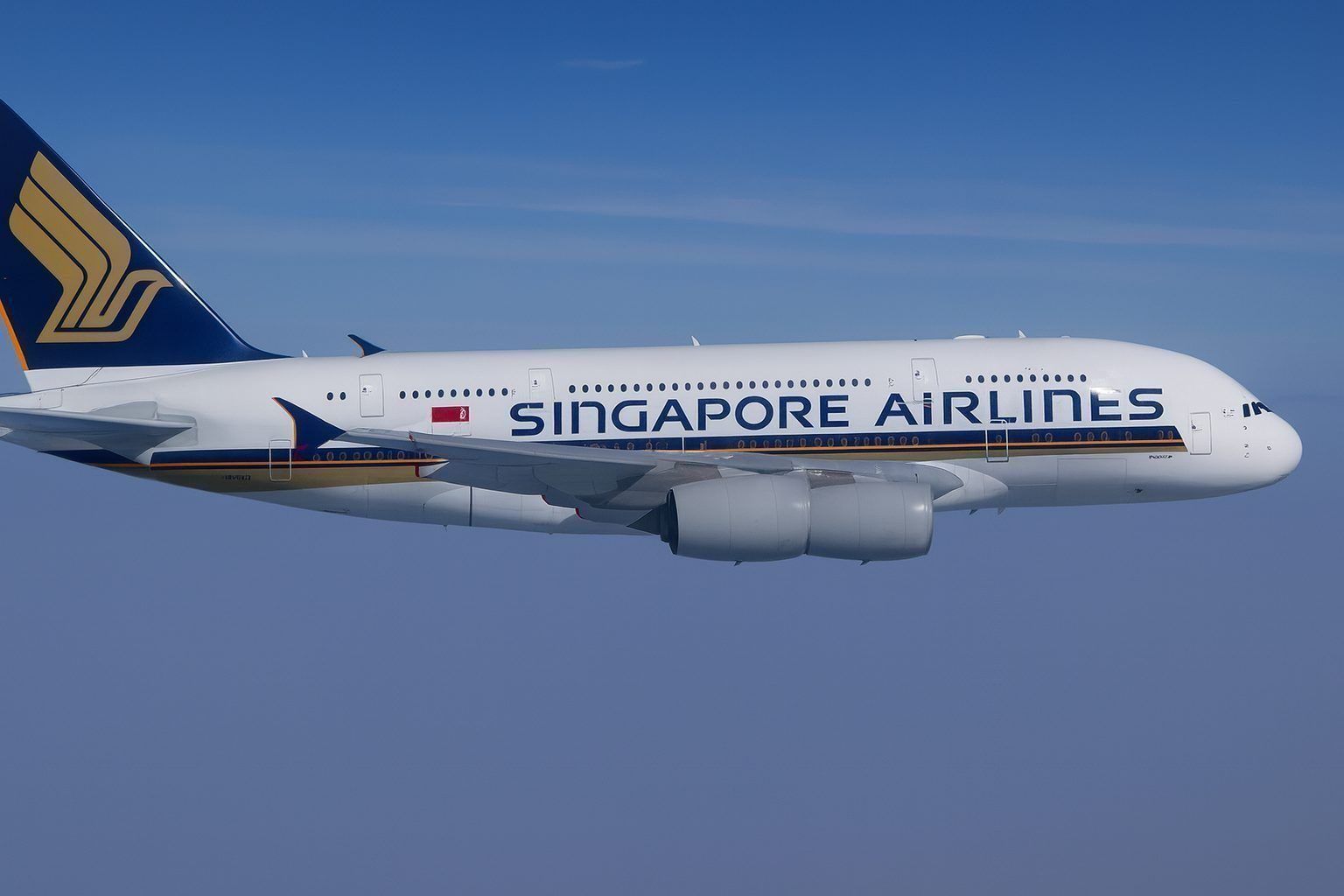
Singapore – 8 December 2025 – Singapore Airlines Ltd (SIA, SGX: C6L) is in that awkward spot investors know well: planes are full, dividends are flowing, but the headline profit just fell off a cliff.
On 8 December 2025, the flag carrier’s share price is trading around S$6.33–S$6.34, roughly the mid‑point of its 52‑week range, even after reporting a nearly 68% drop in half‑year net profit and launching a multi‑year special dividend programme.
Below is a breakdown of what’s driving Singapore Airlines’ stock today – price action, results, dividends, forecasts and key risks – as of 8 December 2025.
Share price snapshot: S$6.33 on 8 December 2025
According to exchange data compiled by Investing.com, Singapore Airlines closed at around S$6.33 on 8 December 2025, after trading between roughly S$6.33 and S$6.36, on volume of about 1.47 million shares.
That puts the stock:
- Near the middle of its 52‑week range of about S$5.90 to S$7.63.
- Down roughly 2.3% over the last 10 trading days, having fallen in six of those sessions, based on technical analysis site StockInvest.
Short‑term technical signals are not especially friendly. StockInvest recently downgraded C6L to a “Strong Sell” candidate, highlighting a break below a horizontal trading range, weak short‑ and long‑term moving averages, and a minor downtrend since mid‑November. StockInvest
For international investors, the over‑the‑counter US listing Singapore Airlines ADR (SINGY) last traded around US$9.79 on 5 December 2025, also easing slightly on the day.
Earnings: resilient operations, sharply lower profit
At first glance, the latest half‑year numbers look like a paradox: record revenue and higher operating profit, but a huge drop in net profit.
In its results for the first half of FY2025/26 (six months to 30 September 2025), SIA reported:
- Group revenue of S$9.68 billion, up 1.9% year‑on‑year, a new first‑half record.
- Operating profit of S$803 million, slightly higher than the previous year (+0.9%).
- Net profit of S$239 million, down 67.8% from S$742 million a year earlier.
- For 2Q FY2025/26, net profit plunged 82.1% year‑on‑year to S$52 million, despite a 22.5% rise in quarterly operating profit.
What went wrong?
The press release and follow‑up coverage point to three main culprits:
- Air India losses
- SIA’s share of results from associated companies was S$417 million lower year‑on‑year, mainly because the group started equity‑accounting its 25.1% stake in Air India from December 2024 after Vistara’s integration.
- Air India’s current losses are now flowing through SIA’s P&L, even though the stake is part of a long‑term “multi‑hub” strategy.
- Lower interest income
- Interest income fell by about S$103 million, as cash balances declined after large dividend payouts and debt reduction, and as interest rates moved lower.
- Fuel-hedging swing
- Net fuel cost actually fell 6.7%, thanks to a roughly 12.7% drop in fuel prices, but that benefit was partly offset by higher fuel volumes and a fuel‑hedging loss this year versus a gain last year.
Operationally, the airline is still humming:
- SIA and Scoot carried 20.8 million passengers in the half year, 8% more than the year before.
- Passenger traffic grew 4.6%, outpacing capacity growth of 3.0%, lifting the passenger load factor to 87.7% (+1.3 percentage points).
In other words: planes are full, but accounting effects, Air India losses and lower interest income are hitting the bottom line.
Special dividends and yield: rewarding shareholders despite the drop
The most eye‑catching news for income investors is SIA’s multi‑year special dividend plan, even as profits slide.
From its November results announcement and dividend disclosures:
- For 1H FY2025/26, the board declared:
- Interim dividend:5 cents per share
- Interim special dividend:3 cents per share
- Total: 8 cents per share, payable on 23 December 2025 to shareholders on record as of 8 December 2025, with an ex‑dividend date of 5 December 2025.
- SIA also unveiled a “special dividend package” of 10 cents per share per year for three financial years (FY2025/26–FY2027/28), totalling about S$0.9 billion:
- The first 3 cents is the special interim dividend above.
- A further 7‑cent special dividend for FY2025/26 is planned, subject to shareholder approval at the 2026 AGM.
- The airline expects (barring surprises and approvals) another 10 cents per share in each of FY2026/27 and FY2027/28.
On a trailing basis, data providers estimate that SIA paid roughly S$0.35 per share over the past 12 months, giving a dividend yield of around 5.5–6.0% at the current share price.
That combination – relatively low P/E and high yield – is a big part of why income‑oriented investors are still watching the stock, despite the Air India drag.
(Reminder: dividend policies can change, and yields move with the share price. Nothing here is personal investment advice.)
Traffic, capacity and network: demand remains robust
Recent traffic releases confirm that demand for SIA Group’s flights remains strong into the Northern winter season.
Key datapoints:
- October 2025:
- Group passenger traffic rose 5.3% year‑on‑year, ahead of a 3.7% increase in capacity.
- Passenger load factor climbed to 87.3%, with SIA at 86.8% and Scoot at 89.0%.
- The group carried about 3.6 million passengers, up 8.3% versus the prior year.
- November 2025:
- An external flight statistics report estimated 10,205 arriving Singapore Airlines flights, a 1.31% year‑on‑year increase, underscoring steady network expansion.
As of 30 September 2025, the SIA Group:
- Operated 208 passenger and freighter aircraft with an average age under eight years.
- Served 129 passenger destinations in 37 countries and territories.
- Had 67 aircraft on order, including Airbus A350 freighters, Boeing 777‑9s and more 737‑8s and A320/A321neos.
Both SIA and Scoot are ramping frequencies to key destinations (Auckland, Tokyo, regional Southeast Asia) and adding new points like Nha Trang, Labuan Bajo, Okinawa and Medan across late 2025 and early 2026.
So from a pure traffic perspective, the airline is still in “full planes, high load factors” mode.
Air India and other strategic moves: long-term upside, near-term pain
The most controversial piece of the SIA investment puzzle right now is its 25.1% stake in Air India.
SIA describes the investment as part of a long‑term multi‑hub strategy, giving it exposure to one of the world’s fastest‑growing aviation markets and new traffic flows beyond Singapore.
But in the near term, Air India is a drag:
- SIA’s share of associated companies’ results fell by S$417 million year‑on‑year in 1H FY2025/26, with the group explicitly citing Air India’s losses as a major factor.
- Coverage from AsiaOne, The Edge Singapore and others emphasised that Air India and lower interest income explain most of the 68% net profit drop, even as operating profit rose.
Analysts quoted in The Business Times broadly share that view: the Air India stake is seen as strategically positive over the long run, but earnings‑dilutive in the short term, with losses expected to continue while the carrier is restructured.
Beyond India, SIA is weaving a dense web of partnerships in Asia:
- Malaysia Airlines joint venture: Singapore’s competition watchdog granted conditional approval in July 2025 for a proposed commercial JV between SIA and Malaysia Airlines, covering sales, marketing and expanded codeshares, pending final approval in Malaysia.
- Deeper ties with Garuda Indonesia and Vietnam Airlines, including new codeshares and reciprocal lounge access.
- A new S$1.3 billion services agreement between SIA Engineering and the SIA/Scoot fleet, aimed at improving maintenance efficiency and reliability.
These moves all point the same way: SIA wants to be the premium “spider in the web” of Asia‑Pacific connectivity – but the Air India hub will take time and money to fix.
Balance sheet and financial strength
Despite the profit plunge, SIA is not looking financially distressed – which partly explains why the board felt comfortable announcing special dividends.
From the half‑year report:
- Shareholders’ equity: about S$15.5 billion as at 30 September 2025, only slightly below March 2025.
- Debt-to-equity ratio: improved from 0.82x to 0.70x, as total debt fell by roughly S$2.0 billion.
- Cash and bank balances:S$6.4 billion, plus about S$2.1 billion in longer‑tenor fixed deposits, and S$3.3 billion in undrawn committed credit lines.
- Net asset value is around S$4.97 per share, implying a price‑to‑book ratio of about 1.25x at the current share price.
In short: the balance sheet remains strong, even after hefty ordinary and planned special dividends.
Valuation: low P/E, mid‑book, high yield
Different data providers deviate slightly, but they broadly agree on one thing: Singapore Airlines is trading on a single‑digit trailing P/E with a mid‑single‑digit dividend yield.
Key valuation metrics as of early December 2025:
- Market capitalisation: around S$19.9 billion.
- Share price: ~S$6.33–S$6.34.
- Trailing EPS (TTM): ~S$0.73 per share.
- Trailing P/E: roughly 8.5–9.0x, depending on the provider.
- Price-to-book: about 1.2–1.3x.
- Price-to-sales: around 1.0x.
- Dividend yield (trailing 12 months): roughly 5.5–6.0%.
Equity research platform Simply Wall St notes that SIA’s P/E of about 8.8x is below both the Asian airlines peer average (~10–21x) and the stock’s own estimated “fair” P/E of 13.3x based on its modelling, labelling the shares “good value” on that metric. Simply Wall St+1
At the same time, some sites tracking long‑term P/E history highlight that the multiple is low relative to global peers, but not especially low versus SIA’s own range, given that airlines are cyclical and earnings can swing dramatically.
Analyst targets and stock forecasts
Analyst and model‑based forecasts for Singapore Airlines are… restrained. No one’s screaming “doom”, but there’s no obvious growth rocket either.
Street targets and ratings
From SGX‑linked consensus data and major broker research:
- Growbeansprout, aggregating SGX data as of 8 December 2025, shows a consensus 12‑month target price of S$5.997, implying about 5.4% downside from S$6.34.
- That consensus is built mainly on “HOLD”‑type calls from CGSI, DBS, Maybank, OCBC and UOB Kay Hian, with target prices mostly in the S$6.00–S$6.85 range.
- Phillip Securities recently upgraded SIA from “Reduce” to “Neutral” and nudged its target price up to S$6.04 (from S$5.94), in a note titled “Flying High, Landing Heavy in India” – an apt summary of the current situation. SG Investors
- Stockopedia reports an analyst consensus target of about S$6.09, about 3–4% below the current share price.
- TradingView’s summary of analyst targets pegs the average 12‑month price objective at S$6.19, with estimates ranging from S$5.25 to S$7.00.
- TipRanks, which tracks a smaller analyst sample, shows an average target around S$6.27 with a narrow range, again signalling mild downside from mid‑S$6 levels.
Across these sources, the message is fairly consistent: most analysts are neutral, seeing limited upside in the near term after the recent profit disappointment and Air India drag.
Quant and technical forecasts
Quant‑driven sites are also lukewarm:
- StockInvest assigns C6L a “Strong Sell” technical rating in early December, arguing the stock has broken down from a horizontal range and is in a short‑term falling trend, with expected daily trading between roughly S$6.30–S$6.36 and limited attractive risk‑reward. StockInvest
- For the US ADR SINGY, the same site calls it a “Hold/Accumulate” candidate, but still within a short‑term falling trend and expecting modest downside over the next three months. StockInvest
Fundamental growth forecasts
Fundamentally oriented models are cautious on earnings:
- Simply Wall St estimates that SIA’s earnings could decline at about 21.7% per year, even as revenue grows around 2% annually, implying margin compression and lower returns on equity (forecast ~6.6% in three years).
Those are just model outputs, not certainties, but they help explain why consensus price targets cluster just below current levels.
Key risks and macro headwinds
Even the best‑run airline is still a highly leveraged bet on things it doesn’t fully control: fuel prices, regulation, and global travel demand. For SIA right now, a few specific issues stand out.
1. Air India restructuring risk
As already noted, Air India’s losses are now directly hitting SIA’s earnings, and analysts widely expect this to continue for some time as the Indian carrier goes through a multi‑year turnaround.
If the turnaround takes longer or costs more than expected, SIA’s reported profits could remain under pressure even if its core Singapore hub business performs well.
2. Sustainable aviation fuel (SAF) and green levies
Singapore has announced the world’s first broad “green fuel” levy on outbound flights, to fund the transition to sustainable aviation fuel: Financial Times+3The Economic Times+3The A…
- From April 2026, tickets sold for flights departing Singapore will include a SAF levy, with charges up to S$41.60 per passenger depending on distance and cabin.
- The levy takes effect for travel from October 2026, and will be collected by airlines such as SIA and Scoot.
- Globally, SAF remains two to three times more expensive than conventional jet fuel, and airlines and oil companies are locked in a tug‑of‑war over who pays – a stand‑off industry bodies like IATA say risks slowing progress toward net‑zero.
For SIA, which positions itself as premium and sustainability‑minded, passing on higher fuel and SAF costs without losing demand will be a delicate balancing act.
3. Cargo softness and macro uncertainty
In its own outlook, SIA warns that the cargo market remains uncertain, with yields under pressure as capacity is redeployed and trade patterns shift. At the same time, management flags geopolitical tensions, macro headwinds, inflation and supply‑chain constraints as ongoing challenges for the broader airline sector.
Cargo is less dominant for the group than during the pandemic, but still an important profit contributor.
4. Cyclical and competitive industry
Even with a strong brand and hub, SIA competes with Middle Eastern giants, Chinese carriers, low‑cost rivals and regional network airlines. That competition is already visible in lower passenger yields (down about 2.9% in the latest half), even while planes stay full.
If global growth slows or capacity ramps faster than demand, yields could fall further, hitting margins.
Investment takeaway: solid airline, messy earnings
Putting it all together as of 8 December 2025:
- Operations: Traffic is growing, load factors are high, and the network is expanding. SIA is still arguably one of the best‑run airlines on the planet.
- Financial strength: The balance sheet is robust, with reduced debt and large cash reserves, giving management room to keep paying dividends and investing in fleet and partnerships.
- Shareholder returns: The ordinary plus special dividend package offers an attractive yield in the mid‑single digits, assuming the board continues as planned and earnings don’t collapse further.
- Valuation: At around 8–9x trailing earnings and ~1.25x book, SIA doesn’t look stretched relative to peers, and some models even call it undervalued.
- But: The Air India stake and lower interest income are hammering reported profit, analysts see limited near‑term upside, and technical indicators lean bearish in the short run.
For long‑term investors, the question isn’t whether Singapore Airlines can fill its planes – recent numbers say it clearly can – but how much of that busy operation actually drops to the bottom line once India, fuel, SAF levies and competition are all priced in.