
Ticker: NSE: INDIGO | BSE: 539448 – Data as of intraday trade on 8 December 2025
InterGlobe Aviation share price today: sharp fall amid week‑long chaos
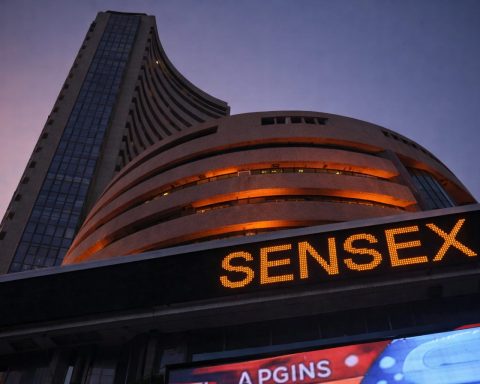
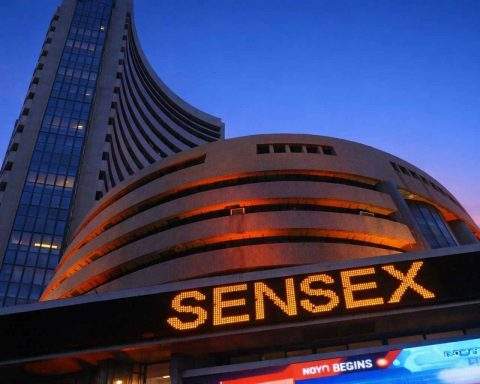
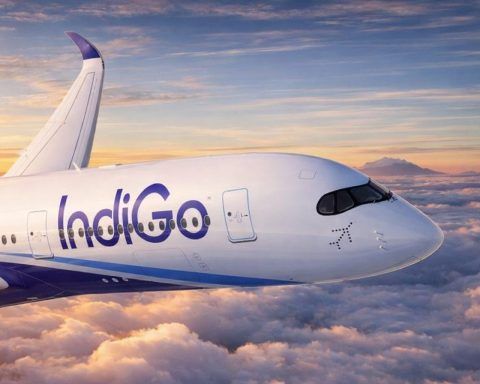
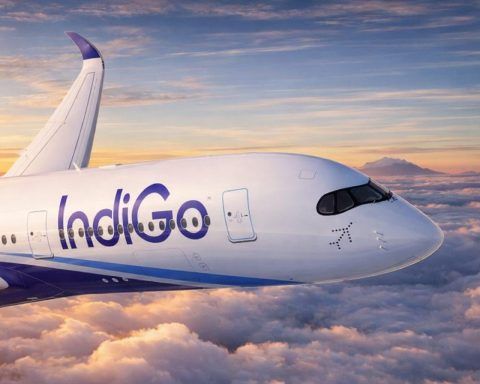
InterGlobe Aviation Ltd, the parent of IndiGo, is under intense pressure in the market on Monday, 8 December 2025, as investors weigh the fallout of the airline’s biggest operational crisis to date.
- In early trade, the stock fell around 6–7%, hitting an intraday low near ₹5,015 on the BSE, according to multiple market updates.
- That move extends a seven‑session losing streak, leaving the stock down roughly 15% since 27 November 2025.
- At current levels around ₹5,100–5,200, InterGlobe’s market capitalisation sits close to ₹2 trillion (₹1.9–2.1 lakh crore).
The sell‑off coincides with mass flight cancellations, a regulatory probe by India’s aviation watchdog (DGCA), a government intervention in airfares, and fresh brokerage downgrades of earnings and target prices – all landing at once.
For investors, the big question is whether this is a temporary operational storm in an otherwise strong structural story – or the start of a deeper re‑rating of India’s largest airline.
What triggered the 2025 IndiGo disruption?
New duty‑time rules, thousands of cancellations
The immediate trigger is IndiGo’s struggle to adjust to new Flight Duty Time Limitation (FDTL) norms – rules that increase pilot rest requirements and reduce night operations to improve safety.
Key facts so far:
- Since early December, IndiGo has suffered the largest operational disruption in its history, cancelling thousands of flights across India.
- As of 7 December, more than 3,800 flights had been cancelled, according to compiled regulatory and media tallies.
- On some days, cancellations exceeded 1,000 flights, causing chaos at major airports such as Delhi, Mumbai, Bengaluru, Hyderabad and Kolkata.
- For 8–9 December alone, IndiGo has proactively cancelled 243 flights across domestic and a handful of international routes, including sectors such as Mumbai–Singapore, Chennai–Penang, and Mumbai–Abu Dhabi.
At the core of the crisis:
- The DGCA had signalled the tougher FDTL rules well in advance, with implementation tied to concerns about pilot fatigue.
- Investigations are now probing whether IndiGo under‑prepared for the change, focusing on scheduling, crew planning and risk disclosures.
This combination of operational strain and perceived planning lapses has turned a technical regulatory shift into a reputational and financial event.
Regulatory heat: show‑cause notices, fare caps and possible penalties
DGCA scrutiny intensifies
India’s aviation regulator, the DGCA, has taken an unusually tough stance:
- The DGCA has issued show‑cause notices to IndiGo CEO Pieter Elbers and other accountable managers, asking why enforcement action should not be taken over the airline’s handling of the disruption.
- While the executives were initially given 24 hours to respond, the regulator has granted a one‑time 24‑hour extension, with a final deadline of 6 p.m. on Monday, 8 December 2025.
Possible consequences range from monetary penalties and compliance directives to more serious actions that could impact senior management, according to legal experts quoted in local coverage.
Government fare controls add another headwind
To contain a spike in fares triggered by capacity constraints, the Indian government has temporarily capped airfares across carriers in certain ranges (for example, roughly ₹7,500–₹18,000 on key routes), a move analysts describe as net negative for IndiGo’s margins.
In parallel, the government has publicly tracked IndiGo’s refund and baggage handling performance and pushed for rapid remediation – a rare level of direct operational involvement.
Crisis Management Group and operational recovery efforts
Board‑level taskforce with heavyweight names
InterGlobe’s board has responded by creating a Crisis Management Group (CMG), signalling that the situation has escalated well beyond routine operations.
According to disclosures and media reports, the CMG includes:
- Vikram Singh Mehta – Chairman
- Board directors Gregg Saretsky, Mike Whitaker (former FAA chief), and Amitabh Kant (former CEO of NITI Aayog)
- CEO Pieter Elbers and other senior management representatives The Pioneer+3The Economic Times+3The Times of India+3
The CMG’s mandate includes:
- stabilising the flight schedule and restoring the network
- overseeing refunds and baggage delivery
- managing engagement with regulators and the government
- conducting internal reviews of how the airline prepared for FDTL
Where operations stand as of 8 December
Operational data points show a system still under strain but improving:
- IndiGo says it operated about 1,500 flights on Saturday and plans to operate around 1,650 flights on Sunday/Monday, versus a normal schedule somewhat higher than that.
- On‑time performance, which had dropped to roughly 30% at the height of the chaos, has reportedly improved to around 75% as of the latest update from the airline.
- IndiGo and government officials say refunds of about ₹610 crore have already been processed, and more than 3,000 bags have been delivered to affected passengers.
- The airline and various officials have guided that operations should largely stabilise around 10 December 2025, though some cancellations continue (including the 243 flights for 8–9 December).
The picture is of an airline moving out of crisis mode but still not back to normal – and investors are clearly not pricing this as “just a few bad days”.
Brokerage reactions: cuts, caution and still a lot of “Buys”
Target prices come down, but the stock is far below most of them
Analysts have responded to the disruption and Q2 FY26 results with a mix of target cuts and reaffirmed long‑term optimism.
From today’s and recent reports:
- UBS maintains a Buy rating but trims its target price to around ₹6,350, citing higher cost assumptions for FY26–FY28 as the airline hires roughly 20% more pilots per aircraft to meet FDTL norms – a move that could add about ₹0.10 per ASK and shave off up to 25% of pre‑tax profit if fares do not adjust.
- Jefferies, which raised its target to ₹7,025 last month, reiterates a Buy and describes IndiGo as being in “full reboot mode” but still backed by strong industry structure and international growth. Investing.com+1
- Investec stays on Sell with a target near ₹4,040, pointing to rising fuel costs, weaker rupee (around ₹90 per USD in their scenario), and the risk that cancellations have pushed out any near‑term earnings rebound.
- JM Financial estimates that if the disruption lasts roughly 15 days, earnings for FY26 could see an 8–9% hit, and flags the DGCA show‑cause and potential penalty or management action as additional overhangs.
- Earlier in the week, Citi and Morgan Stanley remained constructive, with targets around ₹6,500–6,540 and “Buy/Overweight” stances, even as they acknowledged the operational risks. The Economic Times
Across the analyst universe:
- NDTV Profit cites 26 analysts tracking InterGlobe: 21 rate it “Buy”, two “Hold” and three “Sell”, with an average 12‑month target around ₹6,332, implying roughly 17% upside from current levels. NDTV Profit
In other words, near‑term earnings and comfort levels are being marked down, but the stock price has fallen faster than the average target – at least for now.
Fresh analysis: return on capital still looks strong
Even as the newsflow is dominated by cancellations and show‑cause notices, some quantitative research platforms continue to highlight InterGlobe’s return metrics:
- Simply Wall St calculates InterGlobe’s Return on Capital Employed (ROCE) at roughly 13% for the twelve months to September 2025, based on EBIT of about ₹116 billion and capital employed just under ₹900 billion.
- Another Simply Wall St piece notes that ROCE has risen significantly over the last five years, while capital employed has also grown sharply – a pattern often associated with companies that can reinvest at attractive rates.
- Screening sites such as Screener and StockAnalysis show ROCE figures in the 15–17% range for recent years, alongside very high reported ROE (boosted by leverage and prior losses).
These metrics are one reason InterGlobe often appears on “high return on capital” stock lists – but the current crisis tests whether those returns are durable through regulatory and operational shocks, not just cyclical upturns. mint+1
Fundamentals check: Q2 FY26 results and balance sheet
Big reported loss, small underlying profit
Just a month before this crisis, InterGlobe reported Q2 FY26 (September quarter) numbers that already highlighted key vulnerabilities:
- Reported net loss: about ₹2,582 crore, more than 2.5x wider than the loss of ~₹987 crore a year earlier and a sharp reversal from a profit of ~₹2,176 crore in Q1 FY26.
- Revenue from operations: around ₹18,555–19,600 crore, up roughly 9–10% year‑on‑year, driven by higher passenger traffic and steady yields.
- The loss was dominated by foreign‑exchange charges on dollar‑linked leases and obligations – about ₹28.9 billion in FX losses, partially offset by roughly ₹2.06 billion of hedging gains.
- Excluding FX effects, several analyses estimate an underlying net profit of ~₹104 crore for the quarter – essentially breakeven in the context of IndiGo’s scale.
- EBITDAR (earnings before interest, tax, depreciation, amortisation and rent) halved to around ₹1,100 crore, reflecting margin pressure despite revenue growth.
Leverage and lease liabilities
InterGlobe’s balance sheet is dominated by aircraft lease liabilities, a common pattern for large low‑cost carriers:
- ICICI Securities estimates IndiGo’s total debt including capitalised operating leases at about ₹748 billion in Q2 FY26, up from ₹684 billion in Q1 FY26. Of this, lease liabilities alone are around ₹497 billion.
While liquidity is considered adequate by most analysts, the FX‑linked nature of these liabilities means a weaker rupee mechanically hurts earnings, a point that is now front‑and‑centre in broker models.
Valuation snapshot: still expensive on earnings, less so on cash flow
Valuation data from several screening and analytics platforms (using TTM and consensus estimates) show:
- Trailing P/E: roughly 40x, versus a three‑year average near the mid‑teens and an Indian airline/transport peer median in the high single digits.
- Forward P/E: around 28x based on 12‑month earnings forecasts as of late November.
- EV/EBITDA (TTM): about 11x, below the company’s own three‑year average EV/EBITDA above 20x, reflecting the big rebound in EBITDA from the pandemic lows.
So, even after the recent sell‑off, InterGlobe Aviation still trades at a premium multiple to its historical earnings and global airline peers, though the gap is narrower on EV/EBITDA than on P/E.
That premium rests on investor belief that:
- the current FDTL‑driven disruption is temporary, and
- the airline’s structural growth and returns on capital will remain intact once the dust settles.
Growth story: order book, fleet and long‑haul expansion
A massive narrow‑body order book
IndiGo’s long‑term equity story is built around its scale and order book:
- The airline currently operates about 397 aircraft (A320ceo/neo, A321neo, ATR 72 and A321 freighters) as of September 2025.
- It has one of the largest single‑airline order books in the world, with:
- older orders for 480 A320 family aircraft, and
- a record 500‑jet Airbus A320 family order announced in June 2023, covering deliveries from 2030–2035.
Together, this leaves IndiGo with nearly 1,000 aircraft yet to be delivered, giving very long runway (pun absolutely intended) for capacity growth.
Turning to long‑haul and premium international markets
Historically a pure narrow‑body, short‑haul carrier, IndiGo is now pushing harder into international and longer‑haul flying:
- In early 2025, the airline started operating a damp‑leased Boeing 787‑9 from Norse Atlantic Airways, with Norse providing the aircraft, pilots and maintenance while IndiGo provides cabin crew – a stepping stone toward future wide‑body operations.
- IndiGo expects delivery of its first Airbus A321XLR – a very long‑range narrow‑body – by December 2025, with more arriving into 2026.
- The airline has announced Athens as one of the first A321XLR destinations, with six weekly flights planned in early 2026 (subject to final delivery timing).
- According to Aviation Week and other industry sources, IndiGo plans high‑teens capacity growth in winter 2025–26, with long‑haul additions via damp‑leased 787s and A321XLRs as a major driver.
International flying already accounts for about 28% of IndiGo’s capacity and 40+ destinations, and management sees this as a natural hedge against domestic cycles and currency exposure over time.
This backdrop is why many brokerages, including UBS, Jefferies, Citi and Morgan Stanley, continue to frame the current sell‑off as a tactical dislocation within a long‑term growth story, albeit now with a visible scar.
Key risks and variables to watch
From a stock and fundamentals perspective, investors and analysts are now laser‑focused on a small set of tangible variables:
- Speed and quality of operational normalisation
- Does IndiGo truly stabilise operations around 10 December 2025, and can it sustain normal schedules with the new FDTL rules baked in? Whalesbook+3Deccan Herald+3The Times of India+3
- Regulatory outcome
- The tone and substance of the DGCA’s response after reviewing the CEO’s show‑cause reply will matter – both any financial penalty and any hint of constraints on future growth, route rights or slot allocation.
- Government policy on fares
- How long do fare caps stay in place, and are they broadened or tightened? This directly affects IndiGo’s ability to pass higher crew and operational costs to passengers.
- Staffing and culture
- Multiple reports suggest pilot unrest and concerns about how safety vs profitability trade‑offs have been managed. How IndiGo addresses pilot relations, training, and rosters will shape both operational resilience and brand perception.
- Currency and fuel
- With substantial dollar‑linked liabilities and fuel exposure, any further rupee depreciation or spike in ATF prices could compress margins further, especially while fares are capped and load factors remain volatile.
- Earnings revisions and valuation
- Consensus earnings per share (EPS) forecasts are likely to be cut further as the full impact of cancellations, refunds and fare caps is modelled. The extent of those downgrades will determine whether today’s ~40x trailing P/E settles closer to structural averages or remains elevated.
Bottom line: a structurally strong franchise in a self‑inflicted storm
InterGlobe Aviation combines:
- a near‑monopoly‑like domestic position with >60% market share, Wikipedia+1
- a huge future fleet pipeline, and
- historically strong returns on capital and cash generation.
Those are the ingredients that justified premium valuations and bullish long‑term calls.
However, December 2025 has exposed three uncomfortable truths:
- Execution risk – even highly efficient, data‑driven airlines can stumble badly when regulatory changes collide with aggressive optimisation.
- Regulatory risk – when an airline is this systemically important, regulators and the government will intervene, sometimes in ways (like fare caps) that blunt short‑term profitability.
- Market‑sentiment risk – a stock priced for perfection has little room to absorb operational surprises, which is why a seven‑session, ~15% slide has unfolded so quickly.
Whether the current level in InterGlobe Aviation ultimately proves to be a buyable dislocation, a pause in a longer re‑rating, or the start of a de‑rating will come down to how the airline and regulators handle the next few weeks, and how steep the earnings downgrades are.
For now, the market is clearly sending a message: growth and high returns on capital are valuable – but reliability, resilience and regulatory trust are just as important for an airline’s equity story as load factors and yields.
Related articles: NSE:INDIGO