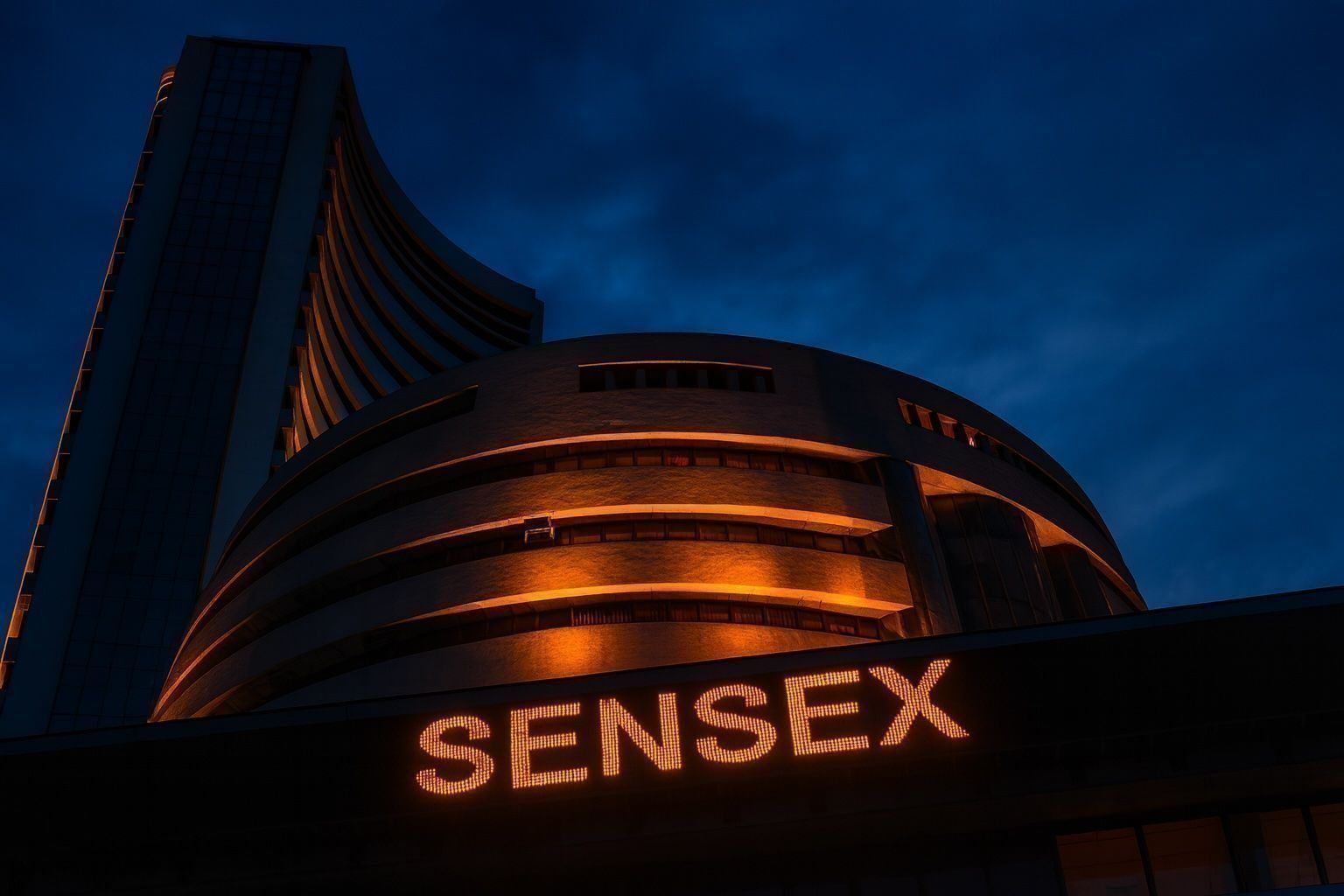
Indian equity markets started the new week on a cautious note on Monday, December 8, with the Sensex and Nifty slipping in early trade and extending losses by midday as investors booked profits in rate‑sensitive sectors, braced for a key US Federal Reserve meeting, and reacted to persistent foreign institutional investor (FII) selling and a weaker rupee.
Opening Bell: Weak Start in Absence of Fresh Domestic Triggers
GIFT Nifty futures on the NSE IX were already pointing to a subdued session, trading about 17 points lower around 26,318 and signalling a muted start for Dalal Street.
At the opening bell, both benchmarks slipped into the red:
- BSE Sensex: down about 90–100 points (around 0.1%) to trade near 85,619
- Nifty 50: lower by around 50 points (about 0.2%) around 26,137
Public broadcaster DD News, citing market analysts, noted that the Nifty was likely to remain range‑bound intraday, with resistance clustered in the 26,300–26,350 zone and support around 26,000–26,050 — levels traders have been using as a short‑term band after the recent record highs.
The cautious mood came despite strong domestic macro data and last week’s rate cut by the Reserve Bank of India (RBI), underscoring how much attention is now focused on global cues — particularly the US Federal Reserve’s policy decision later this week.
Losses Deepen by Midday: All Sectors Turn Red
Through the morning, selling pressure intensified.
According to data cited by Moneycontrol, around 11 a.m. the Sensex was down about 347 points (≈0.4%) at 85,365.87, while the Nifty 50 slipped nearly 124 points (≈0.47%) to 26,062.60 as broad‑based profit‑booking and continued FII outflows weighed on sentiment.
By early afternoon, a separate live market update showed the slide deepening:
- Nifty 50: below 26,050
- Sensex: lower by around 420 points
- BSE Midcap & Smallcap indices: each down about 1%
- All major sectoral indices in the red, with realty down over 2%
These intraday levels represent roughly a 0.4–0.6% decline in benchmark indices from Friday’s close of 85,712.37 (Sensex) and 26,186.45 (Nifty), when markets had rallied on the RBI’s rate cut.
What’s Dragging the Market: Realty, Services, Banks and Autos
Realty Takes the Hardest Hit
The sharpest pain on Monday came from real estate counters:
- The Nifty Realty index fell as much as 2.6% intraday, snapping a two‑day winning streak and hitting an intraday low around 869.
- All ten index constituents were lower, led by Godrej Properties, which dropped nearly 3.7%, while Prestige Estates, Anant Raj, DLF, Sobha, Macrotech Developers, Brigade Enterprises and Oberoi Realty declined roughly 2–3.7%.
Upstox linked the realty sell‑off to profit‑booking after the RBI’s latest 25 bps repo rate cut to 5.25%, noting that the index had already rallied in the two sessions preceding Friday’s Monetary Policy Committee (MPC) decision.
Services and Financials Under Pressure
A PTI‑based report carried by multiple outlets highlighted that services and realty stocks were the main drags, with heavyweight financial names adding to the downside:
- Key laggards on the Sensex included Bajaj Finance, Bharat Electronics (BEL), Axis Bank, Bajaj Finserv, Maruti Suzuki, Asian Paints, Mahindra & Mahindra, NTPC, ICICI Bank, Power Grid, Hindustan Unilever and Larsen & Toubro.
Moneycontrol’s live blog added that InterGlobe Aviation (IndiGo), BEL, Bajaj Finance, Max Healthcare and Jio Financial were among the major losers on the Nifty by midday.
IT and Select Autos Offer Some Support
Despite broad weakness, pockets of resilience remained:
- IT stocks such as Tech Mahindra, Infosys, TCS, HCL Tech and Tata Steel (metal) were among the top gainers in early trade, helping cushion some of the fall.
- Moneycontrol also flagged HDFC Life, Tech Mahindra and Wipro among intra‑day gainers on the Nifty, suggesting that defensives and export‑oriented names were relatively better bid.
Stock‑Specific Action: IndiGo, SpiceJet, Reliance Power and Fino
Beyond the index heavyweights, several individual stocks were in focus:
- InterGlobe Aviation (IndiGo): Economic Times reported that the stock slumped up to around 7% in early trade amid continuing concerns over flight disruptions and regulatory scrutiny by the civil aviation regulator.
- SpiceJet: Benefiting from IndiGo’s troubles, ET’s live coverage noted that SpiceJet shares jumped over 13%, extending a rally driven by expectations of improving market share.
- Reliance Power: The stock fell more than 4% after reports of an Enforcement Directorate chargesheet related to alleged use of a fake bank guarantee, keeping the counter under pressure.
- Fino Payments Bank: Despite receiving landmark approval to convert to a small finance bank, the stock slid about 6%, reflecting profit‑taking and possibly stretched near‑term valuations.
These moves underscore a market environment where stock‑specific news is amplifying volatility on top of macro‑driven worries.
Rupee at 90, Crude Firm and FII Selling: The Macro Headwinds
Rupee Hovers Around 90 per Dollar
Currency markets mirrored the cautious tone in equities:
- ET’s forex update showed the rupee weakening by about 12 paise to around 90.07 per US dollar in early trade, while other reports pegged it slightly weaker at about 90.11, implying a 12–16 paise intraday depreciation.
The psychological breach of the 90 level has already been flagged as a key risk for inflation and imported costs in weekly previews of the market, with analysts warning that persistent rupee weakness could keep FIIs on the sell side.
Persistent FII Outflows vs Strong DII Support
Foreign investors remain net sellers:
- PTI figures show that FIIs sold about ₹438.9 crore of equities on Friday, extending what Moneycontrol described as a seven‑session streak of net outflows.
- Over the same session, domestic institutional investors (DIIs) bought equities worth roughly ₹4,189 crore, offering a sizeable counter‑balance to foreign selling.
GoodReturns data suggest that over the past six weeks, FII outflows have aggregated to more than ₹10,400 crore, while DII inflows have exceeded ₹19,700 crore, highlighting how domestic money has been absorbing foreign selling even as benchmarks hovered near record highs.
Crude and Volatility Gauge Add to the Caution
The macro backdrop also includes:
- Brent crude edging up to around $63.8 per barrel, near two‑week highs, as investors price in a potential US rate cut and ongoing geopolitical risks around Russian and Venezuelan supply.
- A rise in India VIX, the domestic volatility index, by slightly over 2% to about 10.5, signalling a pick‑up in perceived near‑term risk as traders trim exposure ahead of major global events.
For a market already grappling with rupee weakness and foreign selling, firmer oil and a higher VIX compound the sense of unease.
RBI’s Rate Cut: Supportive Backdrop, but Banks May Lag
Monday’s weakness comes just days after the RBI’s Monetary Policy Committee delivered a quarter‑percentage‑point repo rate cut to 5.25%, its fourth cut this year, while also announcing plans for sizeable bond purchases and a dollar–rupee swap to inject liquidity.
- The rate cut and liquidity measures helped the Sensex jump 447 points and the Nifty climb 153 points on Friday, leading many analysts to argue that the macro set‑up for India remains broadly supportive.
- However, ET has highlighted that banks may be reluctant to cut deposit rates further, given intense competition for household savings and a high credit‑deposit ratio — which could compress margins even as lending rates adjust to the RBI’s easing cycle.
Commentary from Geojit and Religare, carried in multiple outlets, reinforces the idea of a “good economy, expensive market” dynamic:
- Real GDP growth printed at about 8.2% in Q2, prompting the RBI to raise its FY26 growth forecast to 7.3%.
- Based on leading indicators, strategists estimate around 15% earnings growth could be achievable in FY27.
- Yet, depreciation of the rupee and sustained FII selling remain key negatives that can cap near‑term upside despite the strong macro.
Fed Week: Why Global Central Banks Matter So Much Today
The single biggest overhang for markets this week is the US Federal Reserve meeting:
- Moneycontrol’s breakdown of “key factors behind the market decline” lists caution ahead of the Fed’s two‑day policy meeting from December 9 as the top driver of Monday’s risk‑off move. Moneycontrol
- Analysts tracked by ET and other global outlets expect the Fed to deliver a 25 bps “hawkish cut”, with odds around 85%, while emphasising that the guidance on future cuts will be crucial for global risk assets. Pulse+1
- The same week also features meetings of central banks in Australia, Brazil, Canada and Switzerland, though the consensus is that none of them will adjust rates immediately.
In addition, Mint’s “top five triggers” for this week’s Indian market action flagged: mint+1
- India’s CPI inflation print,
- India–Russia trade and rupee‑ruble settlement developments,
- progress on an India–US trade deal,
- FII flows, and
- gold prices against a backdrop of Fed expectations.
All of these factors feed into the tug‑of‑war between supportive domestic fundamentals and increasingly complex global headwinds.
New NSE Pre‑Open Session for Equity Derivatives Goes Live
Monday’s session also marked an important structural change in market microstructure:
- Starting December 8, the NSE introduced a 15‑minute pre‑open session for equity derivatives (F&O), between 9:00 a.m. and 9:15 a.m., to improve price discovery and reduce opening‑bell volatility.
- The window operates through a call auction mechanism and currently applies to current‑month and near‑month futures in the equity derivatives segment, excluding far‑month contracts, options and contracts undergoing corporate actions.
While the launch was relatively low‑key amid the broader macro jitters, brokers expect this pre‑open phase to become increasingly important for large institutional orders and for gauging early sentiment in the F&O space.
Global Cues: Asia Mixed, US Dollar Steady
Overseas markets offered a mixed backdrop:
- Asian indices were uneven — Japan’s Nikkei, Shanghai’s Composite and South Korea’s Kospi traded higher, while Hong Kong’s Hang Seng remained under pressure.
- On Wall Street, US indices ended last week with modest gains, supported by softer inflation readings and growing conviction that the Fed will cut rates this week.
- The US dollar index stabilised after two weeks of declines, with analysts expecting a “hawkish cut” from the Fed that could keep the greenback relatively supported even if rates move lower. The Economic Times+1
For India, this combination — a firmer dollar, rupee at 90, and higher crude — is not ideal, and helps explain why traders were reluctant to chase risk despite a still‑strong domestic growth story.
How Analysts See the Market: Volatile but Structurally Bullish
Pre‑week research from brokerages and financial portals broadly converged on a similar theme: short‑term volatility within a longer‑term uptrend.
GoodReturns, in a weekend outlook, highlighted that:
- The Nifty’s immediate support lies near the 25,900–26,000 band, close to key moving averages.
- A decisive move above 26,350 could open the door to 26,600 on the upside, while dips toward support may continue to attract buyers.
- Bank Nifty remains relatively strong, with support just below 59,000 and resistance near 60,000, suggesting banking stocks could provide leadership once the macro dust settles.
Separately, intraday commentary from DD News and Moneycontrol also referenced a “buy‑on‑dips” stance among some traders, who see pullbacks towards 26,000 on the Nifty or stabilisation in Bank Nifty around the high‑59,000 zone as potential entry points — though always with tight risk controls given the event‑heavy calendar. DD News+1
Key Takeaways for Investors
While this article does not offer personalised investment advice, Monday’s session on Dalal Street sends a few clear messages:
- Event risk is in the driver’s seat.
With the Fed meeting, key economic data and multiple central bank decisions packed into a single week, global policy signals are overshadowing even supportive domestic data. - Rate‑sensitive sectors are most vulnerable to swings.
Realty, banks and autos have been the biggest beneficiaries of RBI easing — and are therefore the most prone to profit‑booking when global risk sentiment turns cautious. - Currency and FII flows remain crucial.
A rupee around 90 to the dollar and sustained FII outflows are likely to keep India’s premium valuations under scrutiny, even as DIIs and retail investors continue to buy dips. - Structural changes continue beneath the volatility.
The new pre‑open F&O session, RBI’s ongoing liquidity support, and gradual shifts in India’s global trade relationships (such as the long‑term India–Russia trade targets) point to an evolving, more sophisticated market ecosystem.