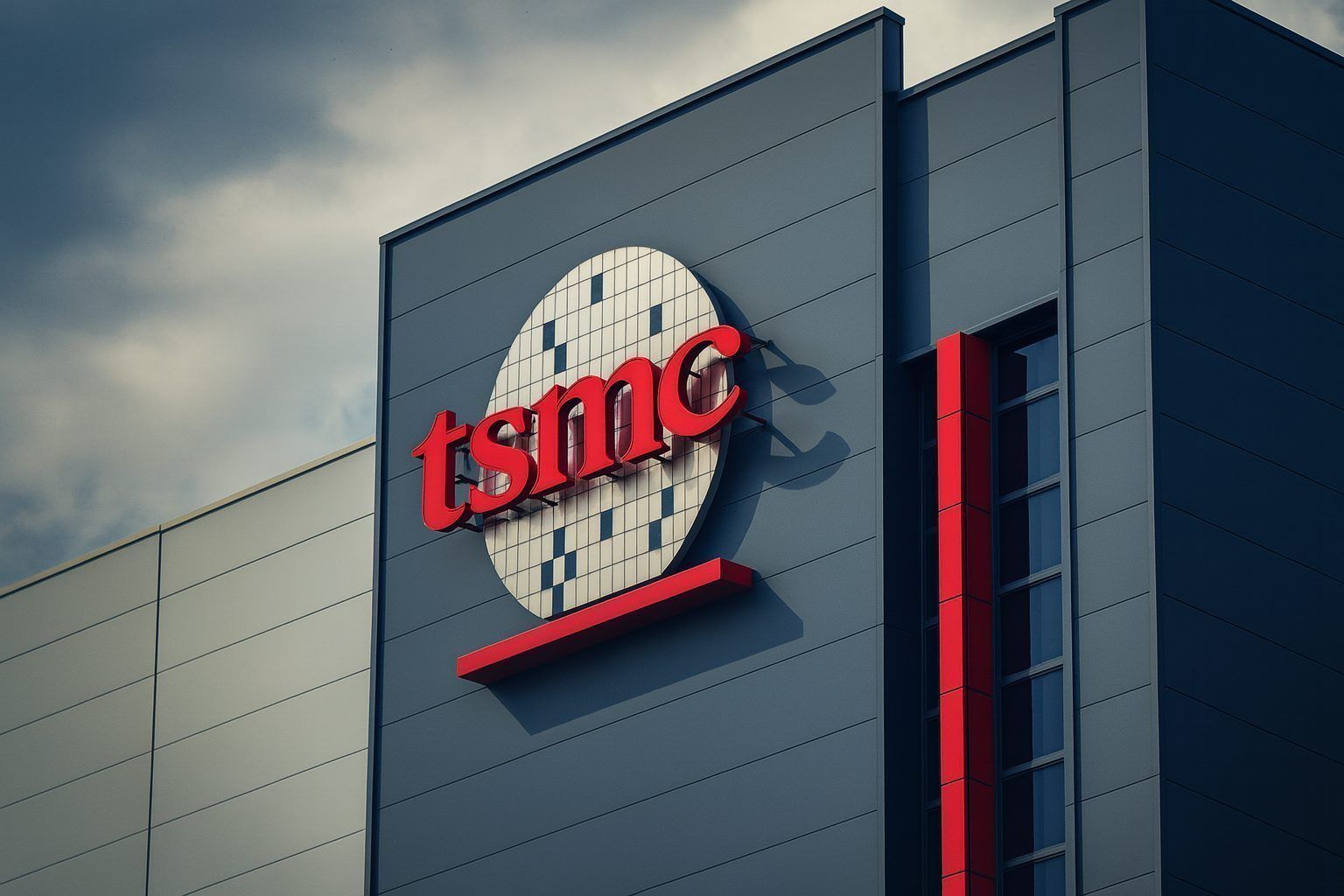
Taiwan Semiconductor Manufacturing Company Limited NYSE:TSM continues to sit at the center of the global AI chip boom, and 8 December 2025 has brought a fresh wave of analyst upgrades, capacity headlines, and institutional positioning that are moving the stock – and shaping expectations for 2026 and beyond.
TSMC stock today: price, performance and valuation snapshot
As of Monday, 8 December 2025, TSMC’s New York–listed ADRs are trading around $295 per share, with intraday quotes near $294.7.
Key metrics from today’s trading and recent filings:
- 12‑month range: roughly $134 to $311 per share.
- Market capitalization: about $1.5 trillion.
- Trailing P/E: ~30x; P/E/G (price/earnings-to-growth) just above 1.0.
- Forward 12‑month P/E: about 24.3, versus 28.5 for the broader Zacks Computer & Technology sector, implying roughly a 15% valuation discount despite TSMC’s leading position.
- Year-to-date performance: the stock is up about 46% in 2025, reflecting the market’s enthusiasm for AI-related earnings growth.
- Dividend profile: the company recently raised its quarterly dividend to about $0.97 per ADR, implying an annualized yield of around 1.3% and a payout ratio near 27%.
In valuation terms, TSMC screens as cheaper than many U.S. peers on forward earnings: Broadcom, AMD and Nvidia all trade at higher multiples than TSM despite relying heavily on TSMC for their most advanced GPUs and accelerators.
Fresh 8 December 2025 analyst calls: price targets march higher
On 8 December 2025, TSMC’s stock is getting a notable boost from a cluster of bullish analyst revisions:
- Bernstein lifted its TSM price target to $330 from $290, reaffirming an Outperform rating and citing aggressive expansion of CoWoS (chip‑on‑wafer‑on‑substrate) advanced packaging capacity.
- Barclays reiterated an Overweight stance and raised its target to $355 from $330, pointing to strong Q3 results and expectations of another robust year in 2026 as AI demand accelerates.
- Bank of America Securities has taken its target from $290 to $330, keeping a Buy rating and highlighting improved pricing power and early contributions from TSMC’s 2 nm node, which the bank expects to account for around 9% of revenue in 2026.
- Morgan Stanley has raised its Taiwan‑listed target to NT$1,588 and now assumes TSMC’s CoWoS capacity can reach around 100,000 wafers per month by 2026, helped by Nvidia’s next‑generation Rubin AI chips and anticipated wafer price increases at 3 nm.
These calls build on a broader consensus shift toward higher numbers:
- An Insider Monkey review notes that as of early December, TSMC is a consensus Buy, with “almost all” covering analysts rating it positively and a 12‑month median target around $355, implying more than 20% upside from recent levels.Insider Monkey
- Zacks’ forecast page shows an average short-term target of roughly $338 based on eight analysts.
- TipRanks data for the past three months shows 15 Buy and 1 Hold rating, 0 Sells, with an average target near $357.
Not all commentary is uniformly exuberant. A new Seeking Alpha article published today downgrades TSMC from “Strong Buy” to “Buy”, arguing that Intel’s foundry revival, backed by U.S. and SoftBank capital, could gradually erode TSMC’s excess demand advantage even if the company’s competitive moat remains wide.Seeking Alpha
Overall, though, the analyst picture on 8 December is unmistakably bullish: higher targets, mostly Buy ratings, and a narrative that TSMC remains indispensable to AI infrastructure.
Earnings recap: AI supercycle shows up in the numbers
TSMC’s latest reported quarter (Q3 2025) provides the fundamental backdrop for today’s optimism.
From the Q3 2025 earnings call and subsequent analyses:
- Revenue: about $33.1 billion, up roughly 41% year-on-year and slightly ahead of guidance.
- Gross margin: approximately 59.5%, near record levels, with operating margin just above 50%.
- Technology mix: 3 nm technology contributed about 23% of wafer revenue; 5 nm about 37%; 7 nm around 14%. Advanced nodes (7 nm and below) accounted for roughly 74% of wafer sales.
- Platform mix: high‑performance computing (HPC) – which includes AI accelerators and data‑center chips – represented about 57% of revenue, smartphones around 30%.
Management’s outlook remains firmly AI‑centric:
- For Q4 2025, TSMC guides revenue to $32.2–$33.4 billion, implying roughly 22% year‑on‑year growth at the midpoint and only a modest sequential dip after a very strong Q3.
- Full‑year 2025 revenue growth is now expected in the “mid‑30%” range in U.S. dollar terms – the second upward revision this year, driven largely by AI chips.investor.tsmc.com+1
- AI‑related revenue tripled in 2024, is expected to double again in 2025, and management sees roughly 40% annual growth from AI over the next five years, according to Zacks commentary on TSMC’s guidance.
To support this, TSMC is committing to extremely high investment:
- 2025 capex is guided to $40–42 billion, up from about $29.8 billion in 2024. Roughly 70% of this is earmarked for advanced process technologies, with 10–20% each for specialty tech and advanced packaging/testing.
For now, the numbers support the AI supercycle thesis: rapid top‑line growth, unusually high margins and a technology mix dominated by cutting‑edge nodes and HPC workloads.
Capacity crunch: AI demand vs. advanced-node and CoWoS bottlenecks
If earnings explain why TSMC’s stock is strong, the capacity story explains why analysts keep lifting price targets.
Advanced-node wafers: “three times short” of AI demand
At the 2025 Semiconductor Industry Association Awards in late November, TSMC chairman and CEO C.C. Wei described the company’s advanced-node capacity (7 nm and below) as “not enough, not enough, still not enough”, estimating that existing output is roughly three times short of what major customers want to buy.Tom’s Hardware
Wei noted:
- Advanced nodes (7 nm, 5 nm, 3 nm and upcoming 2 nm) remain heavily supply‑constrained.
- New fabs in Arizona, Japan and Europe will not add meaningful advanced‑node volume until 2026 or later, leaving the AI supply chain tight through at least next year.
Separate industry reporting goes further, arguing that leading‑edge foundry capacity at 3 nm and 2 nm is effectively “locked up” until the late 2020s for customers that didn’t pre‑book capacity back in 2023–2024.DIGITIMES Asia+1
CoWoS advanced packaging: the real governor on AI GPU output
If advanced wafers are scarce, CoWoS advanced packaging is even scarcer.
Recent coverage highlights several converging data points:
- TSMC’s CoWoS lines – which combine GPU chiplets with stacks of high bandwidth memory (HBM) – are described as “fully booked”, with orders from Nvidia, Google, Amazon and MediaTek overflowing capacity despite aggressive expansions.Benzinga
- TSMC’s own leadership has said CoWoS capacity is “very tight and sold out through 2025 and into 2026”, and Nvidia’s CEO Jensen Huang has publicly acknowledged that packaging bottlenecks will constrain shipments at least into mid‑2026.DIGITIMES Asia+1
- A Morgan Stanley analysis puts TSMC’s CoWoS capacity at about 70,000 wafers per month at end‑2025, rising to 90–95k wpm in 2026 – a 33% increase, yet still insufficient relative to AI demand.
- Another industry estimate suggests TSMC plans to double CoWoS output to around 660,000 units in 2025, largely to serve Nvidia and other hyperscalers.
Analysts and supply‑chain specialists increasingly describe CoWoS as the “single most critical governor” on AI GPU availability: even perfect 3 nm dies and ample HBM are useless without a packaging slot.DIGITIMES Asia
New fabs, new partners: TSMC’s expansion blueprint
To address these bottlenecks, TSMC is expanding both front‑end fabs and back‑end packaging:
- In Taiwan, the company is reportedly planning investments in up to 12 new advanced process and packaging fabs, with capital expenditure in Taiwan alone projected at NT$450–500 billion (~$14–16 billion) next year.
- TSMC is building a broader advanced packaging ecosystem. It has signed a memorandum of understanding with Amkor and is expected to shift some packaging work from its Phoenix wafer fab to Amkor’s Arizona facilities, compressing build‑out timelines from several years to as little as nine months in some cases.
- Industry reports suggest TSMC will boost CoWoS capacity by roughly 60% in 2025 and 50% in 2026, yet every new module is effectively pre‑sold to big names like AMD, Broadcom, Google, Amazon and Meta.
At the same time, both Taiwanese and Korean sources warn that three “physical choke points” – leading‑edge foundry, HBM, and advanced packaging – are likely to stay tight through at least 2027, even after hundreds of billions of dollars in announced capex.DIGITIMES Asia+1
For investors, this is the core of the bullish TSMC thesis: persistent structural shortages that give the company pricing power and long‑term volume visibility.
Institutional positioning: Fairfax trims its TSMC stake
On the institutional side, 8 December 2025 also brings a notable disclosure:
- Fairfax Financial Holdings has reduced its TSMC position by about 33.9% in Q2, selling roughly 48,000 shares and ending the period with 93,700 ADRs valued around $21.2 million. TSMC still represents about 1.1% of Fairfax’s portfolio and remains its 12th‑largest position.
- MarketBeat data in the same report notes that around 16.5% of TSMC’s shares are held by institutional investors.
Fairfax’s trim looks more like portfolio rebalancing after strong gains than a wholesale repudiation of the AI thesis, but it shows that some long‑term holders are locking in profits after TSMC’s big 2025 run.
Valuation and forecast: what the latest targets imply
Putting the various pieces together, the 8 December 2025 forecast picture looks like this:
- Short‑term and 12‑month targets cluster roughly in the $330–$360 range, with:
- Bernstein at $330,
- Barclays at $355,
- Bank of America also at $330,
- Zacks’ average near $338,
- TipRanks’ three‑month average around $357.
- Some individual analysts go higher: an earlier Bank of America note cited by Insider Monkey still points to a potential target of $390 on the strength of 2 nm and advanced packaging.
- Longer‑term projections are naturally more speculative. One recent price‑prediction piece suggests TSMC could reach about $647 by 2030 if the AI infrastructure cycle plays out as expected, though that assumes several years of sustained growth and relatively stable geopolitics.
At today’s price near $295, the implied 12‑month upside from mainstream targets is roughly 12–20%, plus a modest dividend yield.
Key risks the market is weighing
Despite the overwhelmingly positive tone on 8 December, recent analysis also highlights risks that could cap near‑term upside or inject volatility:
- Rising competition from Intel and Samsung: New U.S. and Japanese fabs, together with CHIPS Act incentives and high‑profile investments, are gradually giving hyperscalers a non‑TSMC alternative at advanced nodes. The Seeking Alpha downgrade today explicitly cites Intel’s “second life” as a reason to move from Strong Buy to Buy on TSMC.Seeking Alpha
- Macro and AI-cycle risk: Several reports warn that after the current wave of data‑center build‑out, there could be a digestion phase in 2026 where AI capex growth slows, even if the long‑term trend remains positive.
- Geopolitics and concentration risk: Advanced chip production remains highly concentrated in Taiwan at a time of elevated cross‑strait tensions and global supply‑chain re‑shoring efforts. Multiple industry pieces frame this as a structural vulnerability for both TSMC and its customers.
- Legal and IP challenges: TSMC has filed a high‑profile lawsuit against former senior vice president Wei‑Jen Lo, now at Intel, alleging a high risk of trade‑secret leakage – a reminder that core process know‑how is both crown jewel and flashpoint.
These do not overturn the bullish case, but they help explain why some analysts are raising targets while simultaneously becoming more nuanced in their ratings and risk language.
Bottom line: what 8 December 2025 means for TSMC stock
On 8 December 2025, the story around Taiwan Semiconductor Manufacturing stock is remarkably consistent across news outlets, forecasts and research notes:
- Fundamentals: rapid revenue and earnings growth, high margins and a technology mix dominated by 3 nm and 5 nm AI and HPC chips.
- Capacity: advanced-node wafers and CoWoS advanced packaging are structurally scarce, with credible evidence that demand will exceed supply well into 2026–2027.
- Sentiment: analysts are largely positive, with rising price targets and a consensus Buy stance, even as some begin to flag Intel’s comeback and cycle risk.
- Valuation: TSMC trades at a premium to the overall market but a discount to closest AI‑hardware peers given its pivotal role in the supply chain.
For readers and investors tracking TSMC, today’s developments reinforce a simple but powerful theme: as long as AI workloads keep growing faster than advanced-node and packaging capacity, TSMC will remain one of the most important bottlenecks – and profit centers – in global technology.