
Updated: December 9, 2025
Snapshot: BETA stock today
Beta Technologies, Inc. NYSE:BETA, the electric aircraft maker often framed as a “young Tesla of the skies,” is trading around $30.46 per share in midday U.S. trading on December 9, 2025, up about 0.5% on the day. That gives the company a market capitalization of roughly $7.0 billion.StockAnalysis
The move comes after a sharp jump on Monday, when BETA stock climbed about 8.8%, closing at $30.90 after trading as high as $30.94.MarketBeat The rally follows a cluster of bullish catalysts: the company’s first quarterly earnings as a public company, a 10-year motor-supply deal worth up to $1 billion with Eve Air Mobility, and a wave of upbeat analyst coverage.
Company in focus: What Beta Technologies actually does
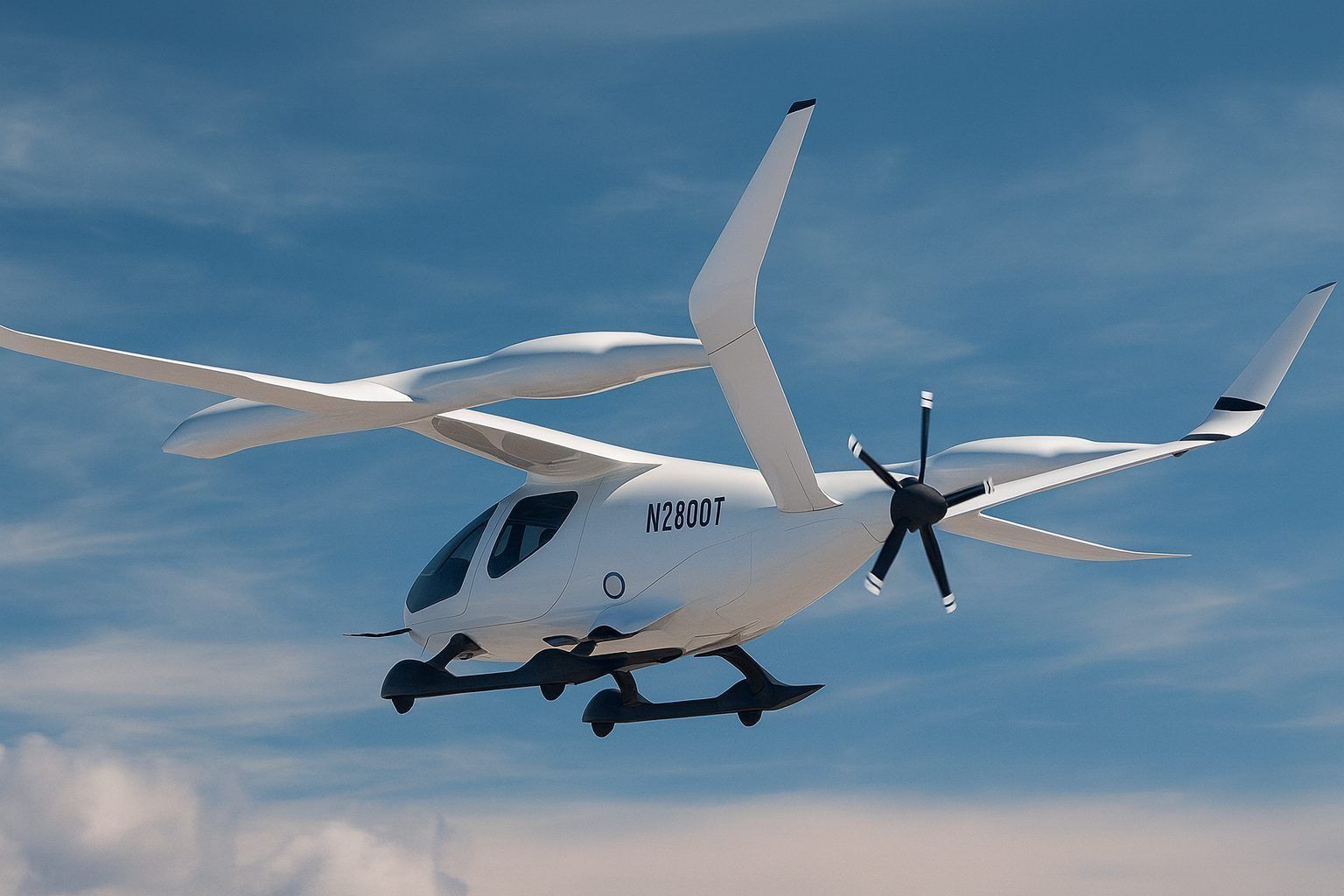
Beta Technologies is a Vermont-based aerospace manufacturer building electric aircraft and charging infrastructure, targeting cargo, medical, defense, and eventually passenger aviation. Its main platforms are:
- ALIA-CTOL (CX300): a piloted, fixed-wing electric aircraft for regional cargo;
- ALIA VTOL (A250): an electric vertical take-off and landing (eVTOL) aircraft aimed at logistics, medevac, and air taxi services;
- Defense VTOL variants for military missions;
- A charging network and “Charge Cube” systems that can serve both aircraft and ground EVs.Wikipedia+1
Beta went public via a traditional IPO on the New York Stock Exchange in early November 2025, raising just over $1 billion at an IPO price of $34 per share and an initial valuation around $7.4 billion.
Latest price action: From IPO to early-December volatility
Since listing:
- IPO price: $34
- Recent range: roughly $22.40–$39.50 over its short trading history so far;
- Current price (Dec 9, 2025): ~$30.46, about 10% below the IPO price but well off recent lows.
According to MarketBeat, the stock’s latest surge on Monday came on above-average interest despite trading volume being about half its recent daily average, underscoring how sensitive BETA remains to news headlines and analyst commentary at this early stage of its public life.
Q3 2025 earnings: Strong revenue growth, heavy losses
Q3 2025 was Beta’s first earnings release as a public company, and the headline was classic “high-growth hardware startup”:
- Revenue: jumped to about $8.9 million in Q3 2025, reflecting growing development contracts and early commercial activity.
- Net loss: widened sharply to roughly $452 million, compared with about $82 million a year earlier, as the company ramped R&D, manufacturing build-out, and certification efforts.
- Trailing twelve-month revenue: around $28.9 million, versus a TTM net loss of about $722 million.
Management highlighted:
- A multi-billion-dollar order and LOI backlog across cargo, defense, and future passenger operators (including UPS, United Therapeutics and others),
- Progress toward certification of the CX300 conventional-takeoff aircraft,
- And acceleration of investments in autonomous capabilities and global charging infrastructure.
The combination of tiny revenue, huge losses, and aggressive capex puts Beta squarely in the “venture-style public company” bucket: investors are betting on future dominance in a new market, not near-term profits.
The Eve Air Mobility deal: A $1 billion headline catalyst
The standout news of the past week was Beta’s deal with Eve Air Mobility (NYSE: EVEX):
- Eve selected BETA’s electric pusher motors for its conforming prototypes and production eVTOL aircraft.
- The agreement is structured as a 10-year supply partnership, representing a potential revenue opportunity of up to $1 billion for Beta.
- Eve has a backlog of roughly 2,800 eVTOL orders, so being a core supplier embeds Beta deep into another major player’s ecosystem.
Following the announcement, BETA stock jumped about 9–10% in a single session, reflecting investor enthusiasm for long-duration, high-visibility revenue streams tied to the broader eVTOL ecosystem.
Other recent strategic developments
Over the past few weeks, Beta has stacked up additional news that feeds the “platform” narrative:
- Autonomous flight development – Beta is partnering with Near Earth Autonomy to build uncrewed aircraft for military applications, with flight tests expected to begin in the first half of 2026.
- Global charging network expansion – Abu Dhabi Airports selected Beta’s Charge Cube infrastructure to support the emirate’s future advanced air mobility network, highlighting the company’s ambition to be the “filling station” as well as the aircraft provider.StockAnalysis
These deals reinforce Beta’s strategy of vertical integration (aircraft + propulsion + chargers + autonomy), which some analysts compare to Tesla’s early approach in EVs.
How Wall Street sees BETA stock right now
Fresh from IPO and first earnings, BETA is heavily in analyst-initiation mode. The consensus picture as of December 9, 2025 looks like this:
- Overall rating:“Strong Buy” from around 7–8 covering analysts.StockAnalysis+1
- Average 12-month price target: roughly $38–39 per share, implying ~28–33% upside from the current price.
Recent notes include:
- Goldman Sachs: Buy, $47 price target – one of the most bullish calls, framing Beta as a top pick in eVTOL and regional electric aviation.
- Citigroup: Buy, $41 target.
- BTIG Research:Strong Buy rating following initiation, reinforcing the positive view.
- Needham: Buy with a $34 target, recently reiterated after Q3 results and the Eve deal.
- Jefferies: a more cautious Hold with a $30 target, essentially saying “the stock already prices in a lot of good news.”Investing.com
FactSet and MarketScreener data show an average target around $37.8, with individual targets clustered between $30 and $47.
The common thread: analysts like the tech, backlog, and early-mover advantage, but acknowledge execution, certification, and profitability risk.
Quant and algorithmic price forecasts
Alongside human analysts, a growing cottage industry of algorithmic models is spitting out Beta price predictions. These should be treated as models, not destiny, but they do give a sense of market sentiment:
- CoinCodex:
- Projects BETA around $30.9–31.3 in the near term (basically flat to modestly higher from current levels).
- Long-term (2030) band of roughly $26.9–29.8, implying modest real returns if held purely on price appreciation.
- Hexn:
- Recent forecasts lean slightly bullish short-term, with only marginal expected upside in the very near future and a largely neutral sentiment rating.
These automated forecasts are mostly momentum- and volatility-driven. They don’t “understand” things like FAA certification, customer adoption, or political/regulatory risk, which are absolutely central for a company like Beta — so they’re best used as a sentiment thermometer, not a crystal ball.
Fundamental snapshot: high risk, high storytelling
From a fundamentals perspective, Beta is still early-stage:
- Revenue (TTM): about $28.9 million
- Net loss (TTM): around $722 million
- No dividend, no meaningful earnings-based valuation metrics yet (PE is not meaningful).
This is a classic “story stock” in a new industry:
- The bull case:
- Electric regional aviation and eVTOL could open up a multi-tens-of-billions-of-dollars market over the next decade.
- Beta is already flying aircraft, winning government and corporate contracts, and building an ecosystem (aircraft + motors + chargers + autonomy).
- Large deals like the Eve motor contract and Abu Dhabi infrastructure give it institutional validation.
- The bear case:
- Enormous cash burn with no clear path to profitability before 2030, according to some early coverage.
- Regulatory timelines (FAA certification) can slip, and hardware programs routinely run over budget.
- Intense competition from other eVTOL and electric aircraft players such as Joby Aviation and Archer Aviation, which already trade publicly and fight for mindshare and contracts.
For now, the market is pricing in a high-risk, high-optionality profile: if Beta becomes a dominant platform in electric aviation, today’s valuation might look cheap; if the tech, economics or regulations don’t cooperate, equity holders feel the pain first.
Key things investors are watching after December 9, 2025
Based on current coverage and guidance, here’s what’s likely to move BETA stock over the next 12–24 months:
- Certification milestones
- Any updates on FAA certification of the CX300 (and later VTOL variants) will be critical; certification slippage is one of the biggest risks.
- Conversion of backlog to revenue
- Investors will track how quickly Beta turns MOUs and LOIs for cargo, defense, and medical operators into firm orders and deliveries.
- Execution of the Eve partnership
- Concrete production schedules, volume expectations, and any expansion beyond the initial $1B framework will matter for long-term revenue visibility.
- Cash burn and capital structure
- With heavy losses and big capex, the company may need additional capital in the coming years. Dilution risk is real for early shareholders.
- Competitive and regulatory landscape
- Policy support for low-emissions aviation, infrastructure funding, and how regulators treat autonomous operations could all reshape the playing field.
Bottom line
On December 9, 2025, BETA Technologies stock sits around $30–31, slightly below its IPO price but buoyed by a powerful combination of:
- A $1 billion, 10-year motor-supply deal with Eve Air Mobility,
- Strong Q3 revenue growth (from a tiny base),
- Aggressive expansion into autonomy and charging infrastructure, and
- A chorus of “Buy” and “Strong Buy” ratings with price targets clustered in the high-30s to mid-40s.Stock Titan+4StockAnalysis+4MarketScreener+4
For now, BETA is a classic speculative growth story: electrified aviation plus a vertically integrated hardware-and-infrastructure platform. It sits at the intersection of climate tech, aerospace, and AI-driven autonomy — and the stock will likely remain volatile as the market digests each new piece of news.