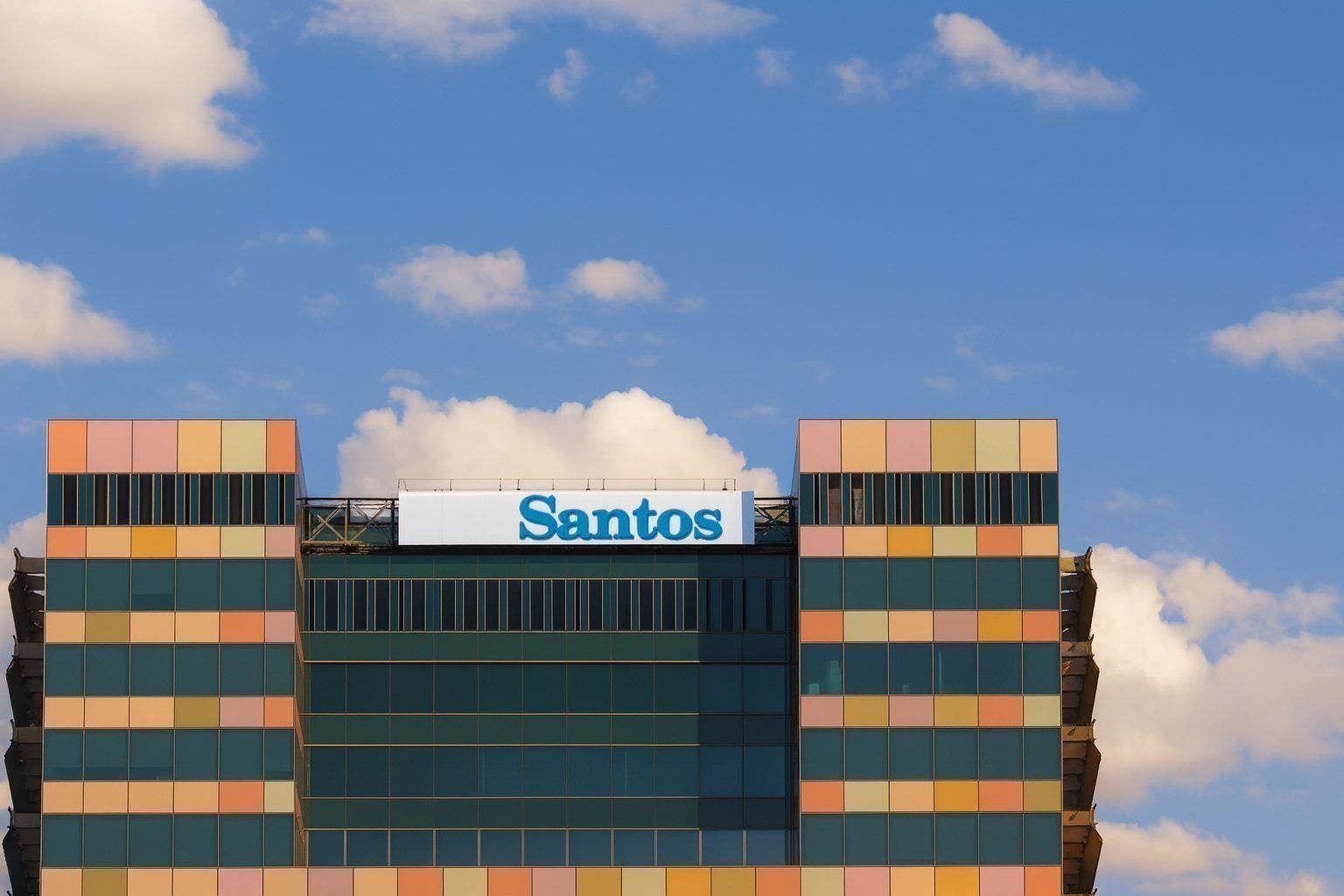
After a failed $18.7 billion takeover and a year of production hiccups, Santos shares are back trading on fundamentals. Here’s what the latest news, forecasts and analyst commentary as of 10 December 2025 mean for investors.
Where the Santos share price stands today
As of 10 December 2025, Santos Limited ASX:STO is trading around A$6.41 per share, with an intraday range of roughly A$6.39–A$6.47 and a 52‑week trading band between A$5.20 and A$8.06.
Over the past twelve months, Santos shares are down about 2–3%, and they’ve slipped modestly year to date, with Rask Media estimating a decline of around 3–4% in 2025 so far.StockAnalysis+1 That leaves the company with a market capitalisation in the region of A$20–21 billion.
On key valuation metrics:
- Price/earnings ratio: about 13.4x trailing earnings.
- Dividend profile: trailing 12‑month dividends of roughly 36.6 cents per share, implying a cash yield in the mid‑single digits at current prices.
- Book value: about A$7.33 per share, putting Santos on a price‑to‑book multiple of ~0.87x, a modest discount to its stated equity base.
In sector terms, Market Index ranks Santos 3rd out of 177 energy stocks on the ASX and 29th out of more than 2,300 stocks overall, underlining its importance in the Australian market.
From premium bid to “orphaned” value: the ADNOC takeover that failed
The defining corporate story for Santos in 2025 has been the rise and fall of a massive takeover bid from a consortium led by Abu Dhabi National Oil Company (ADNOC).
- In June 2025, the ADNOC‑backed XRG consortium lobbed a US$5.76 per share all‑cash proposal for Santos, valuing the company at around US$18.7 billion and roughly A$36.4 billion including debt — a record‑sized all‑cash deal for Australia.
- Santos granted exclusivity and extended it at least once, even as its first‑half profit fell 22%, though still ahead of analyst expectations.
By mid‑August, Santos was already warning that the consortium would miss the agreed deadline to finalise the offer, prompting doubts about whether the deal would close.
Then, in mid‑September, the whole proposal collapsed. ADNOC’s XRG vehicle pulled the bid, citing a mix of commercial and risk factors. Santos shares plunged around 13–14% in one session, erasing most of the takeover premium and taking the stock back towards the mid‑A$6 range.
Reporting from Reuters and the Financial Times highlighted several issues weighing on the deal:
- Concerns in Canberra around national interest and domestic gas supply.
- Discovery of a methane leak during due diligence and potential additional tax liabilities.
- Political and regulatory uncertainty around foreign state‑owned buyers of critical energy infrastructure.
This was the third failed major approach for Santos in roughly a decade, after Harbour Energy’s 2018 bid and shelved merger talks with Woodside Energy.Reuters+1 It also followed the formal end of Woodside–Santos merger discussions announced back in early 2024, and Woodside’s CEO reiterating in August 2025 that a tie‑up is off the table.
Analyst reaction has been mixed:
- Jarden downgraded Santos to Underweight, cutting its 12‑month price target to A$7.05 and arguing that repeated deal collapses have undermined confidence in management’s M&A strategy.
- A FNArena survey of broker views, led by Citi, noted investors increasingly assume little or no takeover premium for Santos, and some would now prefer the company to split its Australian and international assets to unlock value.
For shareholders, the key consequence is that Santos is once again valued as a stand‑alone business, with the share price increasingly driven by its project portfolio and cash flows rather than bid speculation.
Barossa LNG: milestone first gas, but not without headaches
Operationally, 2025 has revolved around Barossa LNG, Santos’ largest growth project and a major driver of its medium‑term production and cash flow story.
Project progress
- The Barossa project, located offshore Northern Australia, is designed to supply feed gas to the existing Darwin LNG facility, adding about 3.7 million tonnes per annum (mtpa) of LNG at full run‑rate.
- That volume implies an ~18% uplift in Santos group production to around 115 million barrels of oil equivalent (mmboe) once fully online, according to project documentation and industry analysis.
- A Northern Territory government case study in November said Barossa was roughly 91% complete and on track to deliver first gas to Darwin LNG in Q3 2025, creating hundreds of long‑term operations roles.
In September 2025, Santos announced that the BW Opal floating production, storage and offloading unit (FPSO) had achieved “ready for start‑up” status and then received first gas from the subsea wells — a landmark step in commissioning the offshore facilities.santos.com+1
Technical issues and guidance cuts
The path has not been perfectly smooth. In October, Santos disclosed that:
- A software issue in the FPSO safety system forced a roughly two‑week unplanned shutdown at Barossa in September.
- Severe flooding in the Cooper Basin also delayed restoration of around 155 wells.
As a result, Santos:
- Narrowed its 2025 production guidance for the second time this year, to 89–91 mmboe, versus an earlier 90–95 mmboe range and slightly below consensus expectations.
- Trimmed its sales volume forecast to 93–95 mmboe and reported an 11% drop in third‑quarter sales revenue to US$1.13 billion.
Nonetheless, management continues to state that Barossa remains on track to ship its first LNG cargo in the December quarter of 2025, keeping the project broadly on schedule despite these hiccups.
For investors, Barossa is a double‑edged sword: a powerful production and cash‑flow growth engine, but also a source of execution and technical risk that can impact guidance and sentiment.
Governance questions and ESG headwinds
Beyond project delivery, Santos is wrestling with governance and environmental, social and governance (ESG) overhangs.
CFO dismissal and leadership concerns
Citi’s investor meetings, summarised by FNArena, highlighted unease around internal governance after:
- The CFO was abruptly dismissed by the chair, reportedly following complaints about the CEO’s leadership style and aspects of Santos’ corporate culture.
Investors worry that a potential change at the top could disrupt a recently refreshed capital management framework, including dividends and any prospective buybacks, just as Santos is moving into a more shareholder‑return‑focused phase.
Narrabri and climate litigation
On the ESG front, Santos continues to face:
- Ongoing legal challenges around its Narrabri gas project in New South Wales, where an Indigenous group won an appeal in 2024 that raised the risk of further delays.
- A prominent greenwashing case in which an activist shareholder group alleges Santos misled investors over the climate credentials of its gas and carbon capture plans.
The company has simultaneously promoted an ambition to build a carbon capture and storage (CCS) business capable of storing up to 14 million tonnes of CO₂ per year by 2040, but this strategy is being tested in court and remains under close scrutiny.
Together, these issues contribute to a higher ESG‑related risk premium in Santos’ valuation compared with some global peers, even as Australian policy still regards gas as a transition fuel.
Short‑term trading signals: technical view on STO
From a purely chart‑driven standpoint, technical research site StockInvest.us currently classifies Santos as a “hold/accumulate” candidate:
- The stock closed on 9 December at A$6.41, down 1.38% on the day and logging three consecutive daily declines.
- Over the last 10 sessions, the share price has risen on five days but remains slightly lower (~1.2%) over the period.
- Trading volume fell alongside price on the most recent session, which the service notes as a relatively benign sign in terms of selling pressure.
Based on its statistical models, StockInvest expects:
- A potential ~9.9% decline over the next three months, with a 90% confidence range that places Santos between A$5.16 and A$6.31 at the end of that window, assuming the current trend persists.
- Strong support around A$6.37 based on accumulated volume, with near‑term resistance around A$6.74.
The site therefore leans cautious on the short‑term trajectory but does not recommend aggressive selling, instead suggesting existing holders wait for clearer signals.
Fundamental valuations: brokers still see upside
While the technical models paint a mildly bearish near‑term picture, fundamental analysts are generally more constructive on the 12–24 month horizon.
Broker consensus
According to FNArena’s collation of broker research as of 8 December 2025:
- Santos is covered by six major brokers.
- The stock attracts four Buy ratings and two Hold/Neutral ratings.
- The consensus target price is A$7.53, implying around 15–16% upside from a recent closing price of A$6.52.
- Individual targets range from A$6.76 at the low end to A$8.00–8.10 at the top of the range.
Consensus forecasts also imply:
- A modest trimming of dividends, from an estimated US$23.7 cents per share in 2025 to US$22.5 cents in 2026, but no major cut akin to what some peers face. That equates to a forward dividend yield still around 5% in local currency terms.
Macquarie and JPMorgan: high‑conviction bulls
Several big global houses are particularly positive:
- Macquarie’s latest Australian energy sector report, summarised in The Motley Fool Australia, assigns Santos an A$8.00 price target, representing about 23–24% upside from recent levels around A$6.48.
- JPMorgan resumed coverage in October with an Overweight rating and A$7.90 target price for December 2026, describing Santos as its top pick in the Australian oil and gas sector, and seeing roughly 22% upside from then‑current prices.
Both banks emphasise Santos’ pipeline of growth projects (Barossa, Pikka and others) and strong free cash flow, particularly once the current capex surge rolls off.
Morningstar view: undervalued gas play
Morningstar’s Australia team has published multiple notes in the second half of 2025, with titles such as:
- “New production imminent for undervalued ASX gas play” (18 October 2025), highlighting commissioning progress at an LNG project.
- “What now for Santos after takeover offer collapses?” (19 September 2025).
- “Cheap ASX energy play boasts strong cash flows and balance sheet” (25 August 2025).Morningstar
Those headlines, combined with Morningstar’s descriptions of markets being “overly bearish” on the company’s outlook, reinforce the idea that valuation screens as attractive on long‑term fundamentals, despite near‑term volatility.Morningstar
Sector context: LNG outlook and competition with Woodside
Santos does not operate in a vacuum. Its fortunes are tied to global LNG pricing and competition with larger domestic rival Woodside Energy Group.
Citi’s global commodities team, cited by FNArena, expects:
- LNG prices to bottom around Q1 2026, after which demand growth and supply discipline could improve pricing power.
- A looming LNG glut, with more than 200 mtpa of new capacity scheduled to come online worldwide over the next five years, over half of it from US projects. That raises the risk that LNG contract terms (“slopes” to oil benchmarks) come under pressure, especially from low‑cost producers such as Qatar.FN Arena
Investors polled by Citi were notably sceptical about Santos’ long‑dated growth options — including Browse, Sunrise, Papua LNG and Narrabri — given high upfront capex and regulatory complexity. Many do not expect swift final investment decisions on some of these projects.
At the same time, Santos’ share price remains closely linked to global oil and gas prices. Recent data show Santos sliding alongside Woodside and Beach Energy as oil prices soften, underlining the stock’s cyclical exposure.
Santos share price outlook: key drivers into 2026
Pulling the strands together, the investment narrative for Santos Limited as of 10 December 2025 hinges on a handful of critical drivers:
- Execution at Barossa and Pikka
Successful ramp‑up of Barossa LNG — and later the Pikka project in Alaska — is essential to delivering the production growth and free cash flow underpinning broker price targets. More commissioning glitches or delays would likely weigh heavily on the share price. - Capital management and governance stability
The market is watching closely to see whether Santos can sustain a 5%-plus dividend yield, introduce buybacks, and keep its capital discipline intact in the wake of CFO turnover and post‑bid strategy debates. - Strategic direction after the ADNOC failure
With three major deals now dead, investors are asking whether Santos will:- Remain a diversified Asia‑Pacific gas producer, or
- Move towards simplifying or splitting the portfolio to surface value in high‑quality assets.
- ESG and regulatory outcomes
The results of the Narrabri litigation and ongoing greenwashing case could influence not just project timelines but also access to capital and cost of equity, especially for European and ESG‑sensitive funds. - Commodity cycle turning point
If Citi’s thesis of an LNG price trough in early 2026 proves correct, Santos could benefit from both better realised prices and a re‑rating as investors look beyond the current supply bulge.
Bottom line: a value story with real execution risk
As of 10 December 2025, Santos Limited sits at an interesting crossroads:
- Valuation: The stock trades below book value and at a mid‑teens earnings multiple, with a trailing dividend yield around the mid‑single digits.
- Broker stance: Most fundamental analysts see double‑digit upside over 12–24 months, with targets clustering between A$7.50 and A$8.00 and several houses labelling Santos an undervalued energy play.
- Technical picture: Short‑term trading models warn of a potential drift lower into the high‑A$5 to low‑A$6 range, unless the trend meaningfully improves.
For investors, the stock is neither a simple recovery bet nor a write‑off. It is a classic execution‑sensitive value situation: upside is tied to the company’s ability to bring Barossa and other projects on line reliably, navigate ESG and regulatory challenges, and prove that its refreshed capital management and governance can withstand post‑takeover scrutiny.