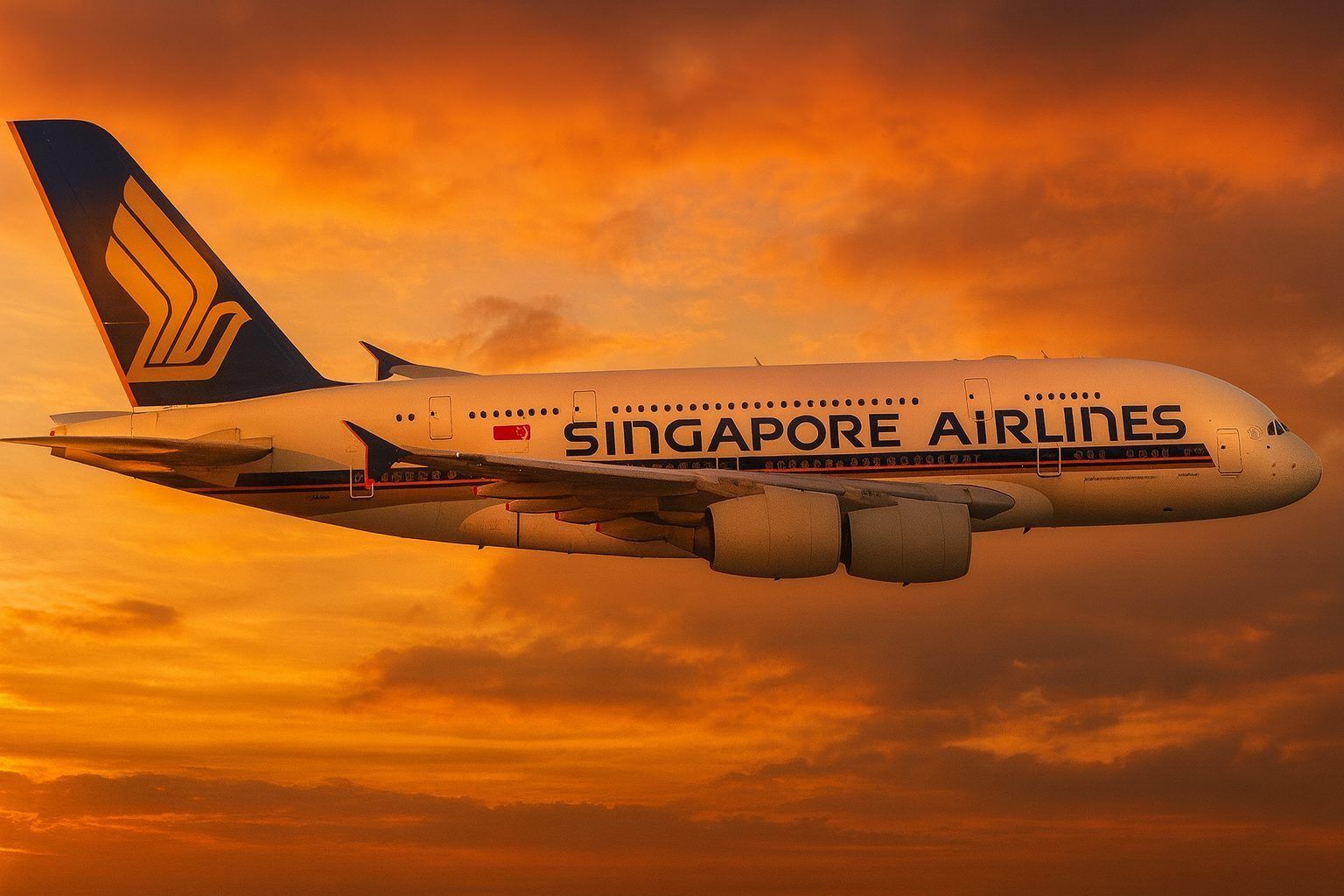

Singapore Airlines Ltd (SIA, SGX:C6L) is in a paradoxical spot: planes are full, balance sheet is strong, shareholders are being promised years of special dividends – and yet net profit has fallen off a cliff and analysts see limited upside for the share price.
This article pulls together the latest numbers, news and forecasts on Singapore Airlines stock as of 10 December 2025, for readers following the counter on Google News and Discover.
Singapore Airlines share price today
As of 10 December 2025, Singapore Airlines shares are trading around S$6.24 on the Singapore Exchange, with an intraday range of about S$6.23–S$6.29 and a 52‑week range of roughly S$5.90–S$7.63.
That puts the stock around the middle of its one‑year trading band, despite a series of negative earnings headlines.
For international investors, the over‑the‑counter Singapore Airlines ADR (SINGY) last changed hands near US$9.65 on 9 December 2025 after several down days, according to technical site StockInvest.
Short‑term technical indicators from StockInvest have been cautious, with the counter recently flagged as a “strong sell” candidate based on a break below a trading range and weaker moving averages.StockInvest+1
Record revenue, but net profit collapses
SIA’s latest half‑year numbers are a study in contrasts:
- Revenue at a record high
- Operating profit slightly higher year‑on‑year
- Net profit down nearly 68%
In its results for the first half of FY2025/26 (six months to 30 September 2025), the group reported:
- Record first‑half revenue of about S$9.7 billion, up roughly 1.9% year‑on‑year
- Operating profit of about S$803 million, up 0.9% from the previous year
- Net profit of around S$238–239 million, a drop of about 67.8–67.9% from a year earlierSingapore Airlines+2The Business Times+2
The second quarter was particularly painful:
- Q2 FY2025/26 net profit plunged 82.1% year‑on‑year to S$52 million, down from S$290 million in the same quarter last year, even though operating profit jumped 22.5% to S$398 million on stronger passenger traffic.
What drove the earnings slump?
Across SIA’s own filings and press coverage, three main factors are highlighted:Singapore Airlines+2Nasdaq+2
- Air India losses
- SIA began equity‑accounting its 25.1% stake in Air India from December 2024, after Vistara was integrated into the Indian flag carrier.
- The share of results from associated companies swung sharply lower; SIA’s management and local media point to losses at Air India as a major drag, shaving hundreds of millions of dollars off profit versus the prior year when the investment was not yet equity‑accounted.
- Lower interest income
- Interest income fell by more than S$100 million year‑on‑year in the first half, as cash balances came down after earlier large dividend payouts and debt reduction, and as interest rates eased.
- Fuel‑related effects and competitive pressure
- Jet fuel prices were lower, but SIA faced higher volumes and an adverse swing in fuel‑hedging, turning last year’s gain into a loss.
- Passenger yields – the revenue earned per passenger kilometre – fell by close to 3% as competition intensified, particularly on key regional and long‑haul routes.
The result is that the headline bottom line has shrunk dramatically, even though the underlying passenger business looks robust.
Operational performance: demand stays strong, planes stay full
Beneath the profit volatility, SIA’s core network continues to perform strongly.
First‑half FY2025/26
From the 1H FY2025/26 investor presentation and results release:Singapore Airlines+1
- Group passenger traffic grew about 4.6% year‑on‑year, outpacing a roughly 3% increase in capacity.
- The group passenger load factor – how full the planes are – rose to about 87.7%, up 1.3 percentage points from a year earlier.
- SIA and Scoot carried around 20.8 million passengers in the half, about 8% more than the previous year.
In other words, demand is not the problem: aircraft are flying fuller, and overall capacity is still expanding modestly.
October 2025 traffic update
Traffic statistics into the Northern winter season reinforce this picture.
For October 2025, SIA Group:
- Saw passenger traffic up about 5.3% year‑on‑year, versus capacity growth of roughly 3.7%
- Achieved a group load factor of 87.3%, with SIA’s mainline operations at around 86.8% and low‑cost arm Scoot close to 89%
- Carried around 3.6 million passengers, up more than 8% from October 2024Smartkarma+2Singapore Airlines+2
On the flip side, the cargo business is softer: cargo load factor fell to the mid‑50s percentage range with lower loads and weaker yields, reflecting a more difficult global freight backdrop.
Network and fleet
As of 30 September 2025, the SIA Group:
- Served 129 destinations in 37 countries and territories
- Operated more than 200 passenger and freighter aircraft, with an average age under eight years
- Had a substantial order book of next‑generation aircraft, including Airbus A350 freighters, Boeing 777‑9s and additional 737‑8 and A320/A321neo jetsSingapore Airlines+1
Both SIA and Scoot plan to increase frequencies to destinations such as Bali, Bangkok, Jakarta and Tokyo, while adding new points like Nha Trang, Labuan Bajo, Okinawa and Medan between late 2025 and early 2026.
Operationally, then, SIA remains a high‑load‑factor, premium‑positioned carrier with a young fleet and expanding network – which makes the profit slump all the more striking.
Special dividend package and dividend yield
Despite the hit to earnings, SIA has moved to step up cash returns to shareholders.
Ordinary and special dividends for 1H FY2025/26
For the half‑year to 30 September 2025, the board declared:Singapore Airlines+2Nasdaq+2
- Interim dividend: 5 cents per share
- Interim special dividend: 3 cents per share
Both will be paid on 23 December 2025, with an ex‑dividend date of 5 December 2025 and record date of 8 December 2025.
That brings the total first‑half payout to 8 cents per share.
Multi‑year special dividend plan
Alongside the results, SIA unveiled a special dividend package of 10 cents per share annually over three financial years (FY2025/26–FY2027/28), amounting to about S$0.9 billion in total capital returned to shareholders.
Key details from SIA’s slides and subsequent media reports:Singapore Airlines+2The Straits Times+2
- The 3‑cent interim special dividend in December 2025 is the first tranche of this package.
- A second tranche of 7 cents per share for FY2025/26 is planned, subject to shareholder approval at the 2026 AGM.
- Barring unforeseen circumstances, SIA expects to pay 10 cents per share in special dividends in each of FY2026/27 and FY2027/28, again subject to approvals.
This special payout is on top of ordinary dividends and reflects what management describes as the group’s strong financial position after the post‑pandemic recovery and portfolio reshaping.
Trailing dividend yield
Data providers estimate that SIA paid roughly S$0.35–S$0.40 per share in dividends over the last 12 months. At share prices around S$6.24–S$6.32, this implies a trailing dividend yield of roughly 5.5–6.5%.
On a pure income basis, Singapore Airlines is currently one of the higher‑yielding blue‑chip names on the Straits Times Index, albeit with the usual caveat that dividend policies remain at the discretion of the board and can change.
Balance sheet and financial strength
The generous cash returns are underpinned by a still‑solid balance sheet.
From the half‑year presentation:Singapore Airlines+2Singapore Airlines+2
- Shareholders’ equity stands at about S$15.5 billion.
- The debt‑to‑equity ratio has improved to around 0.70x, down from approximately 0.82x as SIA paid down debt.
- The group held around S$6.4 billion in cash and bank balances, plus roughly S$2.1 billion in longer‑term deposits and S$3.3 billion in undrawn committed credit lines as at 30 September 2025.
- Net asset value is around S$4.97 per share, implying a price‑to‑book ratio of roughly 1.2–1.3x at current prices.
Taken together, this suggests no immediate stress on liquidity or solvency, even after ordinary and special dividends, which helps explain the board’s confidence in committing to a multi‑year capital return plan.
Analyst ratings, price targets and forecasts
Across broker research and data platforms, the tone on Singapore Airlines is cautious rather than outright bearish.
Street price targets
Different aggregators give slightly different numbers, but the message is broadly consistent: consensus 12‑month targets sit near or slightly below the current share price.
- GrowthInvesting.net (summarising 14 analysts) shows an average target of S$6.10, with a range from S$5.25 to S$7.00, implying roughly 3% downside from mid‑S$6 levels.
- TradingView’s forecast page for SIA lists an average target around S$6.19, with a high of S$7.00 and low of S$5.25.
- TipRanks, which tracks a smaller analyst set, records an average 12‑month target of about S$6.19–S$6.27, again indicating low‑single‑digit downside versus recent prices around S$6.33.
Most of these data sources characterise the stock as a “Hold”‑type idea, not a high‑conviction buy.
Smartkarma sentiment
Smartkarma’s research aggregation shows a more sceptical tilt:
- Among the analysts it tracks, 0 are rated as Buy, 6 as Hold and 9 as Sell on SIA.
- The platform’s proprietary “Smart Score” – a composite of value, dividend, growth, resilience and momentum factors – sits at 3.6 out of 5, with Dividend (5/5) and Resilience (4/5) as standout strengths.Smartkarma
In short, professional and semi‑professional analysts generally like the balance sheet and dividend, but worry about earnings durability and valuation upside.
Earnings and revenue forecasts
Simply Wall St’s forward estimates underline this tension:Simply Wall St
- Earnings (net profit) are forecast to decline by about 21.7% per year over the next three years, even as
- Revenue is expected to grow by about 2% annually.
- Earnings per share (EPS) are projected to fall roughly 23% per year, with return on equity (ROE) drifting to around 6.6% by year three.
These are model‑based consensus estimates rather than guarantees, but they show why many analysts are reluctant to call SIA a strong growth stock at today’s levels.
Longer‑term, some purely quantitative forecasting tools – especially for the US‑traded SIA tickers – even project sizeable nominal price gains by 2040‑plus, but such very long‑dated algorithmic forecasts should be treated with caution and are not widely used as the basis for serious investment decisions.
Ownership structure: who controls Singapore Airlines?
A recent analysis of the shareholder register highlighted that private‑equity and institutional investors collectively control around half of SIA’s shares, while individual investors hold roughly 40%.
This mix – dominated by large, long‑term institutions but with a sizeable retail float – helps explain why:
- Dividends and capital returns matter: institutional investors often push for efficient capital structures and cash returns when balance sheets are strong.
- Share price reactions to news can be sharp: retail investors are more likely to trade on headlines, amplifying short‑term volatility when results surprise.
Key risks for Singapore Airlines stock
From recent company commentary and analyst notes, several recurring risk themes stand out:The Business Times+2Smartkarma+2
- Air India drag could last for years
- The 25.1% stake in Air India is strategically attractive – giving SIA access to India’s fast‑growing aviation market and new traffic flows – but the Indian carrier is still in turnaround mode.
- As long as Air India is loss‑making, SIA’s share of those losses will continue to weigh on earnings, even if the core Singapore‑hub business performs well.
- Yield pressure and intensifying competition
- Regional and long‑haul competition remains intense, with Middle Eastern, Chinese and low‑cost carriers all fighting for traffic through Southeast Asia.
- SIA’s own data show passenger yields drifting lower, as it defends market share and fills additional capacity.
- Fuel prices and hedging risk
- Jet fuel remains one of the largest cost items in aviation; hedge strategies can smooth some of the volatility but can also backfire if prices move abruptly.
- Smartkarma analysts have specifically flagged sensitivity to higher crude prices and the earnings impact of adverse hedge swings.
- Cyclicality of global travel and macro uncertainty
- Despite the strong recovery, air travel demand is still exposed to global growth, trade tensions and geopolitical shocks, which could undermine premium traffic and cargo demand.
- Execution risk on partnerships and network strategy
- SIA is deepening partnerships and joint ventures across Asia – for example, a proposed commercial JV with Malaysia Airlines, and extended links with other regional carriers – which should improve connectivity but also adds complexity and regulatory risk.
What could drive upside?
Despite the risks, several factors could support the investment case or unlock upside if things break right.
- Sustained demand and premium positioning
- Load factors are high, product quality is strong, and SIA’s brand remains one of the best‑regarded in global aviation.
- If yields stabilise and global premium demand holds up, revenue could grow faster than currently modelled.
- Successful Air India turnaround
- If Air India’s restructuring progresses faster than expected, SIA’s share of results could swing from a drag to a meaningful contributor over the medium term, validating the multi‑hub strategy.
- Attractive valuation relative to peers
- Some valuation models note that SIA’s trailing P/E in the high‑single‑digits is below many regional airline peers and below certain estimates of its “fair” multiple.Simply Wall St+1
- If earnings stabilise and investors grow more comfortable with the Air India exposure, multiple expansion could add to returns.
- Strong and predictable capital returns
- The combination of ordinary dividends plus a pre‑signalled three‑year special dividend package gives investors a clearer line of sight on cash yields – unusual in the often‑volatile airline sector.
Bottom line: how does Singapore Airlines stock look on 10 December 2025?
Putting it all together:
- Share price – around S$6.20–S$6.30, mid‑range of its 52‑week band.
- Operations – planes are very full, network is expanding, and SIA retains a strong premium brand.
- Earnings – headline net profit is down nearly 70% year‑on‑year, mainly due to Air India losses and lower interest income, even as operating profit edges higher.
- Dividends – high trailing yield, plus a promised 10‑cents‑per‑share special dividend annually for three years, subject to approvals.
- Analyst view – consensus target prices cluster around S$6.10–S$6.20, signalling modest downside or flat performance, with many rating the stock a Hold rather than a Buy.
For investors, Singapore Airlines currently looks like a high‑yield, operationally solid but earnings‑challenged flag carrier, whose share price may be largely “range‑bound” in the near term unless one of two things happens:
- the Air India story improves faster than expected, or
- the market decides that SIA’s dividend stream and balance sheet merit a higher valuation multiple than today’s mid‑single‑digit yield and high‑single‑digit P/E suggest.
Related articles: SGX:C6L